Every published ruling on the provision has gone the taxpayer’s way. Co-working space counts, a nominee director does not, and an entity with no employees was still excluded.
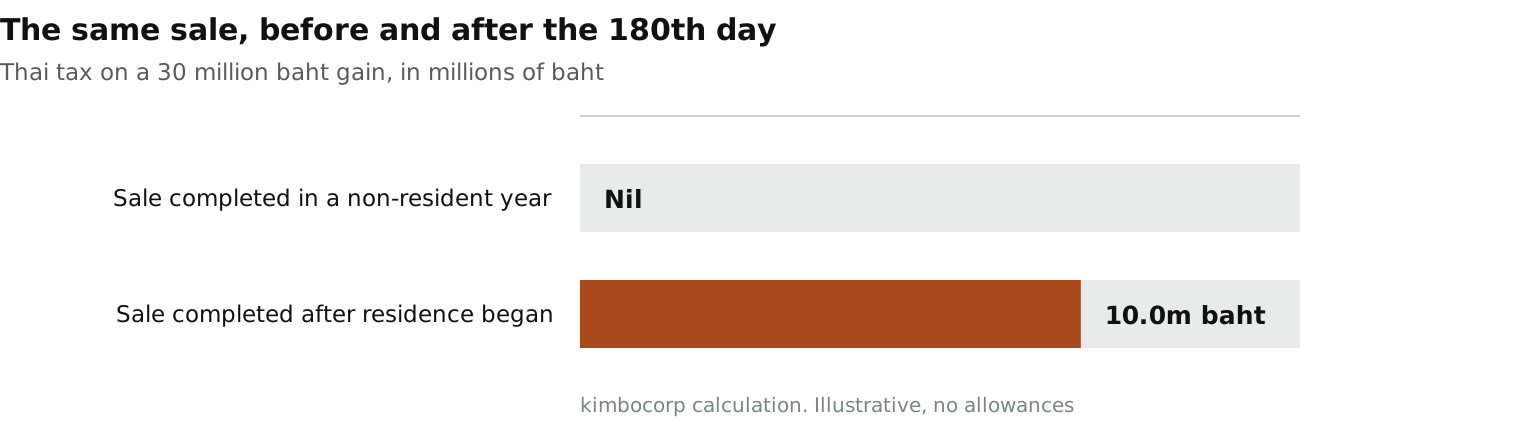
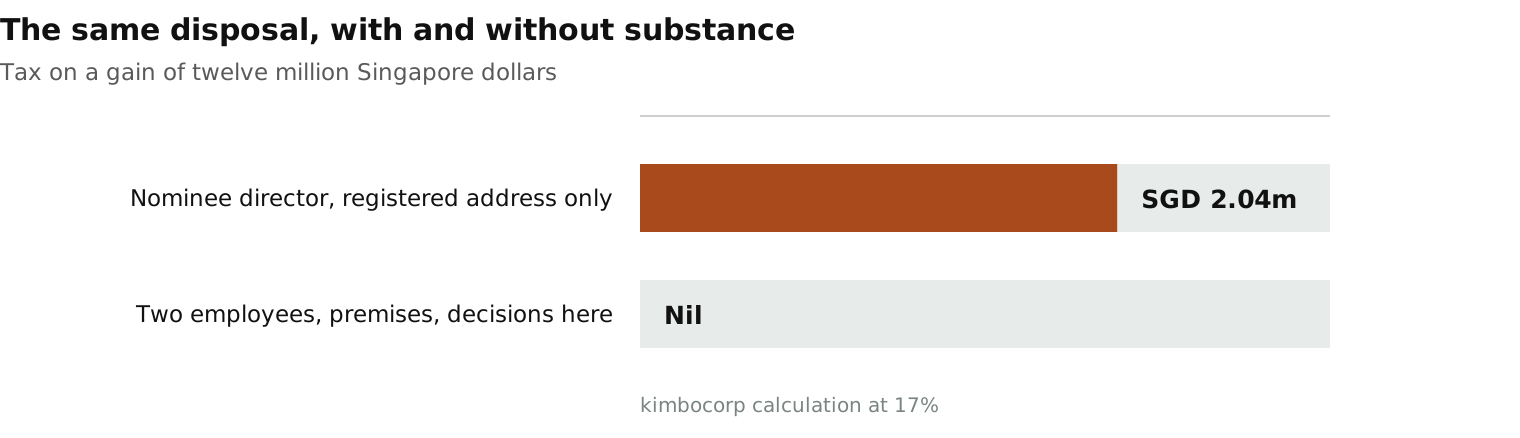
A regional group holds its Vietnamese operating company through a Singapore entity and sells it for a gain of twelve million Singapore dollars. The Singapore entity has a nominee director, a registered office at its corporate secretary’s address and no staff. The board papers are prepared and the decisions taken in another country. The gain is brought into Singapore, and it is taxable at seventeen per cent, which is about two million dollars.
Now change one thing. The same group on the same deal at the same price pays nothing. That is the outcome if the Singapore entity has two real employees, premises it actually uses, and board decisions genuinely taken in Singapore. That is the whole of section 10L in one comparison, and the difference is not a structure. It is whether the company does anything.
The provision was inserted into Singapore’s Income Tax Act with effect from 1 January 2024. A great deal has been written about it, much of it saying that Singapore now taxes capital gains. That is not what it does. The Government said so in terms during the second reading, stating that the policy objective was not to tax capital gains in Singapore.
What it does is narrower and more specific. Four things have to coincide. The gain must be one that would otherwise fall outside the charge or be exempt. It must arise on a foreign asset. And it must be received in Singapore by an entity of a group with some foreign presence. Where all four hold, the gain is treated as income. There is no new tax and no new rate. The gain is simply taxed as ordinary income at seventeen per cent.
The honest qualification is that a taxpayer who is caught cannot tell the difference. Seventeen per cent on a gain feels exactly like a capital gains tax, whatever the mechanism. Both things are true, and a piece that says only one of them is not much use.
Individuals and standalone companies are outside it entirely
The scope rules exclude more than most summaries acknowledge, and two of the exclusions are substantial. Neither is a concession or a relief that has to be claimed. They are limits on the charge itself, written into the definitions the provision depends on. A person or company outside them never engages with the substance question at all, which is worth establishing before paying anyone to think about substance.
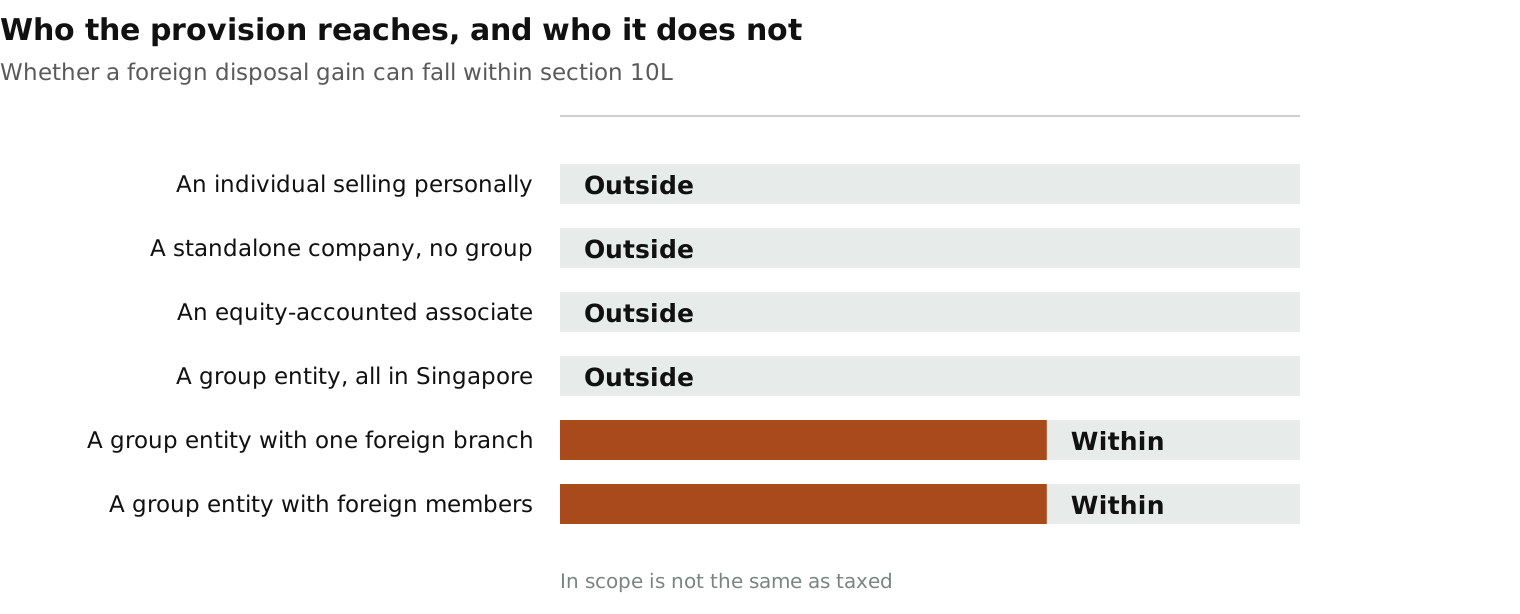
The provision applies only to entities, and the definition of entity expressly excludes individuals. A person selling a foreign asset personally is not within it at all. That is the first thing to establish in any family or founder situation. A great deal of anxious advice has been given to individuals about a provision that cannot reach them. A separate exemption deals with an individual’s gains flowing through a transparent partnership.
It applies only to an entity of a relevant group. A group exists where entities are consolidated line by line, so an associate accounted for under the equity method is outside it. A group is relevant where its entities are not all established in Singapore, or where any entity has a place of business outside Singapore. One foreign branch anywhere is enough to make the group relevant.
A standalone company with no group is therefore outside the provision, and the revenue authority’s own first worked example makes the point. A single Singapore company with an overseas branch is not caught, because the company and its branch are one legal entity. Add a second entity to the picture and the group test is met.
The trigger is the date of disposal rather than the date of receipt. The provision applies to disposals on or after 1 January 2024, and the tax arises in the year the gain is received in Singapore. Receipt includes remittance, applying the amount against a debt of a Singapore trade or business, and using it to buy movable property brought into Singapore.
The substance tests differ for a pure holding entity
The exception that takes a gain out of charge is built into the definition of an excluded entity. It is tested in the period of the disposal rather than the period of receipt, which matters more than it sounds. A group that sells in one year and remits in the next is judged on what the entity looked like in the earlier year. Building substance after the sale and before the money moves does not help.
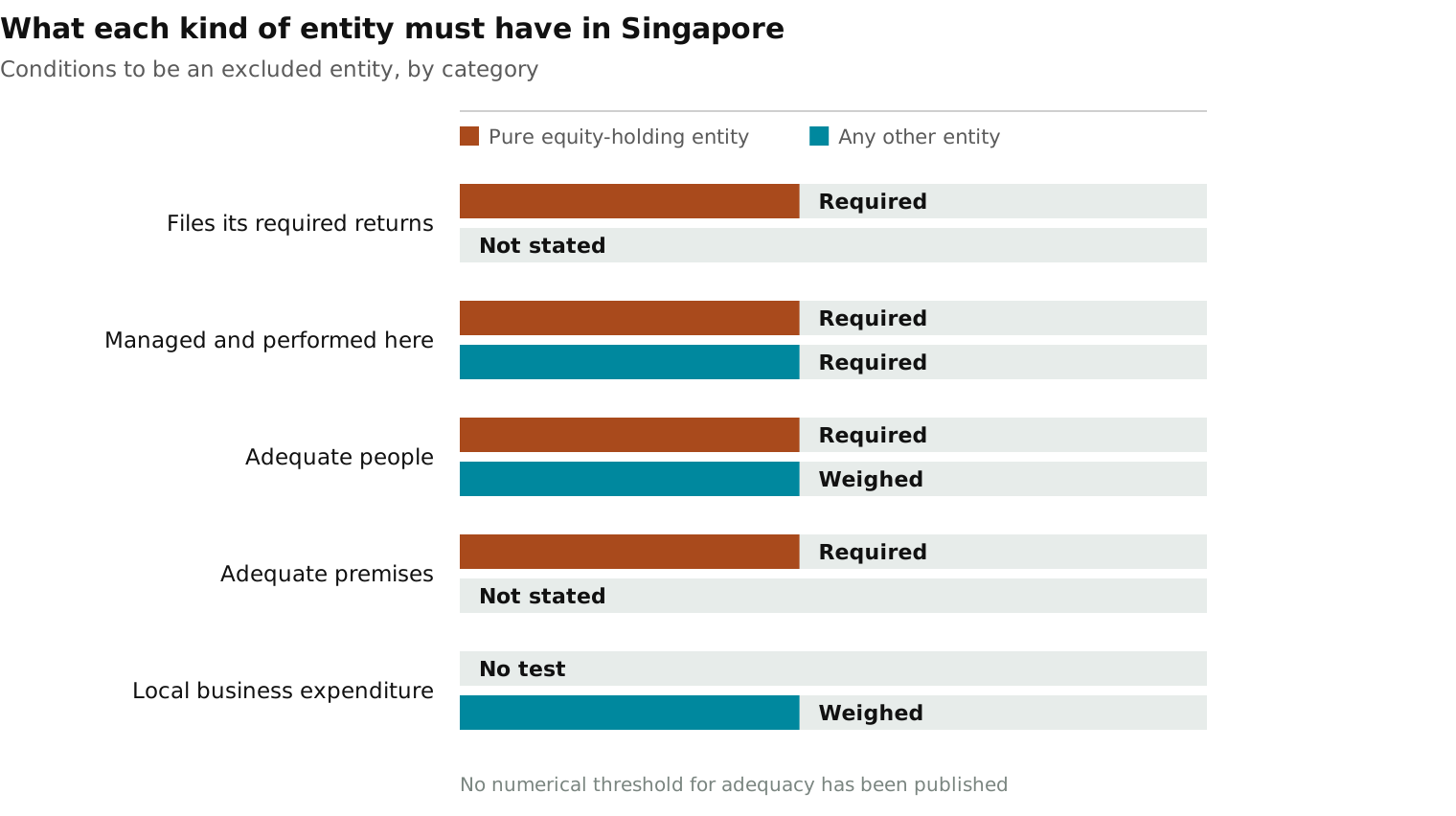
A pure equity-holding entity must satisfy three conditions. It must submit the returns and accounts required where it is incorporated. Its operations must be managed and performed in Singapore. And it must have adequate human resources and adequate premises in Singapore. There is no expenditure condition for this category.
Any other entity must satisfy two conditions. Its operations must be managed and performed in Singapore, and it must have adequate economic substance there. Adequacy is judged on four matters. They are the number of full-time employees or other persons, their qualifications and experience, the local business expenditure, and whether key business decisions are made in Singapore.
The purity distinction turns on what the entity holds. An entity holding only equity and the incidental assets is pure. A single shareholder loan to a subsidiary can move it into the other category, which changes the test it has to meet. That is a cliff rather than a slope, and it catches groups who did not notice the loan was there.
| What the entity has | Treatment |
|---|---|
| A registered office at the corporate secretary’s address | Not adequate premises |
| Co-working space or shared premises actually used | Adequate premises |
| A nominee director | Not a human resource |
| A director who performs the function | A human resource |
| No employees at all, in a special purpose vehicle | Can still qualify, tested at the holding entity |
| Operations outsourced to a Singapore provider | Permitted, on three conditions |
| One provider serving several group entities | Permitted, if resources match the work |
| Board decisions taken outside Singapore | Fails the managed and performed test |
| A prescribed number of staff or floor area | No threshold is prescribed |
Outsourcing is expressly permitted for both categories, and that answers a question many groups assume is closed. Three conditions apply. The activities must be carried out in Singapore. The entity must have direct and effective control over the arrangement, with documented monitoring. And dedicated resources must be set aside for it. An arm’s length fee is expected, and one provider may serve several entities where its resources match the work it is doing.
Special purpose vehicles are dealt with separately and sensibly. Three things have to be true of the immediate holding entity. It must have effective control over the vehicle, derive the economic benefits from it, and set the core investment strategies. The substance test is then applied at the level of that holding entity rather than the vehicle. A vehicle with no employees of its own can therefore be an excluded entity.
Every published ruling has gone the taxpayer’s way
Six advance ruling summaries on the provision have been published, between June 2025 and July 2026. All six were decided in the taxpayer’s favour on the substance question. That is the most useful evidence available of where the line actually sits, because there is nothing else. The figures in each are redacted, so the rulings show the shape of an acceptable arrangement rather than its scale.
One ruling concerned a company with a real head office, a Singapore-based chairman with the final say, and board decisions taken in Singapore. It was an excluded entity. Another concerned a special purpose vehicle with no employees at all. It was tested at the level of the holding entity above it, conditional on that entity keeping its incentive. It too was an excluded entity.
The most instructive ruling is the one the taxpayer nearly lost. An incentivised trading company argued that the exclusion for incentivised activities covered its disposal. It lost that argument. The statutory exclusions for incentives are drafted by reference to activities rather than to entities, and the disposal was not part of its qualifying activities. It survived on the substance limb instead.
That is the point for any group holding an incentive. The incentive is not a shield. Eight named incentives are referred to in the exclusions, including the finance and treasury centre, the global trader programme and the maritime sector incentive. The question in each case is whether the disposal formed part of the activity the incentive covers, not whether the company happens to hold one.
Two further points of fact are worth recording. There is no court decision and no Board of Review decision on the provision. And there has been no amendment to it since it was enacted, with the Budget of 12 February 2026 saying nothing about it at all.
Foreign intellectual property is taxed whatever the substance
The one place where substance does not help is intellectual property. A group that does not know this can be caught while doing everything else right. It is also the part of the provision that departs furthest from the stated principle, because the question stops being whether anything real happens in Singapore. For a business holding the wrong category of asset, the answer is fixed before the substance question is reached.
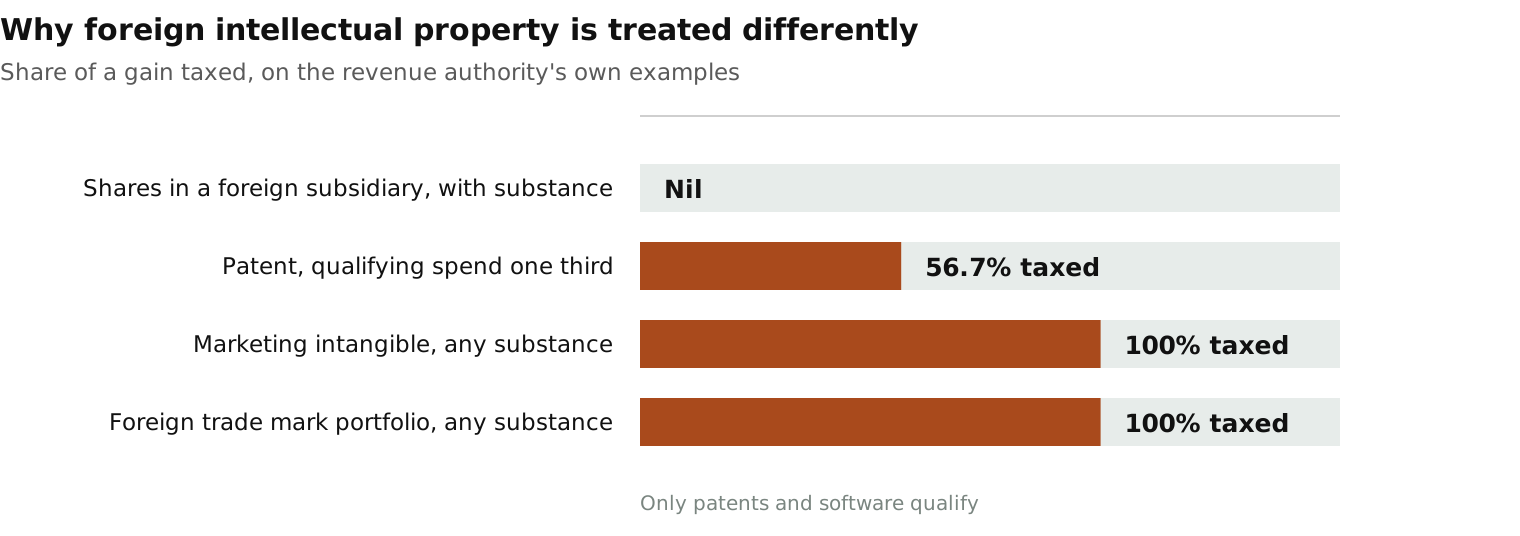
The exclusions that take a gain out of charge apply only to assets that are not intellectual property rights. A gain on a non-qualifying foreign intellectual property right is fully taxed regardless of economic substance. The guide says so directly rather than leaving it to be inferred. Employees, premises and Singapore decision-making make no difference to the outcome.
Qualifying rights are a short list. It covers patents, patent applications, and copyright in software. Trade marks, brands and customer lists are not on it. A business selling a foreign trade mark portfolio is therefore taxed on the whole gain, however many people it employs in Singapore. For a consumer business whose foreign value sits in brands, that is the single most important sentence in the provision.
Where the right does qualify, relief comes through a nexus ratio rather than an exemption. Qualifying expenditure is uplifted by thirty per cent and divided by total expenditure, capped at one hundred per cent. The revenue authority’s own example takes a patent gain of three hundred thousand dollars. Qualifying expenditure is one hundred thousand and non-qualifying expenditure is two hundred thousand. The ratio is 43.3 per cent, and one hundred and seventy thousand dollars is taxed. A three year transitional ratio exists because tracing expenditure cumulatively is genuinely hard.
Losses are allowed, and the symmetry rule is perverse
A loss on a foreign disposal is allowed, but it is ring-fenced in three ways. It can only be set against chargeable foreign disposal gains. It is carried forward rather than set against other income of the year. And it only exists at all if the loss would itself have been within the provision had it been a gain. Each restriction is ordinary enough on its own, and together they produce a result worth noticing.
That produces an outcome worth planning around. An entity with adequate substance is an excluded entity, so its gains are not chargeable. In a loss year that same substance means the loss is not recognised either. Having substance destroys the loss. The revenue authority’s own annex sets this out.
The interaction with the foreign income exemption is also one-directional. The exemptions in section 13 do not apply to a gain caught by section 10L, because the provision overrides the rest of the Act. Disposal gains were never within that exemption in any case, since it covers foreign dividends, branch profits and service income. A dividend paid out of such gains is a separate question and sits outside the provision entirely.
There is no participation exemption and no reorganisation relief. One of the published rulings treated an intra-group share-for-share transfer as a disposal. Nothing about a transaction being internal takes it outside the provision. A group reshuffling its own holdings should establish the position before moving anything. The absence of reorganisation relief is one of the fairer criticisms of the drafting.
The provision is reasonable, and it costs real money to comply with
Section 10L targets genuine double non-taxation, where a gain is untaxed where the asset sits and untaxed where the money lands. It uses the test Singapore’s own policy claims to care about, which is whether anything real happens here. It is narrowly scoped, with individuals, standalone companies and equity-accounted associates all outside it. On the published record the revenue authority has administered it accommodatingly, and it preserves Singapore’s position of not taxing capital gains generally.
One point of background should be stated carefully, because it is often overstated. The provision was introduced in response to European Union guidance on foreign-source income exemption regimes and the international rules on harmful tax practices. Singapore does not appear in either annex of the European Union list, and no verifiable record of a listing or a formal dated commitment was found. The defensible description is pre-emptive compliance with a standard rather than a response to being listed.
The criticisms are real and should be stated at full weight. Adequate is undefined, no threshold is published, and every figure in the published rulings is redacted. Certainty therefore costs professional fees, and that burden falls hardest on small groups, which is regressive. The intellectual property rules punish genuine businesses holding the wrong category of asset. The purity cliff can turn on a single shareholder loan. There is no reorganisation relief. The loss symmetry rule works against the taxpayer in both directions. The relevant group test is crude, in that a single sales office across the causeway puts a company in the same regime as a multinational. And one published question on promissory notes was withdrawn in June 2025 pending further review, leaving deferred consideration unaddressed.
The costs of compliance are not only the substance itself. The most underestimated one is governance discipline. Board meetings have to be held where they are said to be held. Minutes have to record decisions rather than ratify them, and the chain of authority has to be written down. Records must be kept indefinitely under the guide’s own requirements. For intellectual property, expenditure has to be traced cumulatively. And where certainty matters, an advance ruling is the route, with its own fee and preparation cost.
Three claimed costs are not real, and each of them circulates widely. A substantial office is not required, because co-working and shared premises count. Outsourcing is not prohibited, and it is expressly permitted on three stated conditions. Holding companies are not dead either, as the six published rulings demonstrate. A group being told any of those three things should ask where the statement comes from.
What this means for groups, finance directors and advisers
For a group with a Singapore holding company, the work is to establish the position before a disposal rather than after. Substance is tested in the period of the disposal, so arranging it when the sale is agreed is too late. Four items are worth checking specifically. Whether a nominee director is doing the work. Whether the registered office is the only premises. Whether board decisions are genuinely taken in Singapore. And whether a forgotten shareholder loan has moved the entity out of the pure category.
For a finance director, two mechanical points matter more than they look. The group test can be met by a single foreign branch, so a company that considers itself purely domestic may be in scope. The asset test also turns on situs. Singapore immovable property is outside the provision not because of an exclusion, but because it is not a foreign asset. That distinction matters, because an exclusion can carry conditions and a situs point cannot.
For an adviser, a citation trap is worth knowing. The December 2024 amendment to the guide renumbered the paragraphs dealing with special purpose vehicles. Older commentary citing the earlier numbers is now pointing at the test for non-pure entities instead. The current edition is the third, dated 6 June 2025. And the number of entities actually affected by the provision has never been published, so any figure claiming to quantify it is an estimate.