What Indian founders can and cannot do with a Singapore company
Written by

Huan koh
Published on
October 5, 2026

Copy link
Link copied!


India permits a founder-owned trading company and an Indian-company-owned subsidiary. It blocks the Singapore parent placed above an Indian business. An Indian software company in Bengaluru sells to customers in Singapore, Jakarta and Dubai. Every invoice is raised in India and every payment is converted into rupees. Every contract is governed by Indian law and heard in an Indian court. The founder wants the regional side of that business to sit in a Singapore company instead, and her investors have asked for the same thing. Three advisers have told her this is difficult. Each of them described a structure she does not actually need. India's rules separate two things that are usually discussed as one. A resident Indian may own a Singapore company that carries on a genuine business of its own. An Indian company may own a Singapore subsidiary. What a resident Indian may not own is a Singapore company that in turn owns the Indian company he controls. The first two structures let Singapore receive regional income, keep it and eventually be sold. The third has been closed since August 2022. That distinction is easy to miss, because both tests sit in one sentence of the rules. A resident Indian may invest in a foreign company only where it is a genuine operating business. It must also have no subsidiary under his control. Being a real trading company satisfies the first test. It does nothing at all for the second. A Singapore company with real regional customers and real regional staff still fails once the Indian company is placed underneath it. Control is defined at a low threshold, which is why that second test catches almost every founder. A shareholder has control once he holds 10% or more of the votes. He also has it if he can appoint most of the directors. A founder who owns the majority of a Singapore parent clears that bar several times over.
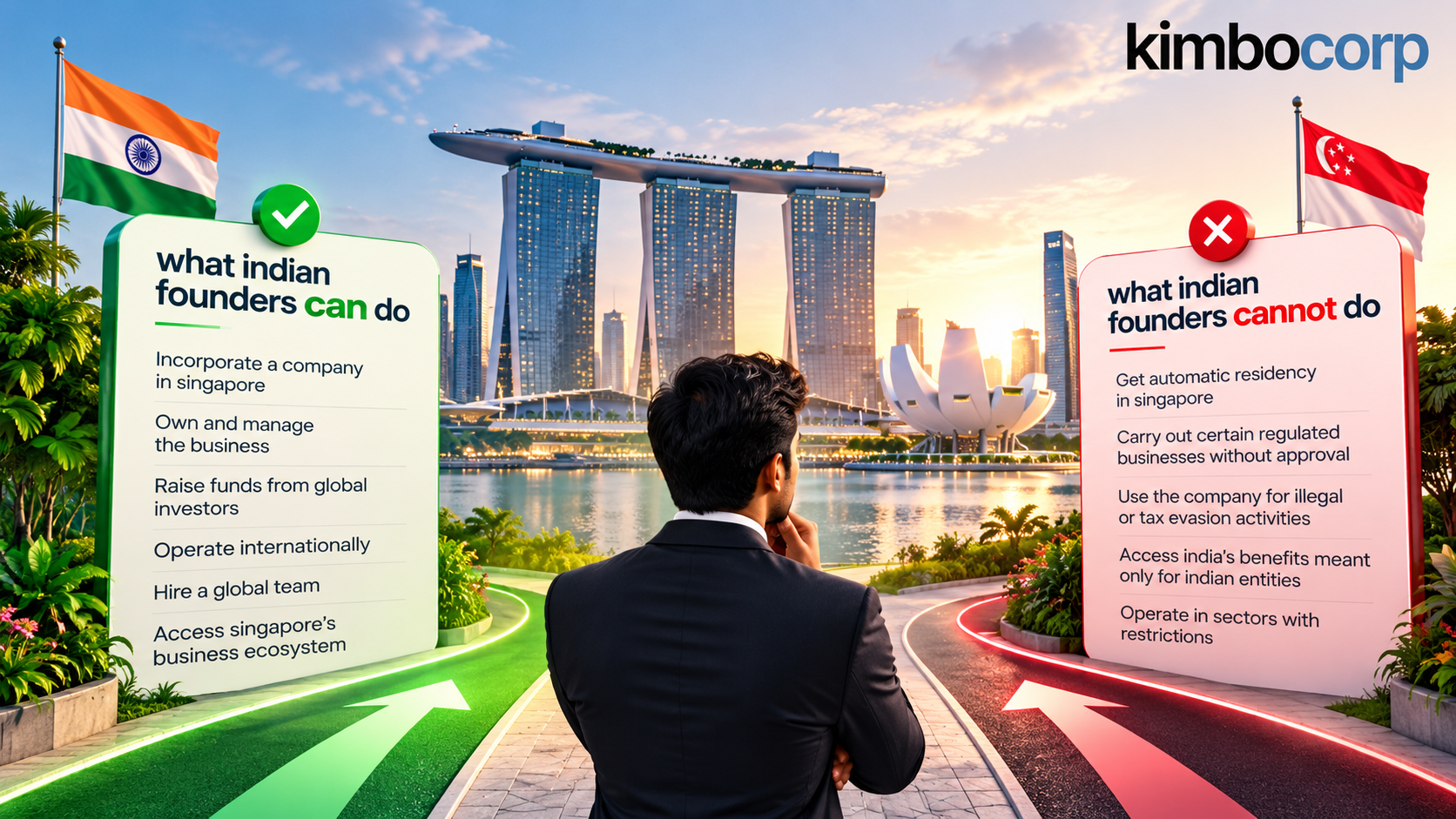
A resident Indian may own a Singapore company directly, provided it owns nothing in India
This structure works because the Singapore company sits beside the Indian business rather than above it. The Singapore company signs its own regional customers and employs its own regional staff. It holds the cash those customers pay, and no Indian company sits underneath it. India does not object to a resident owning a business abroad. It objects only when that foreign business owns something back in India. The Singapore company has to be a genuine operating business. That means a trading company, a services company or a distributor. A vehicle that only holds shares does not qualify, because the rules permit investment only into a company that actually carries on business. The requirement fits how most regional expansions are built in any case. The money to establish the company travels under India's personal remittance allowance. That allowance is US$250,000 for each resident individual in each financial year. Every resident adult holds a separate allowance, so two co-founders can commit twice that amount between them. The funds have to belong to the individual rather than being borrowed, and this matters where the Singapore company is a recognised start-up. Capitalising the company properly is therefore a question of planning across people and years, not of applying for permission. The reporting is light in substance and unforgiving on timing. The bank files a form when the money leaves India and obtains a reference number for the investment. One annual return is then due at the end of December each year. That reference number is often mistaken for an approval, and it is not one. A late filing freezes further investment in the company until the reporting is brought up to date. One limit on this structure can never be crossed. The Singapore company owned personally by the founder must not acquire the Indian company at any point. From the moment it does, the founder holds a foreign company with an Indian company beneath it. That is the exact arrangement the rules forbid. The directions also stop a founder who first invested without control from acquiring control later.An Indian company may put up to four times its net worth into a Singapore subsidiary
Where the business has outgrown a personal allowance, the Indian company invests instead of the founder. An Indian company may commit up to four times its net worth to companies outside India, measured on its last audited balance sheet. The personal allowance does not apply to it. The ceiling is therefore set by the size of the Indian business rather than by a fixed figure. Reserve Bank approval is needed only above one billion United States dollars of commitment in a financial year. India also lets the foreign company invest back into India, up to two layers of subsidiaries deep, and a group holding one Singapore company sits well inside that limit. This is the structure that suits a company with real regional revenue and a long future in India. The Singapore subsidiary signs the regional customers, holds the regional cash and employs the regional team. It pays a dividend up to the Indian parent whenever the group wants the money there. Singapore charges no withholding tax when that dividend leaves. India taxes it on arrival and gives credit for the Singapore tax already paid. The cash can therefore stay in Singapore for as long as the business needs it. The trade-off is about who owns the value rather than about tax. The Singapore company sits beneath the Indian company, so selling the Singapore business is a sale made by the Indian company. That is fine where the plan is to build and sell one group. It is the wrong shape where foreign investors want to own the regional business directly. The question is far cheaper to settle before the structure is built than afterwards.| Founder owns the Singapore company | Indian company owns the Singapore company | Singapore company owns the Indian company | |
|---|---|---|---|
| Permitted under the automatic route | Yes | Yes | No, since August 2022 |
| How much money may be committed | US$250,000 per resident individual each financial year | Up to four times the Indian company’s net worth | Not applicable |
| What the Singapore company does | Signs regional customers, employs regional staff, holds the cash | Signs regional customers, holds regional cash, pays dividends up to India | — |
| The limit that must never be crossed | It must never acquire the Indian company | — | — |
| Where a sale of the Singapore business is taxed | In India, while the founder remains resident there | In India, as a sale made by the Indian company | — |
| The situation it suits | An early regional business, and founders who may move abroad | A company with established regional revenue | None |
Regional customers can contract with the Singapore company and pay it directly
No money has to leave India for the Singapore company to be paid. A customer in Jakarta signs its contract with the Singapore company and pays the Singapore company. That payment never touches the Indian banking system. No Indian approval is involved and no Indian tax arises on the receipt. This is how Singapore comes to hold regional income, and it is simpler than most descriptions of it suggest. What decides whether the arrangement survives scrutiny is where the work behind that revenue is done. If Singapore staff win the customer, serve the customer and support the customer, the profit belongs to the Singapore company. If the Bengaluru team does all three and Singapore only issues the invoice, India will say the profit was Indian throughout. India would be right to say it. The invoice follows the work, and no amount of paperwork reverses that order. The structure is therefore a commercial decision before it is a tax decision. A regional sales team and a regional head who genuinely decides things are what make the revenue Singapore's. Those are the same people the company would hire anyway once it is serious about the region.Singapore taxes company profit at 17%, and charges nothing when money leaves
Singapore's corporate tax rate is 17%. A standing exemption removes the first S$102,500 of chargeable income from tax each year. A company earning S$500,000 therefore pays an effective rate of about 13.5%, and one earning S$200,000 pays about 8.3%. A rebate of 50% of tax payable for the 2026 year of assessment, capped at S$40,000, was announced on 7 April 2026. That rebate sits in a bill before Parliament and had not passed into law by the end of September 2026. One exemption that founders expect does not apply to a holding structure. The start-up exemption is more generous than the standing one and runs for a company's first three years. It specifically excludes investment holding companies. A Singapore company that trades qualifies in the ordinary way, and a Singapore company that only owns shares does not. This is another reason the operating structure suits an early-stage business better. Singapore charges no withholding tax on dividends paid out of the country. That applies to every shareholder, wherever they are resident. It follows from the one-tier tax system introduced on 1 January 2003, under which tax paid by the company is final. A foreign investor taking cash out of a Singapore company loses nothing at the Singapore border. Few competing jurisdictions offer that without attaching conditions.Since 2024, the exemption on selling a foreign asset depends on having real staff in Singapore
Singapore does not tax capital gains, but a rule that took effect on 1 January 2024 qualifies that. A Singapore company that sells a foreign asset and brings the proceeds into Singapore is taxed on the gain. The charge applies unless the company has adequate economic substance in Singapore. Shares in an Indian company are a foreign asset, because the company issuing them is incorporated outside Singapore. The only realistic way out is to meet the substance test. Economic substance has a specific meaning here, and it is not about documentation. The company's operations must be managed and performed in Singapore. It must have adequate people and premises there to do so. Work may be outsourced to a third party or to another group company, provided that work is carried out in Singapore. The older safe harbour for selling a long-held shareholding does not rescue a company that fails this test. The major accounting firms all read the new rule as overriding it. The conditions for a Singapore certificate of tax residence point the same way. A foreign-owned holding company qualifies only where control and management are exercised in Singapore. In practice that means a director based there in a genuine executive role, a senior executive based there, or management by a related Singapore company. A registered address and a nominee director satisfy neither test.India taxes a share sale only where the company's value comes mainly from India
This is where the two permitted structures produce genuinely different outcomes. India treats shares in a foreign company as Indian property where that company derives its value substantially from Indian assets. Two conditions must both be met. The Indian assets must exceed ₹10 crore in value, and they must represent at least half the value of everything the company owns. A Singapore company placed above an Indian business meets both without any effort. A Singapore company that earns its value from the region fails both tests, and India has no claim on the sale of its shares. Where the worth is built on regional customers, regional contracts and regional staff, the Indian assets are neither large enough nor proportionally significant enough. That is the commercial case for building the regional business inside Singapore from the start. The value created in Singapore stays outside India's reach for as long as it is genuinely created there. The founder's own position is a separate question. An individual resident in India is taxed on gains arising anywhere in the world. A gain on selling his Singapore shares is therefore taxable in India for as long as he lives there. If he has genuinely ceased to be resident, that charge does not arise. Residence turns on where a person actually lives and intends to live, not on the visa he holds. A paper change of residence comes apart years later, when a buyer examines it.A resident founder cannot own a Singapore company that owns the Indian one
The blocked structure is the one most founders ask about, so it is worth setting out why it fails. It fails on the investment rules first, for the reasons given at the start of this article. A resident Indian may invest only in a foreign company with no subsidiary under his control. Shares in an unlisted Singapore company count as direct investment however small the stake, and control begins at 10% of the votes. A Singapore parent above an Indian business has a subsidiary from the day it is formed. The rules also require shares acquired outside those limits to be sold within six months, so a structure assembled in breach cannot be left in place and explained later. The swap exception does not assist. It permits an exchange of shares only on a merger, a demerger or a liquidation, and a commercial exchange between a founder and an investor is none of those. The structure fails on tax as well, and it failed there several years earlier. India and Singapore amended the capital gains article of their treaty by a protocol signed on 30 December 2016, in force on 27 February 2017. Before that amendment, a Singapore company could sell shares in an Indian company without paying tax in either country. The treaty reserved the gain to Singapore, and Singapore does not tax capital gains. India now taxes that gain at its full domestic rate.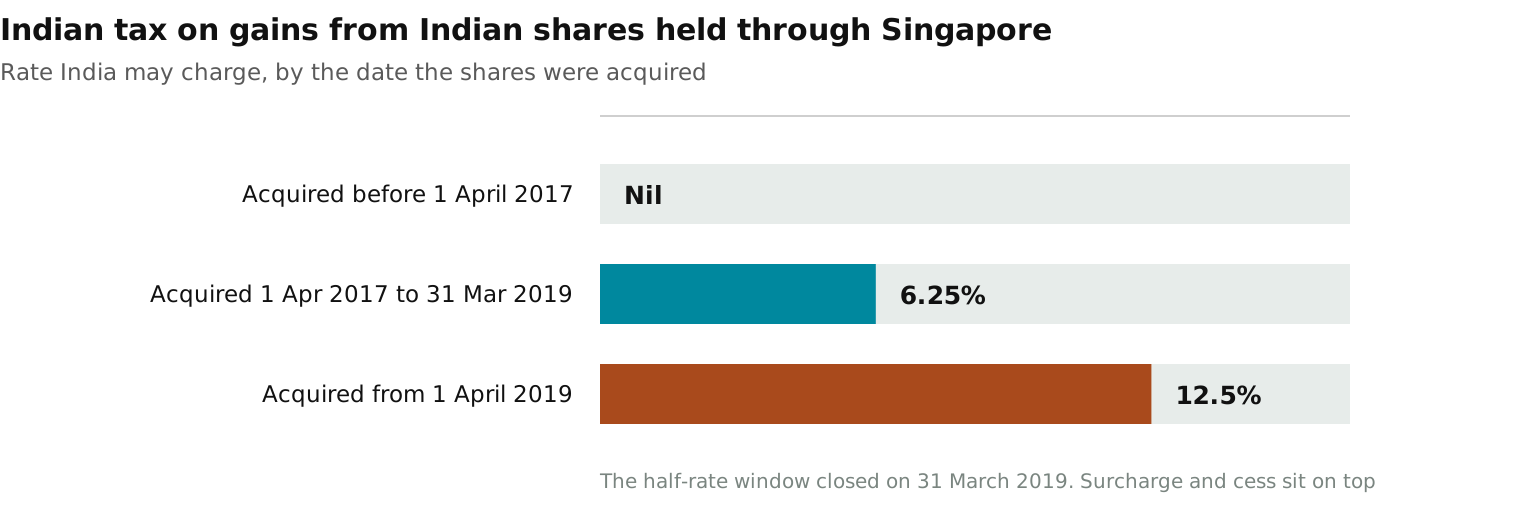 Shares acquired before 1 April 2017 kept the old treatment and stay outside the Indian charge. Shares acquired in the two years from 1 April 2017 attracted half of India's domestic rate under a transitional rule. Shares acquired from 1 April 2019 attract the full rate of 12.5%, with surcharge and cess applied on top. A company formed in 2026 sits entirely inside that third period. The protection founders are still being sold has been worth nothing for seven years.
Transferring the Indian shares up to a foreign parent would also carry an immediate cost. Handing Indian shares to a foreign company in exchange for its shares is a sale for Indian tax purposes. India computes the tax on market value rather than on what was originally paid. The founder receives shares rather than cash, but the tax has to be settled in cash in the year of the swap. That bill falls due before any new investment has been drawn against it.
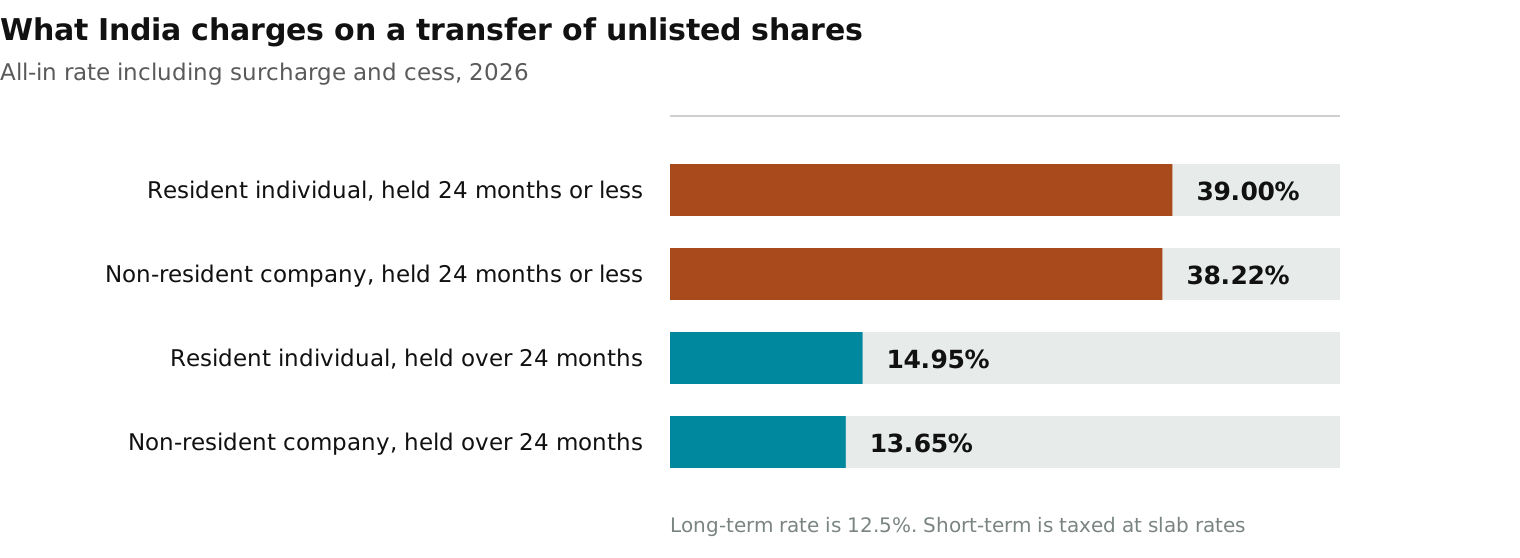 The holding period decides how large that cost would be. Unlisted shares become long-term assets after 24 months. Before that point a resident individual is taxed at 39.00% and a non-resident company at 38.22%. After it, the same parties are taxed at 14.95% and 13.65%. The difference is close to three times the tax on identical value, which makes the timing of any restructuring more consequential than the choice of structure.
Moving a holding company back to India has cost two well-known companies published amounts
Several Indian companies have unwound offshore holding structures, and the cost is public. PhonePe's return from Singapore in 2023 carried a reported tax charge of about ₹7,800 crore. Its investors bore that charge on the increase in value since their original investment. Reuters reported the figure on 5 January 2023 and the parent confirmed it in substance. Groww's move back from the United States carried a reported ₹1,340 crore, though published accounts disagree about whether India or the United States collected it.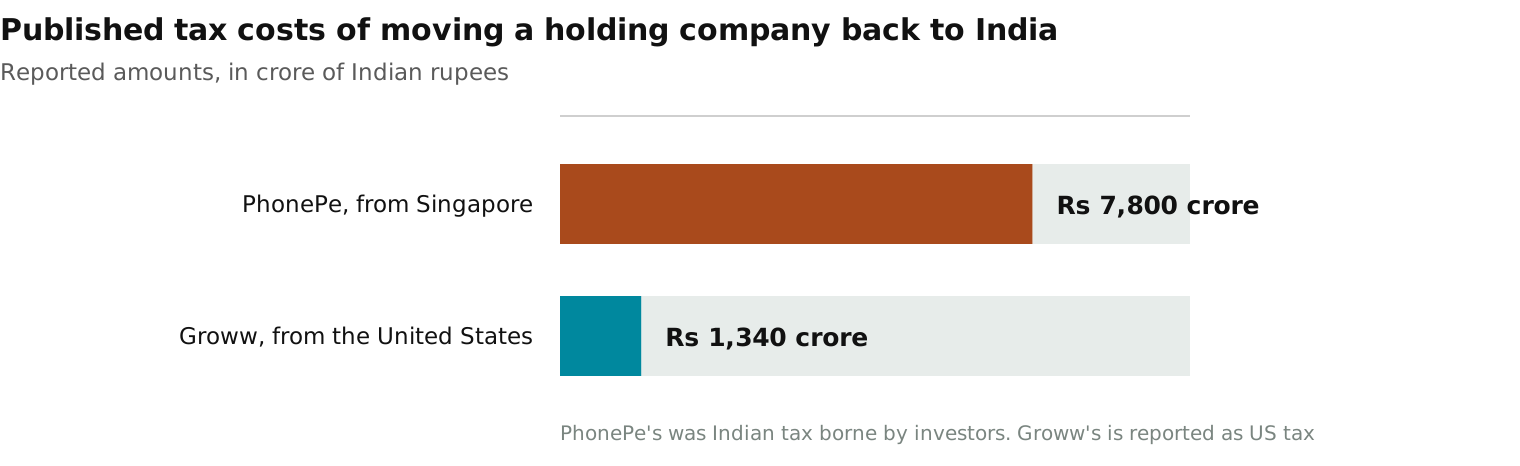 India has simplified the return journey three times since 2024 without reducing its cost. Rules notified in September 2024 removed the National Company Law Tribunal from the process. Rules notified in September 2025 widened the range of companies entitled to use that faster route. An amendment on 29 May 2026 aligned the exchange control paperwork with it.
None of those changes touched the approvals or the tax. The application still goes to the Central Government through the office of the Regional Director. Prior approval of the Reserve Bank of India remains expressly required for both companies. No tax relief has been introduced. The cost is therefore calculated on what the business is worth at the time of the move, not on what it was worth when the structure was built.
Delaware taxes the exit gain at 21%, and Mauritius lost its treaty advantage in 2016
Both jurisdictions are proposed constantly, usually by advisers who have not revisited either position since 2016. Delaware remains the default for founders raising American capital, and Mauritius is still presented as the traditional route into India. Neither improves on Singapore for a company whose operations are in Asia. The table below compares the three on the tests that decide the outcome.| Singapore | Delaware | Mauritius | |
|---|---|---|---|
| Tax on the parent when the business is sold | None, where the Singapore company has real substance | 21% federal corporate tax | None, unless treated as trading income |
| What India takes on the Indian value | The full Indian rate | The full Indian rate | The full Indian rate |
| Tax on dividends received from India | Exempt, on three conditions | Deductible in full in most cases | 80% partial exemption, about 3% effective |
| Tax when money is paid out to investors | None | 30% domestic, reduced by treaty | None |
| Tax on the parent's other profits | 17%, and often less | 21% federal, plus state tax | 15%, plus three separate levies |
| What has to be genuinely in place | Staff, premises and decisions in Singapore | Nothing, for tax purposes | Two resident directors, a local bank account, a local audit |
| Why founders choose it | Regional customers, regional staff and treaty access | Documents every American lawyer already knows | A treaty advantage that ended in 2016 |
India led the world on the number of listings in 2026 and raised a fraction of the money
Indian companies completed more initial public offerings than any other market in the first half of 2026. The amount raised tells a different story from the count. EY recorded 102 Indian listings raising about US$4 billion, against 85 American listings raising about US$128 billion. India leads the world on the number of transactions and sits far behind on their size. A company planning a very large raise should weigh the second figure rather than the first.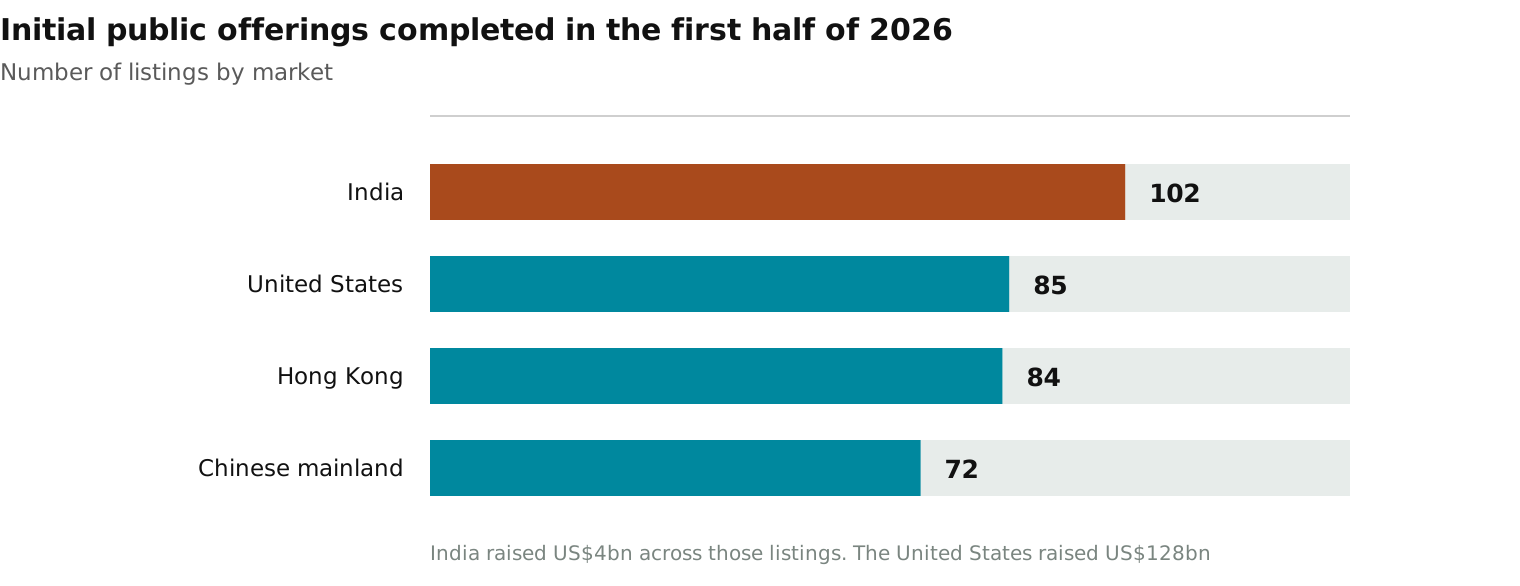 A company intending to sell its regional arm should note a separate point about buyers. The acquirers of an Asian business are mostly in Asia, and they prefer to buy a company they can own and run directly. A Singapore company holding the regional business is straightforward for such a buyer to acquire, and a regional business sitting inside an Indian company is not. That often matters more to the outcome than the tax comparison does.
One widely quoted statistic deserves to be retired. The only sourced study of where Indian companies place their holding companies used data as at 31 March 2022. It found 34 of 90 Indian unicorns registered outside India, with 25 in the United States and 8 in Singapore. Nothing comparable has been published since. Every percentage now circulating comes from firms selling incorporation services.
What this means for founders building regionally, founders already offshore, and investors pricing a round
For a founder building a regional business while resident in India, Singapore has always been available. The only real question is which of the two permitted structures fits. A founder who may move abroad should own the Singapore company personally and keep it separate from the Indian one. The same applies where investors want to own the regional business directly. A company with established regional revenue should let the Indian company invest instead. The choice is far cheaper to make at the outset than to correct later. For a founder whose structure is already offshore, three questions deserve an answer this quarter. The first is where the key management and commercial decisions are actually taken, because that decides whether the foreign company is Indian for tax. The second is whether there is enough genuine substance in Singapore to keep a future sale of a foreign asset outside the 2024 charge. The third is what it would cost to unwind the structure today. That figure is priced on what the business is worth now, not on what it cost to build, and the published examples show how quickly it grows. For an investor pricing a round into an Indian business held through Singapore, the question that matters most is where the Singapore company's value comes from. If its worth comes mainly from the Indian business, India will tax the sale of its shares whoever sells them and wherever they live. If its worth comes from regional customers and regional staff, India has no claim on that sale. That single question deserves more attention in diligence than the structure chart receives. The answer is found in the revenue breakdown rather than in the legal file.Our blog
Latest blog posts
Tools and strategies modern teams need to help their companies grow.