What Thailand taxes when money is brought in, and what it leaves alone

Written by

Huan koh
Published on
October 26, 2026

Copy link
Link copied!


The 2023 change removed a timing escape rather than introducing worldwide taxation. Money earned before 2024, money earned in a non-resident year, and capital itself all stay outside the charge. A British engineer retires to Chiang Mai in March 2025 and keeps a Singapore brokerage account she opened in 2011. She spends more than 180 days in Thailand in both 2025 and 2026, so she is a Thai tax resident in both years. In 2026 she transfers 2.4 million baht to her Thai bank to live on. Her neighbours have told her that Thailand now taxes her worldwide income and that the money is caught. They are wrong on both counts, and the difference in her case is about 150,000 baht. Thailand did change its rules, and the change was real. What it did was narrower than almost every account of it. Thailand still taxes foreign income only when it is brought into the country. What disappeared was a timing escape that had stood since 1987. Under it, foreign income remitted in a year later than the year it was earned fell outside the charge entirely. That escape was not a remittance basis. It was a one-year waiting period, and no comparable system works that way. Removing it brought Thailand into line with how a remittance basis is normally understood. Thailand then declined to go further. A separate draft would have taxed residents on foreign income whether or not it was ever remitted, and that draft is not law either. This article sets out what the rule now catches and the three large categories it does not. It also deals with an announced relaxation that a great many people are relying on and should not be. The announcement was made by the head of the Revenue Department and reported everywhere. No instrument has followed it. Anyone who has moved money on the strength of that reporting has a liability they do not know about.
Three categories of money stay outside the charge
The useful part of the rule is what it leaves alone, and the Revenue Department has published its own position on each of these. That matters, because the exclusions are not inferences drawn by advisers from the statutory language. They appear in the department's own worked examples, which is the best evidence available of how the rule will be applied on audit. The examples are also more generous than the drafting strictly required.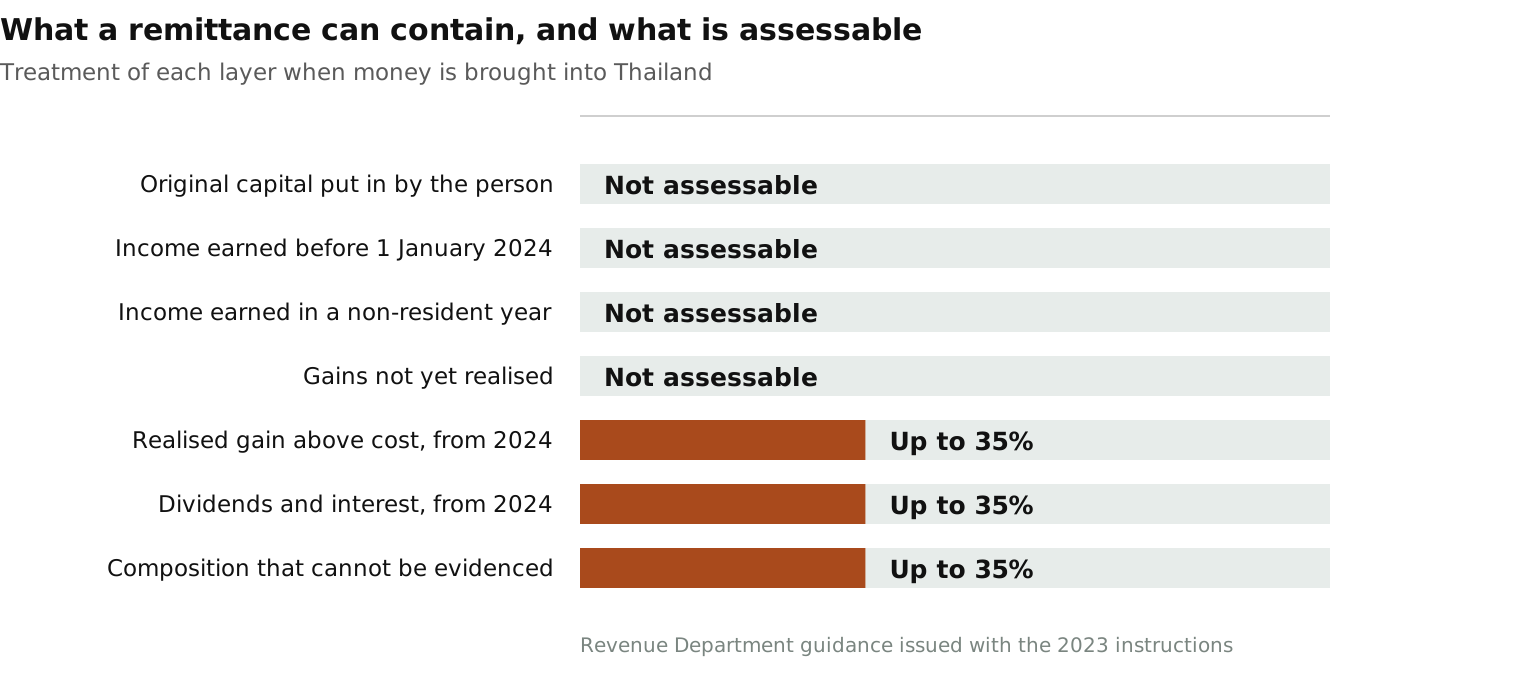 Income that arose before 1 January 2024 is not taxable, whenever it is brought in. That is the effect of the second instruction, issued on 20 November 2023, which disapplied the new reading to income derived before that date. Consulting fees earned in 2022 and remitted in 2026 are outside the charge. This is clean grandfathering on a calendar line, and it is more generous than it had to be.
Income that arose in a year when the person was not a Thai tax resident is also not taxable, whenever it is brought in. The Revenue Department's own worked example covers a Thai national who lived in China from 2007 and returned in 2024. The savings accumulated during those years are untaxed on remittance. Residence is tested in the year the income arises.
Capital is not income, and the Revenue Department says so directly. Only the gain above cost is assessable, computed transaction by transaction. On a bank deposit the principal is untaxed and only the interest is in charge. Unrealised gains are nothing at all. Money that left Thailand and came back is not assessable. Where a remittance is mixed, the taxpayer characterises it on the facts.
| Layer of a remittance | Treatment | Why |
|---|---|---|
| Original capital contributed by the person | Not assessable | Principal is not income |
| Income earned before 1 January 2024 | Not assessable | Disapplied by the November 2023 instruction |
| Income earned in a non-resident year | Not assessable | Residence tested when the income arises |
| Unrealised gains on assets still held | Not assessable | Nothing has arisen |
| Money previously taken out of Thailand | Not assessable | Not foreign-source income |
| Realised gain above cost, from 2024 | Assessable in the year remitted | The charging provision |
| Dividends and interest, from 2024 | Assessable in the year remitted | The charging provision |
| Composition that cannot be evidenced | Treated as assessable in full | The burden is on the taxpayer |
The announced relaxation is a draft, and remitting on the strength of it is expensive
In May 2025 the Director-General of the Revenue Department announced that income remitted within two tax years of arising would be exempt. Income brought in later would remain taxable at the normal rates. The announcement was corroborated the following day by a Deputy Director-General. It was widely reported as a change in the law. It is not law. It requires Cabinet approval and then review by the Council of State, and neither has produced an instrument. The Revenue Department's own register of newly issued Royal Decrees runs as a complete sequence through October 2026, and none concerns foreign-source income. Its register of ministerial regulations shows nothing relevant either. The department's news index through 22 October 2026 contains no item on the subject. Even the form the relaxation would take is disputed. The Revenue Department itself described a ministerial regulation. At least one advisory firm described a Royal Decree. A third said it could be either. That disagreement cannot be resolved, because there is no instrument to read. Two measures are routinely confused with it, and both are enacted. A Ministry of Finance exchange control notification effective 20 January 2026 exempted receipts below USD 10 million from the repatriation requirement. That is exchange control rather than tax. A Bank of Thailand instruction effective 29 December 2025 imposed stricter documentary checks on foreign currency transactions above USD 200,000. The stated purpose of the second was currency volatility, though the paper trail it creates closely resembles what a tax audit would want. Anyone who remitted money in 2026 on the strength of the May 2025 announcement is taxable on it. The Revenue Department has issued no public correction to the reporting. Nor has it formally withdrawn the proposal, so the position is not that the relaxation was abandoned. The position is that it was announced, drafted, and never enacted, and a draft creates no exemption. That silence has cost people money.Residence turns on 180 days, with no apportionment
The test is a count of days in the calendar year, aggregated rather than continuous. At 180 days a person is a Thai tax resident. At 179 they are not. There is no apportionment, no tie-breaker and no partial year. That cliff edge cuts both ways. It makes the test cheap to apply and hard to argue with, which compares favourably with the multi-limbed statutory residence tests used elsewhere. It also means a single extra trip can change a year's tax position entirely. Nationality is irrelevant. The Revenue Department states the point explicitly in its own material, without regard to nationality or ethnicity. Two claims circulate widely and both are wrong. The rule does not target Thai nationals returning from abroad, and it does not target foreign retirees. It applies to anyone who crosses the day count. Companies are not affected at all. The provision sits in the personal income tax part of the Revenue Code and applies to natural persons. A Thai-incorporated company is taxed on worldwide income as it accrues, at 20%, with graduated rates for smaller companies. Remittance is irrelevant to a company in either direction.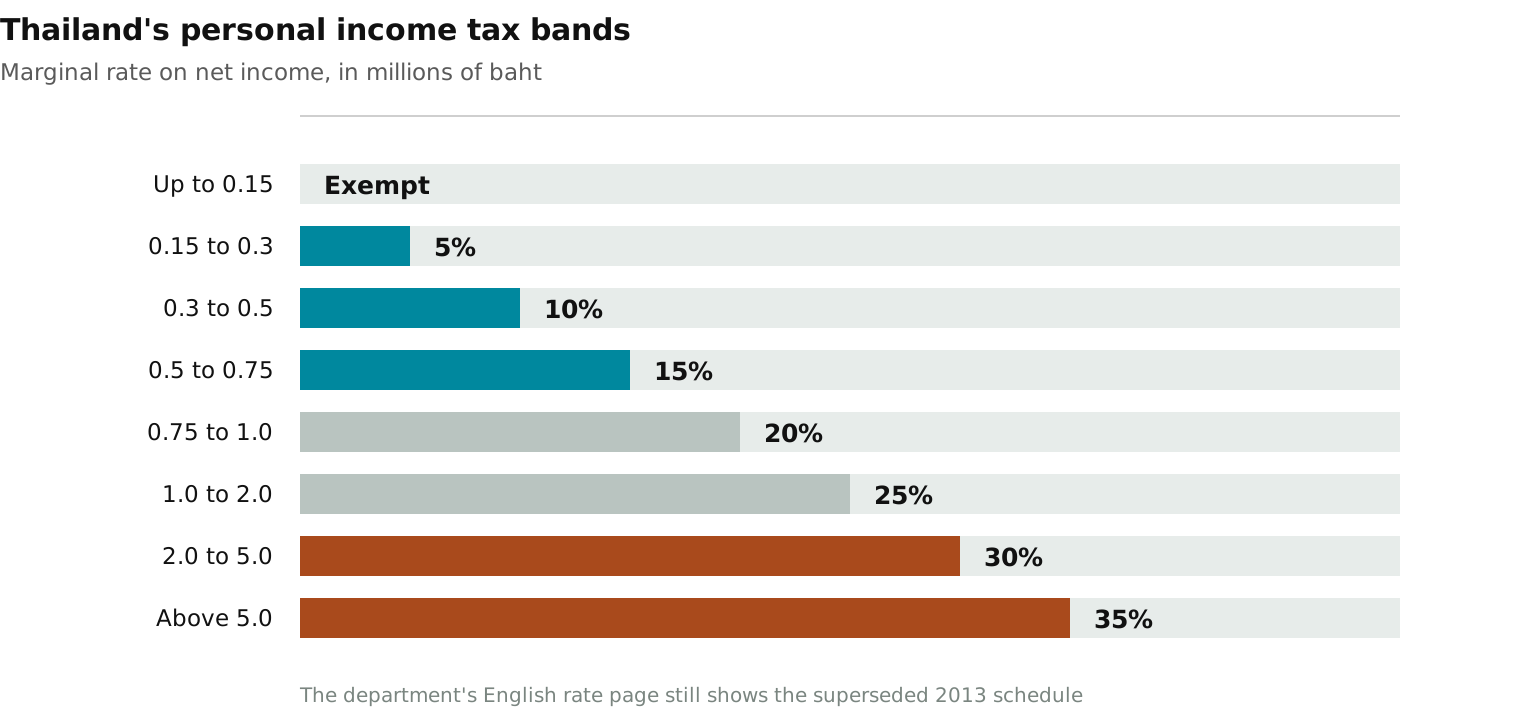 The rates themselves are not punitive at ordinary amounts. The first 150,000 baht is exempt, and the top rate of 35% only engages above 5 million baht. Return to the engineer described at the start. The assessable portion of her remittance is 1.4 million baht, which produces about 215,000 baht of tax. That is 15.4% of the assessable slice and 9% of the whole transfer. The arithmetic only looks bad when the layers cannot be separated.
A thirteen week difference in a completion date can be worth more than a house
The sharpest consequence of the rule is not the rate. It is that residence is tested in the year the income arises. That makes the timing of a disposal decisive for anybody planning a move to Thailand. A gain realised while still a non-resident never enters the charge, however long the money sits abroad afterwards and whenever it is eventually brought in. A gain realised after residence begins enters the charge on remittance, which may be years later.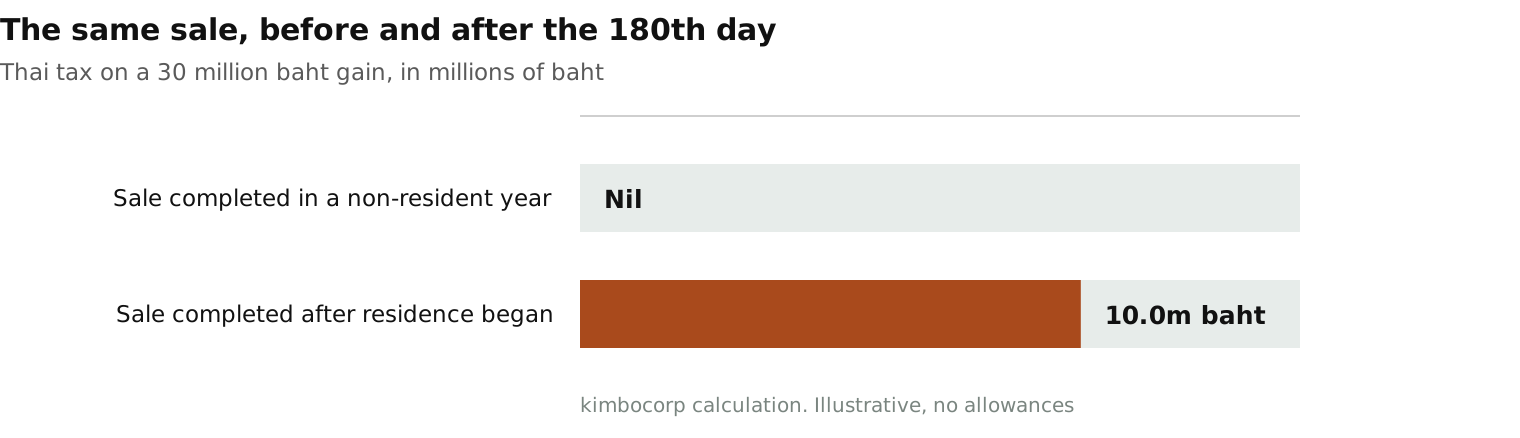 Consider a founder selling a business for a gain of 30 million baht, who intends to settle in Thailand and buy a house there. In the first version the sale completes in August 2025. He spends 70 days in Thailand that year, so 2025 is a non-resident year. He relocates in January 2026 and remits the proceeds. The gain arose in a non-resident year, so the first condition of the charge fails. Later remittance does not revive it. The Thai tax is nil.
In the second version everything is identical except that the sale completes in September 2026, after he has crossed 180 days. He remits in 2027. The gain is now assessable in the year of remittance, and the tax is about 10 million baht. There is no foreign tax credit, because Singapore charged nothing on the gain in the first place.
These are illustrative composites rather than real people, and the allowances are left out, so a real liability would be somewhat lower. The structural point survives the simplification. Ten million baht turns on which side of a day count a completion date falls, and that is a date rather than a judgement. It is the strongest argument there is for doing the work before arrival rather than after.
The treaty credit fails in exactly the case people rely on it for
Thailand and Singapore have a treaty signed on 11 June 2015, in force from 15 February 2016 and effective from 1 January 2017. It provides for Thailand to credit Singapore tax against the Thai tax on the same income, capped at the Thai tax attributable to it. A credit is worth the lower of the two taxes, which is the point that defeats most expectations here. Where Singapore charged nothing, the credit is nothing. Singapore has no capital gains tax and exempts most distributions received by individuals. A gain realised in Singapore and remitted to Thailand therefore bears Thai tax at up to 35% with no relief at all. The treaty is not failing in that case. It was never designed to relieve tax that one side did not charge. Two further gaps are worth knowing. There is no unilateral foreign tax credit for an individual receiving income from a country Thailand has no treaty with, so that foreign tax is simply lost. And where tax is paid abroad in one year and the income is remitted three years later, the Revenue Department has published no criteria for matching them. Its assurance that double taxation cannot arise is a statement rather than an analysis. One route does work, and it is statutory rather than interpretive. A Royal Decree issued in 2022 exempts holders of the Long-Term Resident visa from tax on foreign income brought into Thailand. It covers the wealthy global citizen, wealthy pensioner and work-from-Thailand categories. Because it is a Royal Decree, a departmental instruction cannot override it. The door is narrow: the Board of Investment reports 12,011 approvals across all categories in four years, against 12.57 million personal tax returns filed. One drafting point is unresolved. The exemption is expressed by reference to income derived in the previous tax year. Whether it covers income accumulated over many years is not addressed by any source.Singapore does not tax an individual on foreign income at all
The contrast is clean for an individual and much less clean for a company. Conflating the two is the commonest error in this area, and it runs in both directions. Advisers quote the company conditions at individuals who are not subject to them. They also quote the individual exemption at companies that cannot use it. The two regimes sit in different subsections and were written at different times for different reasons.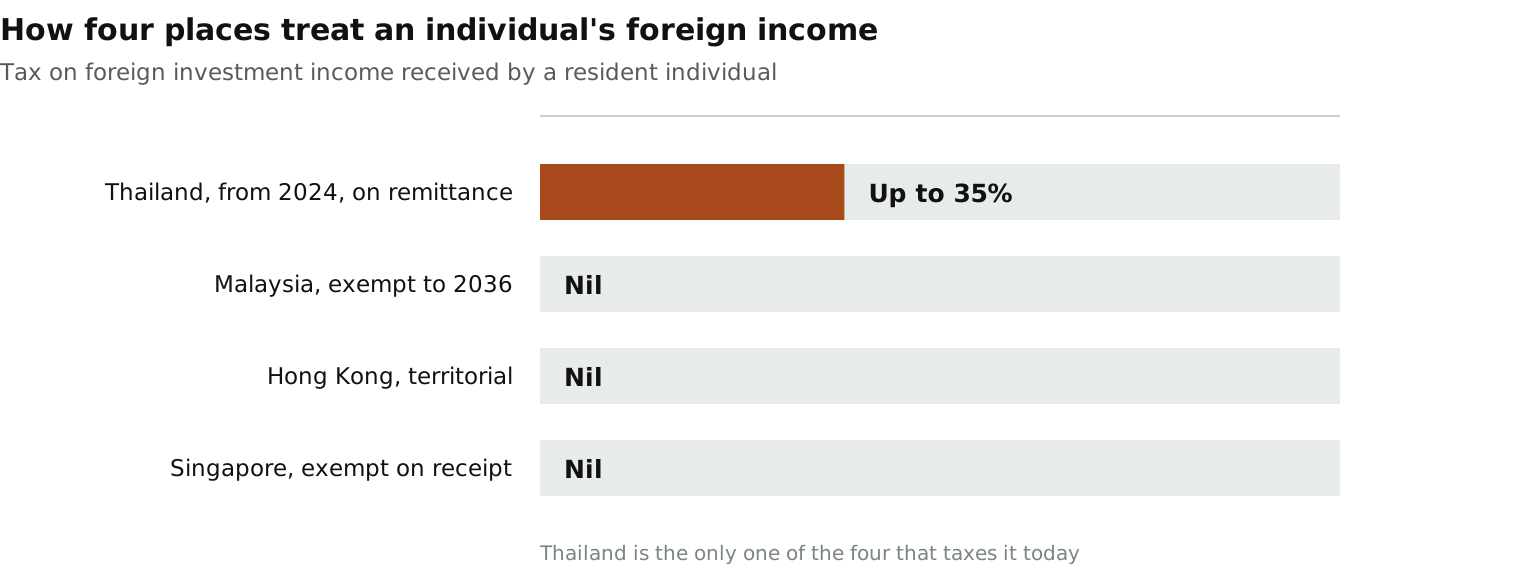 For an individual, Singapore exempts income arising from sources outside Singapore and received in Singapore. For a resident the exemption has depended since 2004 on the Comptroller being satisfied that it is beneficial, which is a formality. There is no subject-to-tax condition and no headline rate test for an individual, because both of those belong to the company regime. One exception is real and catches professional structures. Foreign income received by a resident individual through a Singapore partnership is taxable.
Malaysia brought foreign income into charge from 2022 but exempts resident individuals, on conditions, through to the end of 2036. Hong Kong taxes individuals on a territorial basis and its foreign-source income regime applies only to entities, with natural persons expressly excluded. Of the four, Thailand is the only one that actually taxes an individual's remitted foreign income today.
For a company the picture reverses in an important way. Singapore's exemption for foreign dividends, branch profits and service income requires all three statutory conditions to be met. One of them is that the source jurisdiction's highest corporate rate is at least 15%. That test looks at the headline rate rather than at tax actually suffered, and the Minister may waive the subject-to-tax condition but expressly not the rate test. Thailand's 20% headline rate clears it comfortably. A Thai company, by contrast, simply reports worldwide income at 20% and claims a credit, with nothing to establish.
The rule is defensible, and the way it was made is not
The substantive change closed a genuine gap. Under the 1987 reading a Thai resident could earn income anywhere and in any amount. Bringing it in on the first day of the following year made it free of tax. Describing that as a remittance basis flattered it. Thailand also declined to abolish the remittance basis altogether, having drafted the power to do it. Money left offshore remains untaxed, and so do unrealised gains. That is more generous than the United States and most of the OECD. The grandfathering is clean, and the capital and income distinction is recognised in writing by the Revenue Department itself. The residence test is objective and cheap to apply. Several remittance systems impose ordering rules on mixed funds that force income out first. Thailand lets the taxpayer characterise the pool on the facts, which is the more generous approach. The execution is the problem. A reading that had stood for thirty-six years was overturned by an internal instruction to revenue officers rather than by legislation, with 107 days of notice. The documentation standard is undefined and the burden falls entirely on the taxpayer. One basic question has gone unanswered for nearly three years. Whether spending on a foreign card in Thailand, or drawing on an offshore account from a Thai cash machine, counts as a remittance remains unsettled. The Revenue Department expressly declined to confirm it. Thailand has adopted the common reporting standard, so it has independent data on offshore accounts while the taxpayer has no answer on the basic question. Two contradictory drafts have also been live at once for more than a year. One would relax the rule and one would abolish the remittance basis entirely. Neither has been enacted, so the policy direction is genuinely unsettled. The May 2025 announcement was read by a great many people as a change that had already happened.What this means for new arrivals, founders planning an exit, and advisers
For a person moving to Thailand, the work that matters is evidential and it is best done before the move. A statement of every foreign account as at 31 December 2023 establishes the pre-2024 layer. Records of acquisition cost, sale price and gain for each holding establish the capital layer. Without those, a remittance is treated as income in full. On an illustrative 6 million baht transfer, the difference is about 1.5 million baht of tax on identical money. For a founder planning an exit, the question is the completion date rather than the structure. A gain realised in a year of non-residence is outside the charge permanently, whenever it is remitted. A gain realised after the 180th day is assessable when the money comes in, with no credit for Singapore tax that was never charged. The Long-Term Resident visa is a statutory exemption rather than a concession, and it is worth examining before anybody assumes the ordinary rules apply. For an adviser, three warnings are worth passing on. The announced relaxation is not law and should not be relied on in any written advice. The Revenue Department's English-language rate page is out of date, and so is the treaty text it hosts. The operative article is in the 2015 agreement rather than the 1975 one. This subject also attracts an unusual volume of confident, undated and incorrect material online, much of it with no identifiable author. A figure that cannot be traced to the Revenue Department or the gazette should not be used.Our blog
Latest blog posts
Tools and strategies modern teams need to help their companies grow.