Moving profit out of Vietnam costs no tax and takes seventeen months
Written by

Huan koh
Published on
October 26, 2026

Copy link
Link copied!


Vietnam charges nothing on dividends paid to a corporate shareholder abroad. The constraint is the annual audit cycle, and a Singapore holding company does not shorten it. A precision components manufacturer near Ho Chi Minh City has its first good year. It lost 18 billion dong in 2024 and made 52 billion dong before tax in 2025. Its owner is a Singapore holding company, and the group wants the cash. The finance director has been told that a Singapore parent reduces Vietnamese withholding tax on dividends from ten per cent to five. That advice is wrong in a way that matters, because Vietnam charges nothing on those dividends in the first place. This is the single most common error in the field, and it is imported from elsewhere. China, Thailand and Indonesia all tax outbound dividends, so a holding company in the right treaty jurisdiction genuinely reduces the rate. Vietnam does not. A dividend paid to a corporate shareholder abroad leaves Vietnam free of withholding tax, whoever the shareholder is and wherever it sits. The treaty figures of five, seven and twelve and a half per cent are ceilings on a tax Vietnam has chosen not to levy. What Vietnam does impose is a sequence, and it is long. Profit earned in January 2025 reaches the shareholder in June 2026 at the earliest. The constraint is the audit and filing cycle rather than the tax. No structure shortens it, because every step is a statutory precondition rather than an administrative habit. For a group accustomed to sweeping cash monthly, that is the real cost of operating in Vietnam. It is a working capital problem rather than a tax one. Four of the governing instruments also changed in 2025 and 2026, which means almost all published guidance on this subject is now out of date. The capital account has been renamed. The repatriation conditions have moved into a new decree, with a new condition attached. The transfer pricing decree has been replaced, and the charge on exit has been rebuilt from the ground up.
Vietnam charges nothing on an outbound dividend to a company
The withholding position is better than the one most groups are planning around, and the treaty makes almost none of it better still. That second half is the part advisers get wrong. A treaty sets a ceiling on what a country may charge. Where the domestic rate already sits below the ceiling, the domestic rate applies and the treaty is irrelevant. On two of the four main payment types, Vietnam's domestic rate is already at or below what the treaty would allow.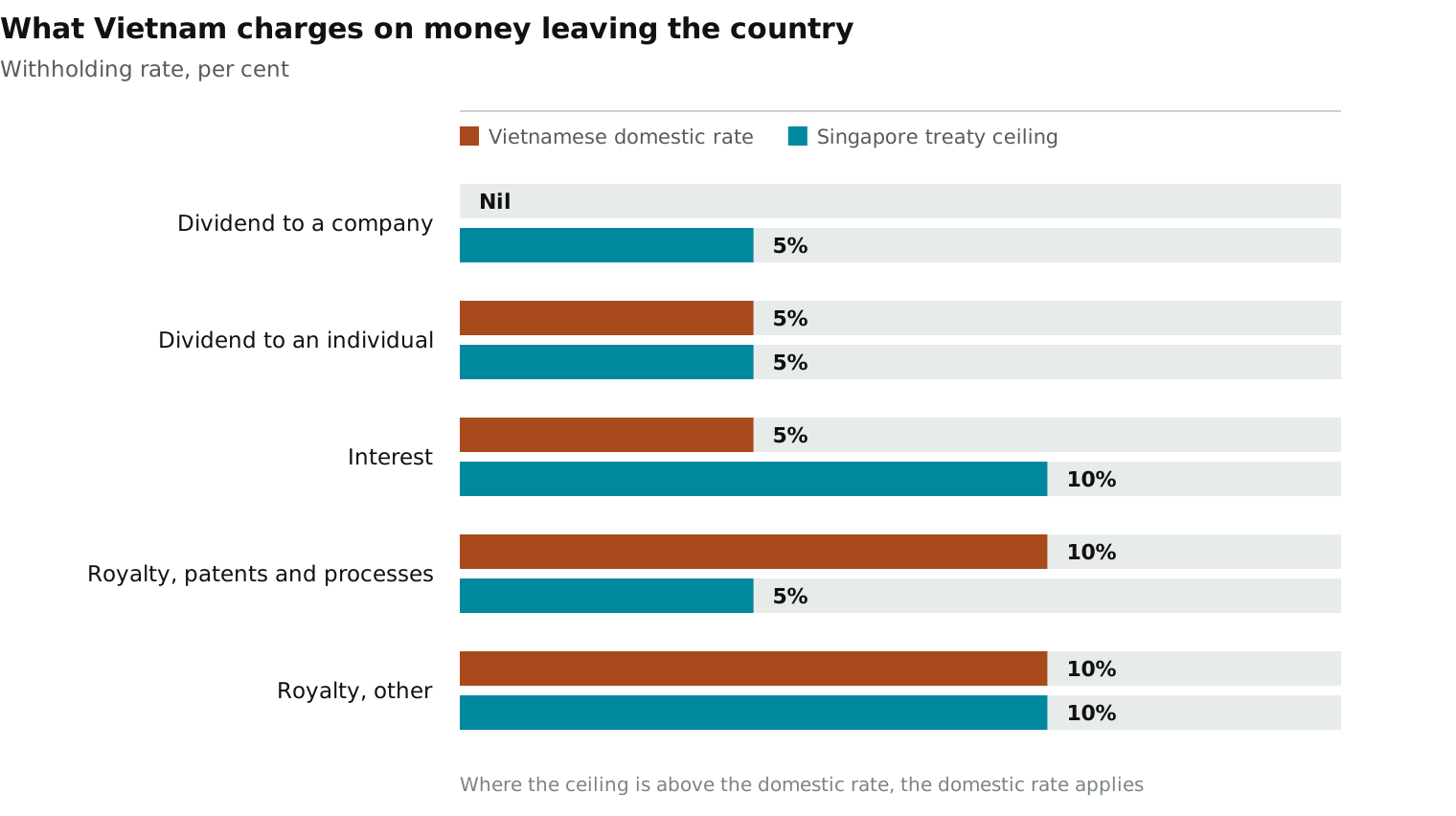 A dividend to a corporate shareholder carries nothing. A dividend to an individual carries five per cent. Interest carries five per cent domestically against a treaty ceiling of ten. The treaty is therefore worse than the domestic position, and a Singapore lender gains nothing from it. Royalties carry ten per cent domestically, and here the treaty does help. For patents, designs, formulas, processes and equipment the ceiling is five per cent, which is a genuine halving.
Services paid to a foreign contractor attract a combined charge of five per cent corporate tax and five per cent value added tax. The second of those is generally creditable. The corporate element can be reduced to nothing under the treaty where there is no permanent establishment, which is a claim rather than an automatic position.
The claims procedure itself changed on 1 July 2026, when a new circular replaced the 2013 rules. The burden of proof sits with the taxpayer, substance is weighed over form, and a claim is refused after three years. A Singapore certificate of residence is the precondition for any of it, and Singapore tightened what it takes to get one from 2025.
The money is free but the calendar is not
The sequence is fixed by statute and by the audit requirement, and it runs on an annual cycle with no interim route. There is no mechanism for an interim dividend out of Vietnam in the way a British or Singapore company would declare one. The year has to close, the accounts have to be audited, the tax return has to be filed and the tax paid. Only then does the question of distribution arise at all.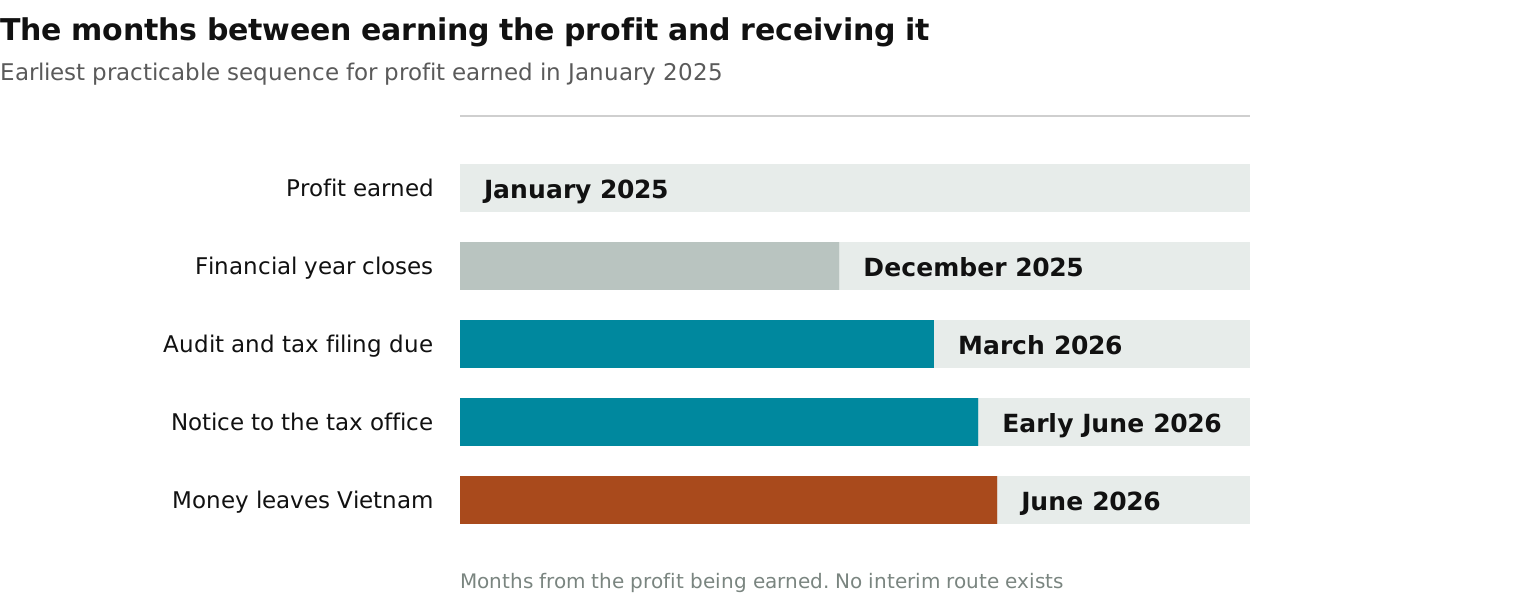 Audited financial statements and a filed corporate tax finalisation are both hard preconditions. Both fall due on the last day of the third month after the year end. An audit is separately compulsory for a foreign-invested enterprise regardless of size. Every tax, late payment charge and penalty must be settled. Since July 2026 a further condition applies, which is that no tax debt may be outstanding or overdue at the moment of remittance.
Accumulated losses block a distribution for the year, and the trap here is a mismatch of two numbers. Corporate tax is computed on taxable income after loss relief, which runs for five years. The distributable amount is retained earnings in the accounts. On the manufacturer described above, tax is charged on 34 billion dong after loss relief. That gives a charge of 6.8 billion dong and an after-tax profit of 45.2 billion. The distributable ceiling is not 45.2 billion. It is retained earnings of 27.2 billion, because the 2024 loss still sits in the accounts.
Notice of the transfer must be given to the managing tax office at least seven working days beforehand, on a prescribed form. There is no approval and no objection period. The claim that the tax office has seven days to object describes a mechanism that does not exist. The notice is a notice.
Taken end to end, profit earned in January 2025 can be distributed in June 2026 and not before. Seventeen months is the figure to plan against, and it assumes everything goes smoothly. A qualified audit opinion, a disputed assessment or an unpaid penalty extends it. So does a late discovery that retained earnings are lower than after-tax profit. The sequence has no mechanism for urgency, and nothing in it responds to the shareholder needing the money.
The capital account was renamed in August 2026
The account through which investment money moves has been known for years by an acronym that no longer exists. A circular issued on 31 July 2026 and effective from 18 August 2026 replaced the 2019 rules in full. It renamed the direct investment capital account as the foreign investment capital account. Three of the changes are commercially useful. A foreign currency account is no longer mandatory, so the account may be held in dong, in foreign currency or both at a single licensed bank. The account may be opened before the investment registration certificate issues, with limited uses until it is granted. Profits may now be retained in Vietnam and moved from the account to the investor's payment account to fund another Vietnamese project. That previously required taking the money out and bringing it back. Two details are worth checking against existing documentation. The ownership threshold that determines whether the account is required is more than fifty per cent, not fifty-one, and it has been since June 2025. Capital contributions, capital transfer payments between local and foreign parties, profit remittance, loan drawdowns and repayments, and returns of capital must all pass through it. Transfers between two foreign parties or two local parties need not. Capital transfers between a resident and a non-resident generally settle in Vietnamese dong. That places the currency risk on the foreign party for the period between pricing and settlement. It is not a detail that appears in any rate table, and on a large transaction it can exceed the tax. The trading band has been five per cent either side of the reference rate since October 2022.The exit charge was rebuilt, and it is now payable on a loss
The charge on selling a Vietnamese company changed completely on 15 December 2025. Whether the change is good news depends entirely on whether the seller made money. A charge on the gain and a charge on the proceeds behave in opposite ways at the bottom of the range. Vietnam moved from the first to the second, which helps a profitable seller and penalises an unprofitable one.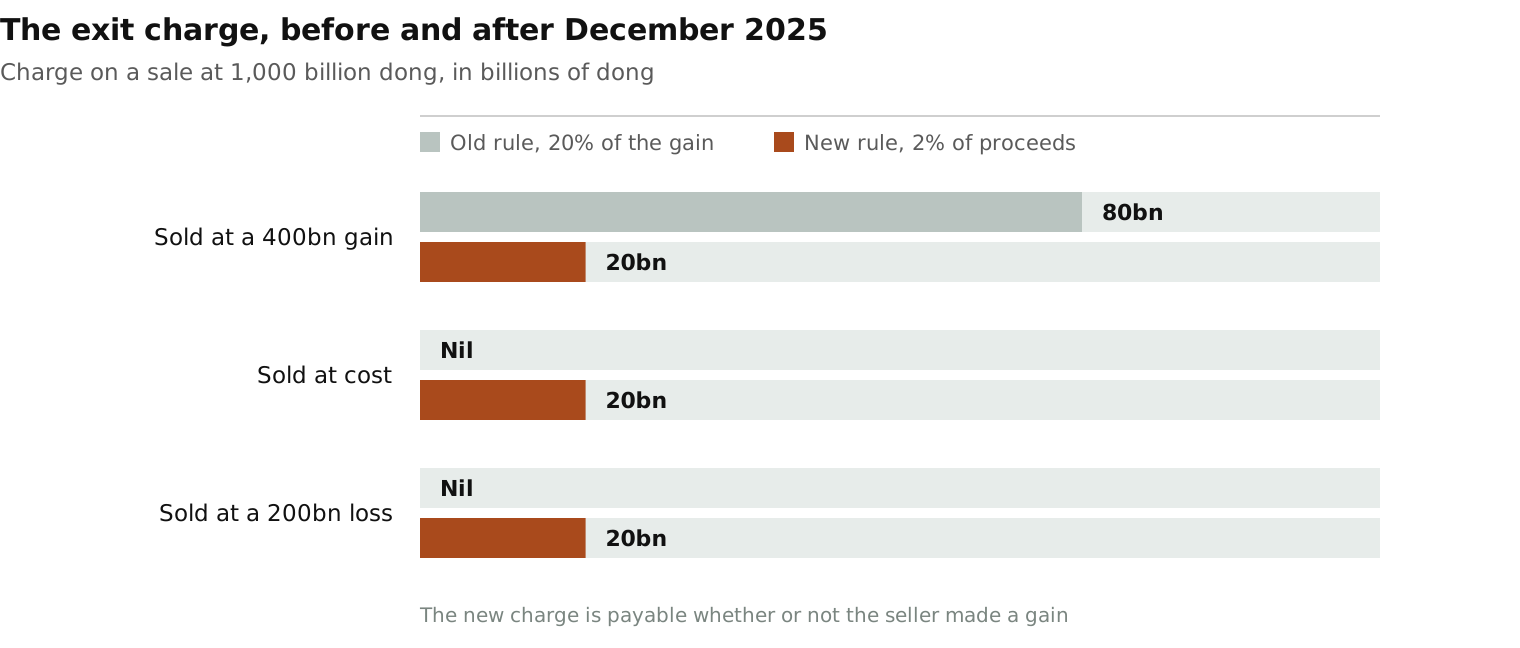 A foreign corporate seller now pays two per cent of gross sale proceeds, in place of twenty per cent of the net gain. Take a sale at 1,000 billion dong with a contributed capital of 600 billion. The old charge was 80 billion dong and the new charge is 20 billion. That is a substantial improvement. Now take the same sale where the seller had put in 1,200 billion dong and is therefore losing money. The old charge was nothing and the new charge is still 20 billion dong. The break-even point is a gain of ten per cent of the sale price.
The charge also reaches indirect transfers. Selling the offshore holding company rather than the Vietnamese shares does not escape it, which closes the structure most often proposed for an exit. That was not the position before December 2025, so a plan built on the older rules now produces a charge its authors did not expect. An intra-group restructuring exemption exists, on four cumulative conditions that have to be met together.
Two practical points follow. The tax point may be the date of contract signature rather than receipt of the money. The charge can therefore crystallise before the seller has been paid and converted. The treaty argument that the gain should be taxable only in Singapore is also contestable on several grounds. Those include the principal purpose test and the new burden of proof rules. There is a further question of whether a contribution to a limited liability company's charter capital is a disposal of shares at all.
Vietnamese corporate tax is where the money actually goes
The headline rate is twenty per cent, and that is where essentially all the tax on a Vietnamese operation is paid. A new corporate income tax law took effect on 1 October 2025 and applies from the 2025 tax period. Implementing decrees and circulars followed through March 2026. Lower rates of fifteen and seventeen per cent exist for smaller companies, tested on the preceding period's revenue. Most foreign-invested subsidiaries cannot use them, because the law denies both tiers to a subsidiary or affiliate of a group that does not itself qualify. Incentive rates are genuinely generous where they apply. High technology, software, semiconductors and large projects can obtain ten per cent for fifteen years. A period of full exemption is followed by several years at half rate. Two changes in the new law bite on common structures. Interest paid to a non-credit institution above the civil code ceiling of twenty per cent a year is wholly non-deductible, which constrains shareholder loans. And industrial parks were removed from the list of incentivised locations for new projects, which a great deal of older site-selection advice still assumes. A replacement transfer pricing decree took effect on 1 July 2026 and applies from the 2026 period. It raised the revenue threshold for the profitability safe harbour from 200 billion to below 500 billion dong. It also moved the country-by-country reporting threshold onto a euro 750 million group revenue basis. The interest deductibility cap of thirty per cent of earnings before interest, tax, depreciation and amortisation is reported unchanged, with a five year carry-forward.A tax holiday is where the Singapore company starts costing money
The one case where a Singapore holding company makes a group worse off is the case investors most often want. It follows directly from Singapore's own conditions rather than from anything Vietnam does. The incentive that attracted the investment is the same thing that breaks the exemption on the way out. Nothing in the Vietnamese rules causes it, and nothing in the Vietnamese rules can fix it. Singapore exempts a foreign dividend only where three conditions are met. The income must have been subject to tax in the source jurisdiction. That jurisdiction's highest corporate rate must be at least fifteen per cent. The exemption must also be beneficial to the Singapore recipient. Vietnam's twenty per cent headline rate clears the rate test comfortably. It still clears it where the subsidiary itself enjoys an incentive rate of ten or fifteen per cent. The test looks at the headline rate rather than at the rate actually applied. The subject-to-tax condition is the problem. Vietnam levies no dividend withholding tax, so there is no Vietnamese tax on the dividend itself to point to. The condition therefore has to be satisfied by the underlying corporate tax the subsidiary paid. A subsidiary paying twenty per cent satisfies it. A subsidiary sitting inside its four year exemption period has paid no corporate tax at all. The condition therefore fails. The dividend is taxable in Singapore at seventeen per cent, with no credit available.| What the Singapore holding company does | Effect |
|---|---|
| Reduces Vietnamese dividend withholding tax | None, because the rate is already nil |
| Reduces Vietnamese withholding tax on interest | None, the treaty ceiling is higher than the domestic rate |
| Reduces Vietnamese corporate income tax | None, which is where essentially all the tax is paid |
| Shortens the time to get cash out | None, the audit cycle is unchanged |
| Creates a cash pooling arrangement | None, cross-border pooling is not available |
| Halves withholding on one class of royalty | Yes, from ten per cent to five, with a residence certificate |
| Supports an argument on the exit gain | Yes, but contestable, and section 10L may tax it in Singapore |
| Holds money once it is out | Yes, and this is the honest case for it |
| In a Vietnamese tax holiday year | Costs seventeen per cent that would not otherwise be payable |
Cross-border cash pooling does not exist in Vietnam
Groups that run a regional treasury routinely ask how to include Vietnam, and the answer is that they cannot in the normal sense. There is no offshore dong market. Domestic settlement must be in dong. A Vietnamese company lending money offshore is a capital movement rather than a treasury operation.
Three channels move money on a defensible basis, and together they fall well short of a pool. The annual dividend is the largest and the slowest. An inbound shareholder loan is useful in both directions. The interest is deductible against twenty per cent tax while bearing five per cent withholding. Repayment of principal is neither taxable nor a profit remittance. That last point is the real structuring insight here: principal repayments need no audit and no seven day notice.
Management fees and royalties are the third channel. A management fee bears the foreign contractor charge, and the corporate element is far smaller than the corporate tax deduction it generates. A royalty for patents or know-how is the one place the treaty genuinely halves a rate. None of this is pooling. It is a set of separate payments, each with its own documentation, each defensible only to the extent it reflects something real.
Offshore borrowing into Vietnam has its own regime. A loan with a tenor over twelve months must be registered with the central bank, and there is no monetary threshold, only a tenor test. Short-term offshore debt may only refinance offshore debt or pay short-term payables, and it cannot fund working capital or capital expenditure.
What Vietnam gets right, and what it costs
The right to remit profit is statutory rather than licensed, which is not true everywhere in the region. Charging nothing on outbound corporate dividends is worth more than any holding company structure. It compares well against Indonesia at twenty per cent, Thailand at ten and China at ten. The accumulated loss rule is ordinary capital maintenance. Vietnam accepted the International Monetary Fund's obligations on current account convertibility in 2005. Profit remittance is a current account transaction. The common claim that the dong is non-convertible is therefore too blunt to be useful.
The 2026 reforms also cut real friction. The foreign currency account became optional, and the capital account can be opened before the licence issues. Profits can be retained for reinvestment without a round trip. The transfer pricing safe harbour threshold also rose substantially. Banks now carry published procedural duties they did not have before.
The costs are equally real. The annual cycle traps cash for up to seventeen months with no interim dividend route. Two per cent of gross proceeds is payable on an exit that loses money. Indirect transfers are caught with no credit mechanism. Capital transfers settle in dong, so the foreign party carries the currency risk. Short-term offshore debt cannot fund the things a business actually needs funded. And the sheer pace of instrument change means nothing learned before 2025 can be relied on without checking.
One figure is missing from the public record entirely. No central bank, finance ministry or statistics office series exists for profit actually repatriated from Vietnam. The World Bank's economic update refers to large profit repatriation from the export sector without giving a number. Several commercial sources publish estimates, and none of them cites an official series.
What this means for investors, treasurers and advisers
For an investor, the planning assumption should be that Vietnam is cheap on tax and slow on cash. Budget for the first distribution to arrive seventeen months after the profit is earned, and fund working capital accordingly. Check whether the subsidiary is inside an incentive period before putting a Singapore company above it. That is the one configuration where the holding company adds a seventeen per cent charge rather than removing one.
For a treasurer, the three channels should be sized and documented separately rather than treated as a pool. The shareholder loan deserves particular attention. Principal repayments sit outside the profit remittance machinery altogether, and they are the only route that does not wait for an audit. The interest rate has to stay inside both the civil code ceiling and the earnings-based deductibility cap. The loan also has to be registered where the tenor exceeds a year.
For an adviser, the instrument list is the work. The repatriation conditions moved into a new decree in July 2026 and acquired a new condition. The capital account was renamed in August 2026. The transfer pricing decree was replaced in July 2026, superseding both of its predecessors. The treaty claims circular was replaced in July 2026. Any memorandum written before the middle of 2026 should be assumed stale until each of those has been checked.
Our blog
Latest blog posts
Tools and strategies modern teams need to help their companies grow.