Singapore listed 21 companies this year, and not one Southeast Asian buyout fund closed
Written by

Huan koh
Published on
September 9, 2026

Copy link
Link copied!


The exchange had its best year in a decade while the funds that supply private capital to the region raised almost nothing.
Two sets of numbers published four weeks apart describe a market doing well and badly at once. Which one you meet depends on which door you are trying to walk through. On 6 August 2026 the Singapore Exchange reported its full-year results. They included twenty-one initial public offerings raising about US$3.2 billion, against six raising US$20 million the year before. On 31 August a review of regional fundraising reported the other side. No dedicated Southeast Asia private equity fund reached a final close in the first half of 2026. Only one venture fund in the region did, at US$8 million. Public listing became far easier and private fundraising far harder, over the same twelve months, in the same city. A founder planning a raise needs to know which market applies, because the advice that follows from each is close to opposite.
The exchange went from six listings to twenty-one in a single financial year
Start with the public side, where the change is unusually clean. No interpretation is required and no adjustment has to be made. One year the venue was almost empty and the next it was busy. That kind of turn is rare enough in a listing venue to be worth pausing on before asking what caused it.
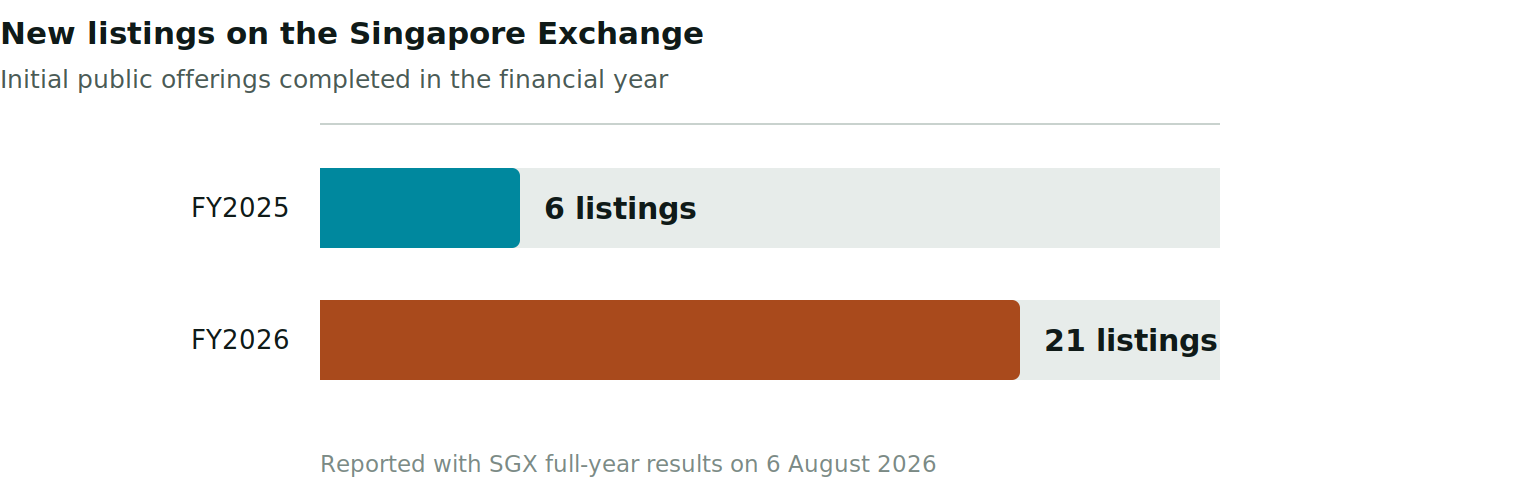
Twenty-one companies completed listings in the financial year to June 2026, against six in the year before. Group revenue rose 14% to S$1.17 billion. A jump of that size in one year is rarely explained by a single cause. The direction of policy, though, is not ambiguous. Singapore's authorities have spent two years working on the depth of the local equity market. That included placing public money with fund managers who invest in Singapore-listed companies, and a review of listing rules aimed at shortening the process. Whatever weight you give each measure, the result is the same for a company weighing a listing. You are joining a queue rather than standing in an empty room, and the comparable companies whose valuations set your pricing actually exist.
The money raised moved by far more than the count of listings did
The count understates what happened. The size of what listed changed far more than the number of listings did. Six companies can raise almost nothing or a great deal, and which it is tells you what kind of company was willing to use the venue. On that measure the two years are barely the same market.
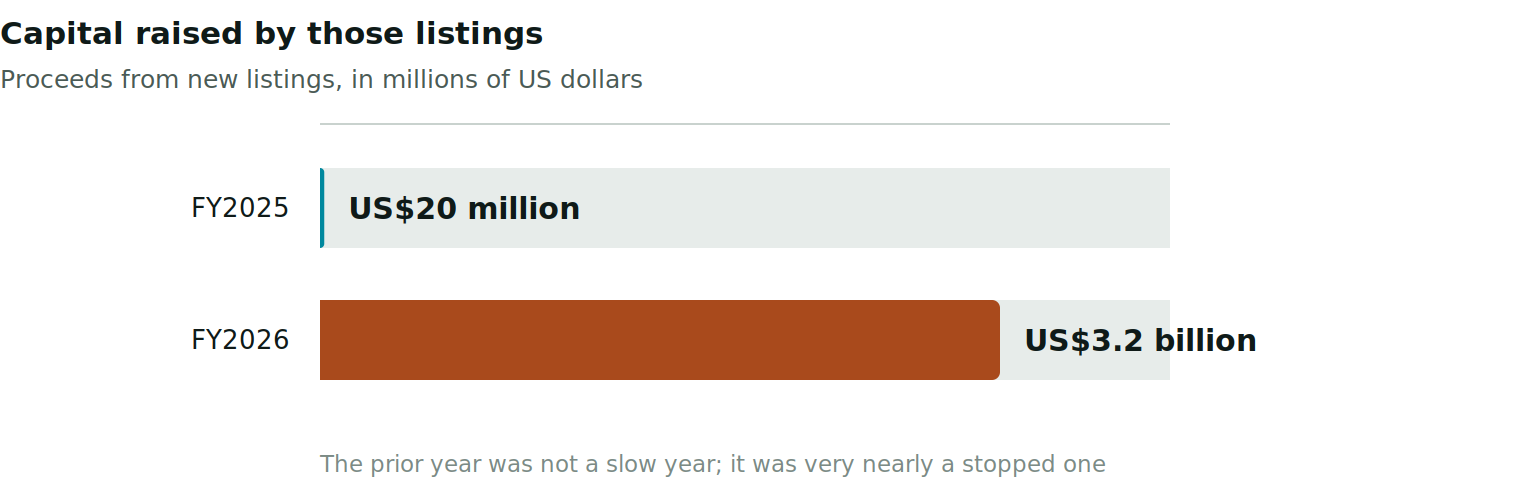
Those twenty-one listings raised about US$3.2 billion. The six listings the previous year raised about US$20 million between them. That is not a slow year followed by a good one. A market raising twenty million dollars across six listings is one where only very small companies are listing. Companies that could have raised properly went elsewhere, or they waited. So the recovery is not only in volume. It is in the size of company willing to use the venue, and that matters more for anyone deciding where to list. A venue that can absorb a large offering prices a small one better, because the investors who buy the large deals are present and paying attention.
No dedicated Southeast Asia private equity fund reached a final close in the first half
Now the other door, which is where most companies in the region actually go for capital. Very few businesses list. Almost all of them raise privately at some point, from funds that have to raise their own money first. That second step broke this year, and it broke quietly, because a fund that fails to close issues no press release.
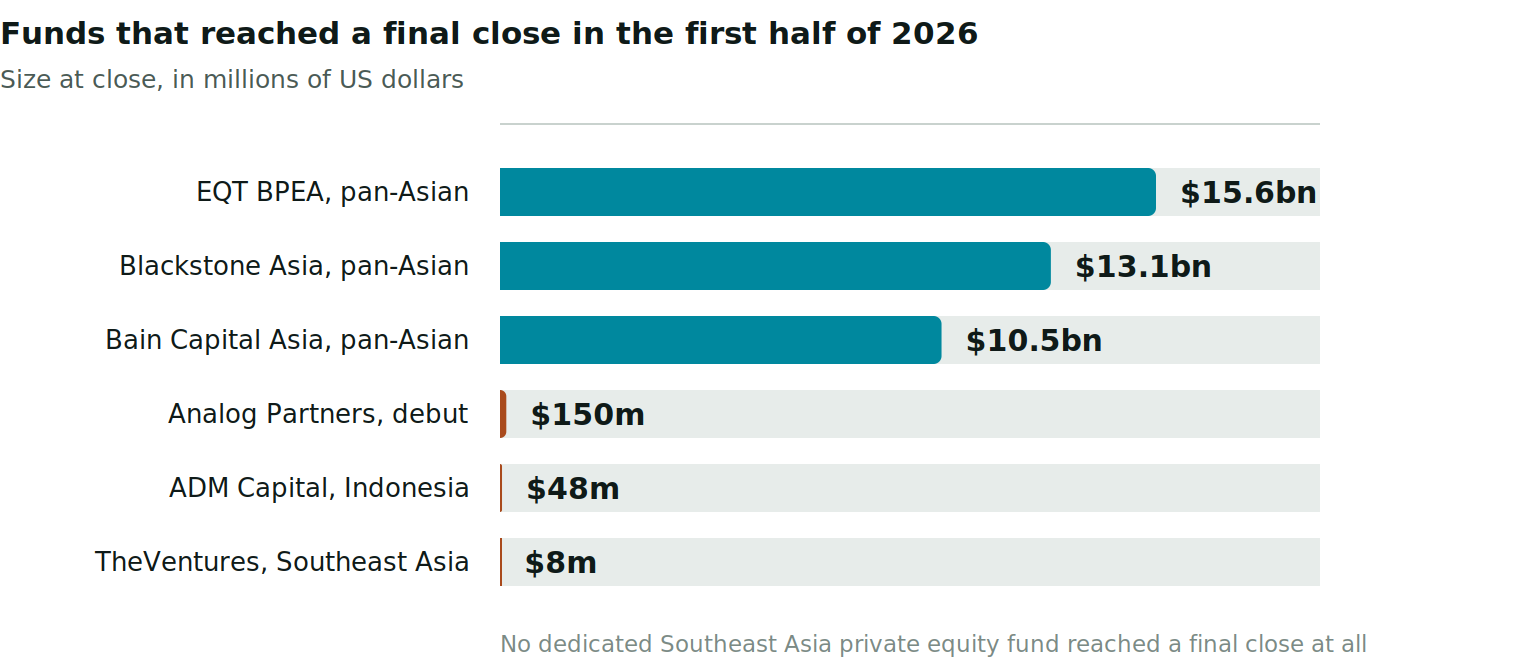
Not one dedicated Southeast Asia private equity fund reached a final close between January and June 2026. The only regional venture close was TheVentures, at US$8 million. Two smaller vehicles closed with a regional focus. Analog Partners raised US$150 million and an ADM Capital Indonesia fund raised US$48 million. Meanwhile the pan-Asian megafunds closed enormous amounts. EQT BPEA closed at US$15.6 billion, Blackstone Asia at US$13.1 billion and Bain Capital Asia at US$10.5 billion. Roughly 85% of Asia Pacific private equity capital went into pan-Asian vehicles rather than country or region-specific ones. The money has not left Asia. It has moved into larger and more diversified funds, which write bigger cheques and do fewer deals.
The regional venture figures look strong until one round is removed from them
The same distortion appears in the venture numbers. The aggregate has been widely quoted this year and the composition rarely is. It is the kind of statistic used in a pitch deck by the founder and the investor alike, to support opposite claims, without either being wrong about the arithmetic.
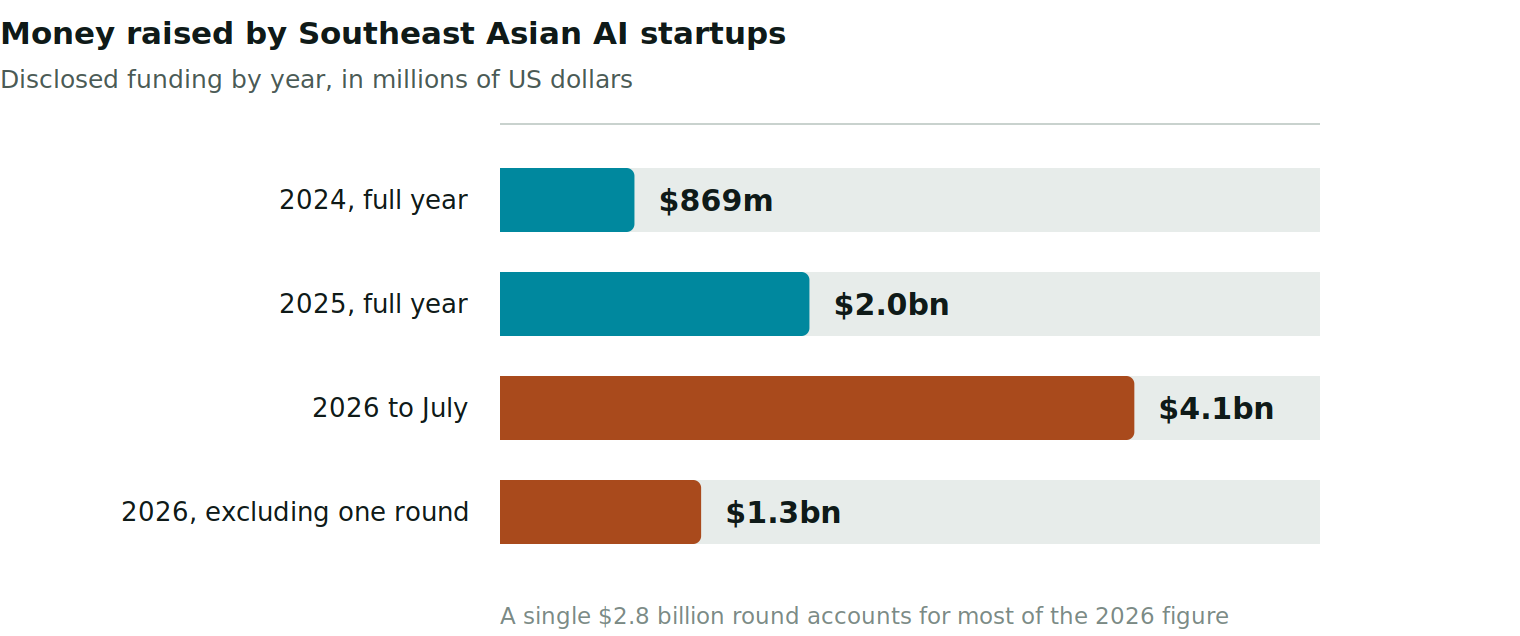
Funding into Southeast Asian artificial intelligence companies rose from US$869 million in 2024 to about US$2 billion in 2025. By July 2026 it had reached US$4.1 billion. Read on its own, that is a market roughly doubling every year. But a single US$2.8 billion round for Kling AI accounts for most of the 2026 total. Remove it and about US$1.3 billion remains, which is below the full-year 2025 figure. Both readings are accurate and they point in opposite directions. The honest version is this. Capital is available in very large quantities to a small number of companies, and scarce for everybody else. That is the pattern the private equity closes describe. A founder benchmarking against the headline is benchmarking against something that happened once.
Institutional money is still arriving, but at a size most companies cannot use
Capital does keep being committed to the region through other channels, and its shape is consistent with everything above. In the first week of September 2026, IFM Investors opened a Singapore office. The Australian institutional manager stated an intention to deploy around US$1 billion across Asian infrastructure and private markets. That is real money arriving with real intent. It also goes out in large positions, from an institution that measures success over a decade. That makes it relevant to a company raising a hundred million dollars and almost irrelevant to one raising five. Take the listings, the fund closes, the venture rounds and the institutional arrivals together. Capital is concentrating, and the threshold for receiving it has risen.
What this means for founders raising now, companies considering a listing, and fund managers trying to close
For a founder raising private capital in Southeast Asia over the next year, plan on a longer process against a smaller field. The regional funds that would historically have led your round did not raise this cycle. The buyer list is shorter than the one your adviser assembled two years ago, and several names on it are managing existing portfolios rather than deploying new money. The pan-Asian funds that did raise write far larger cheques than you are asking for. Three adjustments follow. Raise for a longer runway than the round nominally requires, because the next one will take longer to assemble. Treat strategic and corporate investors as a primary channel rather than a fallback. And be precise about which fund can lead at your size, because a fund that closed US$13 billion will not lead a US$10 million round.
For a company considering a public listing, the venue argument has changed materially in twelve months, and is worth re-examining even if you dismissed it before. Twenty-one listings raising US$3.2 billion brings research coverage, comparable valuations and an investor base that is actually present. None of that existed in a six-listing year. Listing remains expensive, slow and permanently disclosing. It is not a shortcut around a difficult private round. But consider a company with predictable earnings that private investors have told to wait another cycle. For that company the arithmetic has changed, and not marginally. The time to test it is while the queue is forming rather than after it has cleared.
For a fund manager trying to close a Southeast Asia vehicle, the first-half data says something about positioning rather than about the region. Allocators concentrated in pan-Asian funds for understandable reasons. Those funds offer diversification, scale and a familiar reporting relationship. A single-region fund must now explain why its exposure cannot be obtained inside a larger vehicle. The honest answer usually involves access to deals the megafunds never see and could not service. That argument is made with a track record and a live pipeline, not with a slide about market size. It also has to be made from somewhere an allocator's operational due diligence clears without friction, which is a large part of why managers keep arriving in Singapore.
Our blog
Latest blog posts
Tools and strategies modern teams need to help their companies grow.