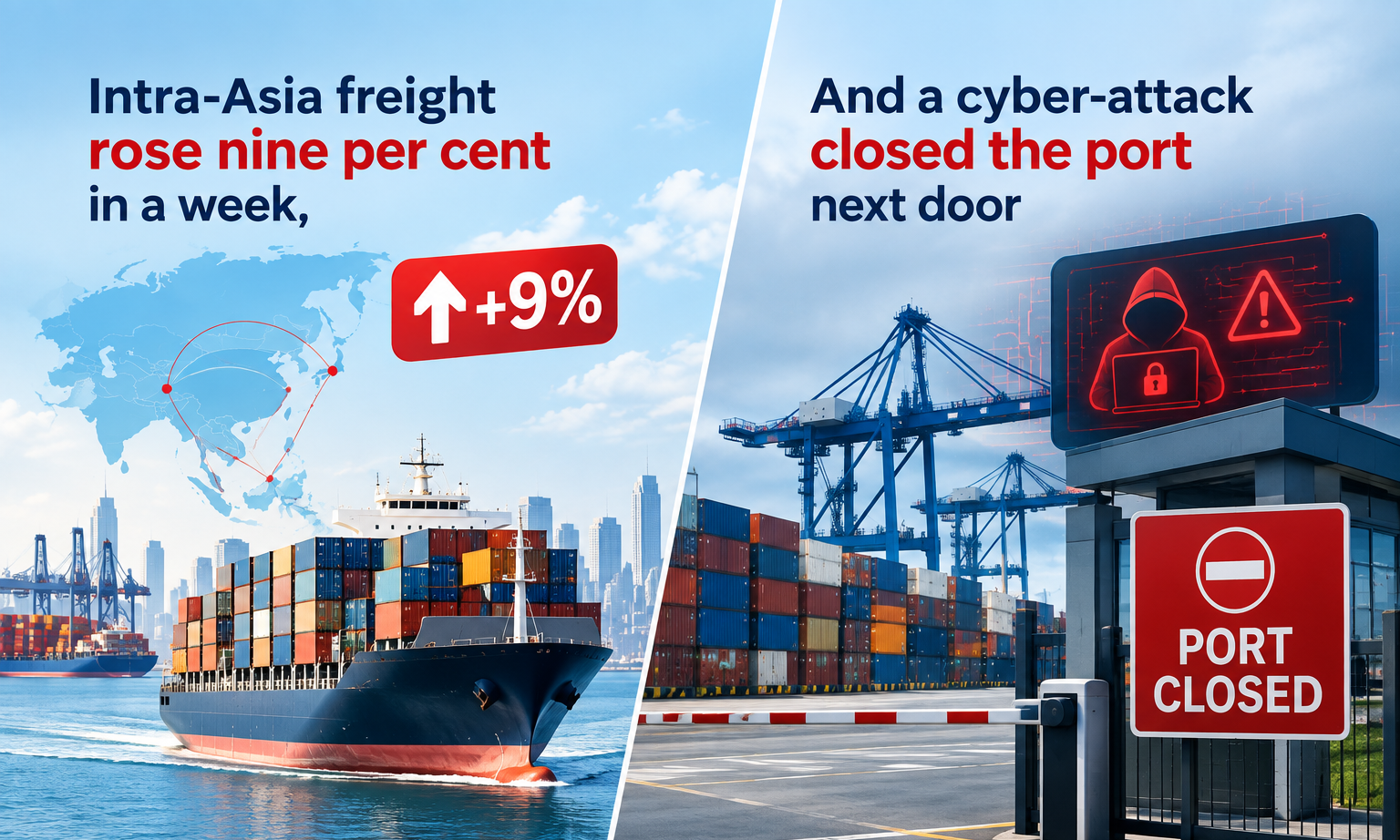
Intra-Asia freight rose nine per cent in a week, and a cyber-attack closed the port next door
Written by

Huan koh
Published on
September 14, 2026

Copy link
Link copied!


Four separate cost increases landed inside seven days, and not one of them was a tariff.
Most traders watch tariffs. Tariffs are announced, dated and argued over in public, so they are easy to watch. But the costs that actually moved in the week to 11 September 2026 arrived by four other routes. Typhoon congestion pushed intra-Asia container rates to a multi-year high. A cyber-attack stopped Malaysia's largest container terminal for about twenty hours. One carrier announced a surcharge of up to ten thousand dollars a box from 1 October. Singapore bunker prices rose for a third straight day. None of these was a policy decision. None was voted on anywhere. Each of them lands on the same landed cost, and a costing model built around tariff risk alone will not see any of them coming.
Typhoons closed two Chinese ports for three days, and the rates have not come back down
The intra-Asia trades are where most ASEAN businesses actually operate, and they have been tightening for over a month. Typhoon Saudel closed Shanghai and Ningbo between 26 and 28 August, following four earlier storms in the same season. The backlog did not clear when the ports reopened, and the rates show it.
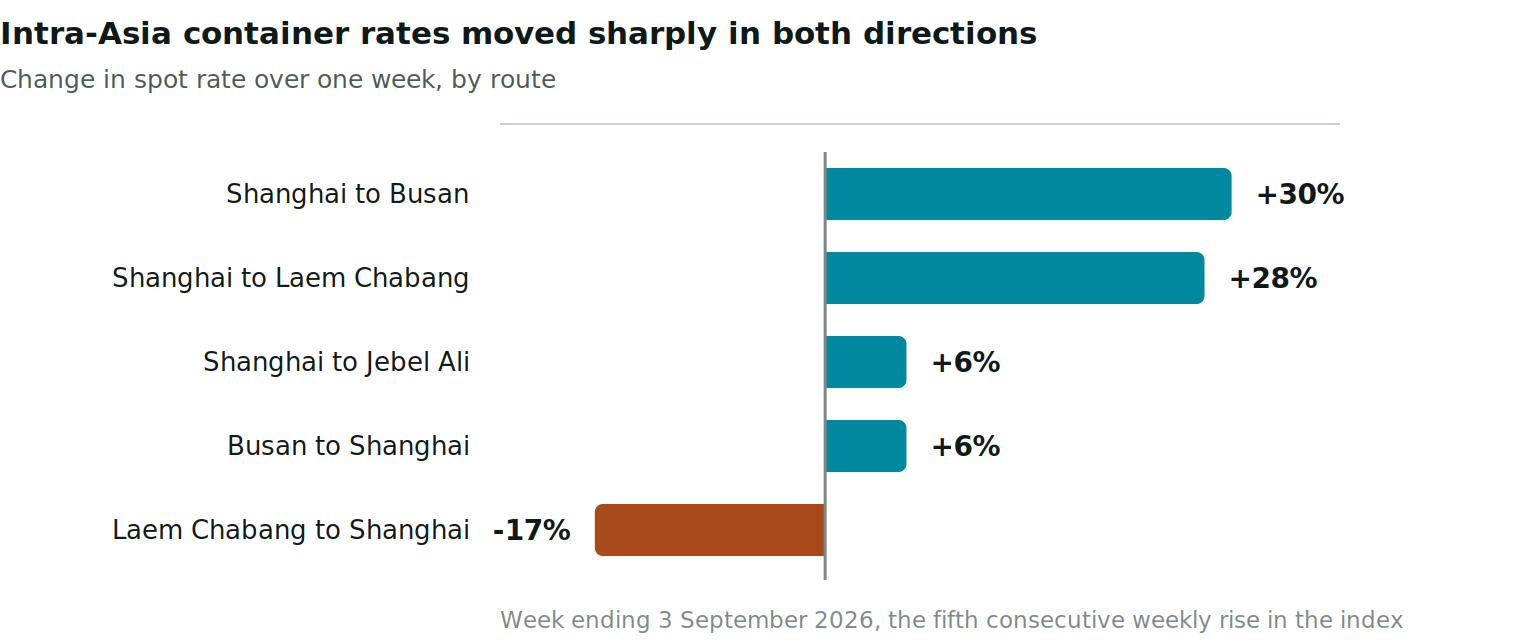
The index rose 9% to US$1,312 for a forty-foot container. That was its fifth consecutive weekly increase. Underneath it the moves were far larger and went both ways. Shanghai to Busan rose 30% to US$925. Shanghai to Laem Chabang rose 28% to US$1,310. Shanghai to Jebel Ali rose 6% to US$8,254. Laem Chabang back to Shanghai fell 17%, to US$194. The outbound legs rose steeply while one return leg fell, which is the signature of congestion rather than of demand. Average vessel waiting times reached 98 hours at Shanghai and 54 hours at Ningbo. Bottlenecks were also reported at Busan, Hong Kong and Singapore. So a box moving through any of those hubs was affected, whether or not it called at a Chinese port.
A cyber-attack stopped Malaysia's largest container port for about twenty hours
The second event was not weather and had no warning at all. At 23:34 local time on Wednesday 9 September, the Port of Tanjung Pelepas detected a cyber-attack and halted container terminal operations. The port is Singapore's nearest transshipment competitor, sitting across the strait in Johor. The Johor port complex handled 15.1 million containers in 2025, with Tanjung Pelepas alone above 14 million.
A phased restart began at 19:30 the following evening, starting with manual processing at the gates. One large vessel, the Maersk Hanoi, deviated for roughly ten hours while inbound through the Strait of Malacca. By the Thursday there were no significant queues and no ships waiting at anchor. The port said there was no evidence that customer data had been accessed. What is worth noting is what did not happen. No source reported cargo diverting to Singapore, and none has since. A twenty-hour outage at a fourteen-million-box port absorbed itself without a visible regional effect. That tells you the system had slack that week. It also tells you what a longer outage would do, because the slack is finite and nobody publishes how much of it is left.
One carrier will add up to ten thousand dollars a container from 1 October
The third cost is the only one of the four that anybody chose deliberately. Weather and cyber-attacks happen to a business. A surcharge is a decision, made by a company, on a date. That makes it the only one of the four you can plan around. On 10 September, CMA CGM announced a peak season surcharge on its Asia to United States trades. It takes effect on 1 October and runs until further notice.
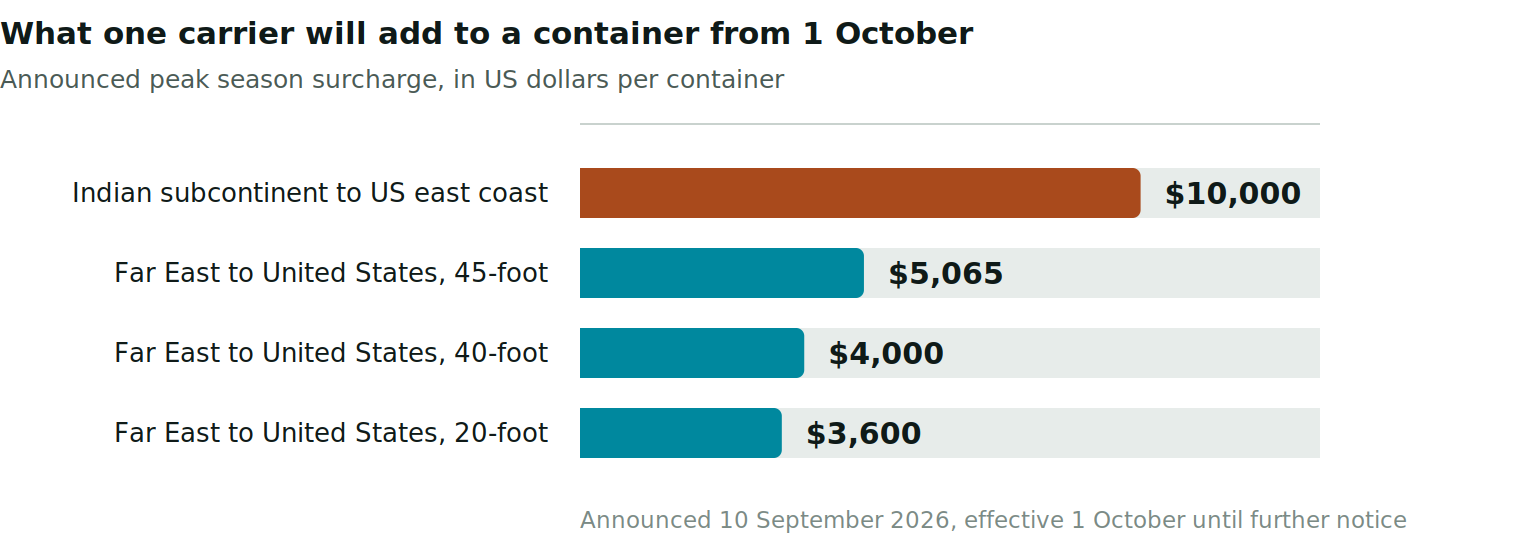
For Far East origins, the surcharge is US$3,600 on a twenty-foot container. It is US$4,000 on a forty-foot and US$5,065 on a forty-five-foot. For the Indian subcontinent and Bangladesh to the United States east and gulf coasts, it is US$10,000 per unit whatever the size. Honolulu and Dutch Harbor are excluded. Two things matter here for a buy-sell operator. The surcharge is announced rather than in force, so there is a window in which cargo can be pulled forward. And it is one carrier's tariff rather than an industry-wide change, so the comparison between carriers is worth running again before October. Carriers were also cancelling sailings that week, eight transpacific voyages against seven the week before, which usually precedes an increase holding rather than collapsing.
America's containers are increasingly arriving from Indonesia, Thailand and Vietnam
The fourth thing that moved was demand, and its shape says more than its total. A strong import month tells an exporter little on its own. What matters is which countries the extra boxes came from. United States container imports reached 2,603,709 containers in August. That was the third-highest month on record, 3.8% above July and 3.3% above August a year earlier.
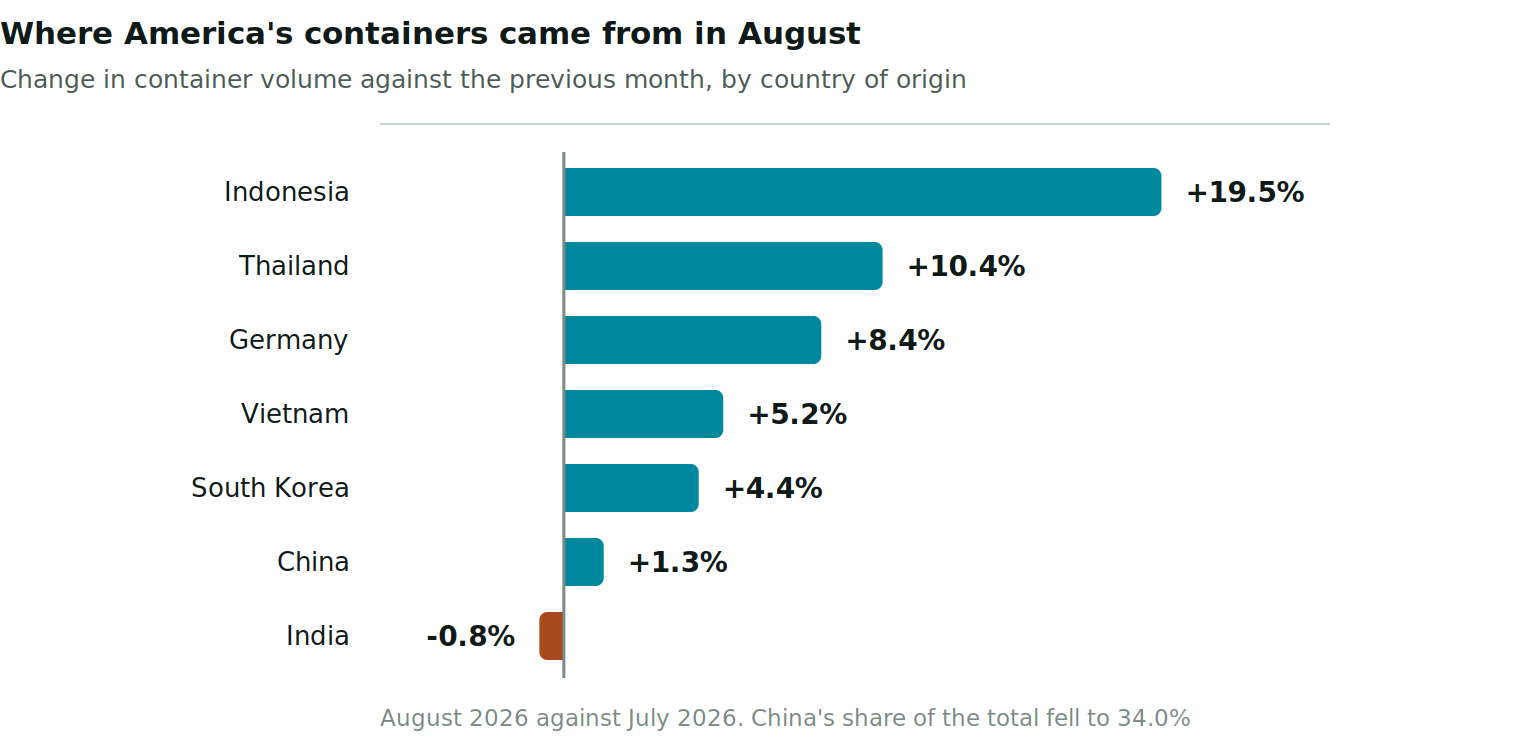
China-origin volume rose 1.3% on the month, to 884,318 containers. Every major ASEAN origin rose faster. Indonesia gained 19.5%, Thailand 10.4% and Vietnam 5.2%. Germany rose 8.4% and South Korea 4.4%. India was the only major origin to fall, by 0.8%. The consequence is that China's share of American container imports fell to 34.0%, from 34.8% in July. That is a small monthly move and part of a much longer one. For a trader with ASEAN manufacturing or ASEAN suppliers, the demand side is going your way at present. That is why the freight cost of serving it deserves attention now, rather than after the fourth quarter has been quoted.
Fuel in Singapore rose for a third straight day, and that reaches every rate eventually
The last of the four is the one furthest upstream, which is why it is the one most often left out of a costing sheet entirely. Bunker fuel is the shipping line's largest variable cost. When it moves, freight rates follow, though never immediately and never evenly across trades.
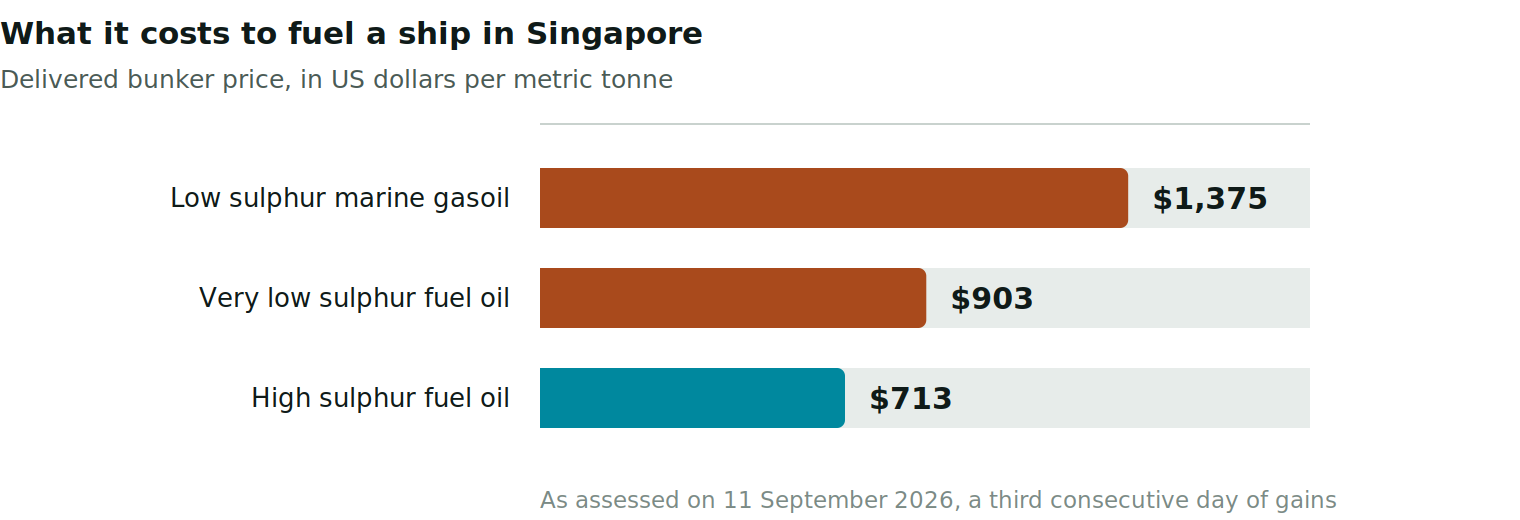
Low sulphur marine gasoil was assessed at US$1,375 a tonne, up US$87 in a day. Very low sulphur fuel oil was US$903, up US$43. High sulphur fuel oil was US$713, up US$54. All three had risen for three consecutive days, the marine gasoil to a multi-month high. One caution is worth stating plainly. A second price reporter assessed the same day's very low sulphur fuel oil at US$878.50. That is a genuine difference in method and timing between assessors, not an error by either. If you index a contract to bunker prices, name the assessor in the contract. Two honest numbers for the same fuel on the same day is exactly the kind of ambiguity that becomes an argument nine months later.
What this means for traders shipping within Asia, traders shipping to America, and anyone with one port in their plan
For a trader moving goods within Asia, the intra-Asia rise will reach you first and is least likely to be in your budget. A 30% move on Shanghai to Busan in one week is not something a quarterly freight assumption survives. Check which of your lanes touch Busan, Hong Kong or Singapore as transshipment points. The congestion was reported at the hubs, so a lane that looks unaffected at both ends may not be. If you quote customers on intra-Asia lanes, shorten your validity periods now. Congestion of this kind unwinds slowly, and five consecutive weekly increases suggests it has not begun.
For a trader shipping into the United States, there is a decision with a date on it. The CMA CGM surcharge takes effect on 1 October. Cargo that moves before then is not subject to it. If you have flexibility on timing, compare the inventory cost of pulling a shipment forward against four thousand dollars a box. Where the inventory cost is lower, move early. Run the comparison across carriers too, since this is one carrier's tariff rather than a market-wide change. The demand backdrop supports the increase holding. Import volumes are near record levels and carriers are removing capacity, so treat this as a real cost.
For anyone whose plan depends on one port, one carrier or one route, the Tanjung Pelepas outage is the one to think about, even though it cost you nothing. A fourteen-million-container port stopped for twenty hours because of something nobody saw coming. The system absorbed it. That is the good outcome. The question worth asking is what your business would have done had the outage lasted a week, and whether you know who to call to find out. Most trading companies cannot name their second port, their second carrier or their second bank. Each of those is a single point of failure that costs nothing to identify and a great deal to discover under pressure.
Our blog
Latest blog posts
Tools and strategies modern teams need to help their companies grow.