Indian tax disputes take twice as long to settle as Singapore’s
Written by

Huan koh
Published on
October 5, 2026

Copy link
Link copied!


On the OECD's 2024 figures a cross-border case took India 46 months to close and Singapore 24. Behind that sit 603,647 appeals and no law setting a deadline to decide any of them. Disputed tax is not an abstraction on a government balance sheet. It is working capital that a business has already earned and cannot use. Where the demand has been paid under protest, the cash has gone. Where it has not been paid, it sits on the balance sheet as a contingent liability that auditors, lenders and acquirers all have to price. India publishes the size of that pool only when Parliament asks. The most recent answer put the total under appeal at more than ₹26 lakh crore as at 31 March 2025, across 603,647 pending appeals. That figure is the sum of the four forum-by-forum numbers given in the answer. It is not a total the government itself printed, and it is worth saying so. Singapore's revenue authority does not publish a comparable number, because there is no comparable backlog to report. What it publishes instead is an arrears rate of 0.66% across income tax, goods and services tax and property tax combined. The two measures are not the same thing and should not be set against each other. What they do show is which problem each administration considers worth counting.
India had 603,647 tax appeals pending at the end of March 2025
The amount under dispute has moved within a band rather than climbing steadily. It stood at ₹30.23 lakh crore at the end of the 2020-21 financial year. It fell sharply the following year and has climbed back since. The 2021-22 fall came almost entirely from the first appellate stage. The parliamentary answer does not explain it. It is better treated as an open question than as evidence of progress.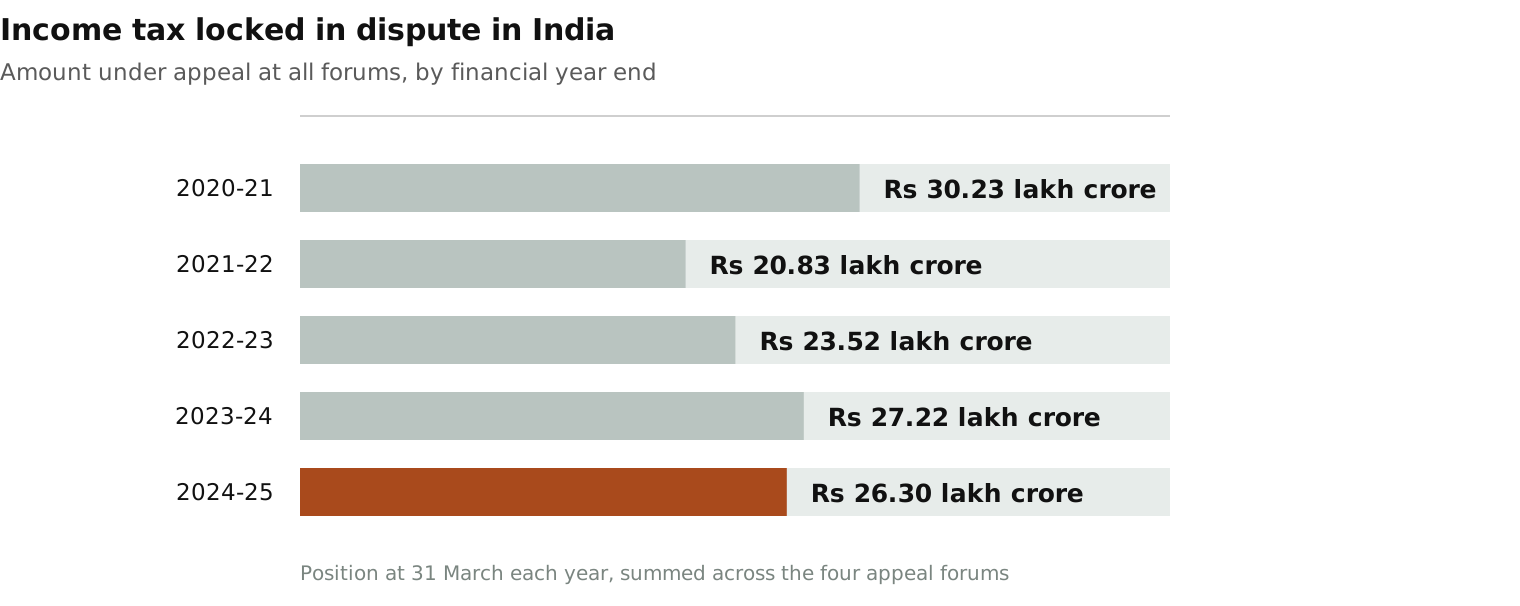 One component has moved in a single direction. The value of disputes before the High Courts was about ₹2.75 lakh crore at the end of March 2021. Four years later it was about ₹5.65 lakh crore. That is a doubling at the slowest and most expensive forum in the system. A matter that reaches a High Court has already passed through two earlier stages.
The flow figures published since then show why the stock does not fall. In the 2025-26 financial year the department disposed of 2.24 lakh first appeals and received 1.79 lakh new ones. First-stage pendency therefore ended the year at roughly 5.4 lakh, almost exactly where it stood five years earlier. The Finance Minister said at the time that the pace of clearing appeals had to match the pace of new filings. That is a fair description of the problem.
Nine in ten appeals sit at the first stage, and no law says when they must be decided
The distribution of the backlog matters more than its size, because the two measures point in different directions. The first appellate stage holds 89.4% of all pending appeals but 63.7% of the money. The High Courts hold 5.7% of the appeals and 21.5% of the money.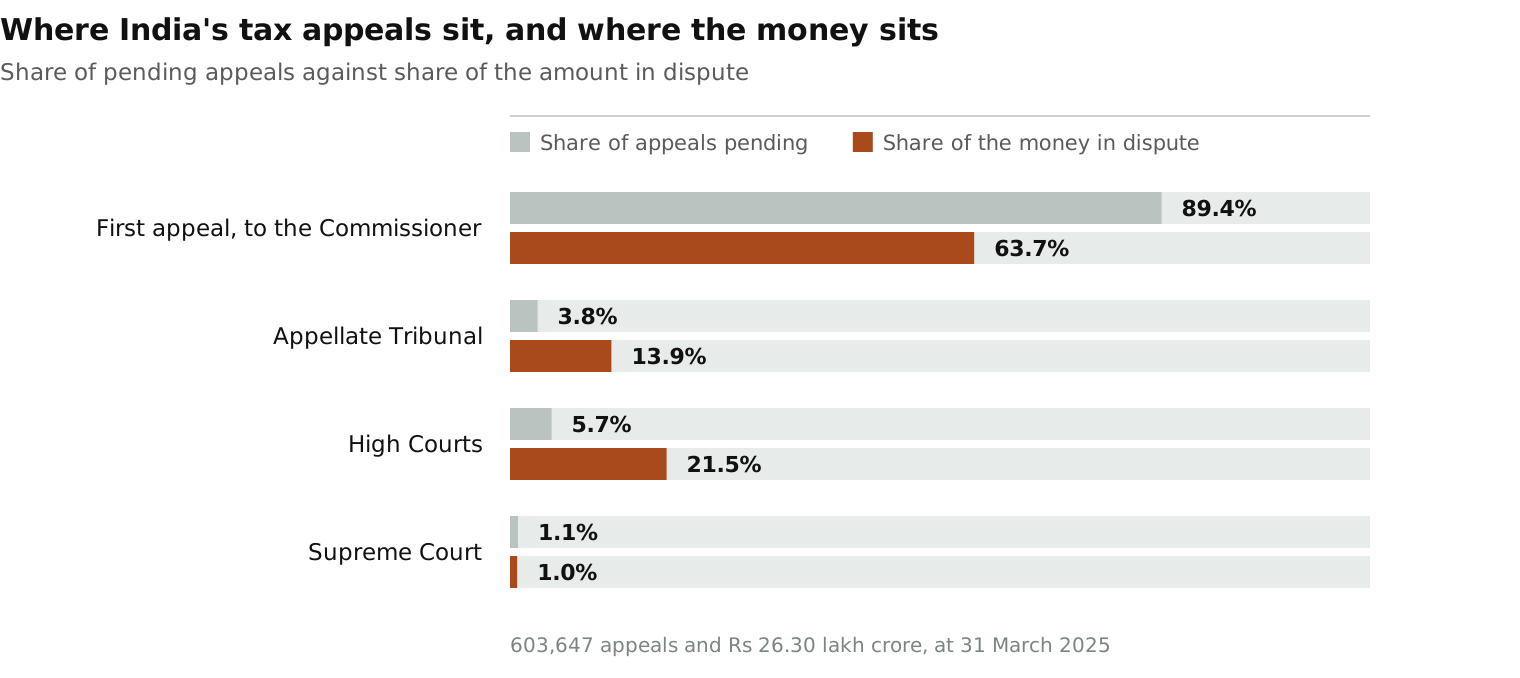 That split tells a business two different things. A large number of small disputes are queued at the first stage, where the decision is taken by a tax officer rather than a tribunal. A smaller number of much larger disputes have escalated into the courts, where they will take years and cost legal fees throughout.
No official figure exists for how long any of this takes. India publishes pendency and amounts, not durations. The Board sets internal disposal targets per officer, and those are not published either. Any average disposal time in circulation is a practitioner's estimate rather than a measurement, and it should be treated as such. The defensible calculation is simpler. At the 2025-26 rate of disposal, clearing the standing first-stage pendency would take about two and a half years. That assumes not one new appeal is filed. In fact 1.79 lakh were.
The one like-for-like measure puts India at twice Singapore's time
There is one place where India and Singapore are measured on the same basis, by the same body, in the same year. The OECD publishes how long each country takes to close a mutual agreement procedure case. That is the mechanism used when two tax authorities both claim the same profit. For a business with cross-border transactions, this is the dispute that actually bites.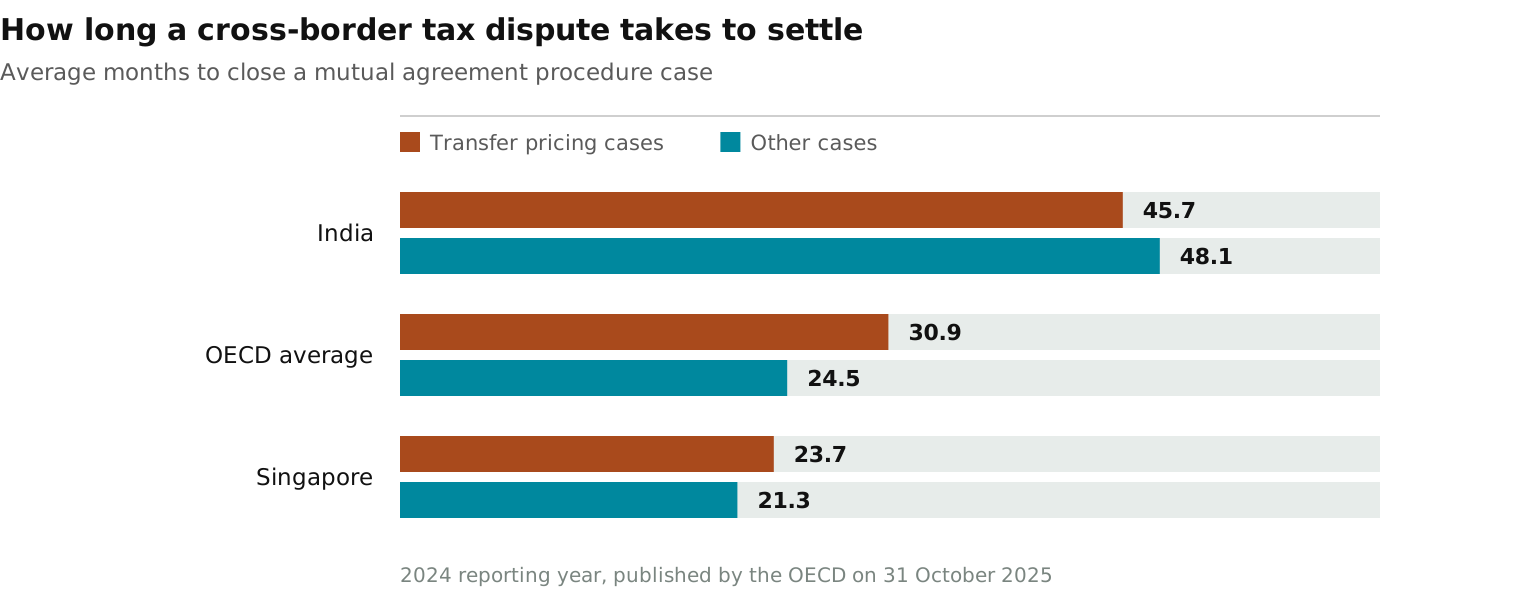 On the 2024 figures a transfer pricing case took India an average of 45.73 months to close and Singapore 23.65 months. India sits 48% above the OECD average of 30.9 months, and Singapore sits 23% below it. On cases other than transfer pricing the gap is wider still, at 48.07 months against 21.34.
India's position also moved in the wrong direction. In 2023 the same measure stood at 35.78 months for transfer pricing and 33.89 for other cases. One year later both had risen by roughly ten and fourteen months respectively. That is a deterioration on the OECD's own numbers, and it happened while the inventory of cases was falling.
India's biggest tax amnesty cleared under a tenth of the money
India has twice offered to settle disputed tax at a discount, in 2020 and again in 2024. The 2020 scheme has now been audited by the Comptroller and Auditor General. That audited result is the most reliable measure available of how much of the backlog can actually be settled. It records what was offered, what was taken up and what was collected.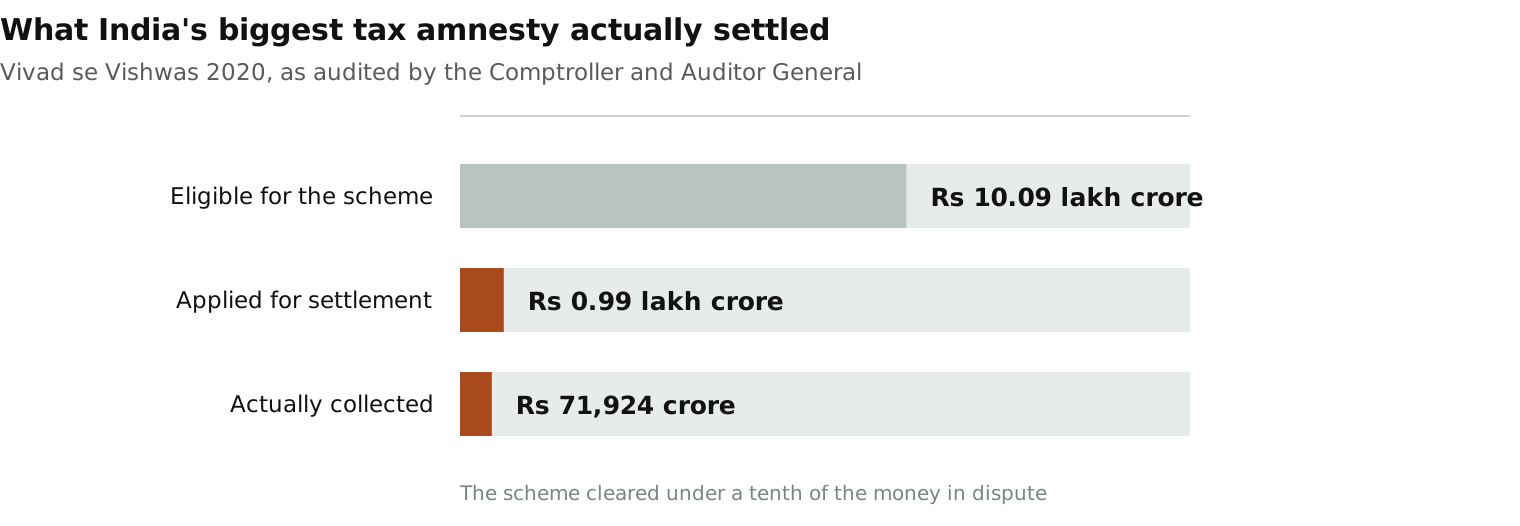 Some 4.15 lakh cases covering ₹10.09 lakh crore were eligible. Applications came in for 1.32 lakh of them, covering ₹0.99 lakh crore, which is 9.8% of the money. Of the amount applied for, ₹71,924 crore was actually collected after interest and penalties were waived. The rest fell away. A scheme designed to clear the backlog therefore moved under a tenth of it.
A second scheme opened on 1 October 2024 on similar terms. No figure for declarations filed, disputes settled or revenue collected has been published in the two years since. No successor scheme was announced in the 2026 Budget. Any claim about what the 2024 scheme achieved should be treated as unsourced until the department publishes the result.
India pays 6% on refunds it delays and charges 12% on demands a business disputes
The asymmetry in interest rates is statutory, small and rarely mentioned. Where India holds money it should have refunded, it pays simple interest at half a per cent a month, which is 6% a year. Where a business has not paid a demand it is contesting, India charges 1% a month, which is 12% a year. The volumes behind that are substantial. For the 2025-26 assessment year, 8.80 crore returns had been filed by early February 2026. Of those, 24.64 lakh had been pending processing for more than ninety days. The department reported better figures by July 2026, with about 1.47 lakh refund cases outstanding against 3.82 crore verified refund claims. No official figure exists for the rupee value of delayed refunds or for their age profile, which is itself worth noting. For a business, the practical effect is that disputed tax is financed at an unfavourable spread in both directions. Money the department owes earns 6% a year. Money the business owes but disputes costs 12% a year. Neither rate reflects what the business actually pays for working capital, and neither is negotiable.The new Income-tax Act left the appeal system almost exactly as it was
The Income-tax Act 2025 came into force on 1 April 2026 and replaced legislation that had stood since 1961. On dispute resolution it changed almost nothing of substance. The ladder runs from the assessing officer to the Commissioner, then the Appellate Tribunal, then the High Court and the Supreme Court, exactly as before. Sections were renumbered and powers were carried across. Two points matter more than the renumbering. No statutory time limit was introduced for deciding a first appeal, which was the single most requested reform and did not happen. The transition provisions also keep every appeal pending on 1 April 2026 under the old Act. The entire backlog of 603,647 appeals is therefore litigated under legislation that has been replaced. The Dispute Resolution Committee was carried over without change, including its thresholds. It is available only where the disputed variation is under ₹10 lakh and the returned income is under ₹50 lakh. Those limits keep it confined to very small matters, so it is not a route for a corporate dispute of any size.Budget 2026 halved the deposit required to contest an assessment
The Finance Act 2026, which received assent on 30 March 2026, made one change that is commercially significant. The deposit required before appealing fell from 20% to 10% of the demand. It is now computed on the core tax rather than on the grossed-up amount. For a business contesting a large assessment, that halves the cash it must hand over to be heard. Two smaller measures help as well. Assessment and penalty proceedings are now dealt with in a single common order rather than separately. The government justified that on the grounds that multiple proceedings hinder doing business. And no interest runs on a penalty amount while a first appeal is pending, whatever the eventual outcome. The department has also become more selective about its own appeals. Monetary thresholds set in September 2024 stop it appealing below ₹60 lakh at the Tribunal. The limits are ₹2 crore at a High Court and ₹5 crore at the Supreme Court. The Supreme Court disposed of 573 direct tax cases that fell below the new limit, and about 6,000 departmental appeals were withdrawn in the 2025-26 financial year. The last official measurement of how often the department won was published in the Economic Survey of January 2018, on data from 2011 to 2015. It put the success rate below 30%.An Indian advance ruling binds neither side. A Singapore ruling binds the revenue.
The cleanest contrast between the two systems is not about speed at all. It is about whether a business can fix its tax position in advance and rely on the answer. India and Singapore both offer a procedure for that, and only one of them produces a result anybody is bound by.| India | Singapore | |
|---|---|---|
| Appeals pending at the first stage | 539,863 at 31 March 2025 | Not published, and no backlog is reported |
| Time limit to decide a first objection or appeal | None in law | Six months, as a published service standard |
| Deposit required to contest an assessment | 10% of the core tax demand, from 2026 | None |
| Does an advance ruling bind the revenue authority | No | Yes |
| Months to close a cross-border transfer pricing case | 45-7 | 23-7 |
| What the revenue authority reports publicly | Disputed tax, when Parliament asks for it | An arrears rate of 0.66% |
India's advance pricing programme is its success story, and it still takes three to four years
The fair comparison concedes what India does well. Its advance pricing agreement programme has grown steadily and now operates at record volume. It signed 174 agreements in the 2024-25 financial year and 219 in 2025-26, taking the cumulative total past a thousand. Singapore is among the countries with which India concludes bilateral agreements, so the route exists for exactly the structure this article describes. The times are the qualification. A unilateral agreement took an average of 42.84 months to conclude in 2024-25, and a bilateral agreement 50.18 months. Both are slower than the global average of 39.6 months for advance pricing agreements. The 2026 Budget set a target of two years for a fast-tracked unilateral agreement for information technology services companies, which would roughly halve the current average. That is an enacted target rather than an achieved outcome, and it should be read as one. Set against a Singapore advance ruling, which is measured in weeks and binds the revenue, the comparison is not close. But a business with substantial Indian transfer pricing exposure should use the Indian programme rather than avoid it. Certainty obtained in three years is still better than a dispute that runs for ten.What this means for businesses with a demand outstanding, groups with cross-border transactions, and finance teams planning ahead
For a business with an Indian assessment outstanding, the arithmetic changed in March 2026 and is worth redoing. The deposit required to appeal is now 10% of the core tax rather than 20% of a larger base, which changes the cash cost of contesting. Against that, there is still no deadline by which the first appeal must be decided. The money deposited earns 6% a year if the business eventually wins. Deciding whether to contest or settle is a financing decision as much as a legal one. For a group with cross-border transactions between India and the region, the mutual agreement procedure figures are the ones to plan around. On the most recent published data, a transfer pricing case takes an average of forty-six months to close. That average has been getting worse rather than better. The same transaction can often be arranged so the counterparty sits in a country that closes cases in half the time. The exposure is halved with it. For a finance team planning ahead, the useful distinction is between countries where a position can be fixed in advance and countries where it cannot. Singapore's binding advance ruling removes the question before it becomes a dispute. India's non-binding ruling does not, and the body issuing them is currently explaining itself to a High Court. A business able to place a transaction on the side of the border where certainty is available should price that advantage properly. The alternative is measured in years rather than in fees.Our blog
Latest blog posts
Tools and strategies modern teams need to help their companies grow.