Why Indian exporters are taking their contract disputes to Singapore
Written by

Huan koh
Published on
October 5, 2026

Copy link
Link copied!


Indian parties were the third-largest group at Singapore's arbitration centre in 2025. India's own courts held 5.6 crore pending cases in March 2026. An engineering components manufacturer in Pune ships to a distributor in Jakarta. The order is worth about US$1.4 million and the goods were accepted without complaint. Four months later the distributor has paid 30% and stopped. The contract was drafted by the manufacturer's own lawyers, it is governed by Indian law, and it gives jurisdiction to the courts at Pune. The scenario is a composite rather than a client, and the contract terms are the ones most Indian exporters actually use. Those two clauses are where the money is decided. A dispute governed by Indian law and heard in an Indian court must take its place in a system holding more than five crore pending cases. The same dispute, written to be arbitrated in Singapore, runs to a published timetable. It produces an award that is enforceable in India under a treaty both countries have signed. The choice costs nothing to make at the drafting stage. It costs years to change afterwards, because the counterparty has no reason to agree to a new dispute clause once it is the one holding the money. By the time the first invoice goes unpaid, the terms are already fixed. Everything that follows is decided by two sentences written when both sides were still friendly.
Indian courts held 5.6 crore cases pending in March 2026
The official figures come from a parliamentary answer rather than from an estimate. As at 9 March 2026, the Supreme Court had 92,755 matters pending. The twenty-five High Courts held 63,61,340 between them. The district and subordinate courts held 4,95,62,229. The three levels together came to 5,60,16,324 cases. Those totals cover every kind of case, and the data does not separate commercial matters from the rest. India publishes a civil and criminal split but no commercial category, so any figure claiming to isolate commercial suits should be treated carefully. What the national dashboard does publish is the age of what is waiting, and that is the more useful measure for a business deciding where to litigate.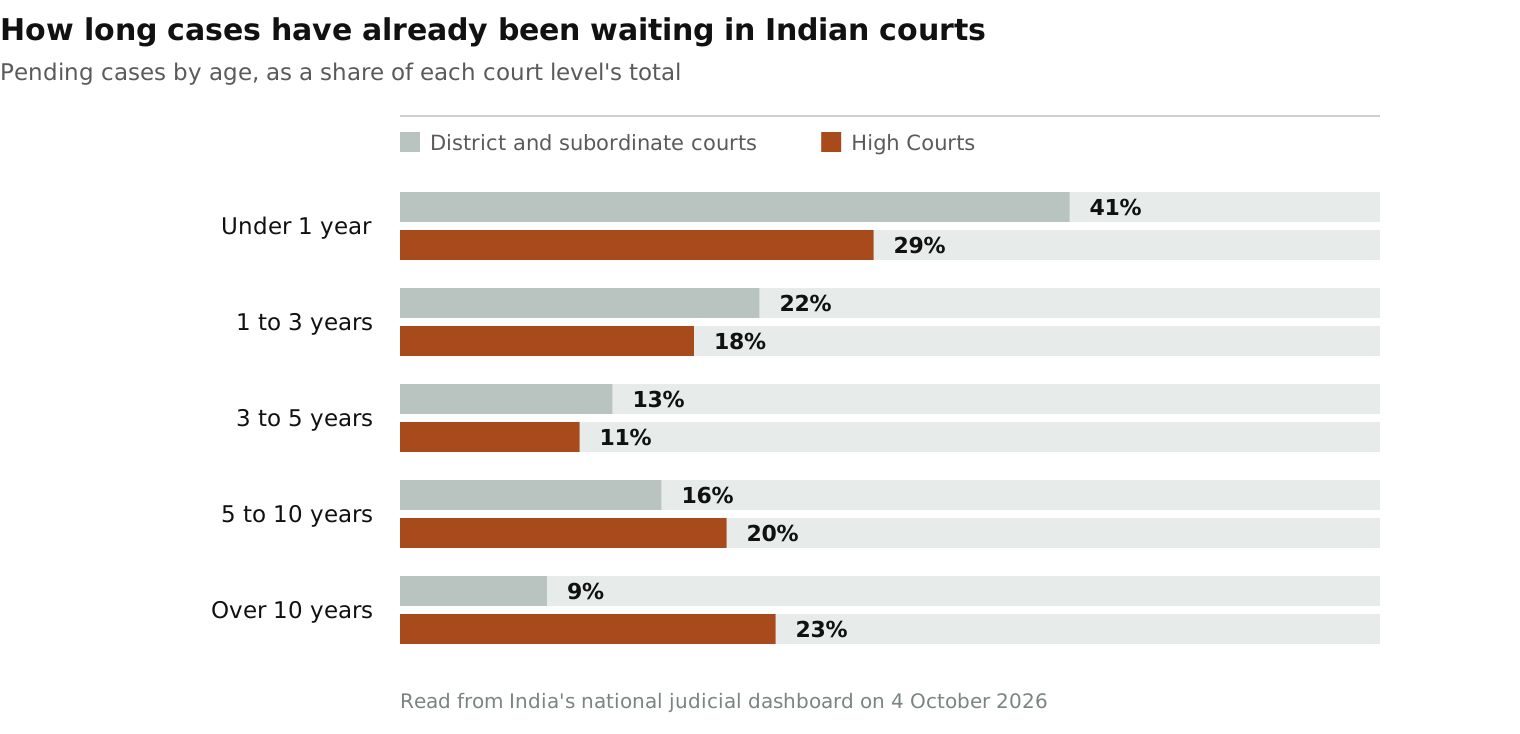 A quarter of everything pending in the district courts has already been there more than five years, and 9% for more than ten. The High Courts are worse on both counts. Forty-three per cent of their pending cases are over five years old and 23% are over ten. Those are the courts an appeal reaches. A commercial matter that is appealed therefore enters a queue where almost a quarter of the cases have been waiting more than ten years.
India requires mediation before a commercial suit, and it settles under 2% of applications
The Commercial Courts Act of 2015 requires a party to attempt mediation before filing a commercial suit, unless urgent interim relief is needed. The process is given three months, extendable by two with consent. On paper it is a sensible filter that keeps straightforward claims out of court. The government publishes what it actually achieves, and the figures are not encouraging. Since the scheme began in July 2018, 2,76,676 applications have been made. Of those, 2,30,751 were recorded as non-starters, which means the other side did not engage at all. Settlements came to 4,854, which is 1.75% of applications made.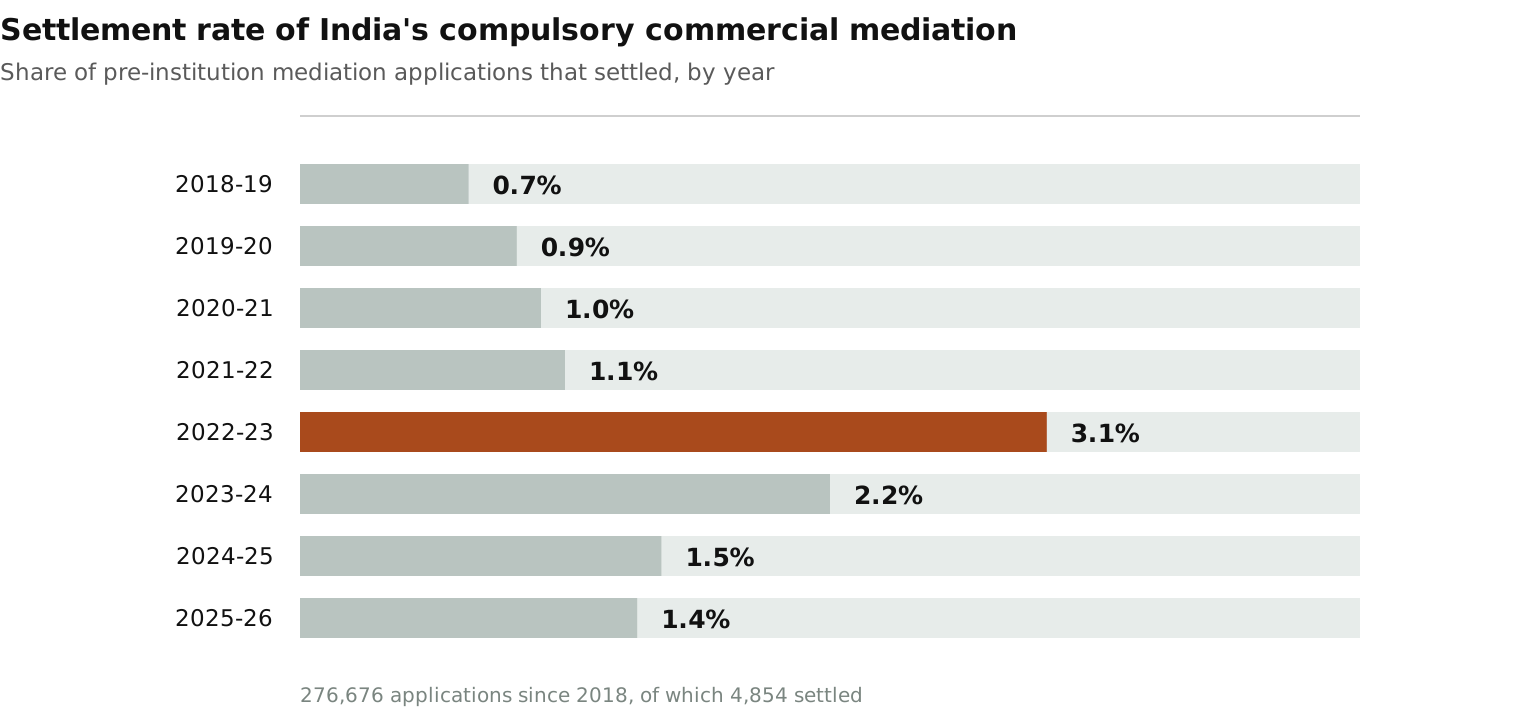 The rate has never exceeded 3.1% in any year and has fallen in each of the last three. For the Pune manufacturer this is a three-month delay with a 98% chance of changing nothing. The distributor in Jakarta has every incentive to be one of the non-starters. The step has to be taken anyway, because a suit filed without it can be rejected.
The Commercial Courts Act sets a timetable, and no official data shows it being met
The Act does set real deadlines, and they are not unreasonable. A written defence must be filed within 120 days of service, after which the right to file one is lost. Arguments must close within six months of the first case management hearing. Judgment is due within ninety days of the close of arguments. An appeal must be filed within sixty days, and the appellate court is to endeavour to decide it within six months. Whether any of that happens is not something India measures. No official average or median disposal time is published for commercial courts at any level. The only government-commissioned evaluation of the Act covered two states and used data ending in June 2021. It reported disposal rates of 0% in one of them and 11% in the other. It published no national timing figure at all. The best available measurement comes from outside government. Two researchers examined the lifecycle of suits filed at the Bombay High Court between 2017 and 2024. They found a median of 1,580 days for commercial suits, against 1,117 days for ordinary ones. Commercial suits, in other words, took more than a year longer than the cases the specialist procedure was meant to improve on. The same work found that 40% of commercial cases had no hearing within three months of filing, and that close to half of all hearings were adjournments. That is one court and one research team rather than an official series, and it should be read as such. There is no current international benchmark either. The World Bank discontinued the survey that used to produce a days-to-enforce-a-contract figure for India in 2021, and its replacement has not yet covered India. Any number in circulation purporting to measure this traces back to data gathered more than ten years ago.A Singapore-seated arbitration runs to a published timetable
The alternative is not a different court. It is a different mechanism altogether, agreed in the contract before anything goes wrong, with its own rules and its own clock. The parties appoint the tribunal, the institution administers the timetable, and no queue has to be joined. The table below sets the two routes against each other on the stages that take the time.| Stage | Indian commercial suit | Singapore-seated arbitration |
|---|---|---|
| Before the claim can be brought | Mediation, three months, extendable by two | None required |
| Written defence | 120 days from service, after which the right is lost | Set by the tribunal at the first case conference |
| Urgent protective relief | A separate application to the court | Emergency arbitrator appointed within 24 hours, decision within 14 days |
| Close of arguments | Within six months of the first case management hearing | Fixed by the tribunal within the overall time limit |
| Decision | Judgment within 90 days of the close of arguments | Three months from the tribunal being constituted on the streamlined procedure, six on the expedited one |
| What the measurements show | Median 1,580 days at one High Court, 2017 to 2024 | Median 117 months to award, on a study published in 2016 |
| Challenge | Appeal within 60 days, then a further process | Limited grounds only, decided by the Singapore courts |
Indian parties have been among the top three users of Singapore arbitration for a decade
This is not a structure being proposed to Indian businesses for the first time. It is one they already use in large numbers, and the figures come from the arbitration centre's own annual report rather than from anybody's marketing material.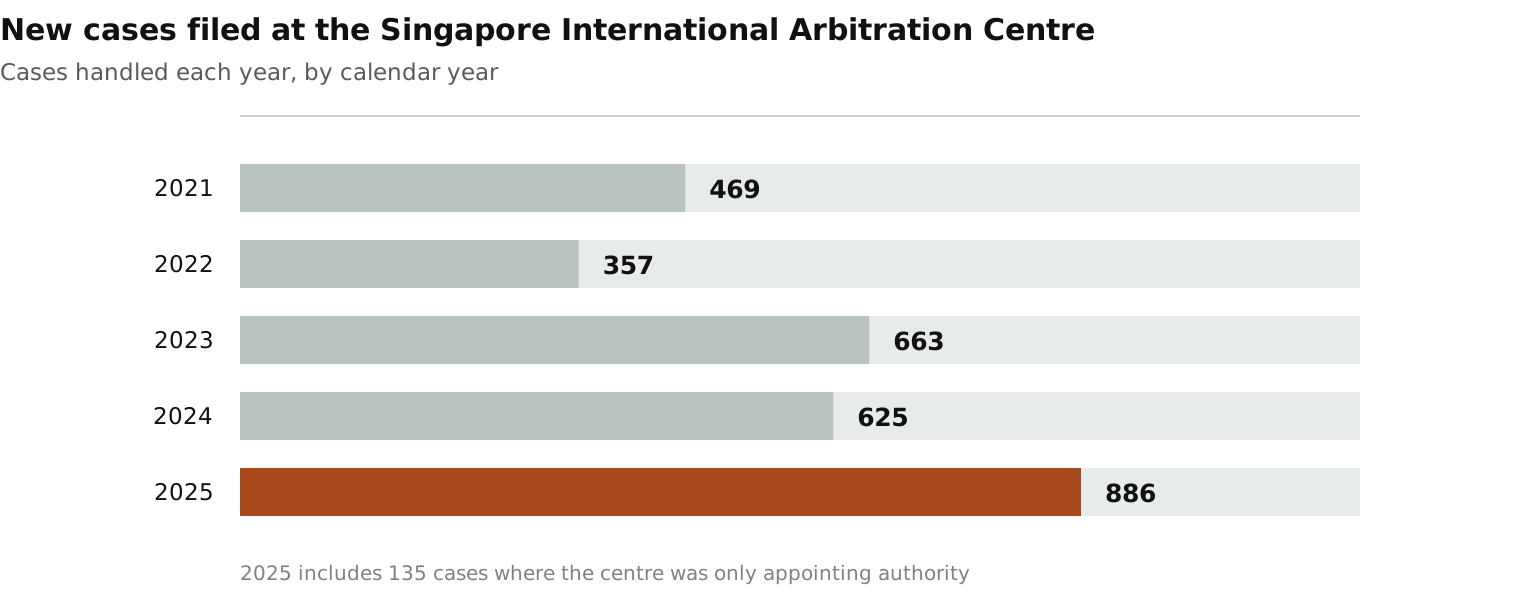 The centre handled 886 new cases in 2025, its second highest on record, with a total sum in dispute of US$14.53 billion. Parties came from 79 jurisdictions and 89% of cases were international. The figure includes 135 matters in which the centre acted only as appointing authority, so the administered caseload was 737.
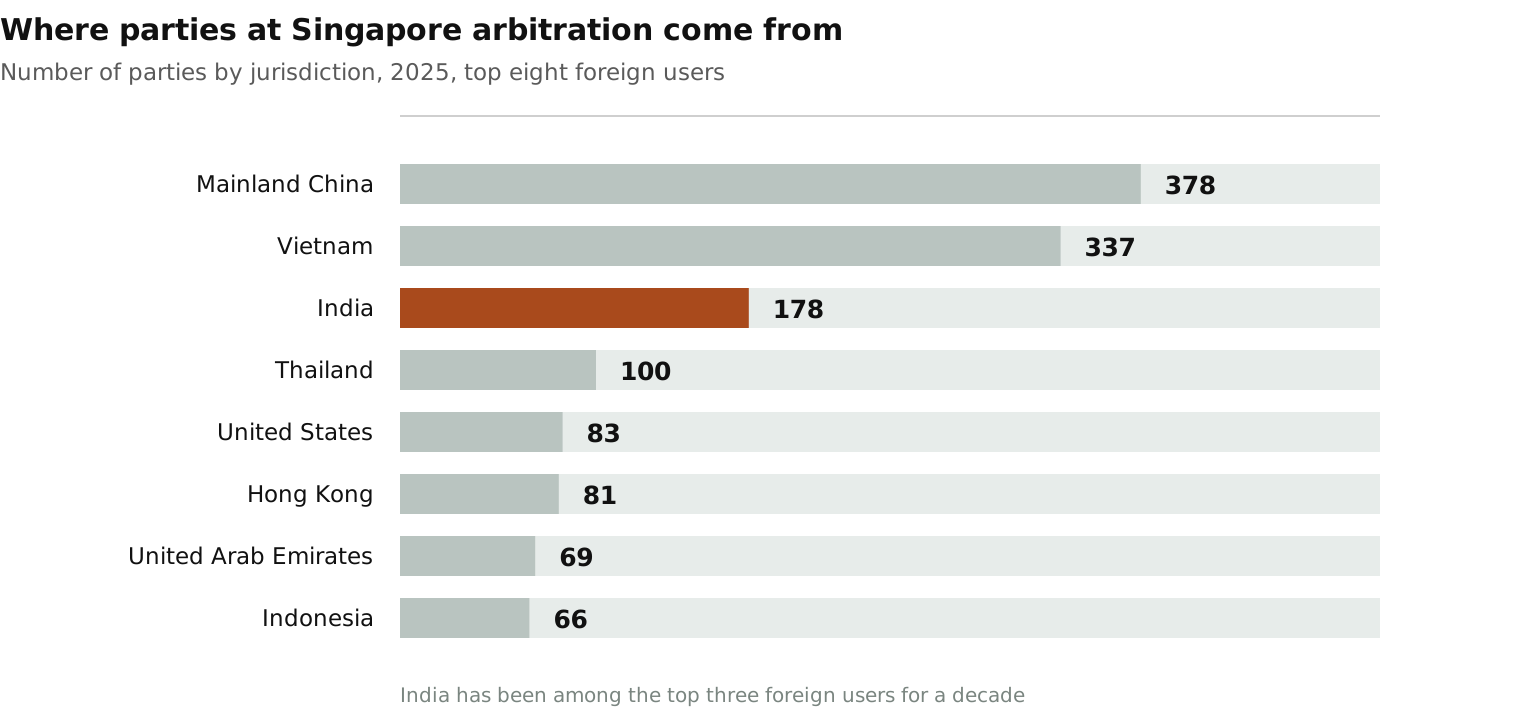 India supplied 178 parties in 2025, placing it third behind mainland China and Vietnam. It was the largest single foreign user in both 2021 and 2022. The centre's own president said in July 2026 that Indian parties had consistently remained among the top three over the past decade. Indian law was the third most frequently applied governing law in 2025. Indian arbitrators were the third most appointed, and four members of the centre's court are from India. A liaison office opened in Delhi on 25 July 2026.
The practical point for a drafting lawyer is that none of this is exotic. An Indian company naming Singapore as the seat is doing what hundreds of Indian companies did last year. Indian counsel appear there regularly and Indian law is routinely applied.
A Singapore award is enforceable in India, and the Supreme Court narrowed the defences in March 2026
An award is only as good as the enforcement behind it. India is a party to the New York Convention and applies it on a reciprocal basis. An award qualifies only if it was made in a country India has notified. India notified Singapore by a notification dated 6 July 1999, so a Singapore award is enforceable in India as a matter of course. The grounds for resisting enforcement were narrowed on 25 March 2026. The Supreme Court held that an argument already lost before the courts at the seat cannot be reopened in India. A party cannot revive it by relabelling it a public policy objection. Public policy itself remains available, and issues that genuinely turn on Indian law still fall to Indian courts. What the decision removes is the second bite, which was the most common delaying tactic. A second decision, on 15 April 2026, confirmed that naming a seat fixes which country's courts supervise the arbitration, and that naming a venue alone does not. For an Indian contract that is the difference between a Singapore clause that works and one that produces a jurisdictional fight before the merits are reached. The drafting distinction is a single word, and it decides which court hears every application.Two long-running enforcement sagas show the worst case, and they are not typical
Honesty requires the counter-examples, because they are well known and a sceptical reader will raise them. Daiichi Sankyo obtained a Singapore-seated award of roughly ₹3,500 crore on 29 April 2016. The Delhi High Court allowed enforcement on 1 February 2018. As at 29 September 2026 the award was still being executed, more than ten years after it was made, with only a small fraction recovered. Avitel followed a similar course. The arbitration centre issued its final award on 27 September 2014. The Bombay High Court decided the enforcement proceedings on 25 April 2023, and the Supreme Court confirmed the position on 4 March 2024. That is nine and a half years from award to final confirmation. Both are among the most heavily contested enforcement proceedings in Indian legal history and neither is a typical outcome. India publishes no average time to enforce a foreign award, so no honest claim about the normal case can be made. What can be said is that these were the hardest fought examples of their kind. The 2026 Supreme Court decision removes one of the tactics used in them. And an award debtor with assets outside India can often be pursued somewhere the dispute is not reheard at all.What India has announced and not yet done
Three items on the Indian side are worth knowing, because they are regularly described to clients as having already happened. All three are announcements rather than law, and the gap between the two is years rather than months. The Arbitration Council of India, authorised by an amendment passed in 2019, has still not been constituted. The Ministry of Law and Justice confirmed this in a statement on 6 February 2026, seven years after the enabling provision. A draft Arbitration and Conciliation Amendment Bill was released for consultation on 18 October 2024, proposing emergency arbitrator recognition and an appellate arbitral tribunal. It has never been introduced in Parliament, and a 2026 session list confirms it was not introduced that year either. India signed the Singapore Convention on Mediation on 7 August 2019, the day it opened, and has not ratified it. Singapore ratified on 25 February 2020 and the Convention entered into force on 12 September 2020. A mediated settlement reached in a cross-border dispute is therefore directly enforceable in Singapore and not in India. India did establish a Mediation Council of India on 27 August 2026 under its own domestic legislation. That is a real step, but it does not change the Convention position. None of this means Indian arbitration does not work. It means the reforms most often cited as evidence of improvement are still drafts. A contract signed today has to work under the law as it stands rather than as it has been proposed.What this means for exporters drafting contracts, businesses already in dispute, and groups selling across the region
For an exporter drafting a contract, the dispute clause is the cheapest clause to get right and the most expensive to get wrong. Naming Singapore as the seat, selecting institutional rules and choosing the governing law deliberately costs nothing at signature. The same change after a dispute has started requires the agreement of the party holding the money, which will not be given. Where the counterparty resists a Singapore seat, that resistance is itself information about how they expect the relationship to end. For a business already in dispute under an Indian jurisdiction clause, the realistic question is about settlement value rather than about forum. The compulsory mediation step produces a settlement in under 2% of cases and will not help. The timetable in the Commercial Courts Act is real but unmeasured. The only published lifecycle study found a median of more than four years at one High Court. A claim worth pursuing should be priced with that duration and the cost of funds over it. The number that produces will often make an early commercial settlement look better than it did. For a group selling across the region, the structural answer is to move the contracting party rather than only the clause. Where the Singapore company signs the regional customers, the contract is naturally Singapore law with a Singapore seat, and the dispute never touches the Indian system. That is the same arrangement that puts regional revenue and regional staff in Singapore for commercial reasons. The dispute resolution advantage comes with it rather than being bought separately.Our blog
Latest blog posts
Tools and strategies modern teams need to help their companies grow.