Where the UAE’s nine per cent rate applies, and where it becomes fifteen
Written by

Huan koh
Published on
October 19, 2026

Copy link
Link copied!


The UAE taxes most companies at nine per cent and large groups at fifteen. Its small business exemption now runs to 2029, and almost every published summary still gives the old date. The United Arab Emirates introduced corporate tax for financial years beginning on or after 1 June 2023. For a company on a calendar year, the first taxed period was therefore the year ended 31 December 2024 rather than 2023. The rate is nil on the first AED 375,000 of taxable income and nine per cent above it. That is a profit threshold rather than a revenue one. Two things about the regime are routinely misstated, and both move the answer. The first is that the UAE is tax free, which it has not been for more than two years. The second is that free zone companies are exempt, which is not what the law says either. Free zone treatment is a conditional nil rate on defined categories of income, and it can be lost for five tax periods at a time. There is also a change that most published summaries have not caught up with. Small Business Relief gives full relief where revenue does not exceed AED 3 million. Its expiry was extended from 31 December 2026 to 31 December 2029 by a ministerial decision issued on 29 July 2026. A great deal of advice written before August 2026 assumes the relief is about to lapse. It is not. This article sets out what the UAE regime actually charges and where it stops being nine per cent. It then compares the two jurisdictions on each point that matters. Where the UAE is better, that is said plainly, because a comparison written any other way is not worth reading.
Nine per cent is the headline, and the effective rate is lower
The nil band below AED 375,000 pulls the effective rate well under the headline. It does so across the range that most owner-managed businesses occupy. A comparison of headline rates therefore overstates the gap at the small end and understates it at the large end. Both comparisons are set out below, because the headline figure is what gets quoted and the effective figure is what gets paid. Neither is the whole answer on its own.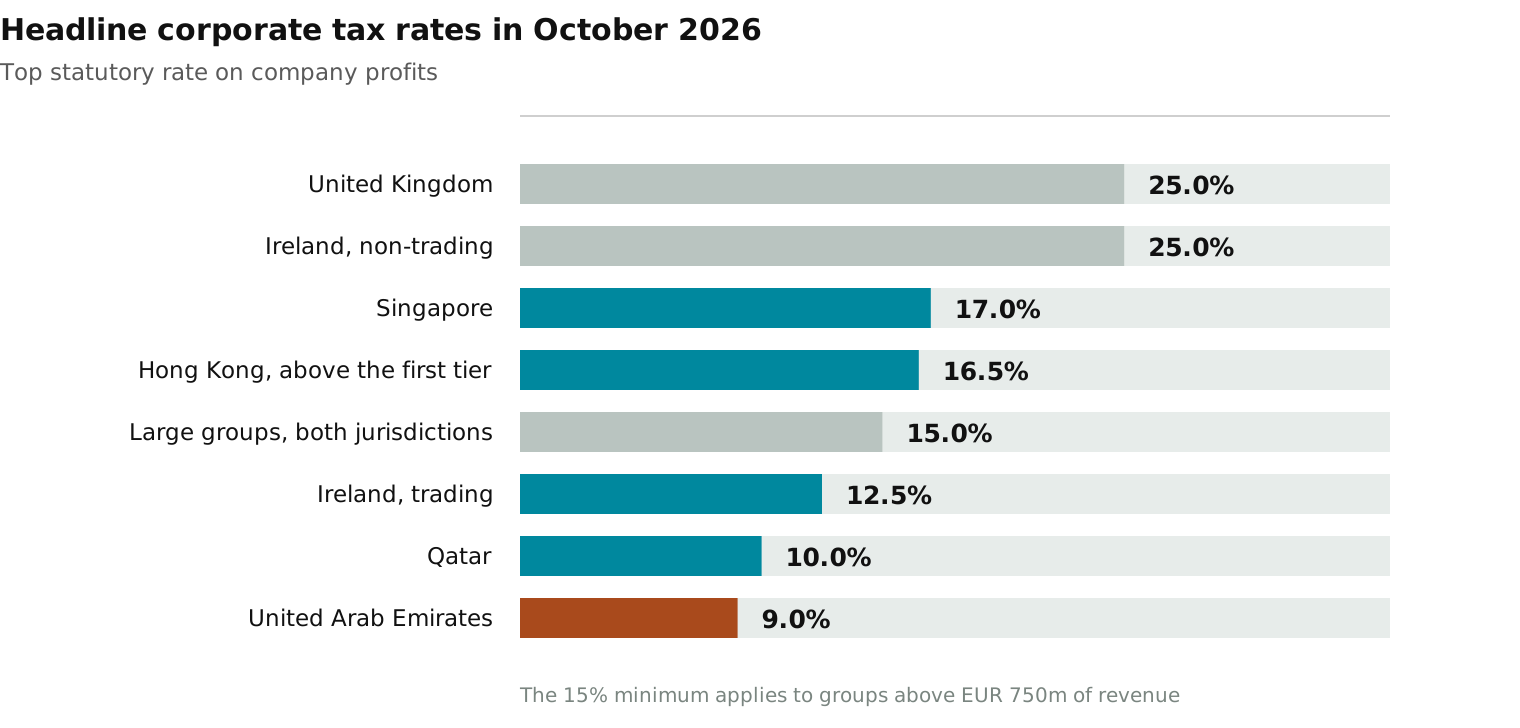 The headline comparison puts the UAE at nine per cent against Singapore at seventeen. Hong Kong charges 8.25 per cent on the first HKD 2 million of profit and 16.5 per cent above it. Only one company in a connected group may claim the lower tier. Ireland charges 12.5 per cent on trading income and twenty-five on non-trading income. The United Kingdom charges twenty-five per cent above GBP 250,000.
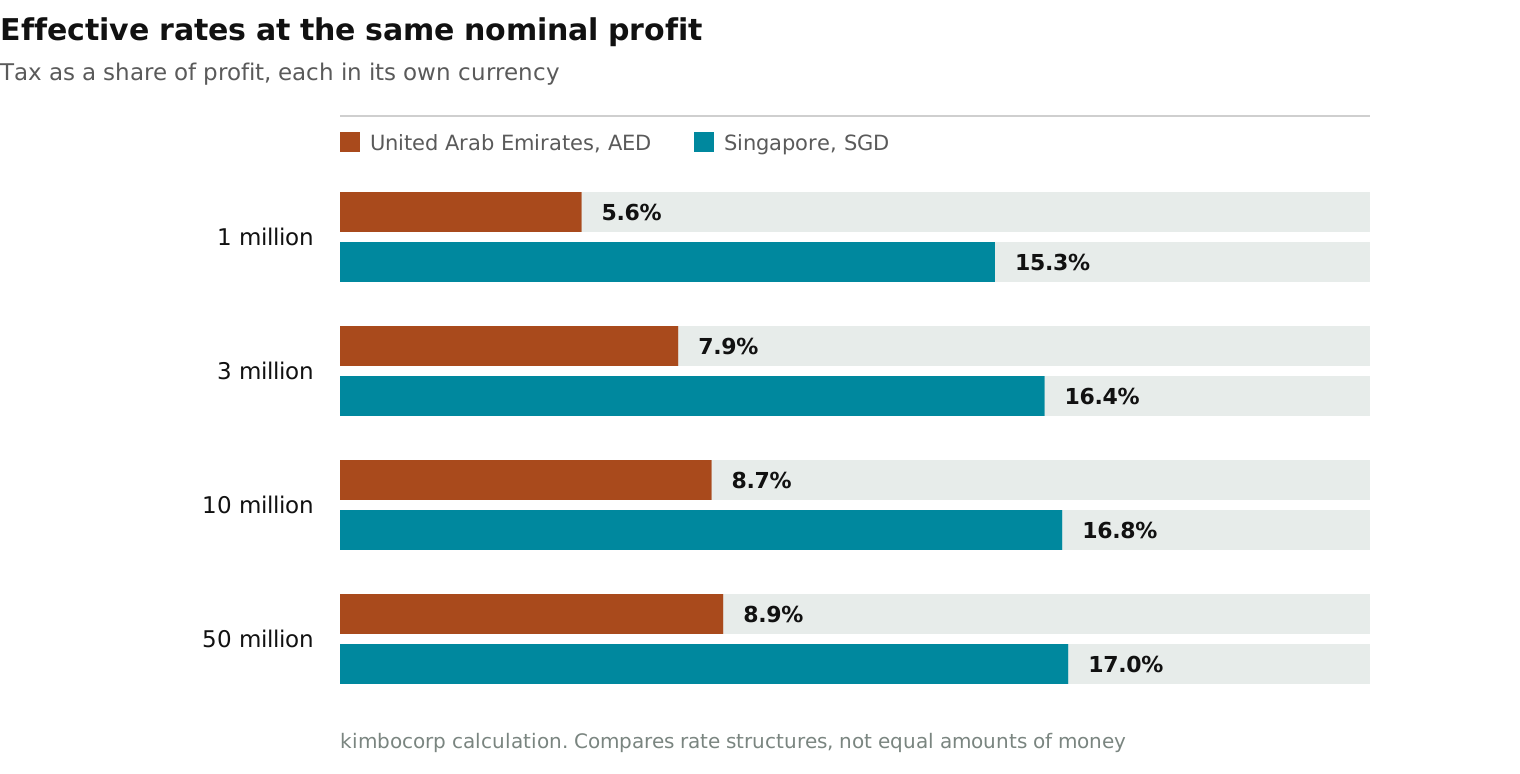 On the UAE rules, a company with AED 1 million of profit pays an effective 5.63 per cent. At AED 3 million that is 7.88 per cent, at AED 10 million 8.66 per cent, and at AED 50 million 8.93 per cent. On the Singapore rules for the 2026 year of assessment, a company with SGD 1 million of profit pays an effective 15.26 per cent before any rebate. At SGD 10 million that is 16.83 per cent.
Singapore's reliefs behave differently from the UAE's, and the difference is worth understanding. Partial tax exemption exempts seventy-five per cent of the first SGD 10,000 of chargeable income and half of the next SGD 190,000. The maximum exempt amount is SGD 102,500, which saves SGD 17,425 of tax. That is a fixed cash amount, and it does not grow as profits grow. The start-up exemption is more generous at SGD 21,250, and it lasts for three consecutive years of assessment only.
The start-up exemption also carries conditions that exclude the structures most often proposed. The company must be incorporated in Singapore and tax resident for the year of assessment. It must have no more than twenty shareholders holding directly, all of them individuals, or one individual holding at least a tenth. Investment holding companies and property developers are excluded outright. A one-year rebate also applies for the 2026 year of assessment, and one-year measures are best left out of a structural comparison.
Above a certain group size both charge fifteen per cent
The comparison changes entirely at the top end, and this is the point to establish before any structuring work begins. Both jurisdictions have adopted the international minimum tax, and both have set it at the same rate and the same threshold. Above that threshold the question of which has the lower corporate rate stops having an answer. A great deal of advice still treats the nine per cent as though it applied at every size, and it does not.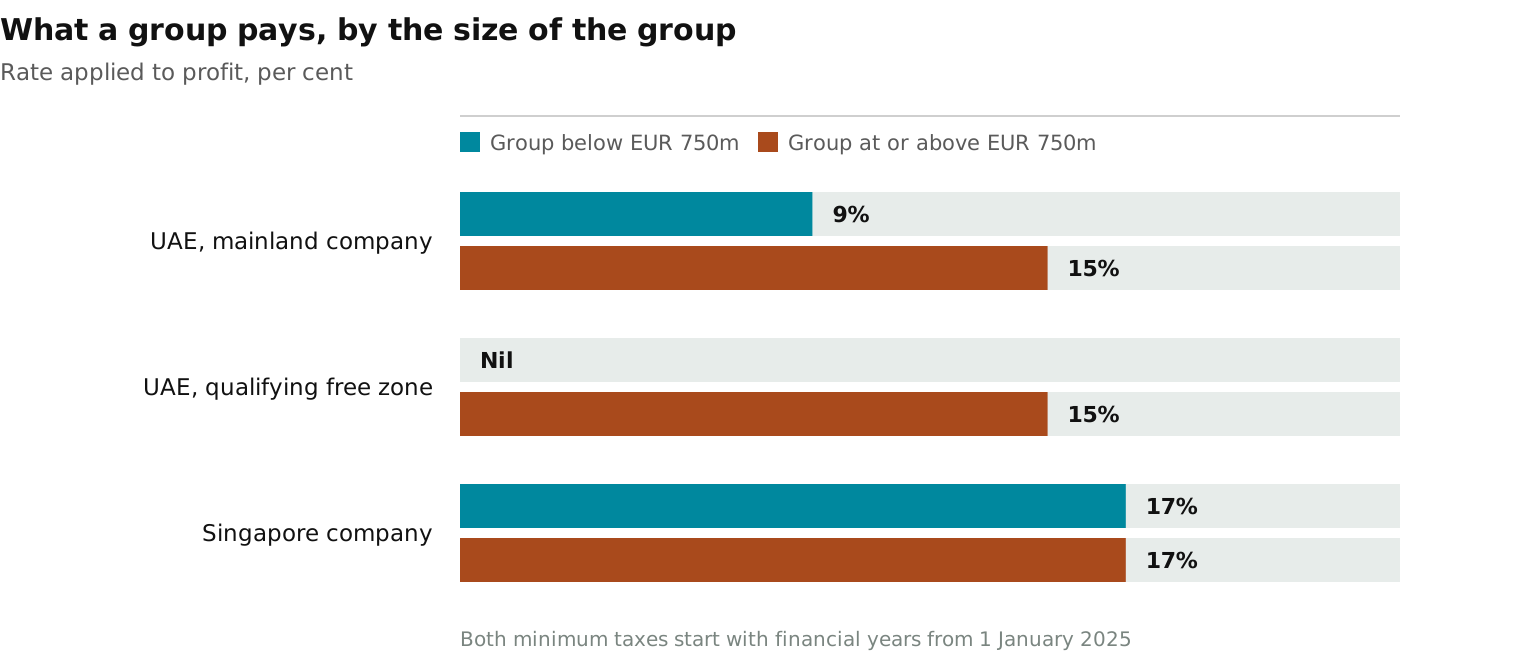 The UAE enacted a domestic minimum top-up tax by a cabinet decision issued on 31 December 2024 and effective from 1 January 2025. It charges fifteen per cent on groups with consolidated revenue of EUR 750 million or more in two of the four preceding years. The nine per cent and the free zone nil rate are both computed first, and the liability is then topped up to fifteen.
Singapore's equivalent arrived at the same time and on the same terms. The Multinational Enterprise (Minimum Tax) Act 2024 introduced both an inclusion rule and a domestic top-up tax at a fifteen per cent minimum effective rate. The threshold is EUR 750 million, and it applies to financial years beginning on or after 1 January 2025. Same rate, same threshold, same currency, same start date.
The consequence is that the UAE's rate advantage disappears completely above that size. A group above EUR 750 million pays fifteen per cent in either place. Both regimes allow a substance-based carve-out of five per cent of payroll and five per cent of tangible assets, and both have a de minimis election. For a group of that scale the corporate rate is no longer a reason to choose between the two.
Free zone treatment is a conditional nil rate, not an exemption
A qualifying free zone person pays nil on qualifying income and nine per cent on everything else. Four conditions have to be met. The company must maintain adequate substance in the UAE, derive qualifying income, not have elected into the ordinary regime, and comply with the transfer pricing rules. Compliance with transfer pricing is itself a condition of the nil rate, which is unusual and easy to overlook. The qualifying activities list was replaced in 2025 and the replacement was backdated. A ministerial decision issued on 28 August 2025 repealed the 2023 list and applied retroactively to 1 June 2023. The current list covers manufacturing, processing and trading in qualifying commodities. It covers holding shares and securities for investment, ship operation and reinsurance. It covers fund management, wealth and investment management, and headquarter and treasury services to related parties. It also covers aircraft financing and leasing, distribution from a designated zone, and logistics. The excluded activities matter as much. Transactions with natural persons are excluded, other than ship operation, fund management, wealth management and aircraft financing. Banking is excluded. Insurance is excluded, with reinsurance and headquarter services preserved. General finance and leasing is excluded, with the specific carve-outs preserved. Ownership of immovable property other than commercial property inside a free zone is excluded. The de minimis rule has two tests and the binding one is often the second. Non-qualifying revenue must not exceed five per cent of total revenue or AED 5 million, whichever is lower. Above AED 100 million of total revenue the absolute cap governs. Breach of the de minimis rule removes the nil rate from the start of that period and for the following four tax periods. A single bad year therefore costs five. Substance requirements for free zone entities have tightened rather than relaxed. The UAE cancelled its separate economic substance reporting regime for financial years ending after 31 December 2022. The Ministry of Finance announced that on 14 October 2024. Substance then moved into the corporate tax law and became more demanding. Core income-generating activities must be performed in the zone, with adequate assets, adequate full-time qualified employees and adequate operating expenditure for each activity. Outsourcing is permitted only within the zone and with adequate supervision. Two newer requirements add real cost. Every qualifying free zone person needs audited financial statements regardless of size, for tax periods from 1 January 2025. A second requirement starts with tax periods beginning 1 January 2026. A free zone distributor relying on the designated zone activity must file an independent auditor's agreed-upon-procedures report, using a prescribed sampling method. It falls due within thirty days of the return deadline. Failure to file it means the conditions are not met.Outbound payments are where the UAE wins clearly
The strongest point in the UAE's favour is the one least often made, and it has nothing to do with the corporate rate. It concerns what happens when money leaves the country. A corporate rate is paid once on profit, while a withholding tax is paid on every payment that crosses the border. For a structure that pays regular service, management or interest fees out, the withholding position is the larger annual number. This is the comparison that decides where a regional services company should sit.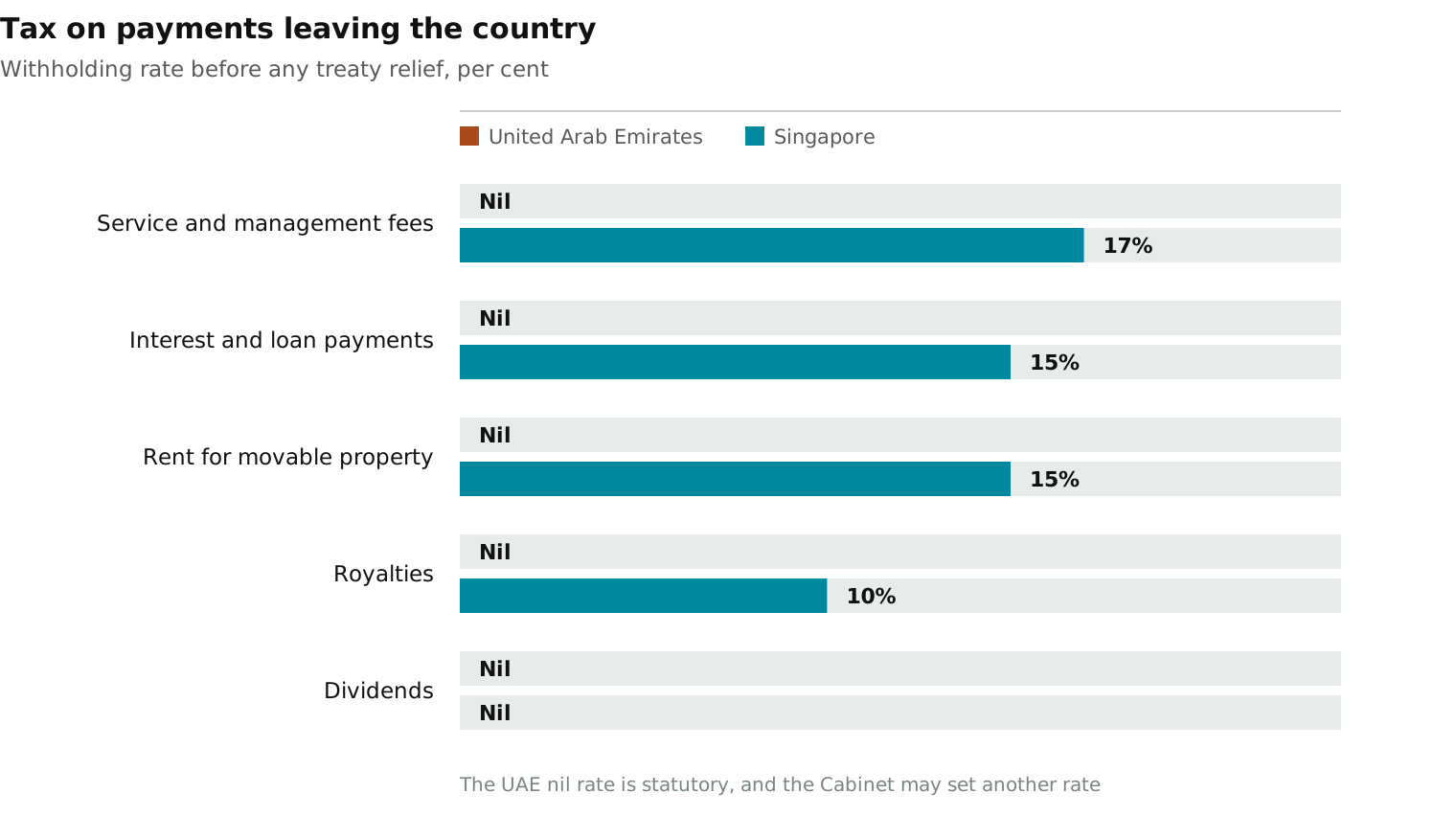 The UAE charges nil withholding tax on a non-resident's income from the country where it is not attributable to a permanent establishment. The nil rate is statutory rather than administrative, and there is no return and no registration. One qualification is worth noting for the long term. The provision allows the Cabinet to specify another rate by decision, so this is a withholding regime set at nil rather than the absence of one. No such decision has been identified as at October 2026.
Singapore's position is quite different, and the figure that bites is not the one usually quoted. Technical assistance, service fees and management fees paid to a non-resident are charged at the prevailing corporate rate of seventeen per cent on a gross basis. Interest and loan-related payments are charged at fifteen per cent, rent for movable property at fifteen, and royalties at ten. Dividends carry no withholding under the one-tier system. For a regional services or holding structure, that seventeen per cent on service and management fees is what actually costs money.
There is a further asymmetry that runs against the UAE, and it matters to anybody placing a UAE subsidiary under a Singapore parent. Singapore's foreign-sourced income exemption requires the foreign headline tax rate to be at least fifteen per cent. The UAE's headline rate is nine. UAE-sourced dividends, branch profits and service income received in Singapore therefore fail that test, and a Singapore parent cannot use the exemption on them.
The treaty networks are counted on different bases
The UAE's Ministry of Finance states that 137 double taxation agreements have been concluded, on a page last updated on 18 October 2026. It does not publish the split between signed and in force. Singapore reports 96 comprehensive agreements signed and 93 in force as at 31 March 2026, in its revenue authority's annual report. Those two counts are on different bases, and printing them side by side without saying so is misleading. What can be said is that the UAE's network reaches considerably further into Africa, Central Asia, the former Soviet states and the Middle East. Singapore's network is deeper and more tested across Asia. For the four markets that matter most to a Southeast Asian group, there is no gap at all. Both the UAE and Singapore have agreements with India, Indonesia, Vietnam and China, and any claim otherwise is wrong. One real asymmetry runs the other way. The Germany and UAE agreement expired on 31 December 2021 and has not been replaced. The German federal trade agency stated in April 2024 that there were no current efforts to conclude a new one. German unilateral relief does not help either, because the UAE does not tax the income. Singapore's agreement with Germany remains in force.The compliance load is real in both places
The UAE requires a master file and a local file where a company's own revenue reaches AED 200 million. The same applies where consolidated group revenue reaches AED 3.15 billion. Documentation is due within thirty days of a request. The return itself requires separate disclosure of related party transactions above AED 40 million in aggregate and AED 4 million by category. Connected person disclosure starts at AED 500,000. Those return thresholds are frequently confused with the documentation thresholds, and they are much lower. Returns are due nine months after the end of the tax period. Registration deadlines ran on a licence-month ladder through 2024 for companies existing before March 2024, and run three months from incorporation for companies formed after it. Penalties are specific. Failure to register costs AED 10,000. A late return costs AED 500 a month for twelve months and AED 1,000 a month after that. Late payment carries fourteen per cent a year charged monthly. Failure to keep records costs AED 10,000, doubling on repetition within two years. Singapore's load is differently shaped. Transfer pricing documentation is required above a revenue threshold, with separate per-transaction thresholds. The threshold for goods and loans rose to SGD 2 million from the 2026 year of assessment. A five per cent surcharge applies to any transfer pricing adjustment even where no additional tax results. Audit is required only where a company exceeds two of three size thresholds. A small Singapore company may therefore be audit exempt, where every qualifying free zone person must be audited.| Point of comparison | Which is better | The honest qualification |
|---|---|---|
| Rate for owner-managed business | UAE, by roughly half | Each in its own currency |
| Small business relief | UAE, a full exemption to 2029 | Revenue cliff edge, losses forfeited |
| Outbound service and management fees | UAE, nil against seventeen per cent | Cabinet may set a rate by decision |
| Founder taxation | UAE, no personal income or capital gains tax | Often decisive, and rarely the headline |
| Treaty breadth | UAE, 137 against 96 | Different bases, no Germany agreement |
| Groups above EUR 750 million | Neither, both fifteen per cent | Same rate, threshold and start date |
| Domestic dividends | Neither, both effectively nil | Different machinery, same answer |
| Regime stability | Singapore | Five UAE instruments replaced since 2023 |
| Audit for a small company | Singapore, exemption available | Every free zone person is audited |
| Bringing profits to a parent | Singapore, except from the UAE | Nine per cent fails the fifteen per cent test |
Where the UAE is genuinely better
Five advantages survive scrutiny. The nil withholding on outbound payments is the strongest and the least disputable. Seventeen per cent on gross service and management fees is a cost a regional structure pays every year. The rate for an owner-managed business is roughly half Singapore's across the middle of the range. Small Business Relief is a full exemption rather than a reduction. It covers AED 3 million of revenue with no profit cap, and it now runs to 2029.
There is no separate economic substance filing regime any more, which removes a recurring compliance exercise from the calendar. The substance itself is still required, and the corporate tax law now sets a higher bar than the old regulations did. What has gone is the annual notification and report rather than the obligation. For a founder, there is also no federal personal income tax and no individual capital gains tax. That is frequently more decisive than anything about the corporate rate.
A genuine nil rate with a statutory fifty year horizon also exists for a defined set of activities, and Singapore has no as-of-right equivalent. Manufacturing, processing, commodity trading, headquarter and treasury services, reinsurance, fund and wealth management, aircraft financing, logistics and designated zone distribution all qualify. For a business that actually does one of those things in a free zone and can carry the substance, that is a real and durable position.
Where Singapore holds the advantage
The honest case for Singapore here is not the tax rate, which is higher. It is predictability. Five instruments have been replaced in three years. The UAE has replaced its qualifying income decision, and repealed and retroactively replaced its qualifying activities decision. It has repealed and replaced its audit decision, and cancelled its economic substance filing regime. It has added a top-up tax and a distribution audit requirement, and extended Small Business Relief by three years. A structure built on the 2023 rules has had to be reconsidered more than once.
The five period cliff is a second point, and it is the one that should be modelled rather than noted. A single breach of the de minimis rule costs the nil rate for that year and the four that follow. Above AED 100 million of revenue the binding test is the absolute AED 5 million cap rather than the five per cent proportion. A growing company therefore tightens the constraint on itself as it grows. That is a severe consequence for what may be an administrative failure. There is no equivalent in Singapore.
The third is what can be done with the profit afterwards. A UAE subsidiary's profits cannot be brought into a Singapore parent under the foreign-sourced income exemption. The nine per cent headline rate fails the fifteen per cent test. For a group that wants to pool regional profit in Singapore, that is a structural problem rather than a detail.
Both jurisdictions have also converged on the same answer to the same question. Capital gains are exempt in both subject to substance, under the participation exemption in the UAE and under section 10L of the Income Tax Act in Singapore. Neither offers a version of itself without substance. Anybody selling an empty company in either place is selling something the law has already addressed.
What this means for founders, groups and advisers
For a founder choosing where to put an operating business, the decision should turn on where the work happens and where the money goes afterwards. Where the business performs a qualifying activity in a free zone with real people and real premises, the UAE nil rate is durable. It should be taken seriously. If the business will pay significant service, management or interest fees out of the country, the UAE's nil withholding is worth more than the corporate rate difference. If profits need to pool in Singapore, the nine per cent headline rate creates a problem that structuring does not solve.
For a group approaching EUR 750 million of consolidated revenue, the corporate rate comparison should be set aside. Both jurisdictions charge fifteen per cent above that threshold from financial years beginning on or after 1 January 2025. Planning should concentrate on the substance-based carve-out, and on where real payroll and tangible assets actually sit. That is the only part of the calculation still moving.
For an adviser, two practical points are worth carrying into the next conversation. Any UAE analysis written before August 2026 should be rechecked. The Small Business Relief expiry and the qualifying activities list have both changed, and the activities change was retroactive. And the effective rate figures in this article are calculations from the published rules rather than published figures, computed in each jurisdiction's own currency. They compare rate structures and not equal amounts of money, and they should be presented to a client that way.
Our blog
Latest blog posts
Tools and strategies modern teams need to help their companies grow.