Three governments rewrote the rules while family structures stood still

Written by

Huan koh
Published on
September 2, 2026

Copy link
Link copied!


Britain, Australia and the Cayman Islands all changed the terms in eighteen months. Singapore changed its terms too, and published the numbers.
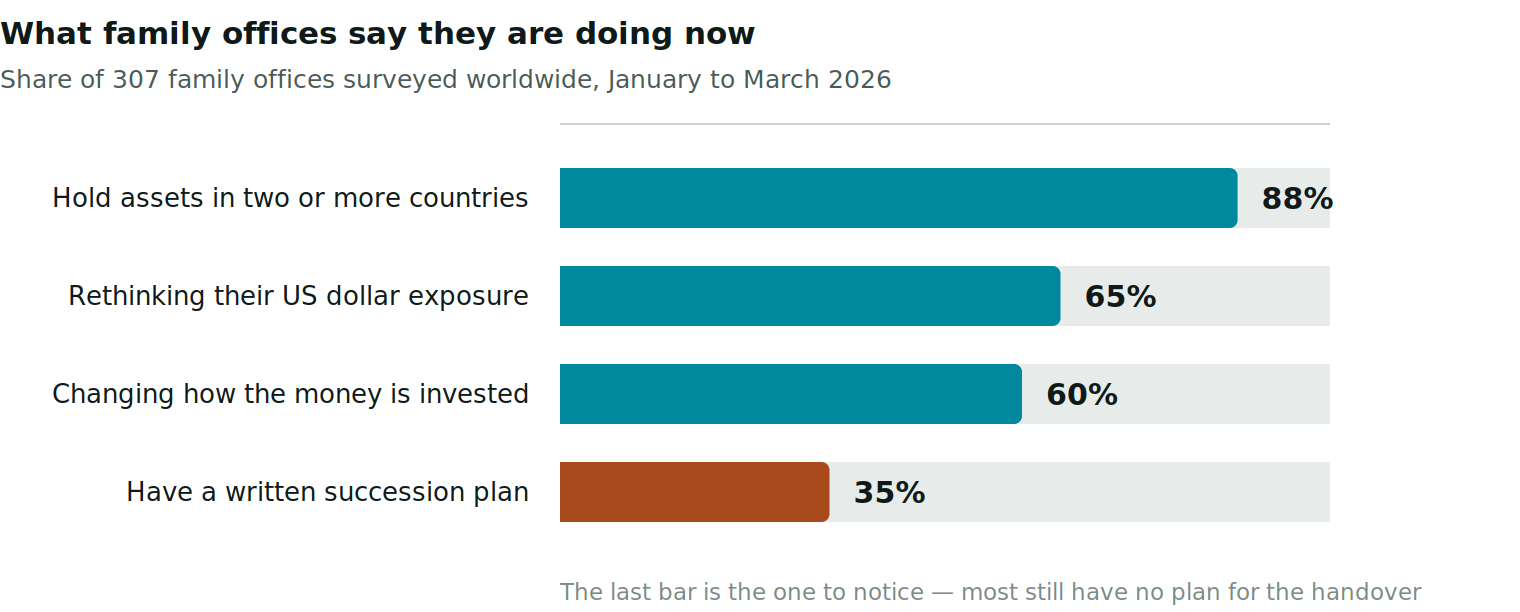
Families plan carefully for markets falling and for businesses failing. Very few plan for the rules themselves being rewritten around a structure that has not moved. In the eighteen months to September 2026, three of the jurisdictions families rely on most did exactly that. Britain withdrew a protection that offshore trusts had carried for decades. Australia rewrote a retirement tax three times before it took effect. The Cayman Islands shortened a reporting deadline from thirty days to five. None of these changes were caused by anything the affected families did. They landed on arrangements built years earlier, under different rules, by advisers who are usually no longer involved. The UBS Global Family Office Report now finds that 88% of family offices hold assets in two or more countries, and this is why.
Britain withdrew trust protections on 6 April 2025, and the tax now falls on income the family never receives
On 6 April 2025 the United Kingdom ended the domicile system it had used for more than two hundred years. The reporting focused on non-doms leaving. The change that hit family structures hardest was quieter and concerned trusts. Until that date, income and gains accumulating inside a settlor-interested offshore trust were protected. That protection is gone. Income and gains inside the trust are now taxed on the UK-resident person who created it, in the year they arise. Nothing has to be paid out. A family that settled a trust in the 1990s and left it to compound now owes tax annually on money it has never received. UK income tax runs up to 45% on income inside the trust, and capital gains tax is 24% on gains realised inside it. Nothing has to be sold or distributed for the assessment to arrive.
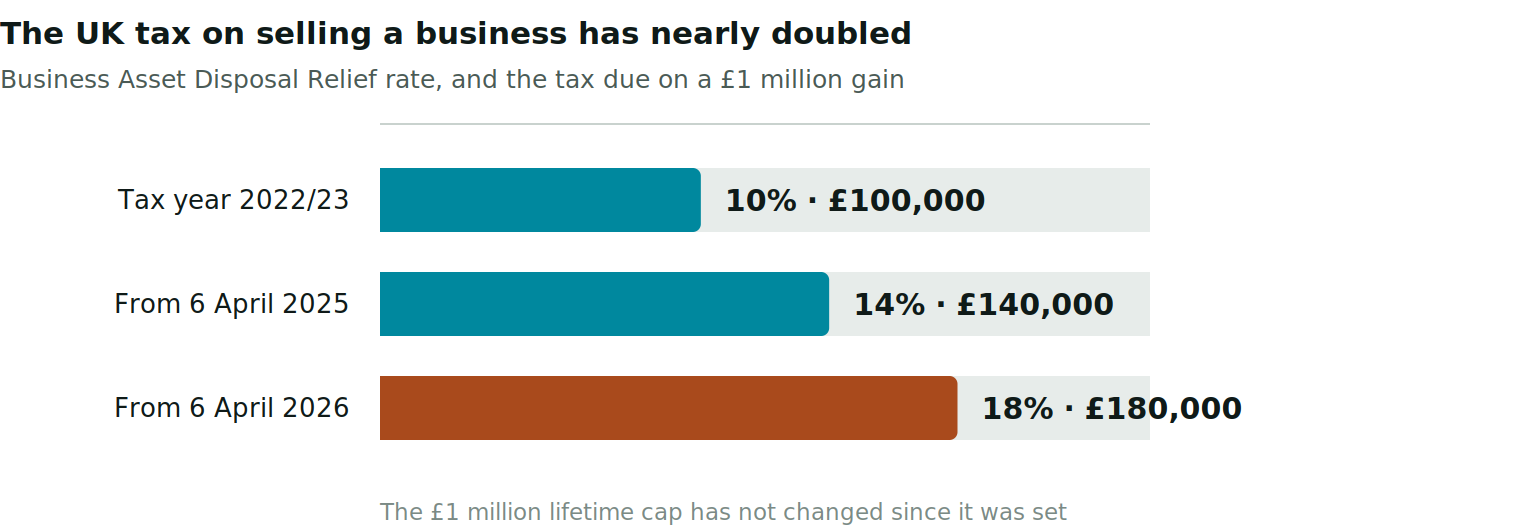
Selling the family company became more expensive over the same period. Four years ago the relief rate on a qualifying business disposal was 10%. It rose to 14% in April 2025 and to 18% in April 2026. On a £1 million gain that is £80,000 more tax on an identical sale of an identical business. The £1 million lifetime cap has not been adjusted for inflation, so it shelters less real value with each year that passes. There is a route for bringing historic offshore money onshore at a flat 12%, but that rate rises to 15% in 2027/28. It is a concession with a published expiry attached, which means the cost of deciding later is already known.
Australia rewrote Division 296 three times before it finally took effect on 1 July 2026
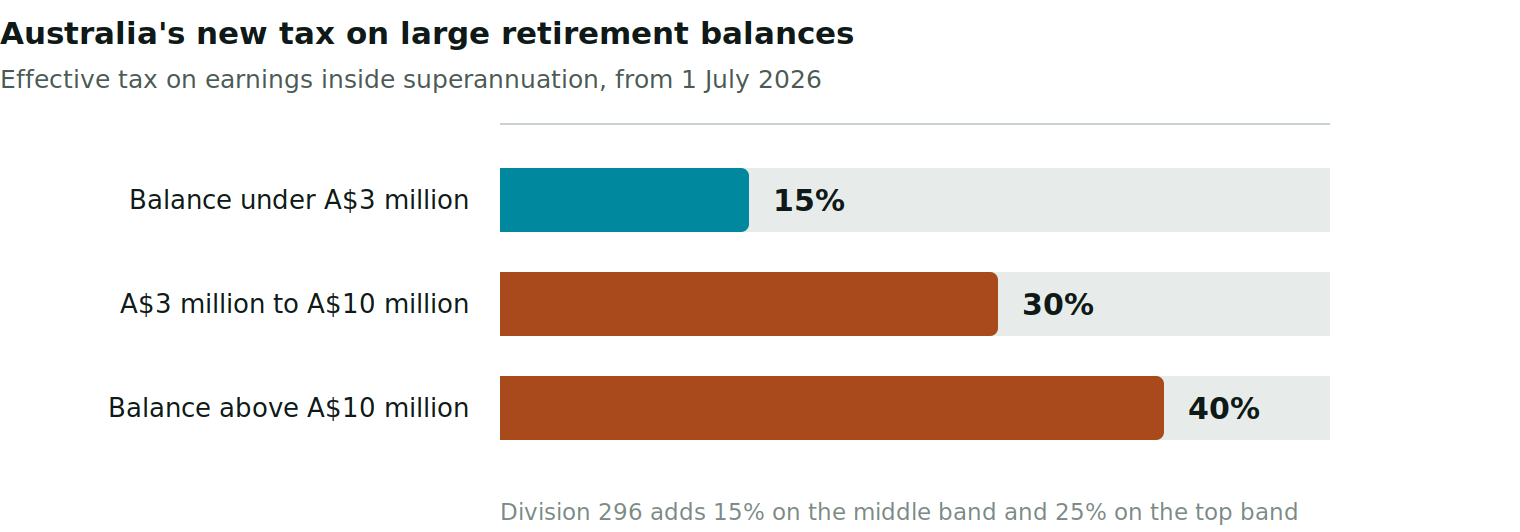
Australia's story is not about a rate. It is about being asked to plan against a target that kept moving. The version proposed in 2023 would have taxed unrealised gains, meaning rises in value on assets nobody had sold. It used a single threshold and was to start a year earlier. After three years of argument it was rewritten. What began on 1 July 2026 taxes realised earnings only, across two tiers, with a later start date. Families restructured around the first version and then restructured again around the second, paying professional fees both times. The thresholds now rise with inflation, which is a genuine improvement. Nothing prevents a future government from moving them back, which is the part that matters when the wealth in question is meant to last three generations.
Cayman cut its correction window from thirty days to five, and the BVI raised inspections by a quarter
Families who moved assets offshore for privacy have had an expensive year. The Cayman Islands adopted crypto-asset reporting rules on 1 January 2026, so holdings inside Cayman structures are now exchanged automatically with foreign tax authorities. The first report is due 30 June 2027, and penalties run to around CI$50,000 per breach. Every affected firm must appoint a Cayman-resident contact by 31 January 2027, which is a physical presence requirement that did not previously exist. On 23 January 2026 Cayman also cut the window for correcting ownership records from thirty days to five. It removed the discount that had rewarded firms for reporting their own errors. In the British Virgin Islands the regulator raised its 2026 inspection programme by 25%, from forty firms to fifty. None of this makes offshore unlawful, and neither place has emptied out. Cayman still carried about 123,500 active companies in 2026, and the BVI 356,256 at the end of 2025.
Only 35% of family offices have written down who takes over, while 88% have spread assets across borders
Between January and March 2026, UBS surveyed 307 family offices across more than thirty markets, managing an average of US$1.3 billion each. Nearly nine in ten already hold assets in two or more countries. Sixty percent intend to change how their money is invested within the year, the highest that figure has ever been. Sixty-five percent are reconsidering how much they hold in US dollars. Then comes the number that sits awkwardly beside the others. Only 35% have a written succession plan, and only 27% run a structured programme to prepare the next generation. Families are working hard on where the money sits, and have not written down who takes responsibility when the person holding it together is gone. Spreading assets across borders answers one question and leaves the harder one open.
Singapore published what it wants: a resident employee, a local bank, and S$200,000 to S$1 million a year
Singapore changed its rules across the same eighteen months, and the difference is that it published the terms. More than 2,000 single family offices here had been awarded tax incentives by the end of 2025, MAS told Parliament in 2026. That growth is why the requirements tightened rather than loosened. From 15 June 2026 a family office no longer applies to MAS case by case, but files a notification instead. Existing offices have until 15 June 2027 to file a Notice of Continuation. The conditions are short. Be incorporated in Singapore. Keep at least one employee who is ordinarily resident here. Hold accounts with a Singapore-licensed bank, and file an annual return within four months of the year end. From 1 August 2026 there is also a minimum you must spend locally each year, set against the size of the assets you manage.
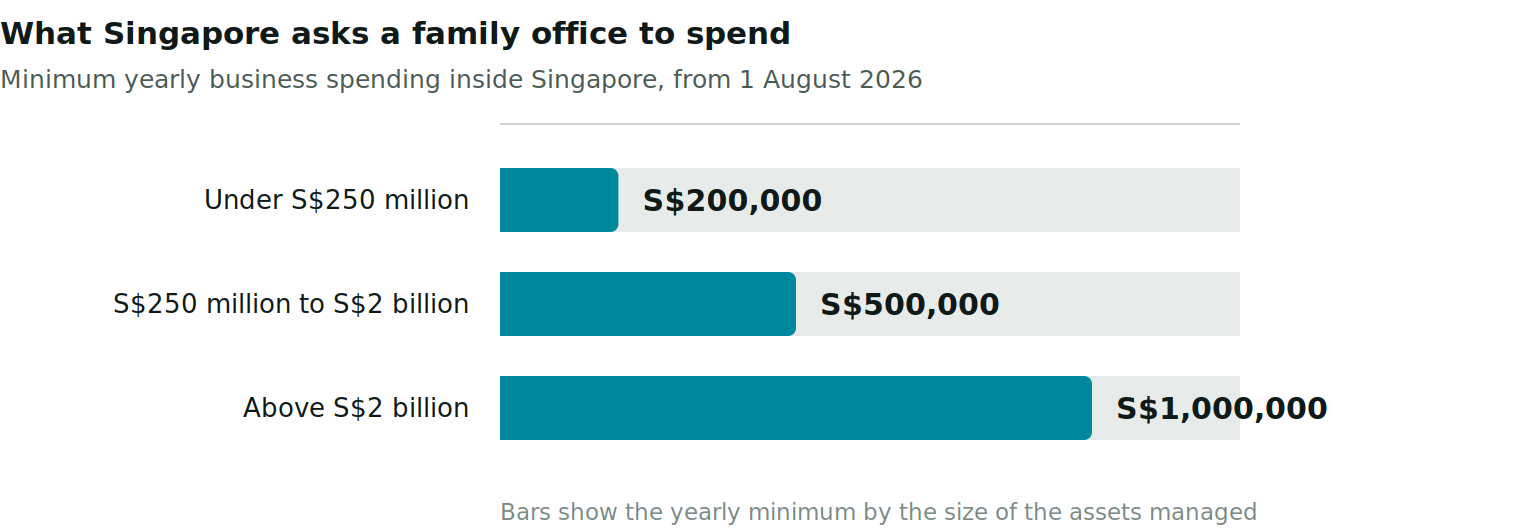
Read that against the previous three sections. Britain removed a protection families had relied on for decades. Australia rewrote the same rule twice before it began. Cayman cut a deadline by twenty-five days. Singapore published a table stating what it requires and by when. You may dislike the figure in the table, but a published figure can be planned against. The exchange is not a soft one. Since 16 June 2025 ACRA has published nominee director information on a company's public Business Profile, visible to any bank running checks. In 2025 the Singapore High Court replaced fines with ten months in prison for a chartered accountant who acted as resident director without exercising supervision. On 25 May 2026 MAS fined Padang Trust Singapore S$300,000 over anti-money-laundering failures.
What this means for UK-resident settlors, Australian super holders, and existing Singapore family offices
For a UK resident with a settlor-interested offshore trust, the assessment now arrives every year on money the family has not received. It will arrive again next April. The first step is not to move anything. It is to establish what the trust actually generates in income and realised gains, and what the annual charge on that comes to. Most families have never seen that figure written down in one place. Only once that number exists can anyone judge whether restructuring is worth the professional cost. The 12% repatriation rate rises to 15% in 2027/28, so the price of deferring is already published rather than speculative.
For a family with most of its wealth inside Australian superannuation, Division 296 in isolation is survivable. The lesson underneath it is the part worth acting on. That rule was rewritten three times before it commenced, and both thresholds can be moved again by a future government that needs revenue. If nearly all the family's capital sits in one country's retirement system, the plan depends on that country's politics staying stable for decades. Holding part of it under a second set of rules is not a tax strategy and should not be sold as one. It is a decision to stop being fully exposed to one government's next budget.
For a family office already established in Singapore, the deadline of 15 June 2027 is closer than it appears, because the work it requires is not paperwork. Check three things this quarter. Establish whether you have an employee genuinely ordinarily resident here rather than nominally appointed. Confirm that your local spending will clear the tier applying to your assets, counting a full year rather than a projection. Then ask whether your directors could describe, in a meeting with a bank, how the last significant decision was taken. If any answer is uncertain, the firm that set the structure up is rarely the firm that can operate it. While the file is open, check the succession plan too.
Our blog
Latest blog posts
Tools and strategies modern teams need to help their companies grow.