An Indian founder may control a Singapore company that has no subsidiary
Written by

Huan koh
Published on
October 26, 2026

Copy link
Link copied!


The rule is written as a condition on control rather than as a flat prohibition. The Reserve Bank's own drafting settles it, and four routes sit outside the restriction altogether. A founder in Pune runs a profitable engineering services company and wants a Singapore entity. Her investors want one too. She has been told three different things by three advisers. The first said a Singapore company is simply not available to her. The second said it is available and she can put her Indian company underneath it. The third said it depends. All three were working from summaries rather than from the rule, and the rule says something more precise than any of them. India's Overseas Investment Rules were notified on 22 August 2022. The provision that governs a resident individual is Schedule III. Its first paragraph permits investment in an operating foreign entity that is not engaged in financial services. The entity must also have no subsidiary or step-down subsidiary where the resident individual has control. Those last six words are the whole argument. They are in the text, and they mean the restriction is conditional on control rather than absolute. A founder may hold a Singapore company outright, provided that company owns no subsidiary she controls through it. She may also hold a stake without control in a company that does have subsidiaries. What she may not do is combine the two. A second condition sits in the same sentence and gets far less attention. The investment must be in an operating foreign entity. That term is nowhere defined in the rules or in anything published under them. It is the harder of the two gates for anybody proposing a pure holding company. A company that only holds shares does not obviously carry on business. Almost every discussion of this subject argues about control and passes over the operating condition entirely.
The Reserve Bank's own drafting settles the control question
Three things establish that the subsidiary condition turns on control, and the third is close to decisive. None of them requires a view about what the policy ought to be. They are the words of the rule, the structure of its proviso, and the way the regulator has drafted its own guidance. Taken together they leave very little room for the absolute reading, though that reading is still in print.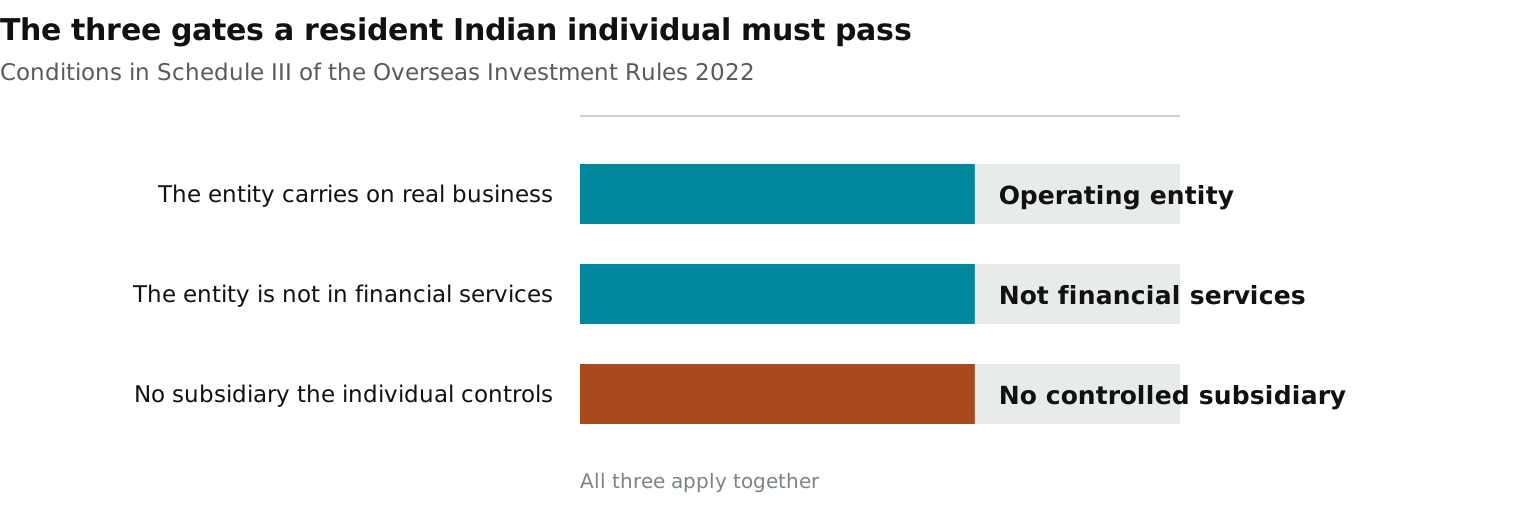 The first is the language itself. The words restricting the subsidiary are qualified by where the resident individual has control. On an absolute reading those words do nothing at all. A court would not readily treat a qualifying phrase in a statutory instrument as surplus.
The second is the proviso. The rules relieve certain categories of acquisition from the restriction. That relief is expressed as applying whether or not the foreign entity has a subsidiary or step-down subsidiary where the resident individual has control. A provision cannot relieve against a condition that does not exist.
The third is the Reserve Bank's own Master Direction on Overseas Investment. It was issued on 24 July 2024 and updated on 1 April 2026. Its paragraph 22(1) addresses a particular case. A resident individual has invested without control in a foreign entity, and that entity then acquires or sets up a subsidiary. It provides that the individual shall not then acquire control. That sentence makes no sense on an absolute reading. It takes for granted that holding a stake in an entity which has subsidiaries is lawful. It has been in force unamended since the rules were notified.
One caution belongs here. A different paragraph of the same Master Direction lists a foreign entity having a subsidiary as a non-conforming holding, without the control qualifier. It requires disinvestment within six months. An officer at an authorised dealer bank reading that paragraph in isolation could take the stricter line. The conditional reading is the better one, and it is not the only one in circulation.
Control starts at ten per cent and arises by agreement as well as by shares
The definition is wide, and it is why the subsidiary condition catches almost every founder who proposes a holding structure. A founder considering a Singapore parent rarely wants a passive minority stake in it. The whole point of the arrangement is that she directs it. That intention is what brings her inside the definition, usually several times over. No amount of share structuring changes it while she keeps the ability to decide things.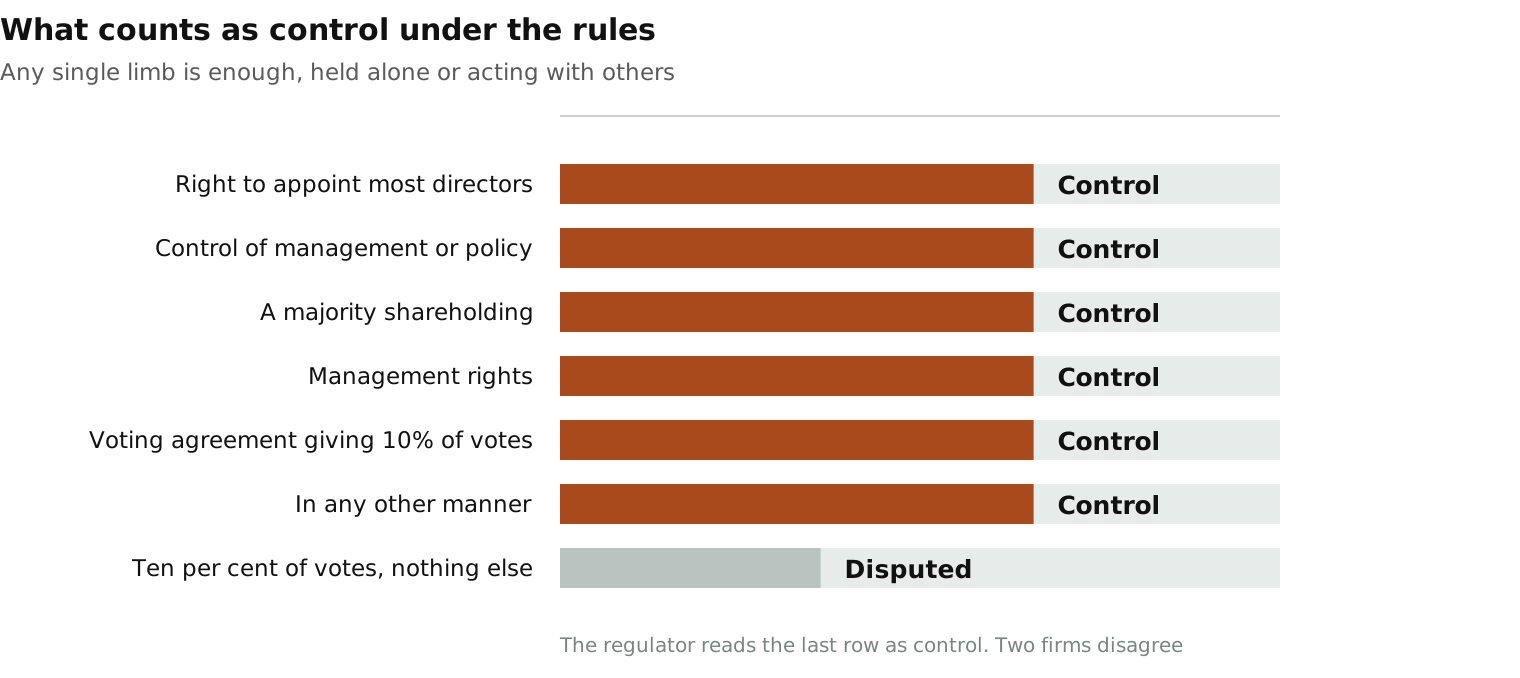 Control arises from the right to appoint a majority of directors, or from control of management or policy. It arises from shareholding and from management rights. It arises from shareholders' agreements and voting agreements that entitle a person to ten per cent or more of voting rights. It arises in any other manner, directly or indirectly, individually or acting in concert with others.
A founder who holds the majority of a Singapore company clears that bar several times over. So does a founder holding twelve per cent with a board seat and a shareholders' agreement. The definition is also what makes a subsidiary a subsidiary. An entity is a subsidiary where the foreign entity has control of it.
One question is genuinely disputed. It is whether ten per cent on its own, with no board seat and no agreement, amounts to control. One firm has argued in print that the ten per cent figure should not be read as a standalone test. Its further point is that the Reserve Bank's directions cannot be treated as exhaustive aids to interpreting rules made by the Central Government. Two others read it broadly, one of them describing the threshold as substantially low. The Reserve Bank itself takes the broad reading in a note to its own Master Direction. Since the bank applies the directions, the broad reading governs in practice whatever its merits.
The second gate is the one that stops a holding company
Schedule III permits a resident individual's direct investment only in an operating foreign entity. The term is not defined in the rules, in the related regulations, in the directions or in the Master Direction. At least one law firm has publicly identified the gap. Nothing published since has filled it. A founder therefore has to form a view on ordinary meaning, knowing that the bank applying the rule will form its own. On ordinary meaning, a Singapore company whose only function is to hold shares in an Indian subsidiary is not operating. There is also structural support for treating it as a real restriction. The directions governing investment through the international financial services centre at GIFT City deal with the point expressly. They disapply the restriction on making investment only in an operating foreign entity. A restriction that needed no disapplication would not have been disapplied. The practical consequence is that the founder-controlled Singapore holding company over an Indian operating business fails twice. It fails the control gate, because the Indian company beneath it is a subsidiary she controls. It fails the operating gate, because a pure holding company does not carry on business. The second failure is the harder one to argue around, and it has had almost no attention. A trading company is a different matter entirely. Take a Singapore company that signs its own regional customers and employs its own regional staff. It holds the cash those customers pay, and it is plainly operating. Owned outright by the founder and owning nothing in India, it passes all three gates. That is the structure most regional expansions actually need, and a flat prohibition would have wrongly discouraged it.| Configuration | Permitted on the automatic route |
|---|---|
| Singapore trading company, founder controls, no subsidiary | Yes |
| Singapore services company alongside the Indian business | Yes |
| Stake under ten per cent, no control, entity has subsidiaries | Yes |
| Singapore holding company above the Indian company, founder controls | No, on two independent grounds |
| Pure holding company with no business, founder controls | No, fails the operating condition |
| Holding acquired by inheritance, with control and subsidiaries | Yes, expressly without limit |
| Shares from an employee plan, sweat equity or qualification shares | Yes, the proviso disapplies both conditions |
| Structure built while non-resident, retained on returning | Yes, the rules do not apply to it |
| Holding company inside the GIFT City financial centre | Yes, both conditions are disapplied |
| Lending to or guaranteeing the Singapore company | No, an individual may hold equity only |
Four routes sit outside the restriction
The exceptions are not marginal, and two of them are considerably wider than the rule they sit inside. Each one has a different logic. Two reflect the fact that the individual did not choose the structure. One reflects a deliberate policy of routing international business through a designated centre. The fourth follows from the ordinary principle that rules made for residents do not reach back over what a non-resident lawfully did.
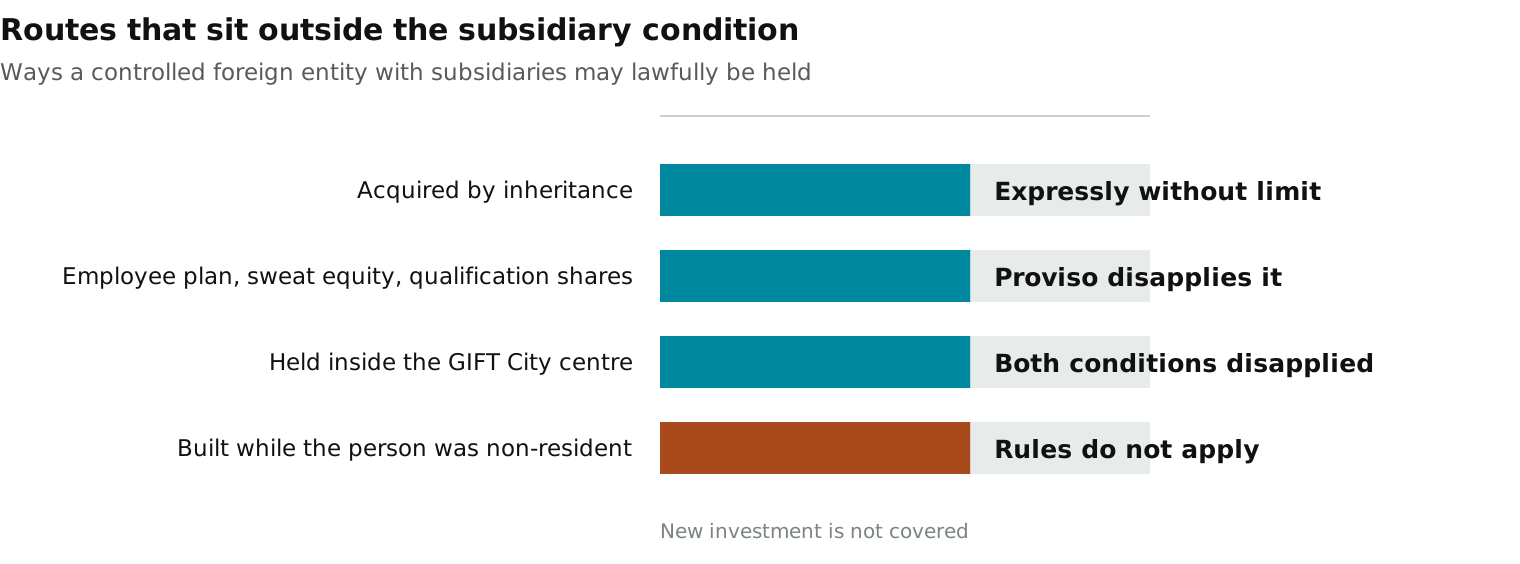
Inheritance is the widest. The rules permit acquisition by inheritance without any limit, from a resident or a non-resident. That category also sits inside the proviso. An inherited Singapore company that is controlled and has an Indian subsidiary is therefore lawfully held. It could not have been created, but it can be inherited. A gift is narrower, because gift is not inside the proviso, so all three conditions continue to apply. A gift from a non-resident also engages the foreign contribution rules, which are rarely satisfiable.
Employee share plans, sweat equity and minimum qualification shares are the second route. For them the proviso disapplies both the financial services bar and the subsidiary and control condition. The rules describe the amount as without limit, though any actual remittance still counts against the personal allowance. It requires a genuine employment or directorship connection and a plan applied uniformly across the company. It is not a device for a controlling founder.
The international financial services centre is the third and the most important for anybody who genuinely needs a holding company. The directions disapply both the operating entity condition and the financial services restriction for investment there. They also permit subsidiaries inside the centre, including with control. Outside it, a resident individual may hold a company with subsidiaries only without control. This is the one answer on the automatic route to a founder who wants to control a holding structure.
The fourth is the most valuable and the least known. The Act provides that nothing in these rules applies to an investment made outside India while the person was not resident. Consider a founder who built and held a controlled Singapore holding company with Indian subsidiaries while living abroad. She may continue to hold it on returning to India. The configuration prohibited to a resident is protected where it was created by a non-resident. Fresh subscriptions after the return are not protected, which is where the care is needed.
The two layer relaxation does not rescue an individual
The 2022 rules changed the position on a foreign entity investing back into India. Before them there was no express provision, and the Reserve Bank required specific approval that was in practice not forthcoming. Since 22 August 2022 the rules deal with it directly. They bar a financial commitment in a foreign entity that invests back into India. The bar applies where the result is a structure with more than two layers of subsidiaries. Within two layers it is automatic, with no approval needed.
Most commentary stops there, and that is the commonest error in this area. A founder holding a Singapore company that holds an Indian company is one layer, comfortably inside the two layer limit. But the Indian company is still a subsidiary for the purposes of Schedule III. If the founder controls the Singapore company, the Schedule III condition is breached regardless of how few layers there are.
The two layer relaxation is in substance a relaxation for Indian companies investing abroad. For an individual, Schedule III bites first and bites harder. How the layers are counted is itself openly disputed, with no clarification from the Reserve Bank. At least one firm has questioned whether the relaxation reaches resident individuals at all.
One point of scope is worth stating because it removes an escape route people reach for. Acquiring any amount of unlisted foreign equity is direct investment under these rules. There is no percentage threshold in the first limb of the definition. A Singapore private limited company is unlisted, so a single share is direct investment and all three gates apply. The ten per cent figure is relevant only to listed entities.
The reporting is light and the deadlines are unforgiving
A form is filed through the authorised dealer bank before the first investment is made, and a unique identification number issues. No money may leave India until that number is issued. The Master Direction states expressly that its allotment is not an approval from the Reserve Bank. Evidence of the investment is due within six months or the funds must come back.
An annual performance report falls due at the end of December each year. It is not required where the holding is under ten per cent without control and there is no other financial commitment. For an individual it must be certified by a chartered accountant. The report requires disclosure of any step-down subsidiary acquired or established, so the Schedule III condition is in effect self-reporting.
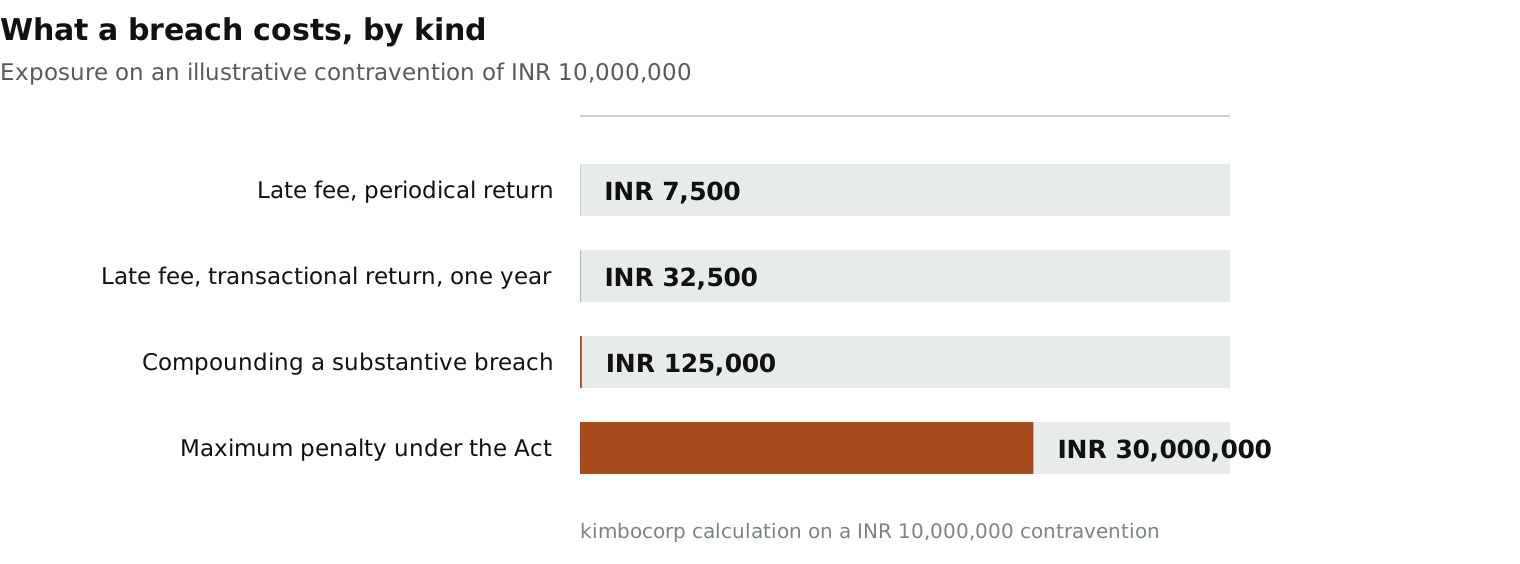
Late reporting is curable, and the mechanism is published rather than discretionary. A late submission fee runs on a formula, is available for up to three years, and is capped at the amount involved. For a periodical return it is a flat figure. For a transactional return it rises with the amount and the delay. It cures late reporting only, and it does nothing at all for a substantive breach of the conditions.
A substantive breach is a different matter. The Act provides for a penalty of up to three times the sum involved. Where the amount is not quantifiable the figure is two lakh rupees, with a continuing daily charge. Compounding is available. For a contravention of this kind the published schedule gives a fixed amount plus a percentage of the sum involved, subject to an overall cap.
No enforcement has been published on this specific point
The Reserve Bank publishes summaries of its compounding orders, and the term step-down subsidiary does not appear in any contravention description. Orders have been made against individuals under these rules through to September 2026. They concern limits, reporting and transfers rather than the control condition.
That absence cuts both ways and should not be oversold. The rules are young, and compounding is started by the applicant rather than the regulator. An absence of published orders is not evidence of tolerance. There is also no adjudication, tribunal decision or court decision on the point. No official set of questions and answers on the Overseas Investment Rules exists at all.
One false positive is worth flagging for anybody searching the orders. Entries citing rule 5 read with paragraph 1 of Schedule III are made under a different instrument. The Current Account Transactions Rules 2000 have their own Schedule III. They have nothing to do with overseas investment, and a search on the phrase will return them.
In the absence of enforcement, paragraph 22(1) of the Master Direction is the best available evidence of how the Reserve Bank reads the rule. It is nearly as good as a compounding order would be. The paragraph could not have been drafted on any reading but the conditional one.
What this means for founders, returning non-residents and advisers
For a founder building regionally, the structure that works is the one most businesses actually need. A Singapore company that signs its own customers, employs its own people and owns nothing in India passes all three gates. It may be held outright. The capital travels under the personal remittance allowance. That is USD 250,000 for each resident individual in each financial year, so two co-founders hold two allowances. One limit must never be crossed. That company must not acquire the Indian business at any point. From the moment it does, the founder holds a controlled foreign company with an Indian subsidiary beneath it.
For a founder who genuinely needs a holding company, there are two honest answers and neither is an offshore workaround. The international financial services centre permits it on the automatic route, with both conditions disapplied. The investors can instead come into the Indian company directly as inbound investment. That is how most of these situations are actually resolved. A stake below ten per cent without control is a third possibility, and it is a one-way door. A person who went in without control may never acquire control while the entity has a subsidiary.
For a returning non-resident, the most valuable thing in these rules may already be in place. A controlled Singapore holding company with Indian subsidiaries may already exist, built while the founder was abroad. On return it is protected by the statutory carve-out. The documentation establishing when the investment was made, and what the person's residence was at the time, is therefore worth assembling properly. It is the whole of the protection. Anything subscribed after the return sits outside it.
For an adviser, three points are worth carrying. The bar is conditional on control. A flat statement that a resident Indian cannot own a Singapore company is wrong, and it discourages legitimate business. The operating entity condition is undefined, and it is the stronger objection to a pure holding company. It is almost never raised. A claimed 2025 amendment to these rules also circulates online. It carries no notification number, no date and no operative text, and it is corroborated nowhere. The rules as notified on 22 August 2022 appear never to have been amended.
Our blog
Latest blog posts
Tools and strategies modern teams need to help their companies grow.