Japan’s inheritance tax treats a work visa better than permanent residence
Written by

Huan koh
Published on
October 19, 2026

Copy link
Link copied!


Since April 2021 a foreign national on a work visa has their foreign assets outside Japanese inheritance tax, however long they have lived there. Taking permanent residence forfeits that. Japan's inheritance tax reaches a top rate of fifty-five per cent, which is the highest in the developed world. Most of what is written about escaping it is wrong, and some of it is expensively wrong. The single most useful fact is also the least known. A foreign national living in Japan on a work visa has had their foreign assets outside Japanese inheritance and gift tax since 1 April 2021. Length of stay makes no difference to that. That relief is not a loophole. It is a deliberate policy choice, stated as such, to make Japan workable for skilled foreign professionals. Before April 2021 the same person was taxed on worldwide assets once they had been in Japan for more than ten of the previous fifteen years. The condition was repealed on the side of the person who dies or gives. It remains in place on the side of the person who receives. The relief attaches to the visa category and not to the person. Japan's immigration law divides residence statuses into two appended tables, and the relief covers table one only. Every work-related status sits in table one, including engineer, specialist in humanities and international services, intra-company transferee, business manager, highly skilled professional, professor and student. Permanent residence, spouse of a Japanese national, and long-term resident sit in table two, and none of them has ever qualified. That makes permanent residence an expensive thing to apply for. Consider a professional who has lived in Japan for a decade on a work visa and then takes permanent residence. That step moves their worldwide assets into the Japanese inheritance tax base. It starts the clock on the exit tax at the same time. Almost nobody is told either thing before they file the application.
The tax is charged on the recipient, on a notional share
Japanese inheritance tax works differently from the British and American systems, and the difference changes the arithmetic. It is a tax on the person who receives rather than on the estate. The rate bands are applied to each heir's hypothetical statutory share of the estate after the basic deduction. They are not applied to the whole estate, nor to what any heir actually receives.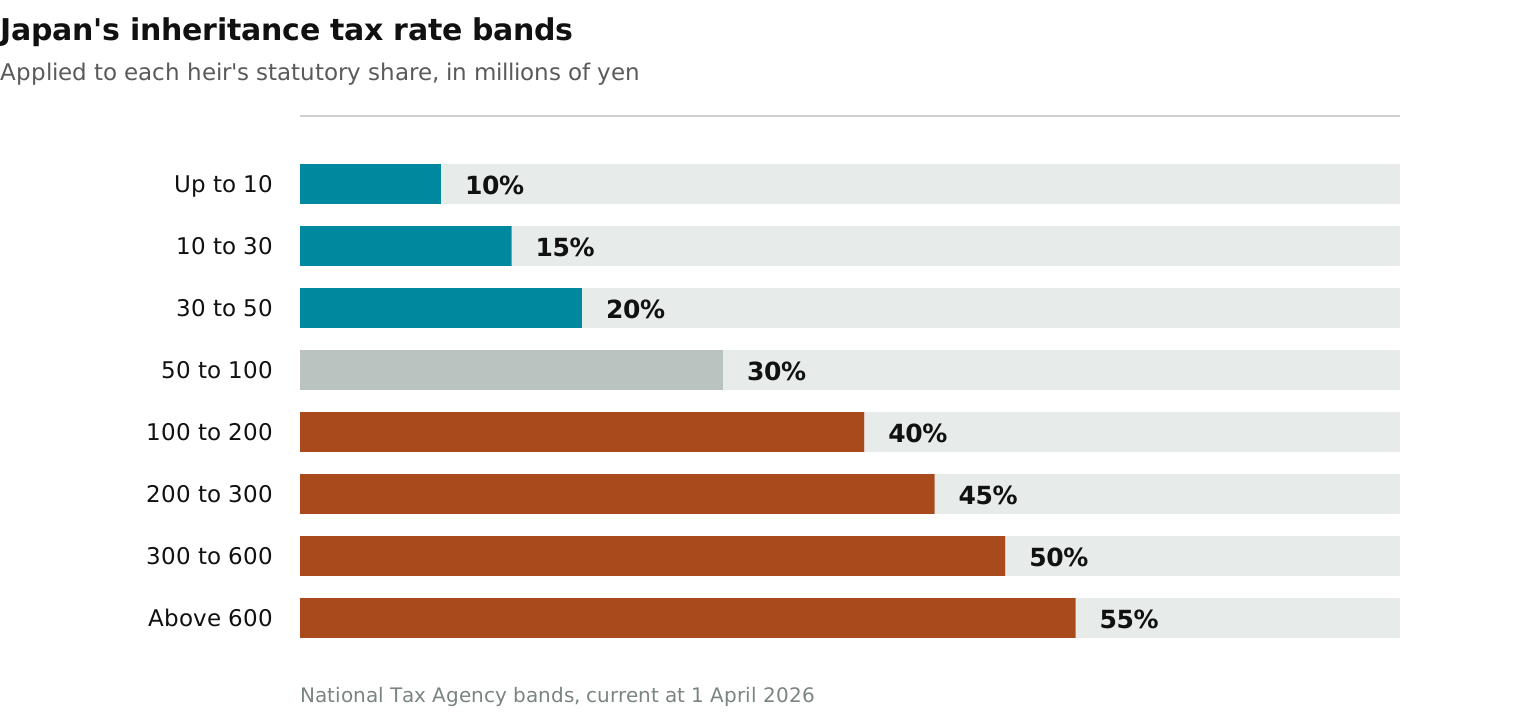 The basic deduction is thirty million yen plus six million yen for each statutory heir. Heirs who renounce are still counted, and adopted children are capped at one where there are biological children and two where there are none. A family of a spouse and two children therefore has a deduction of forty-eight million yen before any tax arises.
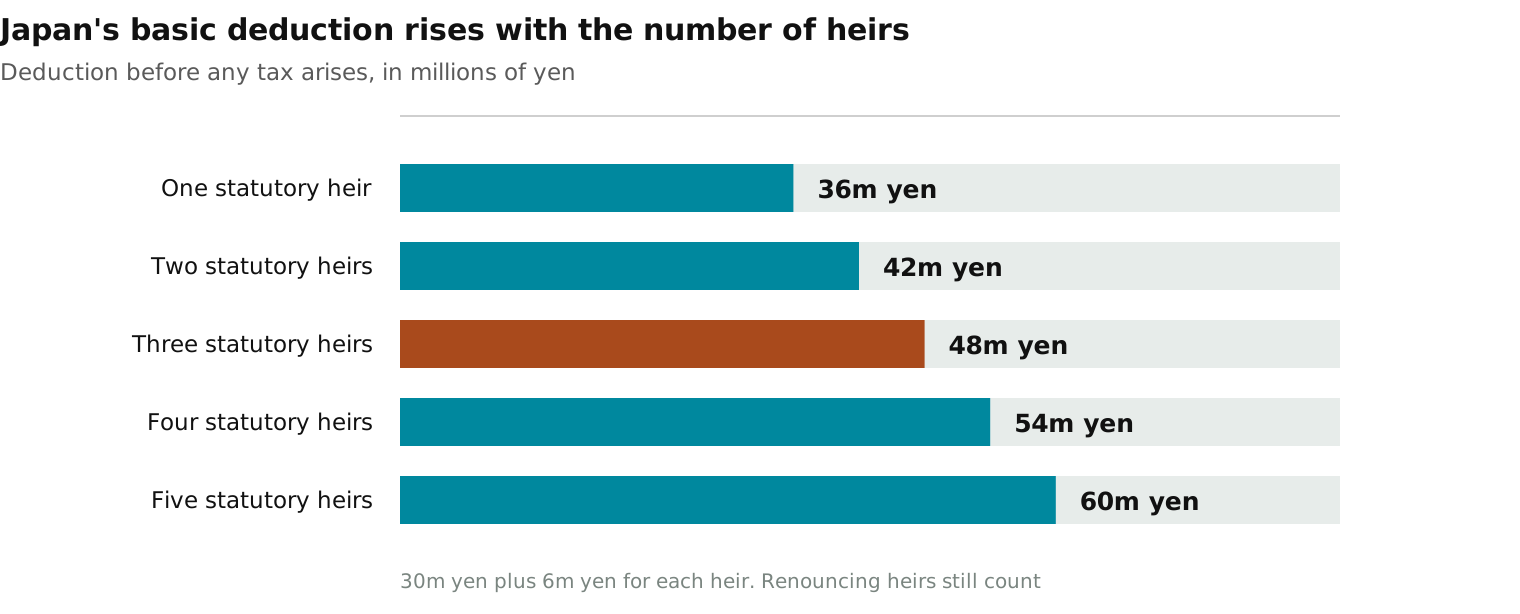 That deduction is the real complaint about Japanese inheritance tax, and it is a domestic complaint rather than a cross-border one. It was cut in the 2013 reform. Before that reform the deduction stood at fifty million yen plus ten million yen for each heir. The effect of the cut is visible in the published filing statistics, and it is larger than anything the cross-border rules have done.
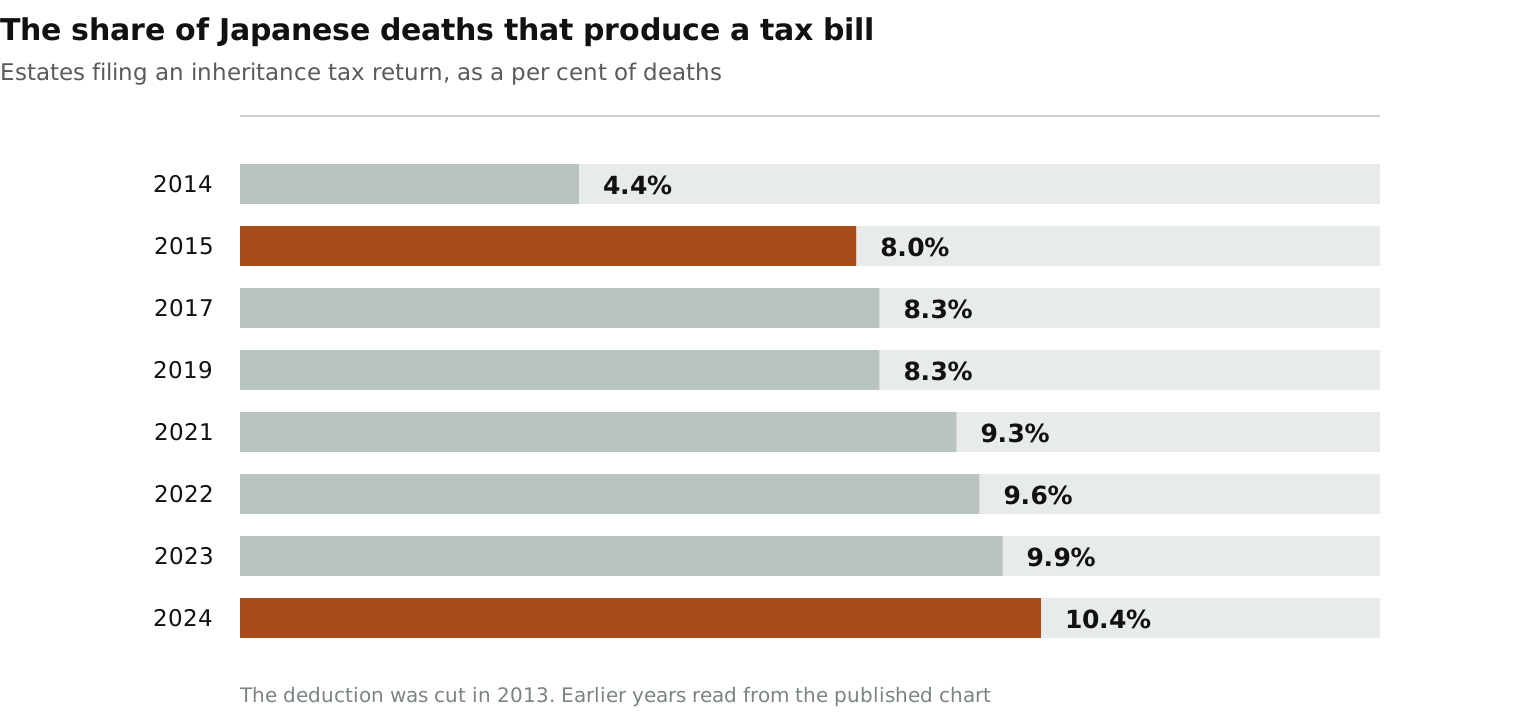 In 2014 about 4.4 per cent of Japanese deaths produced an inheritance tax liability. In 2015, the first year under the reduced deduction, that doubled to about eight per cent. It has risen in almost every year since, and 2024 was the first year above ten per cent, at 10.4 per cent of 1,605,378 deaths. The taxable value assessed in 2024 was 23.4 trillion yen and the tax 3.2 trillion yen.
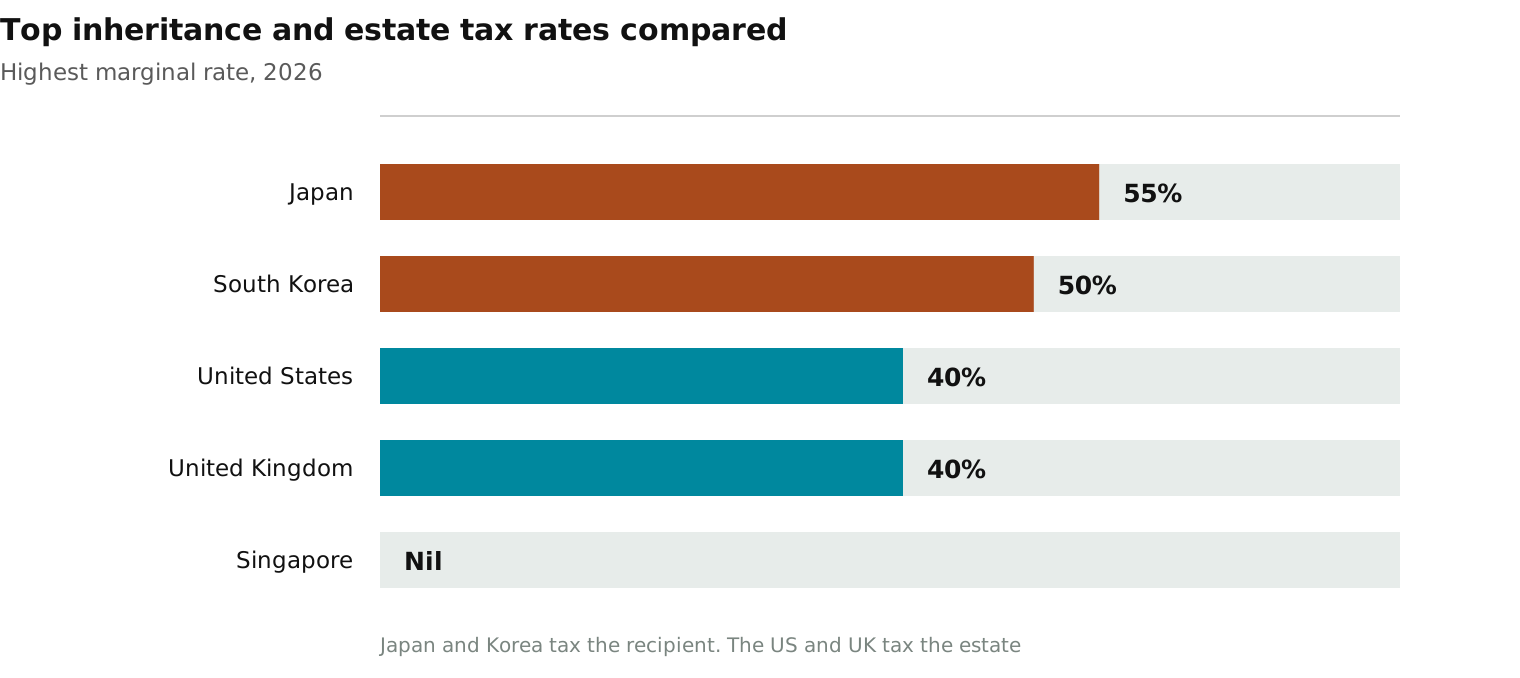 Against other systems, Japan is at the top and not by a small margin. South Korea reaches fifty per cent above three billion won. The United States reaches forty per cent, with an exclusion of USD 15 million for deaths in 2026. The United Kingdom reaches forty per cent above a nil rate band of GBP 325,000. A further residence band of GBP 175,000 tapers away above GBP 2 million. Singapore abolished estate duty entirely for deaths on or after 15 February 2008.
Foreign assets leave the net only when both parties have been gone ten years
The rule that defeats most planning is a double test, and it is routinely described as a single one. Take two Japanese nationals. Foreign assets fall out of the Japanese inheritance tax base only when both of them have been without Japanese domicile for more than ten years. That applies to the person who dies and to the person who receives. The ten year lookback itself is often quoted as five years. It was five until the 2017 reform, which extended it to ten with effect from 1 April 2017. Stale summaries are still in wide circulation. The practical meaning is that one generation leaving is not enough. The next generation has to move as well, and stay moved for over a decade, with the death falling after both clocks have run. A second rule is also commonly misstated. One measure once allowed a donor who had left Japan to give foreign assets free of Japanese gift tax after a short period. It was repealed on 1 April 2021. The advice to leave Japan, wait two years and then give is no longer correct, and following it now produces a Japanese gift tax charge. Gift tax is harsher than inheritance tax at the same amount, which is why giving things away before leaving usually backfires. The annual exemption is 1.1 million yen. The top rate of fifty-five per cent is reached at thirty million yen on the general table. Where the gift comes from a parent or grandparent, it is reached at forty-five million yen. The scope rules mirror the inheritance tax rules, with the same table one definition and the same clocks. One further change is worth knowing because the transition is keyed to the date of death rather than the date of the gift. Gifts made within three years of death are added back for deaths up to 31 December 2026. For deaths between 2027 and 2030, gifts from 1 January 2024 onwards are added back. The full seven year add-back applies only to deaths from 1 January 2031.The exit tax charges unrealised gains at 15.315 per cent
Japan taxes unrealised gains on departure, and the measure has been in force for departures on or after 1 July 2015. It applies where a person holds at least one hundred million yen of assets in scope. They must also have had a domicile or residence in Japan for more than five years in aggregate within the preceding ten. The threshold is aggregated across the whole holding, including loss positions and tax-exempt government bonds. Unsettled derivative and margin positions enter at their deemed settlement gain or loss. The assets in scope are securities, which covers listed and unlisted shares, investment trusts and bonds, together with silent partnership interests and unsettled trades. The rate is 15.315 per cent, being fifteen per cent with the reconstruction surtax, and local inhabitant tax does not apply. Here the visa rule helps again. Periods spent on a table one status do not count towards the five years. A person on a work visa is therefore outside the exit tax however long they have been in Japan. A person who has taken permanent residence is inside it. Transitional rules mean the earliest such a person could have crossed the five year line was 1 July 2020. Deferral is available for five years and can be extended to ten. It requires a tax agent appointed before departure, a claim made on the return, security equal to the deferred tax and interest, and an annual continuation notice. The charge is cancelled in full if the person returns within the period still holding the asset. Deferral is therefore real relief, and it is conditional on paperwork that has to be in place before anybody boards a plane. The exit tax also has two limbs that bite while the owner is still in Japan. A gift of in-scope assets to a non-resident triggers it. So does an inheritance passing to a non-resident. A family that moves one child abroad and leaves the parents in Japan has created an exit tax event on the parents' death, not avoided one.A Singapore holding company makes the position worse
Shares in a Singapore company are foreign-situs property under Japanese law, because shares are situated where the issuing company has its head office. That fact leads a great many people to the wrong conclusion, because situs only matters to a person taxed on Japanese assets alone. Where Japanese inheritance tax reaches a person's worldwide assets, a holding company removes nothing. The shares themselves are an asset. A portfolio worth twenty million dollars moved into a Singapore company becomes shares in a Singapore company worth about twenty million dollars. It is taxable at that value. Interposing an entity changes the description of the asset. It changes neither the value nor the taxpayer's status, and those are the only two things that matter.| The move | Effect on Japanese inheritance tax | Effect on the exit tax |
|---|---|---|
| Singapore bank account | None | None |
| Singapore holding company | None, and adds annual Japanese income tax | None |
| Singapore trust | None, and may be deemed a gift on creation | None |
| Singapore address while living in Japan | None | None |
| Holding a table one work visa | Foreign assets out of scope since 2021 | Period does not count towards five years |
| Taking permanent residence | Worldwide assets into scope | Starts the five year clock |
| Both parties without Japanese domicile ten years | Foreign assets out of scope | Departure itself is the charging event |
Changing residence is the only lever, and it carries its own bill
Residence is the only thing that changes the scope rules, and it changes them on statutory terms rather than on paperwork. Japanese law treats domicile as a question of fact, turning on where the centre of a person's life actually is. Deregistering an address does not move it. A Singapore address maintained while the family, the work and the home remain in Japan changes nothing. The arithmetic also needs doing in the right order. The exit tax is certain, immediate and charged at 15.315 per cent on unrealised gains. The inheritance tax is uncertain and more than ten years away. For a holding with large accrued gains, the exit charge can exceed the eventual inheritance tax. The basic deduction and the spouse's relief are what close the gap. That calculation should be done before anybody commits to moving. Two conclusions follow for different readers. A table one visa holder already has the relief on the side of the person who dies, and does not need to leave Japan to get it. They should establish whether the intended recipient is independently taxable on worldwide assets, because that is where the exposure actually sits. A Japanese national with Japanese children has no cross-border planning available at all, and should be told so plainly rather than sold a structure.Japan's own direction of travel is domestic
The annual tax reform acts are the place to look for what is coming, and the two most recent ones say something useful by omission. The 2026 reform was enacted on 31 March 2026. It contains nothing on the exit tax, nothing on inheritance or gift tax scope, and nothing on foreign trusts or holding companies. The 2025 reform contained nothing on those subjects either. What the 2026 reform did address was domestic valuation. Rental real estate acquired or built within five years before death will be valued at normal transaction value rather than at the lower assessed value. That applies to events on or after 1 January 2027. Fractional real estate products are treated the same way. A minimum tax on high incomes was also tightened, with the deduction halved and the rate raised from the 2027 tax year. The pattern is consistent across both years. Japan is closing domestic valuation gaps and tightening the income side. It has left the cross-border scope rules alone since 2021. A planner should therefore assume that the scope rules are stable and that the domestic valuation rules are not. The real estate valuation change is the one that will alter numbers already in existing plans, and it takes effect in just over a year.Singapore taxes less here, and it is not nothing
Singapore abolished estate duty for deaths on or after 15 February 2008. The abolishing Act was passed that year, and the original Act of 1929 remains on the books for earlier deaths. There is no inheritance tax, no gift tax and no estate duty in Singapore today. That position has held for eighteen years, which is worth saying because it is the kind of exemption other jurisdictions have introduced and then withdrawn. What Singapore does tax should be said, so that nobody reads this as a claim that Singapore taxes nothing. Individual income tax reaches twenty-four per cent above SGD 1 million. Corporate income tax, goods and services tax at nine per cent, property tax, stamp duty and withholding tax all apply. Stamp duty on residential property includes an additional buyer's duty, and there is a separate conveyance duty on the transfer of property-holding entities. One Singapore rule now works against the substanceless holding company specifically. Section 10L of the Income Tax Act applies to disposals of foreign assets on or after 1 January 2024. It taxes gains received in Singapore by an entity in a relevant group where that entity lacks adequate economic substance in Singapore. The test is applied at entity level, and a pure equity-holding entity meets it only with Singapore management, people and premises. An empty Singapore company is therefore worse in Singapore terms than it was before 2024, quite apart from what Japan does to it.What this means for professionals, families and advisers
For a foreign professional in Japan, the position should be established before any structure is discussed, because the answer is often better than expected. A table one visa holder's foreign assets are outside Japanese inheritance and gift tax on the side of the person who dies. Their time in Japan also does not count towards the exit tax. The question to settle is the recipient's status, and the question to think hard about is whether permanent residence is worth what it costs. For a Japanese family considering a move, the two clocks are the whole of the planning. Both the person who dies and the person who receives need more than ten years without Japanese domicile. The death has to fall after both periods have run. That is a decision about where a family lives for a generation rather than a tax structure. The exit tax should be quantified first, because it is usually the largest number in the plan. For an adviser, the defensible work is determining and documenting status under the four statutory definitions and planning around the clocks. The indefensible work is interposing an entity, because the controlled foreign company rules make a Singapore holding company a negative-value transaction for a Japanese resident. A structure that adds annual tax and removes nothing from the base is not a plan. A client who has been sold one should be told what it is costing.Our blog
Latest blog posts
Tools and strategies modern teams need to help their companies grow.