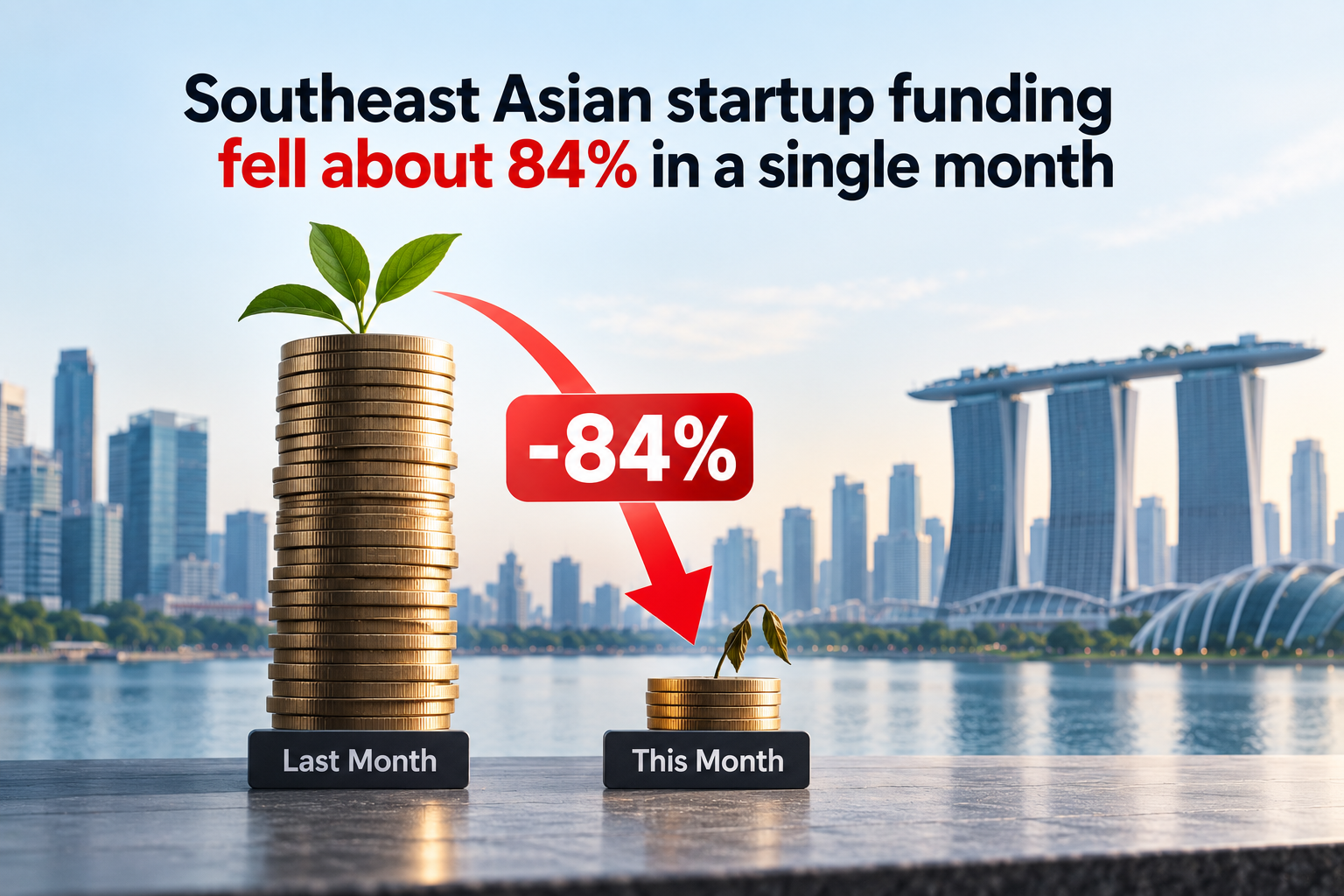
Southeast Asian startup funding fell about 84% in a single month
Written by

Huan koh
Published on
September 14, 2026

Copy link
Link copied!


Equity has become lumpy and unreliable. Most of the money now arriving in the region comes with a repayment schedule.
A founder reading regional funding headlines this year would have seen two markets. One looks healthy and one looks broken, often in the same week. Both come from real numbers. Southeast Asian startups raised about US$4.22 billion across 41 deals in June 2026. In July they raised roughly US$698 million across 30 deals. That is a fall of about 84% in four weeks. Neither month describes the market fairly, and the gap between them is what is worth understanding. Equity capital in the region has not disappeared. It has concentrated into a handful of very large rounds, so any monthly total now depends on whether one of those rounds happened to close. Meanwhile a different kind of money has been arriving quietly, and it is not equity at all.
June raised US$4.22 billion and July raised US$698 million
Start with the raw movement, because its size is what makes every monthly comparison unreliable. Two consecutive months, in the same region, covering broadly the same companies, differed by a factor of six. Nothing changed in those four weeks that could explain a gap like that. No policy shifted and no market closed. What changed was which deals happened to sign.
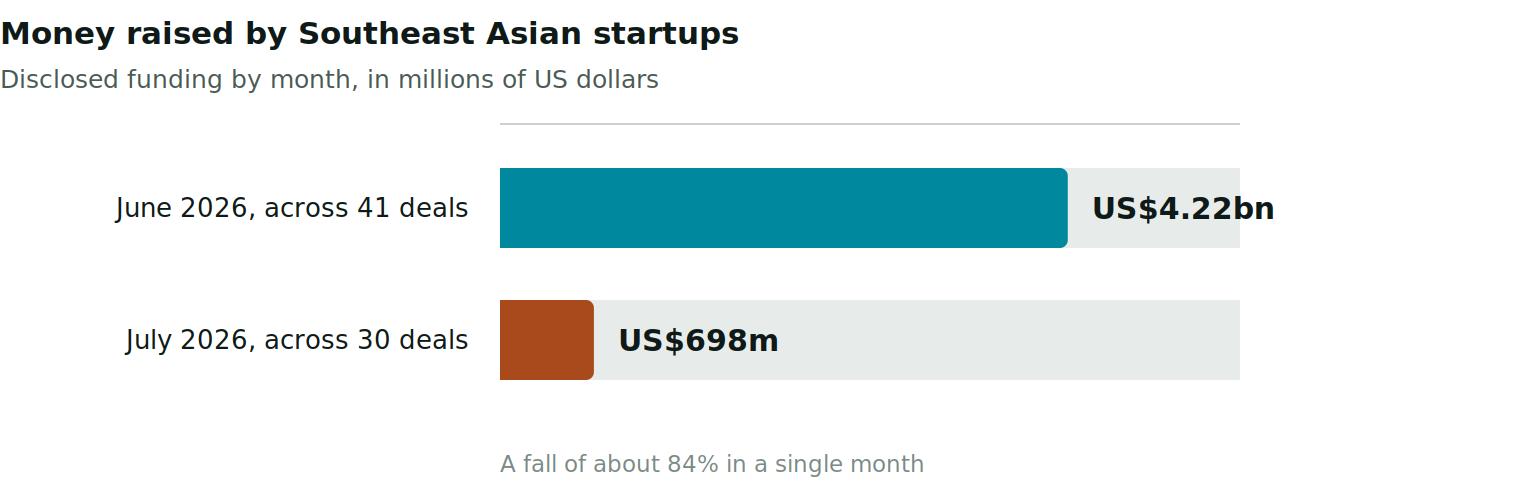
The deal count barely moved. June recorded 41 deals and July recorded 30, a fall of about a quarter. The capital fell by about 84%. When the number of transactions holds roughly steady while the money collapses, the explanation is almost never that investors stopped investing. It is that the largest cheques stopped clearing in that particular window. For a founder this has a direct consequence. Benchmarking your raise against a monthly regional total means benchmarking against a statistic driven by three or four companies you will never compete with for capital. The deal count is the more honest signal, and it says the market is slower rather than closed.
Ninety-three per cent of June's money went to five companies out of forty-one
The concentration is visible as soon as you break the good month apart rather than taking it whole. June is the month that looked healthy. It is worth asking who it was healthy for, because the arithmetic is not close.
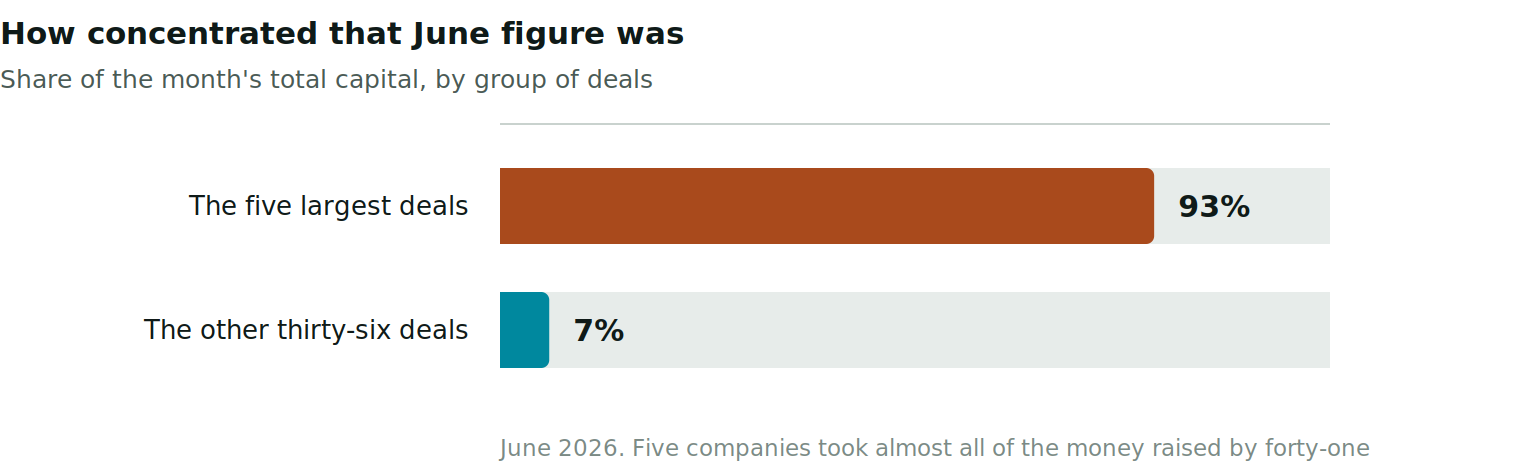
Five deals accounted for about 93% of the capital raised in June. The other thirty-six companies shared roughly 7%, which on a US$4.22 billion total is something under US$300 million between them. That is the pool a typical founder is actually raising into, and it bears almost no relationship to the headline. The same pattern showed up in the regional artificial intelligence figures earlier this year, where one very large round accounted for most of an annual total. This is not a distortion in the data. It is what the market now looks like. Capital is available in enormous quantities to a few companies and in ordinary quantities to everybody else, and averaging the two describes neither.
Three debt and hybrid funds appeared in the region inside a single week
While equity behaved like this, something else was happening with far less attention paid to it. In the week to 11 September, three separate credit or hybrid vehicles aimed at Southeast Asia were in the news. Granite Asia, headquartered in Singapore, confirmed it has raised over US$500 million for a hybrid strategy, with eight transactions and two exits completed and no fixed cap on its eventual size. OSK Ventures and Affin Hwang launched a debt and equity hybrid fund for revenue-generating Southeast Asian companies, on a three-year investment tenure. And a European development finance institution was reported to be proposing a US$10 million top-up to a Singapore-managed venture debt fund. That would sit on top of US$20 million already disbursed in March.
That third item rests on a single outlet and should be treated as unconfirmed. The pattern across all three does not depend on it. These structures share a purpose. They give a company capital without forcing a valuation, which matters when the last equity round was priced in a different market. They also carry obligations that equity does not. A repayment schedule is not a milestone you can miss quietly. Hybrid instruments usually come with covenants, security or conversion terms, and those bite in exactly the circumstances that made you need the money.
Hong Kong raised HK$342 billion from new listings in eight months
The public markets tell a third version of the same year, and it is worth seeing next to the private numbers. The two moved in opposite directions over the same months. Private fundraising in the region thinned out. Public fundraising in Hong Kong more than doubled.
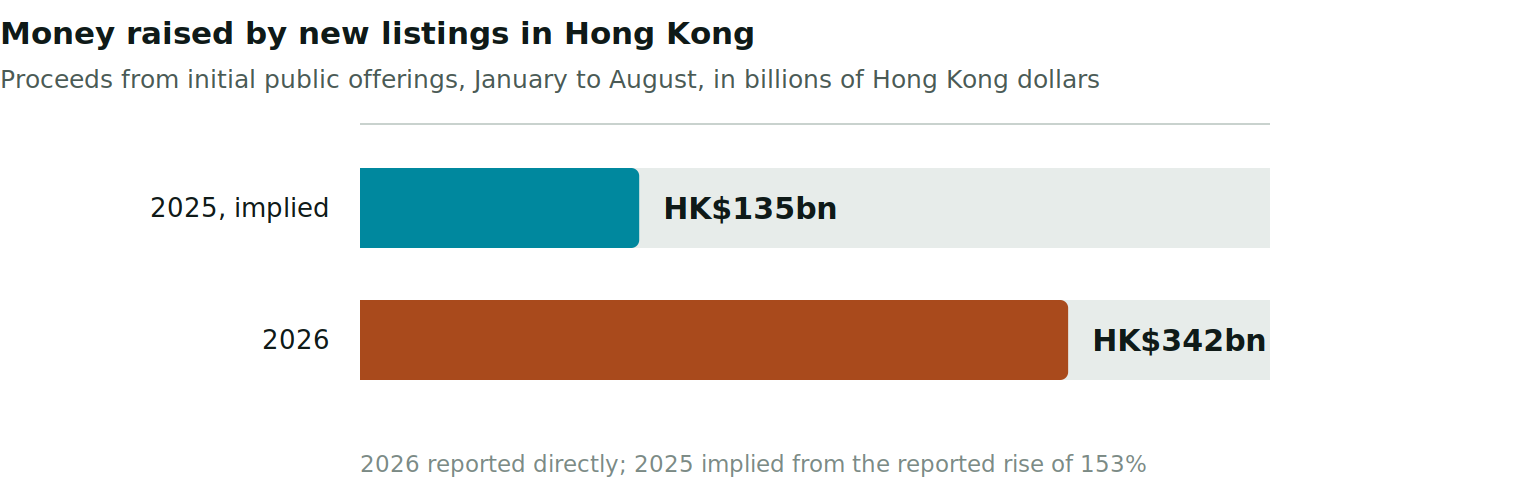
Hong Kong raised HK$342.4 billion from initial public offerings between January and August 2026, up 153% on the same eight months of 2025. New listings numbered 106, up 80%. Average daily turnover rose 14%. At the end of August the exchange had 2,761 listed companies and a market value of about HK$47.2 trillion. It also doubled the validity period of a new listing application, from six months to twelve, a temporary measure in force since 21 August. That matters more than it sounds. An application that expires before approval has to be refiled from the beginning, and several hundred companies were reported waiting earlier this year.
Singapore traded 35% more by value in August, which is not the same as raising money
Singapore's exchange reported its August figures on 11 September. They need reading carefully, because the strongest numbers measure the wrong thing for a company that wants money. There is a difference between a market where shares change hands briskly and one where companies raise capital. Both are useful, but only one puts money into a business.
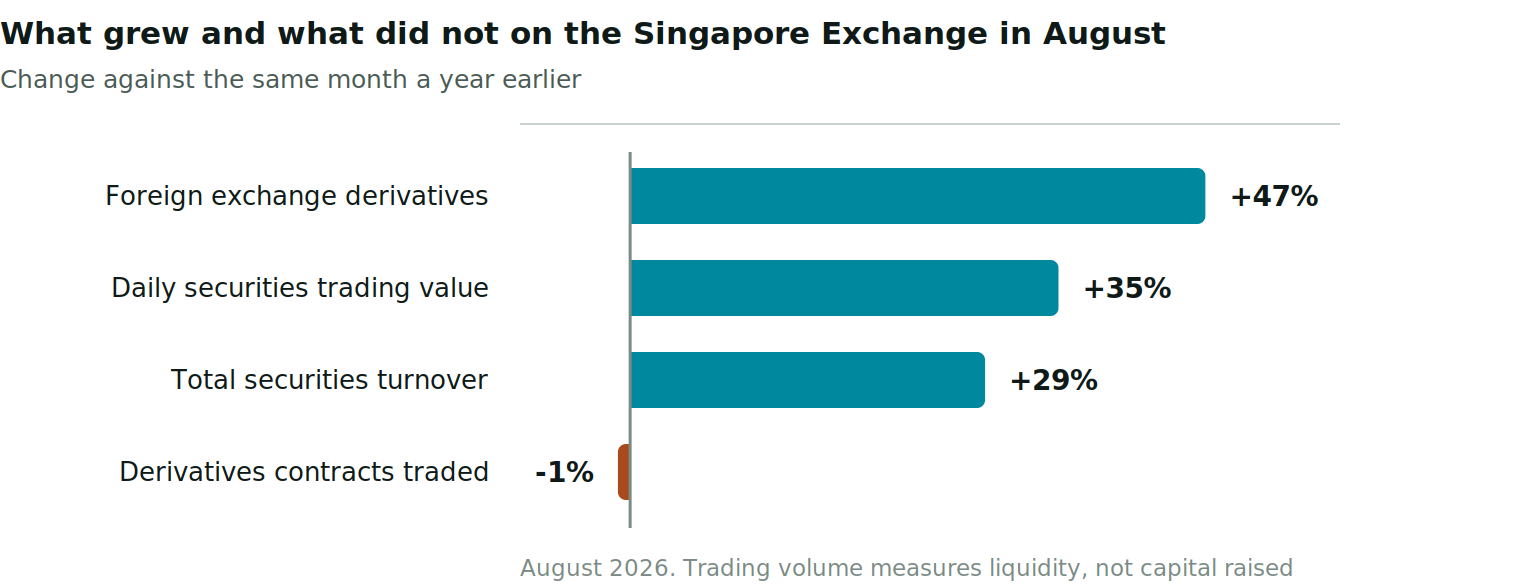
Daily securities trading value reached S$2.2 billion, up 35% on August a year earlier and 8% on July. Total securities turnover was S$43.3 billion, up 29%. Foreign exchange derivatives volume rose 47% to 8.1 million contracts. Total derivatives contracts fell 1%. Retail participation rose 22% month on month in real estate investment trusts. All of that describes liquidity, which is how easily existing shares change hands. It is not capital raised, and the two are regularly confused. Liquidity does matter to a company considering a listing, because it affects the price you achieve and how easily early holders exit. But an exchange can trade heavily for a year without one new company raising a dollar on it.
What this means for founders raising now, companies weighing debt, and anyone benchmarking against a headline
For a founder raising equity in Southeast Asia, build the plan around the deal count rather than the capital total. Thirty deals in a weak month and forty-one in a strong one means transactions are still happening at close to normal frequency. What has changed is the size distribution, and that changes who can lead your round rather than whether anyone can. Assume a longer process than your last raise, and that the first cheque is harder to secure than the rest. Be honest about which group you are in. A company raising into the 7% that thirty-six companies shared is competing on completely different terms from the five that took the rest. Both are viable, but running the second playbook from the first position wastes months.
For a company weighing debt or a hybrid instrument, the arrival of these funds is useful and is not a consolation prize. Capital without a priced round protects you from setting a valuation in a bad market, and for a business with real revenue it is often cheaper than the equity it replaces. The conditions are where the attention belongs. Understand what triggers a default, what security sits over which assets, and what happens if revenue slips for two quarters rather than one. Equity is patient by construction and debt is not, so the instrument that looks kinder at signing gets stricter precisely when trading is hard. Model the downside case before the base case, which is the reverse of how most term sheets get read.
For anyone benchmarking against a published figure, this month is a lesson in how easily accurate numbers mislead. Funding fell 84% and the market did not change much. Hong Kong raised 153% more and Singapore's turnover rose 35%. Neither of those tells a Singapore company what it can raise. The useful comparisons are narrower and harder to find. How many companies at your stage, in your sector, in your region raised in the last two quarters, and from whom? That takes about a week to answer properly and it is worth the week. Every shortcut produces a number built mostly out of other people's outliers.
Our blog
Latest blog posts
Tools and strategies modern teams need to help their companies grow.