What Australia’s new super tax does, and what offshore structuring cannot fix

Written by

Huan koh
Published on
October 12, 2026

Copy link
Link copied!


Division 296 became law on 13 March 2026 and applies from 1 July 2026. No company outside Australia reduces it by a dollar. Australia has added a second layer of tax to large superannuation balances. Two Acts received Royal Assent on 13 March 2026, and the measure applies to income years starting on or after 1 July 2026. It had a difficult passage. An earlier version announced in February 2023 would have taxed unrealised gains, and it never passed. The Government redesigned it in October 2025, dropped the unrealised gains element and moved the start date back a year. The commercial response being marketed to Australian owners is an offshore company, and it does not work. Division 296 measures two things only, both of them inside the superannuation system. A Singapore company is in neither. Money cannot lawfully leave superannuation before a condition of release. If the fund itself buys the shares, they stay in the balance and the calculation is unchanged. That is worth stating plainly at the start, because the opposite is being sold by incorporation agents on both sides of the trade. What a Singapore company does for an Australian owner is a separate and narrower thing. This article sets out the tax as it actually works, and then what a Singapore structure can and cannot carry.
Division 296 is charged on earnings, not on the balance
The common description is that balances above A$3 million are taxed at 30% and balances above A$10 million at 40%. That is right about the headline and wrong about the base. The tax applies to earnings, and only to the proportion of those earnings attributable to the part of the balance above each threshold.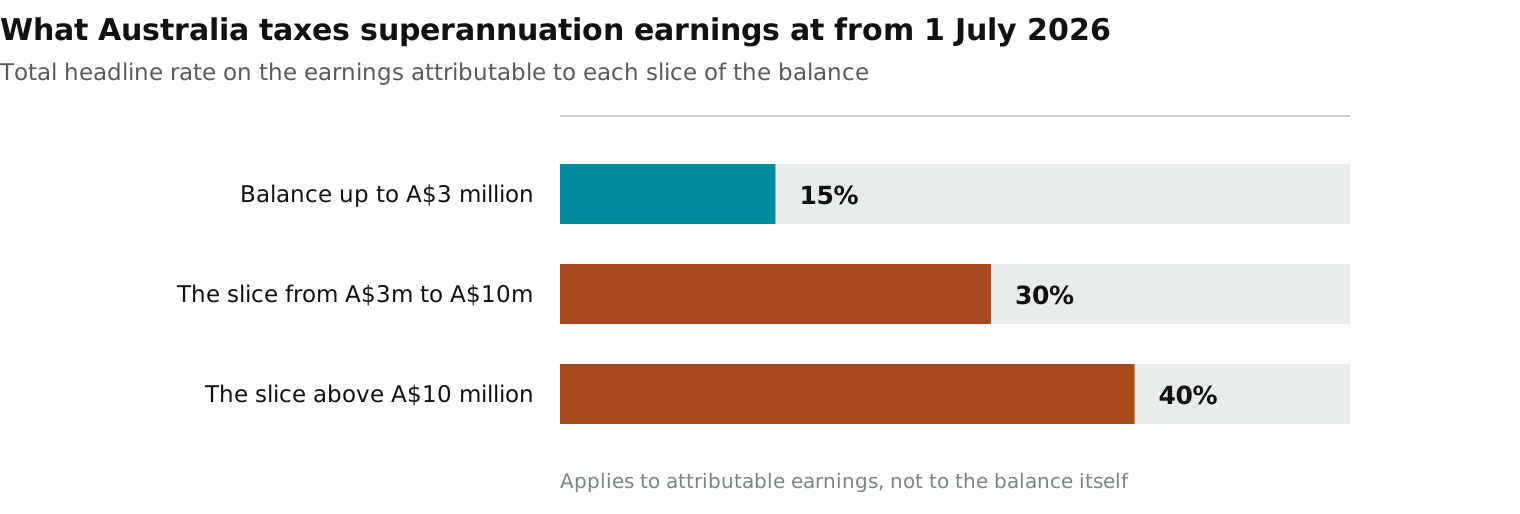 The mechanism works by proportion. An additional 15% applies to the share of earnings attributable to the balance above A$3 million. A further 10% applies to the share attributable to the balance above A$10 million. The fund's own 15% sits underneath both. That is where the 30% and 40% headline figures come from, and they are the total rather than the additional charge.
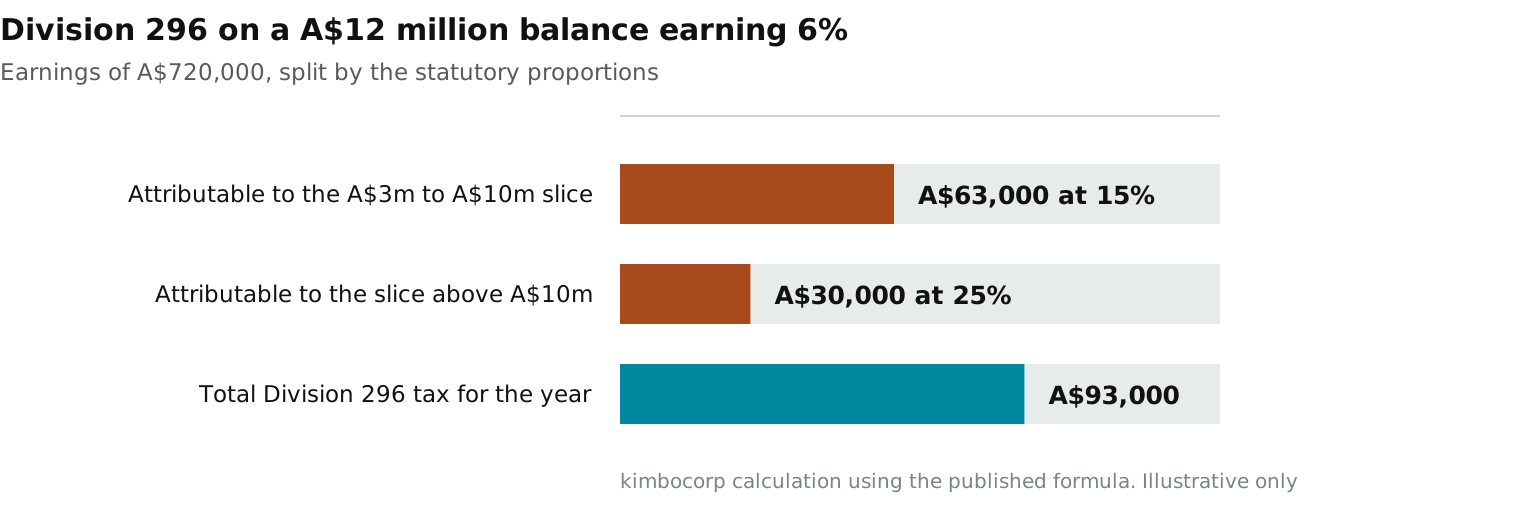 A worked example makes it concrete. On a balance of A$12 million earning 6%, total earnings are A$720,000. Three quarters of the balance sits above A$3 million, so A$540,000 of those earnings attract the extra 15%, which is A$81,000. One sixth sits above A$10 million, so about A$120,000 attracts the further 10%, which is A$12,000. The Division 296 charge is therefore about A$93,000 for the year.
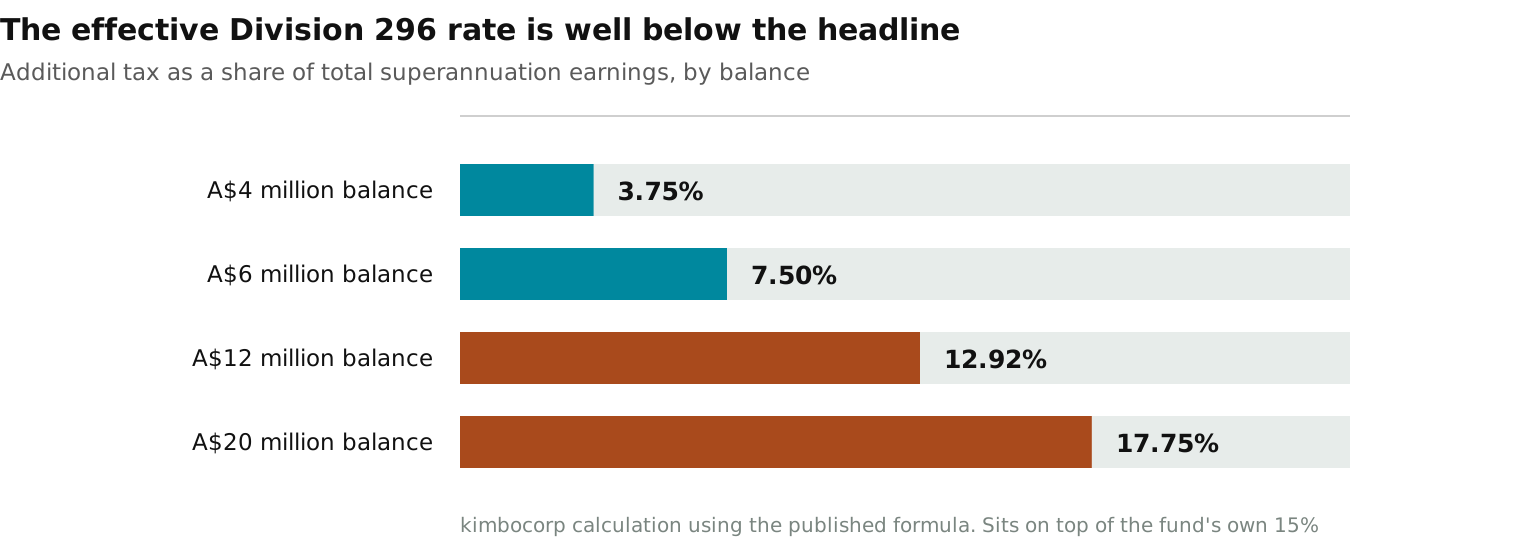 Expressed as a rate on all the earnings, that is 12.92% rather than 30% or 40%. The effective charge rises with the balance, from 3.75% at A$4 million to 17.75% at A$20 million. Both thresholds are indexed, in steps of A$150,000 and A$500,000, which removes the criticism that drove most of the opposition to the 2023 design.
Nobody is liable yet, and the first assessments arrive in 2028
Timing is the detail most commentary gets wrong, and it matters for planning. For the 2026-27 year the balance is tested at 30 June 2027 alone, which is a transitional concession. Nobody has a Division 296 liability as at October 2026, because the measurement date has not arrived. The assessments come later still. Large funds have until the end of October to report balances, and self-managed funds may not lodge until the following May. The Australian Taxation Office has said the first assessments begin issuing in the later half of the 2027-28 income year. Payment is due 84 days after the notice. One transitional concession deserves more attention than it gets. An eligible self-managed or small fund may elect to reset the cost base of its assets to market value at 30 June 2026. The election counts for Division 296 purposes only. For a fund holding assets with large accrued gains, that election is the single most consequential decision available, and the window for it has already opened.A Singapore company does not reduce Division 296 by one dollar
There are four reasons for that, and each one is sufficient on its own. They are worth going through in order, because the first two defeat the idea outright and the second two defeat the fallback versions of it. The first is that Division 296 is a function of the member's total superannuation balance and the earnings reported by superannuation funds. A foreign company is neither a superannuation interest nor a superannuation fund, so money genuinely outside the system was never in the base to begin with. The second is preservation. Superannuation benefits cannot be accessed until a condition of release is met. That generally means retirement at or after preservation age, reaching 65, death, permanent incapacity or terminal illness. A member below preservation age cannot move superannuation money into a foreign company at all. Attempting it is illegal early release, and the consequences are severe. The third is what happens if the fund itself invests. A self-managed fund generally cannot acquire private company shares from a member or a related party. An investment in a related company is an in-house asset capped at 5% of the fund. Non-arm's length dealings produce income taxed at the top marginal rate inside the fund. And decisively, the shares would still be a fund asset, still counted in the member's balance, and the income still part of the Division 296 calculation. The fourth reason applies outside superannuation entirely, and it is the one most offshore marketing ignores. It is also the reason an offshore company is usually the wrong answer for an Australian investor even where superannuation is not involved at all.Outside superannuation, the controlled foreign company rules remove the usual advantage
An Australian tax resident is assessable on income from all sources, inside and outside Australia. The controlled foreign company rules then close the deferral that an offshore company would otherwise provide. Singapore is not on Australia's list of seven listed countries, which contains Canada, France, Germany, Japan, New Zealand, the United Kingdom and the United States. The test that decides the outcome is the active income test. A foreign company passes if less than 5% of its gross turnover is tainted income, which means at least 95% must be genuine active business income. Interest, dividends, rent, royalties and gains on shares are all tainted. A Singapore holding or investment company owned by an Australian resident will therefore fail that test. Its income is attributed to the resident and taxed at marginal rates in the year it is earned. That happens whether or not a dividend is paid.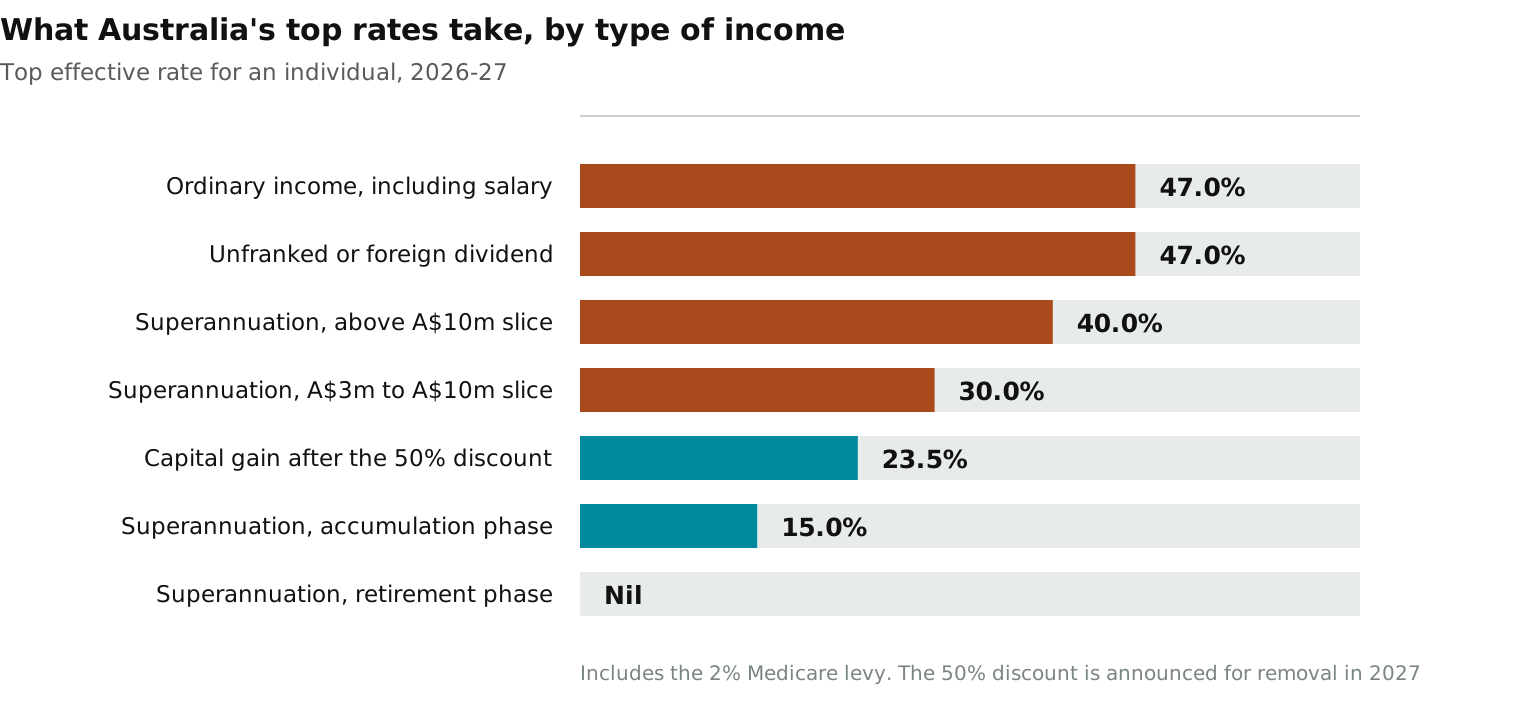 The distribution is no better. A dividend from a Singapore company carries no Australian franking credit, because only Australian company tax generates franking credits. Singapore levies no withholding tax on dividends, so there is usually no foreign income tax offset either. The dividend therefore arrives with no credit of any kind and is taxed at the resident's full marginal rate, up to 47%.
| For an Australian tax resident | After genuinely ceasing residency | |
|---|---|---|
| Reduces Division 296 | No, in any circumstances | No, if Australian superannuation is retained |
| Shelters passive investment income | No, the controlled foreign company rules attribute it | Yes, Australia no longer taxes worldwide income |
| Produces franking credits | No | Not applicable |
| Produces a foreign tax credit on dividends | No, Singapore withholds nothing | Not applicable |
| Visible to the Australian Taxation Office | Yes, through automatic exchange of account information | Yes |
| Houses a genuine regional operating business | Yes, and active profits can escape attribution | Yes |
| Gives treaty access and a regional base | Yes | Yes |
Leaving Australia triggers a deemed sale of almost everything
Residency is the only thing that changes the analysis, and changing it has a price. On ceasing to be an Australian resident, the individual is treated as having disposed of every asset at market value, except taxable Australian property. There is an election to defer, but it is all or nothing across every affected asset. The deferred assets are then treated as Australian property until sold, or until the person returns.
That election is often the worse choice. A later sale while non-resident loses the 50% capital gains discount for the non-resident period and attracts non-resident rates with no tax-free threshold. Triggering the deemed disposal on departure crystallises the gain while the person is still a resident and still entitled to the discount. That is the opposite of what most people assume.
Two things do not change on leaving. Division 296 contains no residency test, so an Australian expatriate who keeps a superannuation balance above the threshold remains liable. And a self-managed fund must continue to meet the tests for an Australian superannuation fund, including where central management and control sits. Members moving abroad for an extended period put the fund's complying status at risk, and with it the concessional rate on everything inside it.
Three larger changes have been announced and not legislated
Division 296 is not the only thing moving in Australian tax. An owner planning for the next five years should know what is proposed as well as what is already law. Three larger measures sit in the announced column, and two of them would reshape how private wealth is held.
The 2026-27 Budget on 12 May 2026 announced the removal of the 50% capital gains discount for gains arising after 1 July 2027. It would be replaced by cost base indexation for assets held at least twelve months and a 30% minimum tax on real capital gains. It would apply to individuals, trusts and partnerships across all asset classes. Assets acquired before 20 September 1985 would be brought into the net for gains after that date. None of this is legislated.
The same Budget announced a 30% minimum tax on the taxable income of discretionary trusts from 1 July 2028, payable by the trustee. Franking credits would be applied by the trustee first, so they would not flow to beneficiaries, and company beneficiaries would receive no credit at all. Fixed trusts, superannuation funds, deceased estates and testamentary trusts existing at 12 May 2026 would be excluded. This too is announced only.
Separately, the High Court decided on 10 June 2026 that an unpaid present entitlement owed by a trust to a corporate beneficiary is not a loan. That takes it outside the deemed dividend rules. That is a win for a common structure, though the Tax Office has signalled it may use other provisions where those rules no longer reach.
What a Singapore company actually does for an Australian owner
The honest case is narrower than the marketing and more durable. A Singapore company that carries on a genuine business passes the active income test. It needs real people performing real functions, and at least 95% active income. Its retained active profits are not attributed to the Australian owner. They are taxed in Singapore at 17%, with exemptions that reduce the effective rate on smaller profits.
Beyond tax, it provides a regional base with treaty access, multi-currency banking and a labour market for regional roles. For an Australian business genuinely selling into Asia, that is a commercial decision that happens to have a reasonable tax outcome. For an Australian investor holding a portfolio, it is a worse outcome than doing nothing, with compliance costs on top.
One claim should be treated with suspicion wherever it appears. There is no dataset showing Australians relocating or restructuring offshore in response to Division 296. The closest official series is Australian Bureau of Statistics migration data for 2024-25. It shows Australian citizen departures falling rather than rising, and it covers a period ending before Division 296 was even law. Anyone citing a relocation wave is inventing it.
What this means for members near the threshold, owners weighing an offshore move, and advisers fielding the question
For a member whose balance is near or above A$3 million, the decisions worth making are inside the Australian system rather than outside it. The cost base reset election to 30 June 2026 market value is available now and is irreversible once the year closes. The measurement date is 30 June 2027, which means asset allocation and realisation timing in the current year both matter. Neither of those decisions involves a foreign company.
For an owner weighing a move abroad, residency is the only lever that works, and it carries its own bill. The deemed disposal on departure should be quantified before anything else, because it is usually the largest single number in the plan. Taking the charge rather than deferring it is frequently the better answer. And superannuation follows the person, so an expatriate with a large Australian balance remains inside Division 296.
For an adviser being asked whether a Singapore company helps, the answer separates cleanly into two parts. It does nothing for Division 296, and nothing for passive income while the client is an Australian resident. It does work for a genuine operating business in the region, where the active income test can be met and the structure stands on commercial grounds. Keeping those two answers apart is what protects the client and the adviser.
Our blog
Latest blog posts
Tools and strategies modern teams need to help their companies grow.