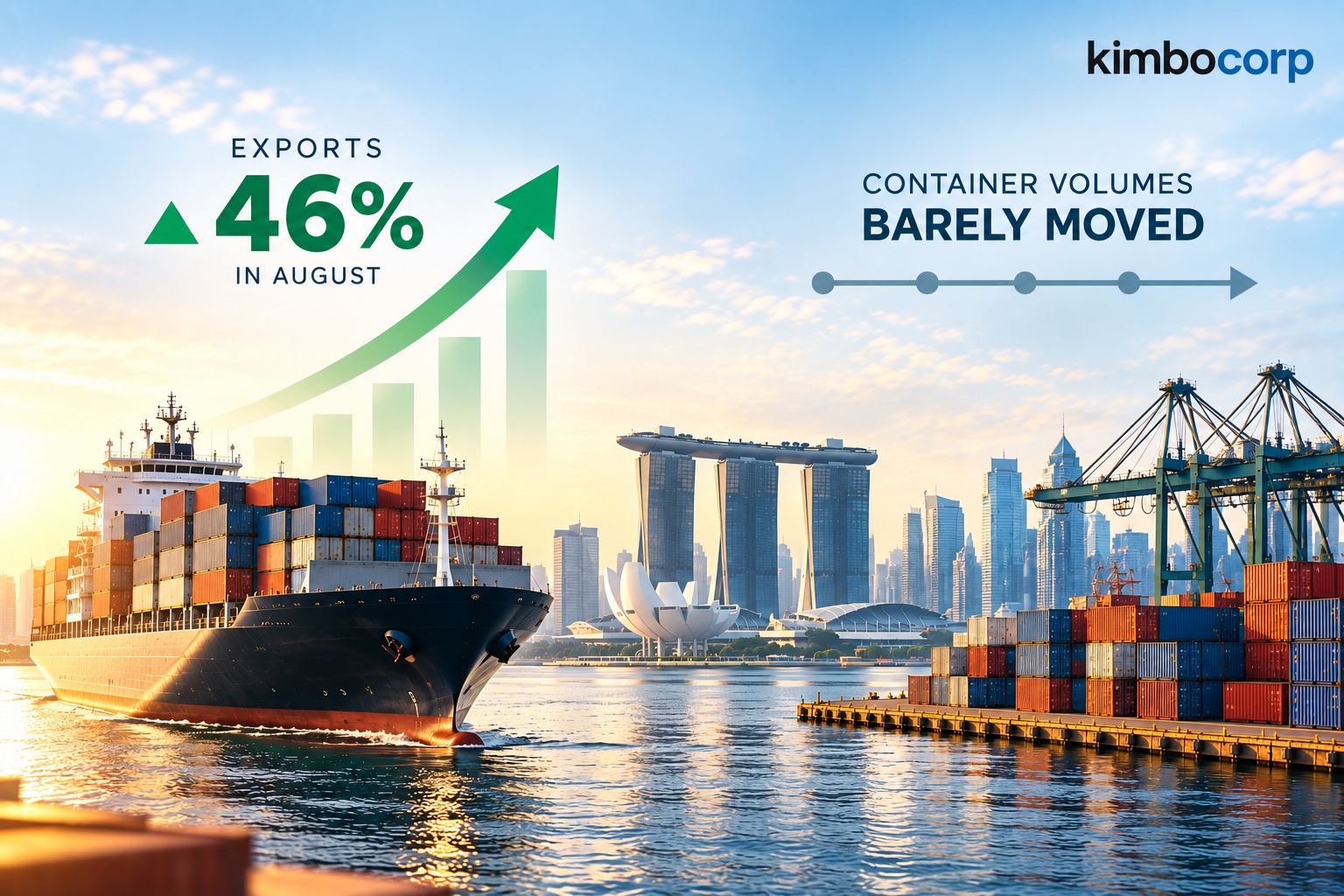
Singapore’s exports rose 46% in August while its container volumes barely moved
Written by

Huan koh
Published on
September 22, 2026

Copy link
Link copied!


Value and volume have come apart. The goods driving the surge take up almost no space.
Singapore's non-oil domestic exports rose 46.2% in August 2026 against the same month a year earlier, Enterprise Singapore reported on 17 September 2026. Non-oil re-exports rose 53.3%. Total merchandise trade rose 44.5%. Over the same month, container throughput at the Port of Singapore rose 2.3%, according to Maritime and Port Authority data. Both figures cover the same month and the same port.
Export value and container volume measure different things. Value counts what the goods are worth. Volume counts how much space they take up, measured in twenty-foot equivalent units. When growth concentrates in small, dense, expensive electronics, the first number can move many times faster than the second. That gap decides whether an export boom reaches a trading company's freight bill and warehouse space, or stays in the headline. It also decides which businesses in Singapore feel the boom at all.
Exports grew 46.2%, and four products carried most of it
Electronics exports rose 131.8% in August 2026, up from 112% in July 2026. Non-electronics rose 12.0%, reversing a fall of 2.4% the previous month. That reversal matters more than the headline rate. July 2026 was a month in which one category carried everything while several others contracted. August 2026 was broader. Exports rose to nine of Singapore's top ten markets, and the United States and China remained the two largest.
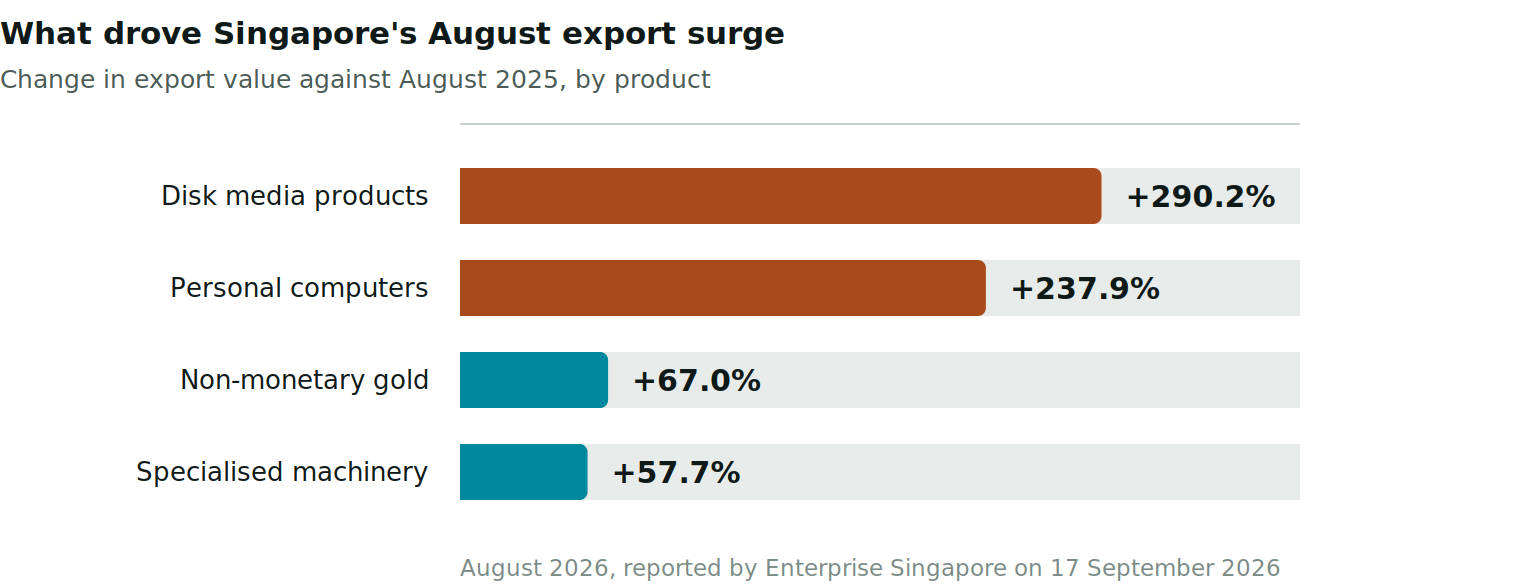
Four products account for most of the increase. Disk media products rose 290.2%, adding S$1.4 billion. Personal computers rose 237.9%, adding S$1.3 billion. Specialised machinery rose 57.7%, adding S$0.8 billion. Non-monetary gold rose 67%, adding S$0.5 billion. Three of those four are artificial intelligence hardware or its inputs. The fourth is gold, which moves for reasons unconnected to technology demand. Separating gold out is worth doing before quoting the total, because it is the one line most likely to reverse on its own.
Container volumes grew 2.3% over the same month
The port handled 3.95 million containers in August 2026, on a preliminary estimate, against 3.86 million in August 2025. That is a rise of 2.3%. Against July 2026, volumes fell 0.9%. For the first eight months of 2026 the port handled 30.68 million containers, up 4.2% on the same period of 2025.
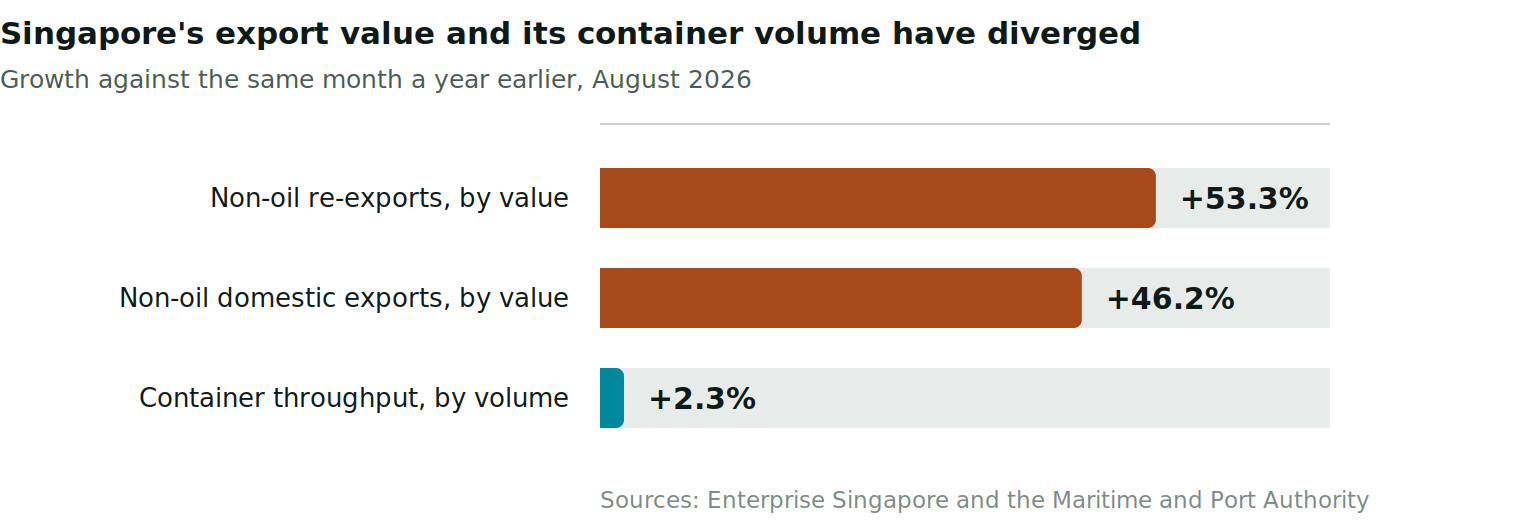
So Singapore moved roughly the same number of boxes while the value inside them rose by almost half. For a trading company this has three practical consequences. Freight capacity is not the constraint on this particular boom, because the goods driving it are light. Cargo insurance and financing requirements rise with declared value rather than with volume, so both move with the larger number. And a business trading in anything other than electronics gains nothing from the headline, because the 12% growth in non-electronics is the figure that applies to it.
Transpacific rates reached a four-year high in the week to 17 September 2026
Freight costs moved sharply in the same period, and they moved in opposite directions by route. The Drewry World Container Index composite stood at US$4,500 for a forty-foot container in the week to 17 September 2026, up 1% on the week. Underneath that composite the spread widened considerably.
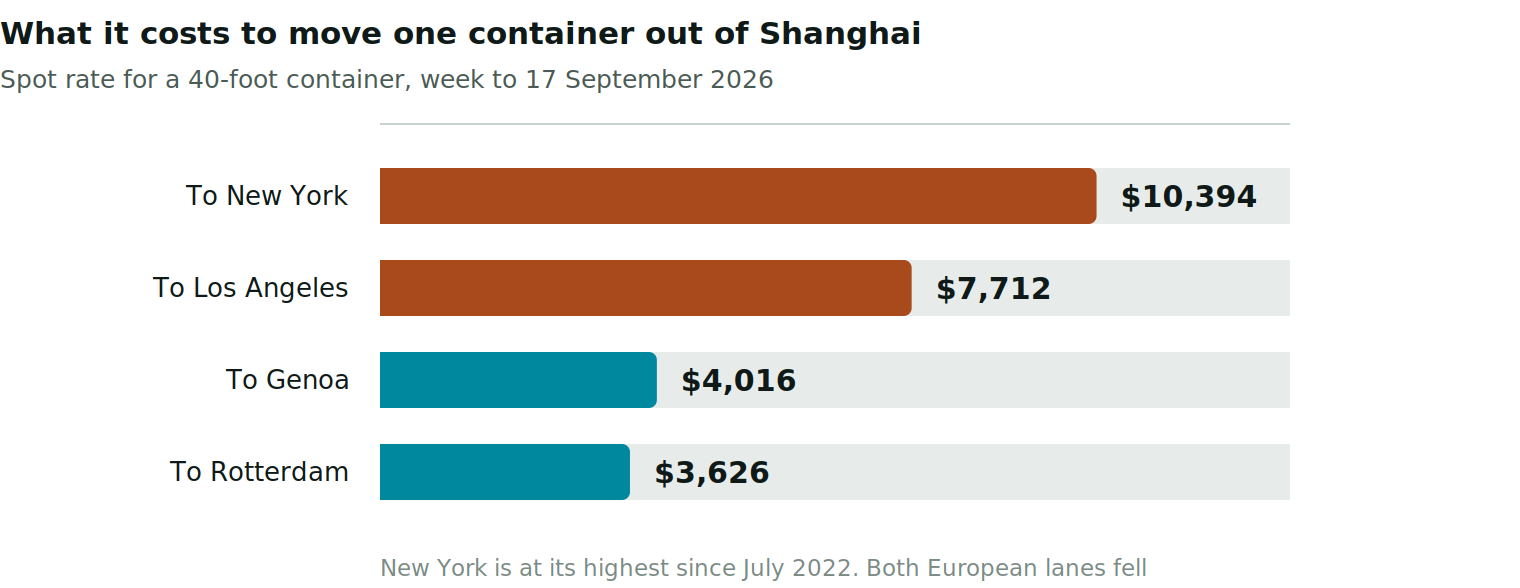
Shanghai to New York reached US$10,394, up 7% on the week. That is the highest level since July 2022. Shanghai to Los Angeles reached US$7,712, up 5%. Shanghai to Genoa fell 5% to US$4,016, and Shanghai to Rotterdam fell 9% to US$3,626. Carriers announced nine blank sailings on the transpacific for the following week, meaning scheduled voyages cancelled to take capacity out of the market. Asia to Europe had four, up from one. Xeneta assessed Far East to US East Coast at US$11,259 per forty-foot unit on 17 September 2026, up 324.7% from 28 February 2026.
A second constraint tightened on the American east coast route in the same week. The Panama Canal reduced bookable transits to 32 a day from 15 September 2026, made up of nine slots through the Neopanamax locks and 23 through the Panamax locks. Normal capacity is closer to 36. The cause is low water in the watershed that feeds the locks, which is a supply problem that higher payments do not solve. One transit slot sold at auction for US$5.3 million on 1 September 2026, reported as the highest price ever paid for passage.
Carriers moved services back to the Suez Canal
The second structural change is the route itself. On 14 September 2026 Maersk and Hapag-Lloyd announced that four services in their Gemini network, AE5, AE11, AE12 and ME2, would shift from the Cape of Good Hope to the Suez Canal. MSC said the same day that its Indusa service would resume Suez transits westbound from 23 September 2026, while eastbound sailings continue around the Cape. On 16 September 2026 the OOCL Portugal, at 24,188 containers, made the first southbound Suez transit by a COSCO group vessel since the diversions began. Evergreen has not returned.
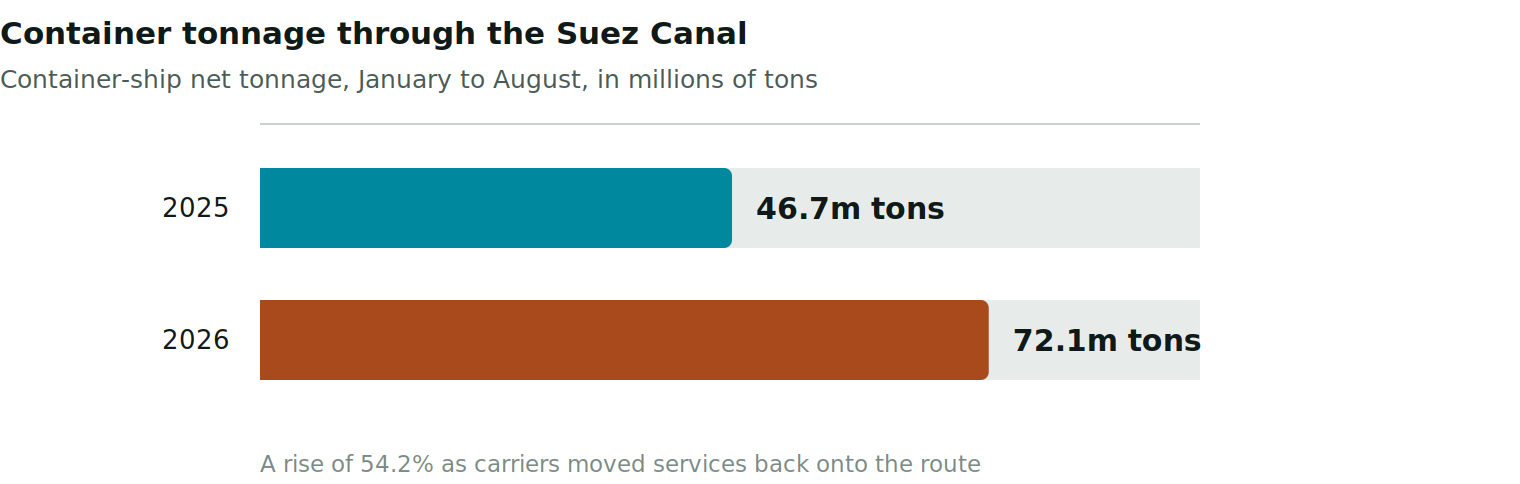
Suez Canal Authority figures put container-ship net tonnage at 72.1 million tons for January to August 2026, against 46.7 million tons in the same period of 2025. That is a rise of 54.2%. A normalised Suez routing shortens Asia to Europe transit times by roughly ten days against the Cape, which is the single largest variable in European lead times and a direct input to Singapore's role as a transhipment point. Carriers have announced no day-count savings of their own, and the return is partial rather than complete.
What this means for exporters, importers into America, and companies routing through Singapore
For an exporter outside electronics, the August 2026 headline does not describe the conditions that apply. The relevant figure is the 12.0% rise in non-electronic exports, which is a genuine improvement on July's contraction but a different order of growth. Costing and forecasting should use the category number rather than the aggregate. The same discipline applies to any customer or lender quoting Singapore's trade performance back at a business, since the aggregate has been carried by four products for two consecutive months.
For a company importing into the United States, freight is now a larger risk than tariffs on this route. New York at US$10,394 and Los Angeles at US$7,712 are both far above European levels. Both rose while European lanes fell. Nine blank sailings in a single week indicates that carriers are managing capacity to hold those rates rather than to fill ships. The Panama restriction points the same way on the east coast route. Any quote given on a September 2026 rate should carry a short validity period, or an explicit freight adjustment clause, and the east coast premium is worth costing separately from the west.
For a company routing goods through Singapore, the Suez return is the development to plan around. European lead times should shorten as more services move back, which releases working capital tied up in longer transits and in the inventory held to cover them. The return is not complete, carriers are phasing it and at least one major line has not moved, so schedules should be confirmed service by service rather than assumed. Businesses that recalculate their European inventory cover on the shorter transit before their competitors do will free cash that is currently sitting on the water.
Our blog
Latest blog posts
Tools and strategies modern teams need to help their companies grow.