China set a 22 October deadline for offshore trusts while Singapore made family offices easier
Written by

Huan koh
Published on
September 9, 2026

Copy link
Link copied!


One government started taxing structures that were built to be untaxed. Another loosened the conditions on the alternative in the same week.
Two decisions taken days apart this summer will move a great deal of Asian family money. In late July 2026, China's Ministry of Finance and State Taxation Administration issued guidance on offshore trusts. Distributions are now taxable income of the Chinese-resident beneficiary, at 20%, with a declaration deadline of 22 October 2026. On 31 July the Monetary Authority of Singapore issued circulars of its own. They cut what a family office must have and spend to qualify for Singapore's tax incentives. The first decision makes an old structure expensive. The second makes a newer one cheaper. Families who set up an offshore trust years ago were told it sat outside any tax net. That understanding had a shelf life, and the alternative they were quoted last year has just moved closer.
China's guidance treats a trust distribution as the beneficiary's own income, taxed at 20%
The Chinese change is the more consequential of the two, and it is worth being precise about what it does. The guidance was issued in the last week of July 2026, and it looks through the trust to the person receiving the money. Where a Chinese tax resident benefits from an offshore trust, the distribution is treated as that person's income, taxed at the 20% rate applied to investment income. The mechanism defeats the usual defence. A trust is normally argued to be a separate person, holding assets for itself, so distributions are gifts rather than income. The guidance does not accept that where the beneficiary lives in China. It also applies retroactively, rather than only to distributions made after publication. The 22 October date is when affected taxpayers must declare.
The practical problem is that the records the tax office wants may not exist
Retroactive application creates a difficulty that has nothing to do with willingness to pay. Think about what a family would need to produce. It received distributions over several years, from a trust administered abroad, by a trustee who reported to the person who set it up rather than to the people receiving money. Documentation of the kind a tax office wants was never assembled, because nobody had reason to. Distributions were often described as loans, capital returns or gifts, and at the time that carried no consequence. Working out which payment was which, across several years and more than one currency, is an accounting reconstruction under a fixed deadline. It falls to people who did not create the records. The trigger for moving is often the impossibility of that computation rather than the rate itself. A family that could pay 20% comfortably may still be unable to prove 20% of what.
Singapore cut the investment headcount a family office must have at application
Against that, Singapore moved in the opposite direction. The circulars issued on 31 July 2026 took effect on 1 August. They changed several conditions attached to the section 13O and section 13U fund tax exemptions, which almost every single family office in Singapore relies on.
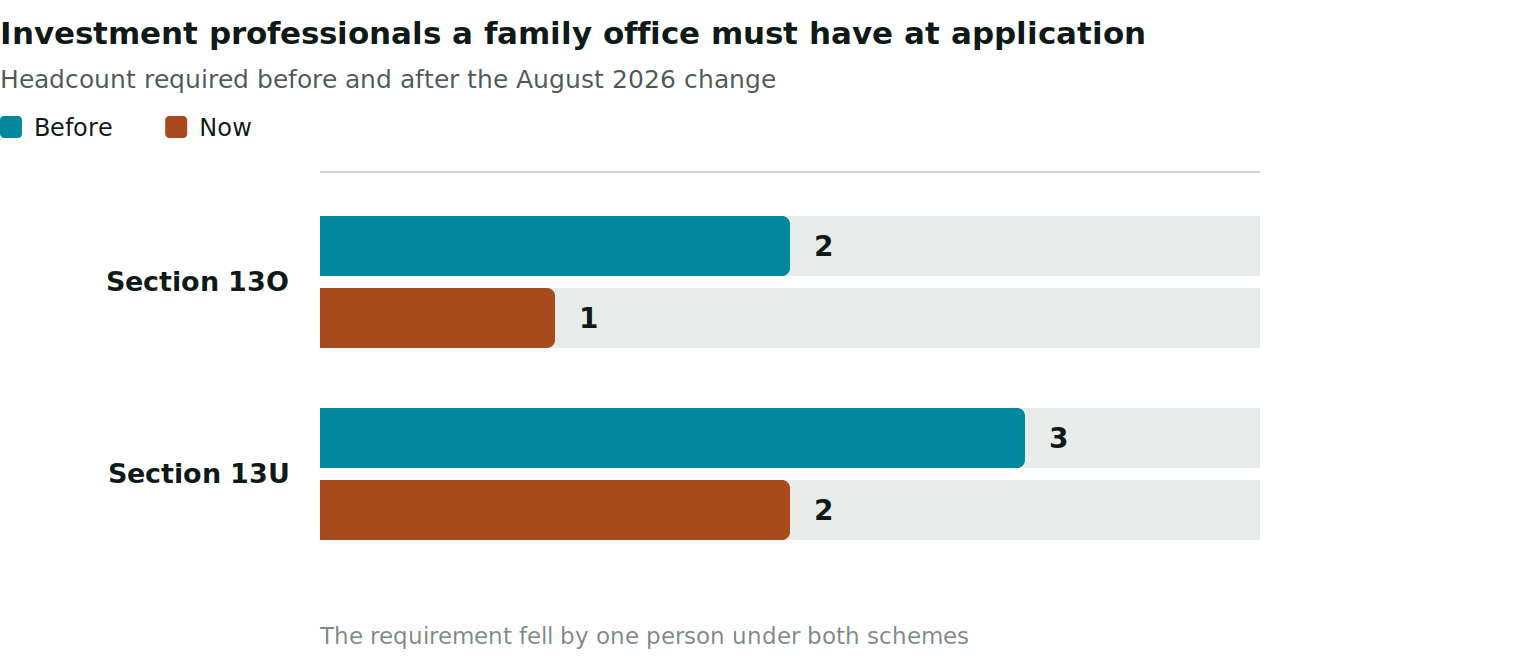
The headcount requirement fell by one person under both schemes. A section 13O fund previously had to employ two investment professionals at the point of application. It now needs one. A section 13U fund needed three and now needs two. That sounds like a small administrative adjustment. It is not. The hardest part of setting up a family office here has consistently been the hiring. You must find, employ and relocate qualified investment staff before the structure generates anything for them to manage. A family with one capable person and a plan to hire the second can now begin. Under the old rule it waited, and the waiting is where many applications quietly died.
The local spending requirement now separates single family offices from everyone else
The second change concerns what the fund must spend in Singapore each year. This condition decides whether the incentive is worth having at all for a smaller structure. A family with S$80 million to manage cares far more about the annual spending floor than about the headline relief. The tiers were redrawn on 1 August, and they no longer treat every fund alike.
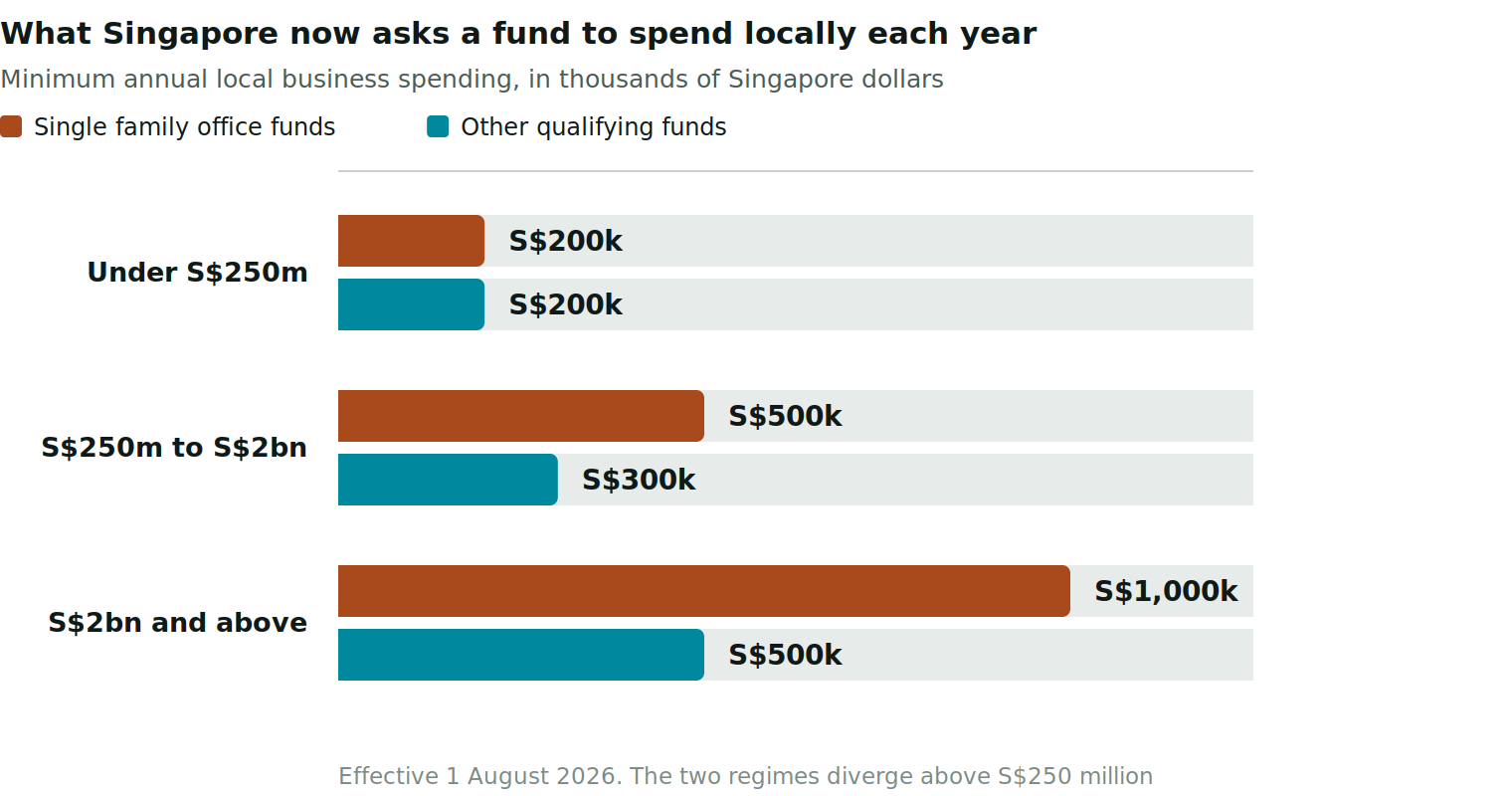
For a single family office fund, the tiers run at S$200,000 a year below S$250 million of assets. They rise to S$500,000 between S$250 million and S$2 billion, and to S$1 million above that. For other qualifying funds the same bands carry S$200,000, S$300,000 and S$500,000. The two regimes agree at the bottom and diverge sharply above S$250 million, where a single family office is asked for roughly twice what a non-family fund is. Two further changes matter as much. Qualifying donations to Singapore charities now count double toward the spending requirement, so a family already giving can convert part of that into compliance. And the annual re-test of assets under management has gone, retroactive to 1 January 2025. A fund whose assets fall below its band in a bad year no longer risks its status.
Singapore now manages S$6.7 trillion, and three quarters of it belongs to somebody else
These adjustments are worth watching because of the scale of what they adjust. Singapore is not competing for this money from a standing start. It is tuning the conditions on a pool that is already very large, and still growing at a double-digit rate.
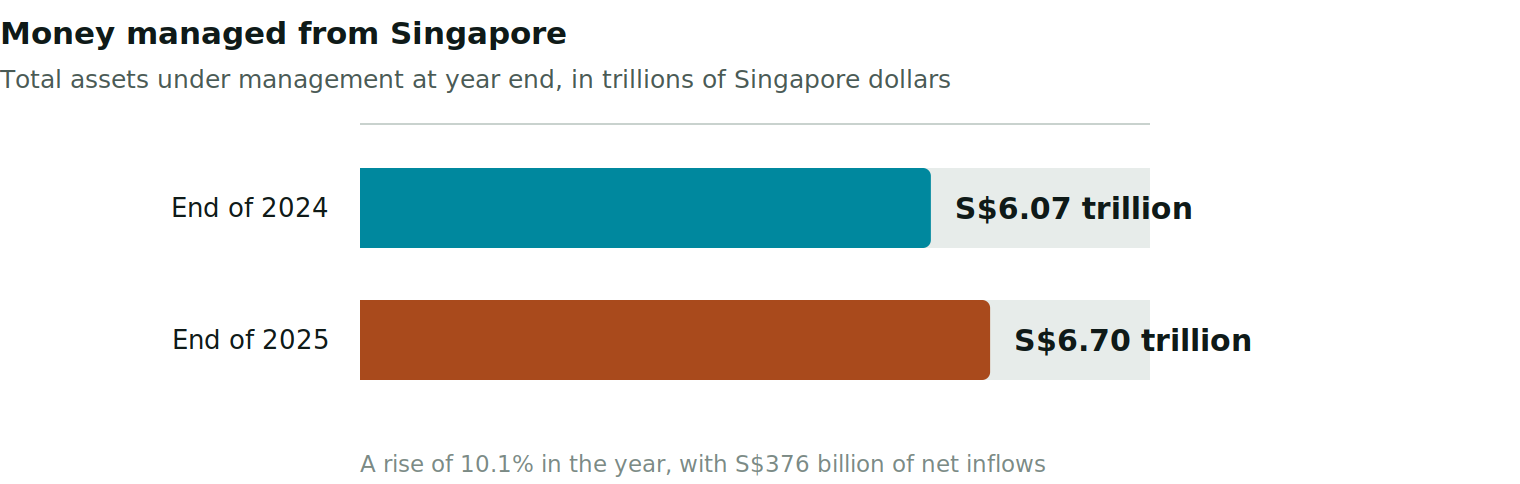
Assets under management reached S$6.7 trillion at the end of 2025. That is up 10.1% from S$6.07 trillion a year earlier, with net inflows of S$376 billion. Inflows are the number to watch rather than the total. A total can rise because markets rose. Inflows rise only because money was moved here deliberately, by people who had other options.
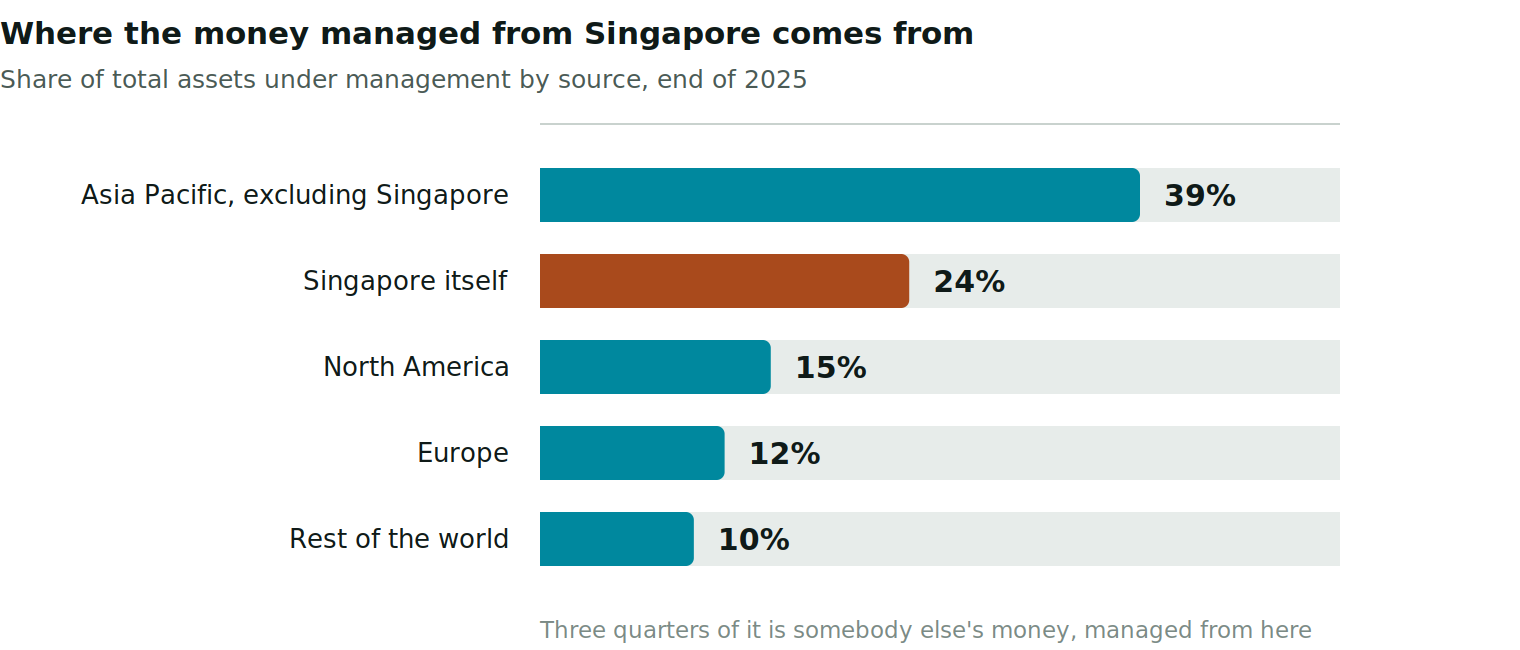
Twenty-four per cent of the money originates in Singapore. Thirty-nine per cent comes from the rest of the Asia Pacific. North America supplies fifteen per cent, Europe twelve, and the rest of the world ten. So roughly three quarters of the money managed from Singapore was made somewhere else and brought here. That is what a working hub looks like from the inside. It is also why the conditions get adjusted rather than simply lowered. Singapore competes for flows it does not generate at home, against Hong Kong, Dubai and Luxembourg. It must stay attractive without becoming the kind of place the OECD writes reports about, and those two aims pull against each other.
What this means for families with an offshore trust, families considering Singapore, and existing family offices
For a family with an offshore trust and a Chinese-resident beneficiary, the deadline is the immediate problem and the structure is the longer one. Establish before 22 October what was actually distributed, to whom, and how it was described at the time. That answer determines the exposure, and the reconstruction takes longer than anyone expects. Ask the trustee for a complete distribution history in writing now rather than later, because trustees respond at their own pace and your timetable is no longer flexible. A structural question sits behind the filing one. A trust whose tax treatment depends on where its beneficiaries live may not suit a family whose members live in different countries and may move again. That should not wait until the next country issues guidance of its own.
For a family considering Singapore, the conditions are better than they were three months ago, and for specific reasons. One investment professional rather than two lets a section 13O application begin with the person you already have. Removing the annual asset re-test means a market drawdown no longer threatens the incentive. Double-counting donations means money you were giving anyway can carry part of the local spending requirement. What has not changed is that the structure must be real. The people must be here. The decisions must be taken here. The file must show both. Singapore has loosened the arithmetic of qualifying without loosening the substance behind it, and applicants who confuse the two fail slowly and expensively.
For a family office already running under either scheme, the changes are worth applying rather than noting. The removed re-test is retroactive to 1 January 2025. A fund that has been managing its assets to stay above a threshold has done a year of unnecessary work and can stop. The donation double-count may apply to giving you already do through another entity, so the fix is which vehicle writes the cheque. There is a wider point in the timing. Both governments moved within a week of each other, in opposite directions, and neither announcement reached the general news. Families who found out in September had three months less to act.
Our blog
Latest blog posts
Tools and strategies modern teams need to help their companies grow.