Investors spend four weeks checking the company after they say yes
Written by

Huan koh
Published on
September 2, 2026

Copy link
Link copied!


The questions that decide a round are about control, signing authority and custody. Most founders have never been asked them before.
The difficult part of raising money is not the meeting where somebody says yes. It is the four weeks afterwards, when the term sheet has been signed and the work moves to people the founder has never met. A lawyer, an analyst and somebody in compliance now examine the company rather than the business. They are not asking whether the product is good, because that was settled in the meeting. They are asking who controls the company and who is authorised to sign for it. They want to know where the money will sit once transferred, and who is accountable if it moves. A founder who has spent two years on the product frequently cannot answer any of those. Nothing is wrong. Nobody has asked before, and the company was assembled to satisfy a registration form rather than an investor.
The questions that decide a round are about control and custody, not about the product
Investors are not only buying growth. They are buying the prospect of getting their capital out again, years from now, through a process nobody can predict today. That prospect rests on four things unrelated to what you sell. Whether the directors are genuine participants or names on a form. Whether a bank account exists, and has been open long enough to show a pattern. Whether the register and statutory records are accurate. Whether an investor can see what is happening after the money goes in. A certificate of incorporation answers none of these. A structure that has been operating for six months answers all four without anyone needing to ask.
S$6.7 trillion is now managed from Singapore, and three quarters of it comes from outside the country
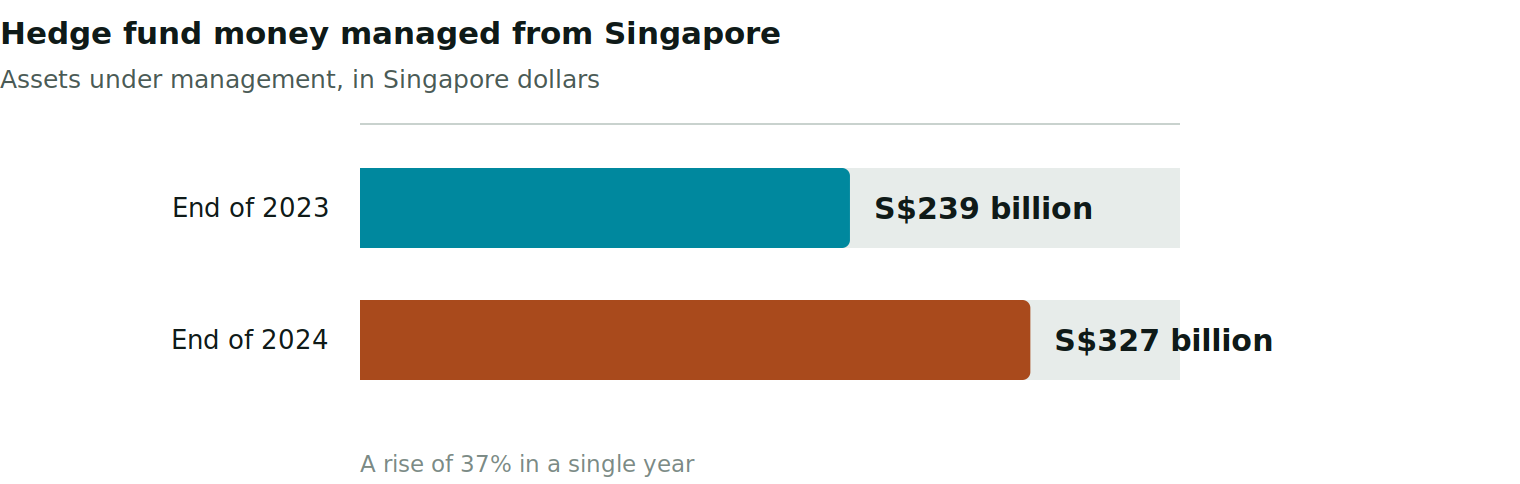
There is a reason so many of these conversations run through Singapore. Hedge fund assets managed here rose 37% in a single year, from S$239 billion at the end of 2023 to S$327 billion at the end of 2024. Across all fund types, MAS reported S$6.7 trillion under management at the end of 2025, about US$5.2 trillion, and 10% more than the year before. S$376 billion of new money arrived during the year, and there are now 1,320 licensed and registered fund management firms. Hong Kong is the only other centre of comparable size in Asia, and the two now compete for the same managers in public rather than quietly.
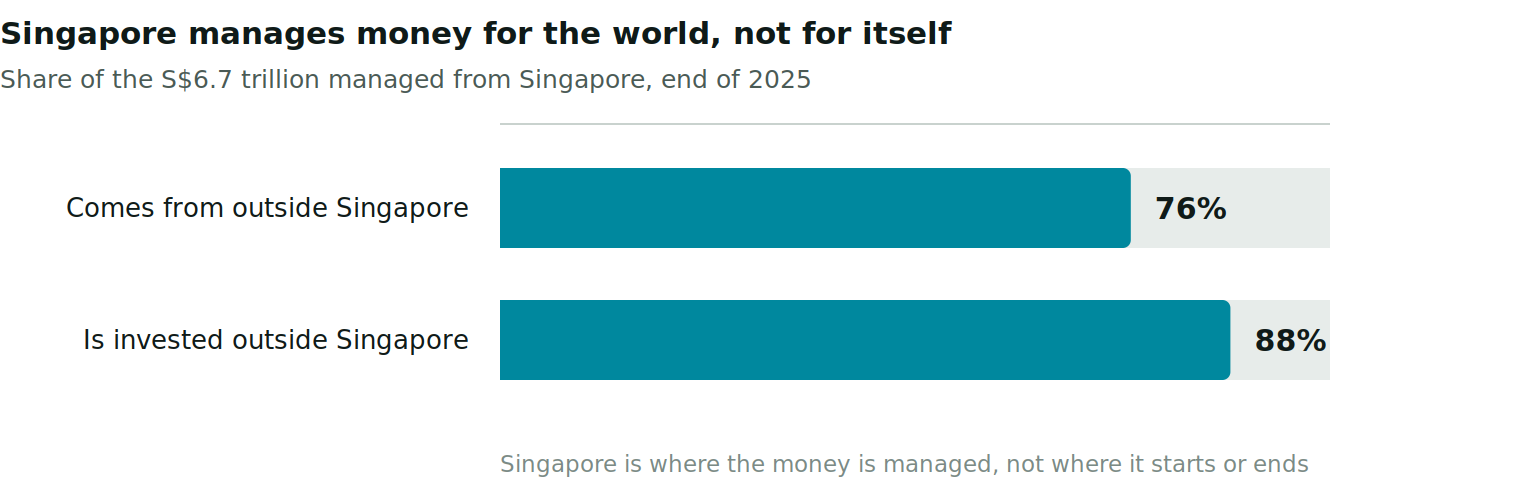
One pair of numbers explains Singapore better than the totals do. Three quarters of the money managed here originates outside the country, and nearly nine tenths is invested outside it. Singapore is neither where the capital starts nor where it ends. It is the place in the middle, where money is managed, governed and accounted for. That is what a founder is offering an investor, and it is worth saying plainly. You are not asking anyone to bet on Singapore's economy. You are asking them to accept Singapore's courts, accounting standards and regulator as the referee. Investors in Jakarta, Tokyo, Dubai and London accept that referee on ordinary working days.
MAS announced a carried interest exemption on 19 August, days after Hong Kong widened its own
On 19 August 2026 MAS announced a set of measures aimed squarely at fund managers. The headline was tax. When a fund performs, its manager earns a share of the profit. MAS and the Ministry of Finance said that share will be exempt from personal income tax for managers based here, covering qualifying income from the 2026 calendar year. The mechanics arrive at Budget 2027 in February. This is an announcement rather than a law anyone can yet rely on, and it should be described that way to an investor. Two smaller changes came with it. The ONE Pass work visa requires S$30,000 a month, and senior asset management staff may now meet that with other forms of income. MAS also said it would run a programme to anchor hedge funds here. The timing is the substance: this landed days after Hong Kong widened its own fund tax concessions.
A Korean state fund chose a Singapore VCC over Cayman for its first vehicle outside Korea
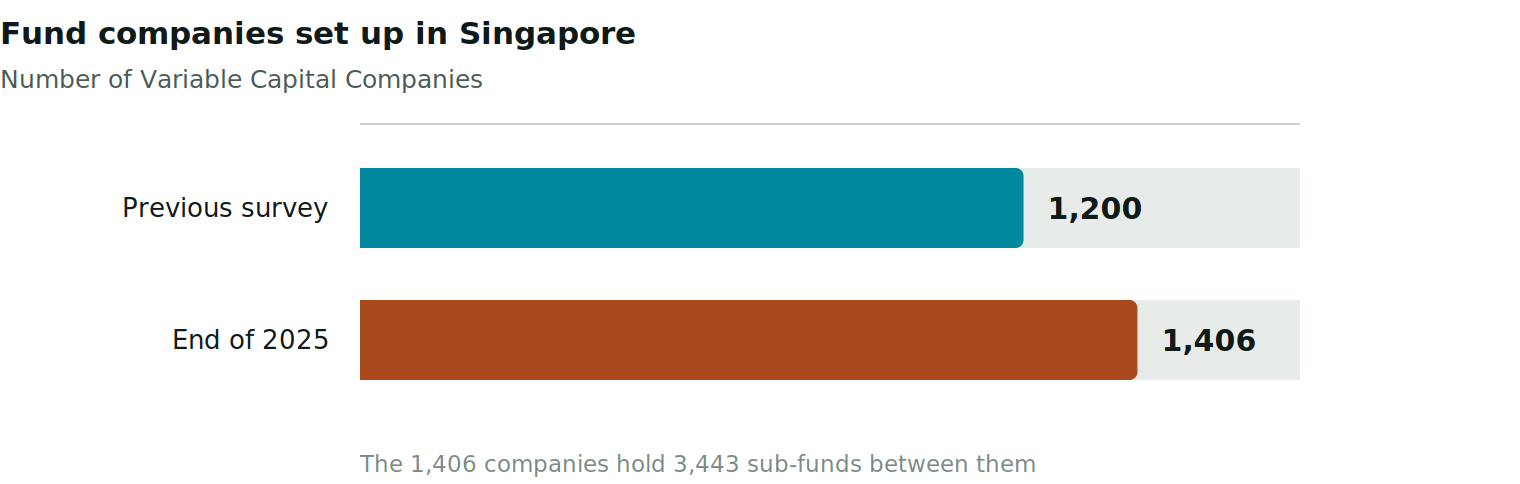
The clearest reading of that competition came the following day, from an institution with no reason to flatter anyone. On 20 August 2026 MAS granted a full Capital Markets Services licence to Korea Venture Investment Corp, a South Korean state fund that invests in other funds. It is the organisation's first asset management licence outside Korea. Its K-Global Venture Fund is being established as a Singapore Variable Capital Company, targeting US$300 million by 2030. A VCC is Singapore's purpose-built fund structure, launched in 2020, and it is what most new funds here use instead of a Cayman company. A single VCC can hold many sub-funds, each with its own assets and investors, ring-fenced from the others. That is how 1,406 companies carry 3,443 funds between them.
Consider what that decision actually was. A state-backed institution, accountable to its own government and auditors, chose Singapore over Cayman for its first vehicle abroad. That is not a tax calculation. It is a decision about which regulator it wants its name standing beside. The capital flows point the same way. In the first quarter of 2026, private equity firms committed US$9.2 billion to Southeast Asian companies across 19 deals. A year earlier it was US$2.04 billion across 14 deals. The region's share of Asia-Pacific private equity deal value moved from roughly 4% to roughly 17% in twelve months.
Two routes at S$5 million and S$50 million, and the annual size re-test has been removed
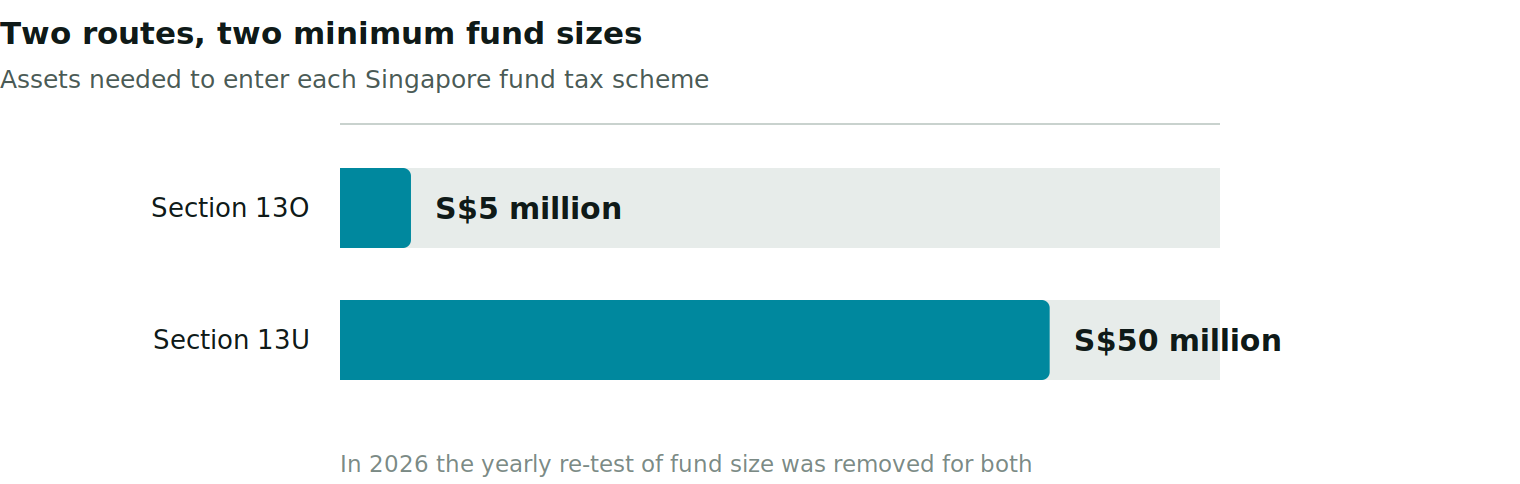
If you are running a fund rather than raising into a company, Singapore offers two main tax routes and they differ mainly by size. One change here matters more than its wording suggests. A fund previously had to clear its size threshold every year. A well-run fund could lose its tax status because markets fell or a large investor redeemed. That annual test has been removed, backdated to 1 January 2025, so it covers funds that have already filed. Closed-end funds may now also count committed capital towards the entry threshold. The rest is straightforward to explain in a first meeting. Corporate tax is 17%, there is no capital gains tax, and dividends are not taxed again in a shareholder's hands.
None of this opens a bank account, which is where most timelines actually break. MAS requires banks to establish where a customer's money comes from, and they apply that most carefully to foreign-owned companies with no trading history. That describes nearly every new company at the moment it needs an account. Corporate service providers report that account opening for a foreign-owned company usually takes several weeks. Most of the delay has nothing to do with the business itself. It is a missing ownership declaration, an address document that does not match the passport, or a register that disagrees with the application. Each is preventable, and none is visible to a director who does not participate. Which returns us to the lawyer, asking who is accountable here.
What this means for first-time raisers, fund managers elsewhere in Asia, and anyone choosing between Singapore and offshore
For a founder raising a first outside round, do not treat the structure as work to be tidied up once the term sheet is signed. The checks happen between the handshake and the transfer. That is the worst possible moment to discover the register is wrong or the account is not open. Give the company six months of operating history before the first serious conversation. Six months means an account with transactions in it, board minutes recording real decisions, and a register that matches the application. If a round is already in motion and none of that exists, tell the investor early rather than late. A disclosed gap is a workstream. A discovered one is a reason to reprice.
For a manager running a fund elsewhere in Asia, the August announcement changes where it makes sense to base people. But the tax mechanics only arrive at Budget 2027, and nothing requires signing this month. Start the slower work instead. Choose a route, establish that you meet its size threshold on the correct measure, and get banking underway. Those take considerably longer than the tax paperwork. For most managers the removal of the annual size re-test matters more than the headline exemption. It means a route you qualify for today is far more likely to still be yours in three years.
For anyone weighing Singapore against an offshore structure, compare the cost of being believed rather than the cost of being registered. Offshore jurisdictions now require resident contacts, faster reporting and more frequent inspection, so the substance requirement follows you there anyway. If real substance must be built somewhere regardless, the only question left is where it buys the most credibility with the people who will fund you. And if a bank has stalled your application, ask two questions before assuming the business was refused. Which document is missing, and who at the company was the bank able to speak to? If the answer to the second is nobody, fix that before anything else.
Our blog
Latest blog posts
Tools and strategies modern teams need to help their companies grow.