The dollar’s reserve share is slipping, and most of the move is the exchange rate

Written by

Huan koh
Published on
October 12, 2026

Copy link
Link copied!


The IMF put the dollar at 56.70% of world reserves in mid-2026. Central banks bought a record 289 tonnes of gold that quarter, into a falling price. A particular story has been circulating for two years. The dollar is being abandoned, central banks are piling into gold, and money is moving east. Each part of it has a grain of truth and each part is overstated in the retelling, usually by people selling something. The underlying data is published quarterly by the International Monetary Fund and annually by the World Gold Council, and it is worth reading directly. What it shows is a slow drift away from the dollar over a decade. Most of the quarterly movement is explained by exchange rates rather than by decisions. Gold buying has fallen back from its 2022 to 2024 peak. None of that makes the question irrelevant to a business. It changes what the honest answer is. The case for holding company money across more than one currency does not rest on predicting the dollar's decline. It rests on where the money is earned and where it has to be spent, and it is stronger for not pretending otherwise.
The dollar held 56.70% of world reserves in the second quarter of 2026
The latest figure was released on 30 September 2026 and covers the second quarter of that year. The dollar accounted for 56.70% of global official foreign exchange reserves, down from 57.18% in the first quarter. Total world reserves stood at about US$13.2 trillion, up on the quarter before.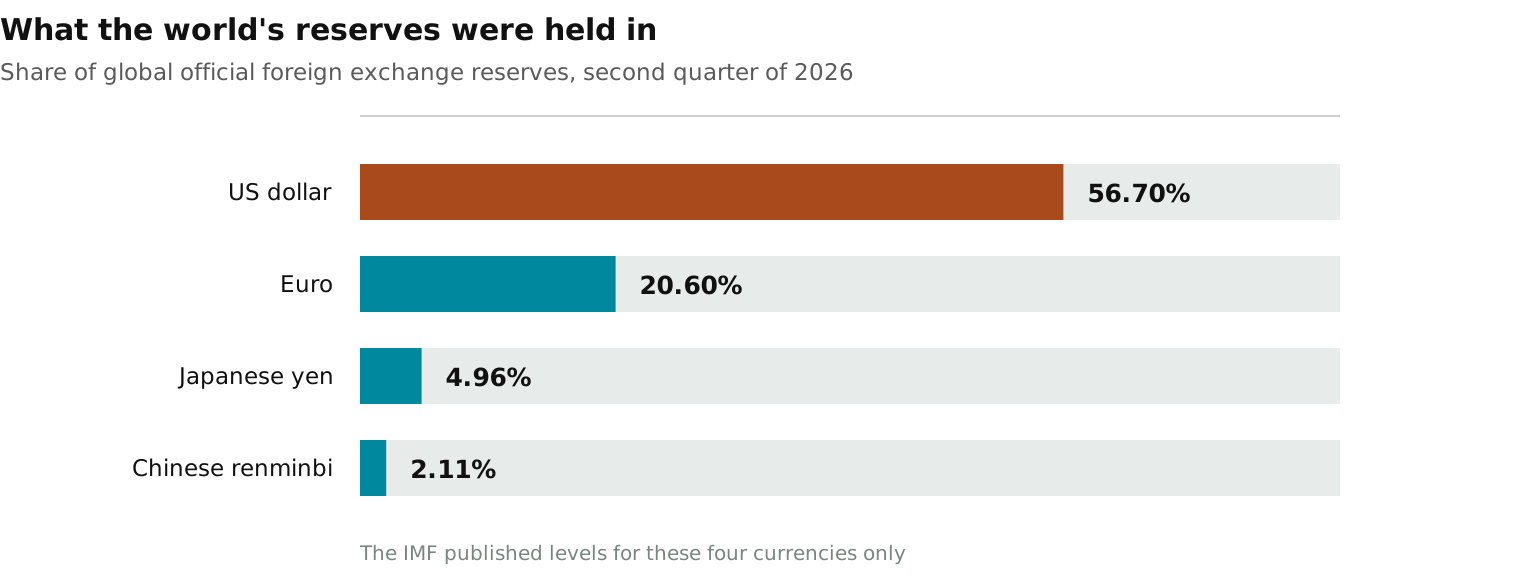 The euro was second at 20.60%, having gained about half a percentage point in the quarter. The yen was third at 4.96% and the renminbi fourth among the currencies the IMF published levels for, at 2.11%. The fifth-largest reserve currency on the most recent full data is the Canadian dollar rather than the renminbi, which is a detail most summaries skip.
The renminbi point is worth pausing on, because it runs against the headline narrative. Its share is small and it has fallen since early 2022. Whatever is happening to the dollar, the money is not going into the Chinese currency in any quantity that shows up in reserves.
The decade-long drift is real, and smaller than it looks
Taking a longer view removes most of the noise. The dollar accounted for 65.8% of disclosed reserves at the end of 2015 and 57.8% at the end of 2024. That is a fall of eight percentage points over nine years, or a little under one point a year.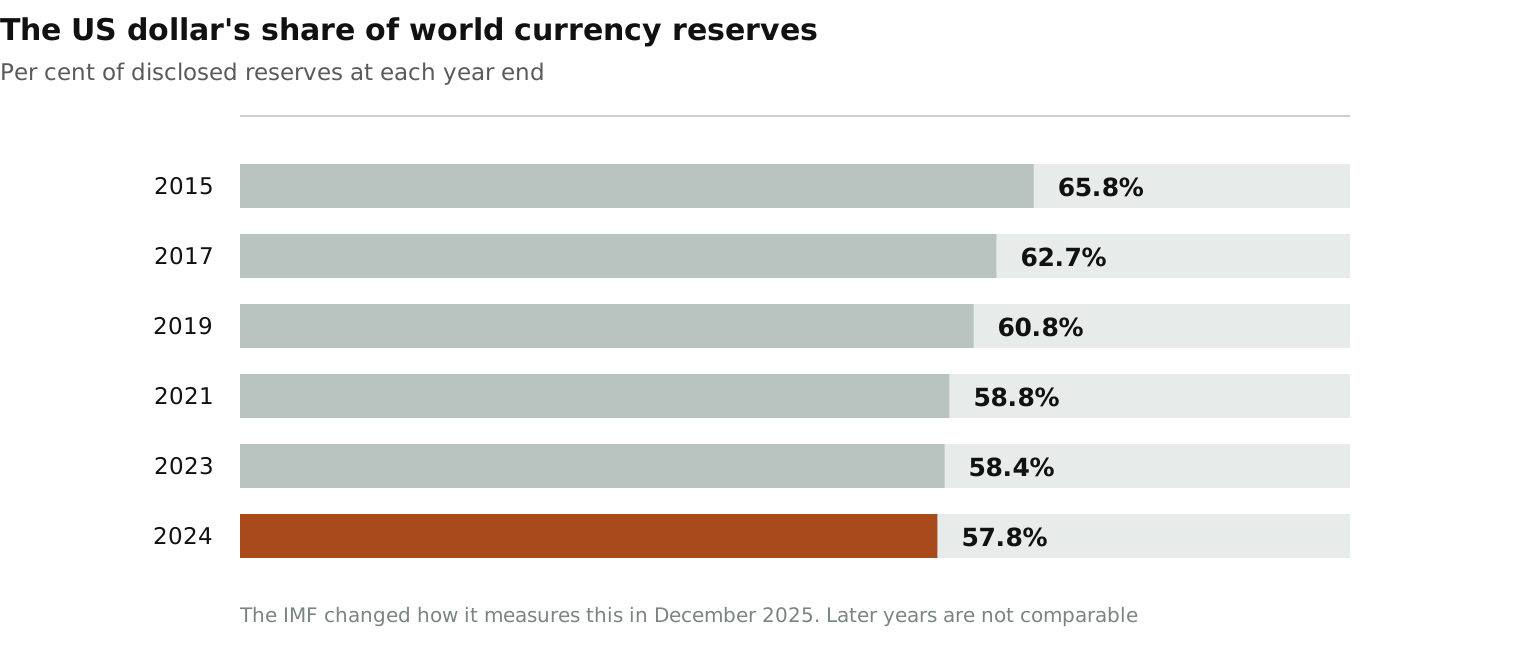 A fall in share is not a fall in holdings. Total reserves grew over the same period, so central banks can hold more dollars than before while the dollar's percentage declines. Anyone presenting the share as evidence that dollars are being sold has skipped a step.
There is also a measurement break that matters. Until December 2025 the IMF reported shares of allocated reserves, meaning only those countries that disclosed their composition. Since then it has imputed the composition of non-reporters so the data covers all of the world's reserves. The restatement moved the numbers by about eight tenths of a point on its own. A single line running from 2015 to 2026 mixes two different denominators.
Most quarterly moves are the exchange rate, not a decision
This is the point that gets lost most often, and the IMF has made it explicitly. In the second quarter of 2025 the dollar's share fell by almost a point and a half. At constant exchange rates it would have been essentially flat. Currency movements explained 92% of the decline, and the IMF concluded that the shift reflected valuation effects rather than active reallocation by central banks. The mechanism is simple enough. When the dollar weakens against other reserve currencies, the dollar value of euro and yen holdings rises. The dollar's share then falls without anyone having traded anything. That accounts for much of what gets reported as a retreat from the dollar. The second quarter of 2026 is the exception, and it is the reason the latest release is interesting. Exchange rates were range-bound within about two per cent, so valuation effects were limited. The IMF attributes that quarter's movement mainly to other price changes and to portfolio reallocation. It is the first recent quarter where the shift looks like a decision rather than an artefact.Central banks bought less gold in 2025 than in each of the three years before
The gold half of the story is the one most frequently inflated. Central banks bought 863 tonnes on a net basis in calendar 2025, according to the World Gold Council's figures published on 29 January 2026. That is a large number by historical standards and a smaller one than 2022, 2023 or 2024.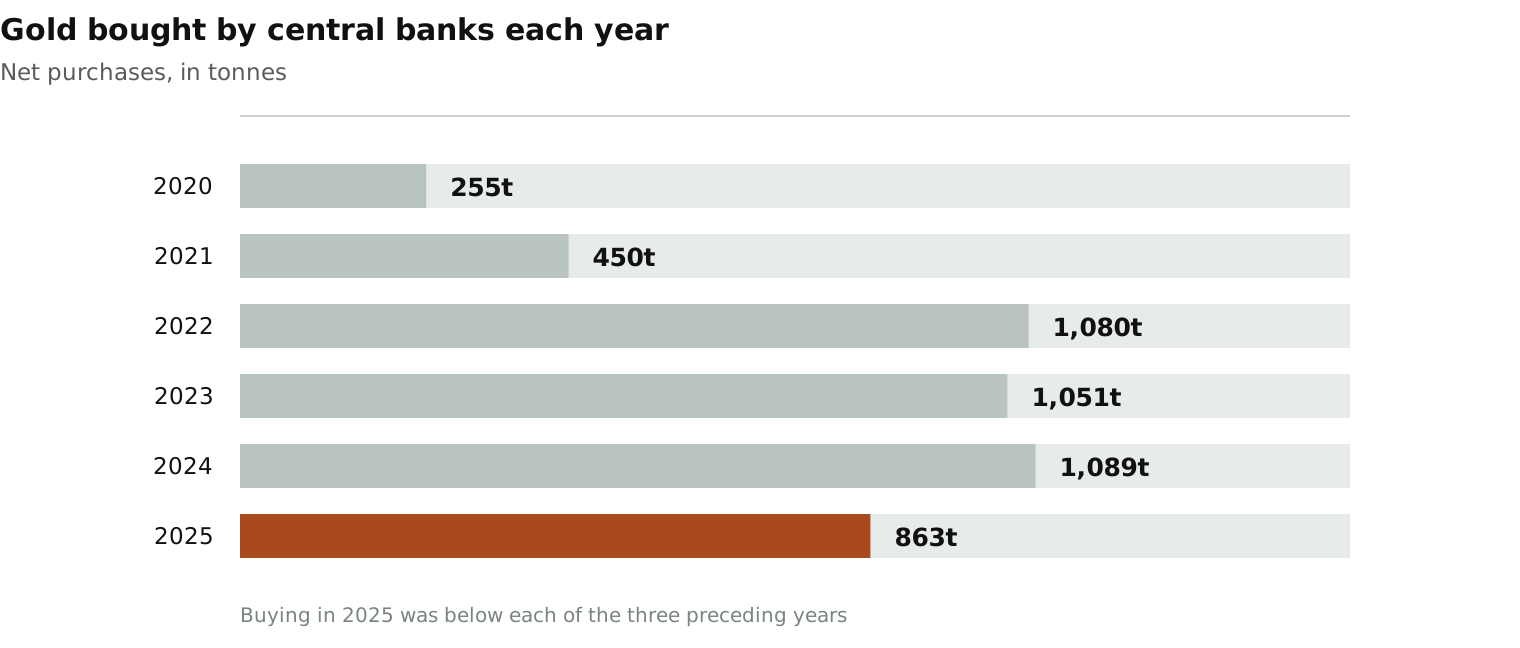 The 2026 picture is mixed and has already been revised once. The first quarter was initially reported at 244 tonnes and cut to 57 tonnes by erratum in July 2026, after a large volume was reclassified. The second quarter was 289 tonnes, a record for any second quarter and up 62% on the year before. The first half came to 345 tonnes, the weakest first half since 2022.
The price context cannot be left out. Gold traded above US$5,500 an ounce in January 2026 and was around US$4,190 in early October 2026. It is roughly a quarter below its peak and up only a few per cent over twelve months. The genuinely interesting fact is that central banks bought a record second-quarter volume into a falling price, which says more about intent than a rising price would.
No major central bank has published a policy of holding fewer dollars
This is the claim that fails most comprehensively on the evidence. A search for an official statement of intent to reduce dollar holdings produces nothing from any major central bank. The European Central Bank said as much in January 2026, describing the dollar as likely to remain by far the largest international currency. What does exist is a gold target rather than a dollar target. Poland's central bank announced on 10 September 2025 that it was raising its target for gold to 30% of official reserve assets. That arithmetically implies a smaller share in currencies, but it is not a statement about the dollar. The survey evidence runs the other way. HSBC's annual survey of reserve managers, published on 6 May 2026, drew responses from 101 central banks managing more than US$9.5 trillion. Of the 92 that answered the question, 25 were considering increasing their dollar exposure over the following year and 11 were considering decreasing it. More reserve managers are leaning towards the dollar than away from it.| What is claimed | What the published data shows |
|---|---|
| The dollar is at its lowest reserve share since 1995 | The low point of the IMF's series is 56.42%, in the fourth quarter of 2025. The series itself begins in 1995 |
| Central banks bought record gold in 2025 | They bought 863 tonnes, less than in 2022, 2023 or 2024 |
| Reserve managers are cutting their dollar holdings | More surveyed central banks are considering increasing dollar exposure than reducing it |
| Money is moving into the renminbi | Its share is 2.11% and has fallen since early 2022 |
| Gold keeps setting records | The price is about a quarter below its January 2026 peak |
| The dollar's fall reflects decisions by central banks | Exchange rate movements explained 92% of one recent quarterly fall |
What any of this means for a company rather than a central bank
A business does not hold reserves and does not need a view on the international monetary system. What it needs is narrower. It must be able to receive money in the currency a customer pays in, hold it until it is needed, and move it without asking permission. That requirement exists whether or not the dollar's share falls another point. The reserve data is useful to a company in one narrow way. It establishes that the major currencies are all actively used and none is being abandoned. A business selling across several markets will therefore keep receiving several currencies. Converting each receipt into a single home currency on arrival is a decision with a cost, and it is usually made by default rather than deliberately. The relevant question is therefore operational. Where can a company hold several currencies at once, move between them at market rates, and pay a supplier in a third currency without a filing. That is a banking and regulatory question, and it has a short list of answers.Singapore has had no exchange control since 1978
Singapore liberalised exchange control with effect from June 1978. The instrument is a notice issued by the Monetary Authority on 25 May 1978, exempting transactions from the operative provisions of the Exchange Control Act. The Act itself remains on the statute book, which is a point of accuracy worth keeping. There is no restriction on a company holding, receiving or remitting foreign currency. The absence is structural rather than discretionary. Singapore conducts monetary policy through the exchange rate rather than through interest rates, managing the Singapore dollar against a trade-weighted basket within an undisclosed band. A country that targets its exchange rate and permits free capital movement gives up control of domestic interest rates. That is the trade Singapore has made, and open capital flows are the side of it that a business experiences. One restriction does exist and should be stated rather than glossed. The Monetary Authority limits Singapore dollar credit facilities to non-resident financial institutions where the proceeds could be used to speculate against the currency. It constrains lending to that specific class of counterparty. It does not touch an operating company holding or moving foreign currency. Singapore's own official foreign reserves stood at S$553.57 billion in September 2026, released on 7 October 2026, the highest level since February 2022. The Monetary Authority tightened policy slightly in April 2026 and again on 27 July 2026, steepening the path of appreciation. That is policy rather than forecast, and a currency on a steepened appreciation path is a relevant fact for anyone deciding where to hold a balance.Where internationally sourced money is being managed
The asset management figures say more about direction of travel than the reserve data does. Singapore's industry held S$6.7 trillion at the end of 2025, up 10.1%, with net inflows of S$376 billion. About three quarters of that money came from outside Singapore and about 88% of it is invested outside Singapore.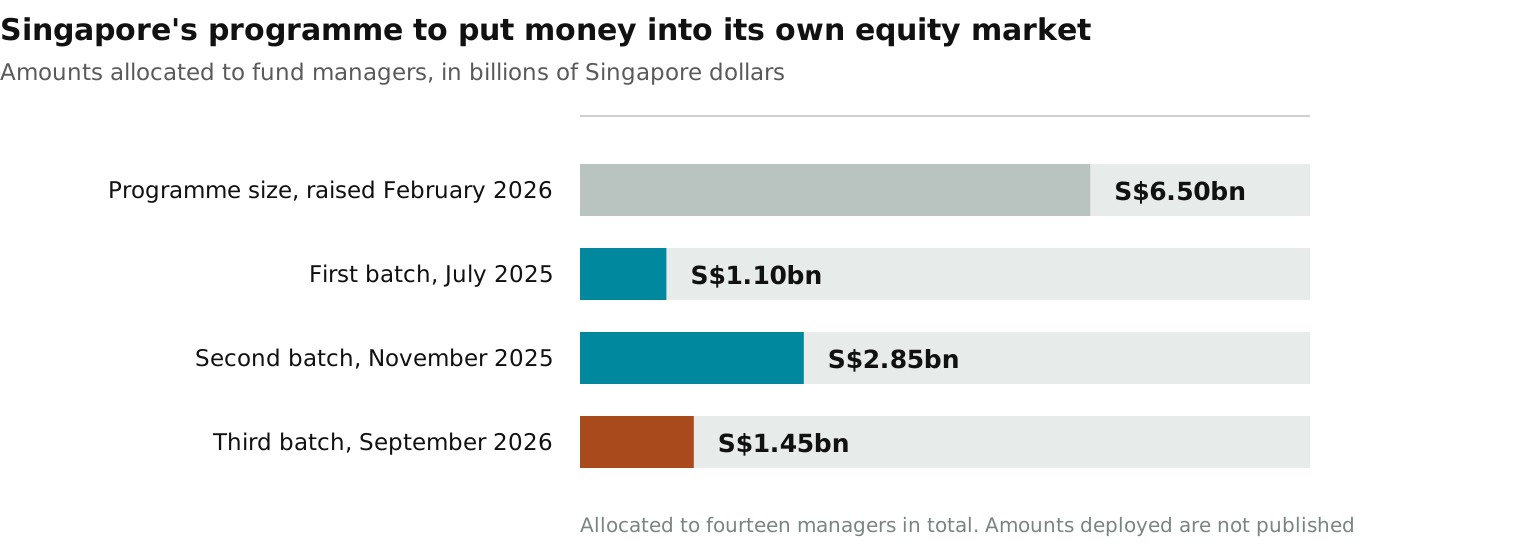 Singapore is also putting public money behind its own equity market, which is a different kind of signal. A programme announced in February 2025 was raised to S$6.5 billion in February 2026. It has allocated about S$5.4 billion to fourteen managers in three batches, the most recent on 30 September 2026. The distinction between allocated and deployed matters, and the amounts actually invested have not been published.
Two qualifications belong with the asset management figures. The 2025 growth was driven largely by market performance rather than new mandates, and the alternatives picture was weak, with real estate assets falling 16%. The number of licensed managers grew under 2% against 10% asset growth, which is not the shape of an industry adding firms.
What this means for treasurers, owners holding cash across markets, and anyone being sold a currency thesis
For a treasurer, the practical decision is about matching rather than forecasting. A company that earns in several currencies and spends in several currencies does not need a view on the dollar. It benefits simply from holding balances in the currencies it actually uses. The cost of converting every receipt on arrival is a real spread paid repeatedly, and it is usually invisible because nobody books it as a line item. For an owner holding cash across markets, the question to ask of each banking relationship is narrow. Can the account hold the currencies the business receives, can money move between group entities without approval, and is there a filing attached to any of it. Those answers differ sharply between countries, and they differ more than tax rates do. For anyone being shown a currency thesis by an adviser, the reserve numbers are a good test of whether the adviser has read the source. The dollar's share is 56.70% and falling slowly. Most quarterly movement is the exchange rate. Gold buying is below its peak and the gold price is a quarter below its own. An adviser whose case depends on any of those three being otherwise is selling a story rather than reading the data.Our blog
Latest blog posts
Tools and strategies modern teams need to help their companies grow.