Tariffs, currency and credit each took a share of the same margin in 2026
Written by

Huan koh
Published on
September 2, 2026

Copy link
Link copied!


Three research teams measured three different problems this year. For a buy-sell operator, they are one problem arriving in stages. Three research teams measured different things in 2026, and their numbers only make sense beside each other. DHL asked more than 400 small business owners in the United States about costs, and 78% said tariffs had pushed them up. Bibby Financial Services asked more than 500 British firms that sell overseas, and among those hit by currency movements the average loss was £71,600. The Asian Development Bank asked more than 110 banks about trade finance, and 41% of small business applications were refused. Filed apart, these look like a trade problem, a treasury problem and a credit problem. For an operator who agrees a price in March and gets paid in August, they are one problem arriving in stages. Each stage takes its share of the same margin.
The average US tariff reached 11%, and 53% of small firms shelved their growth plans
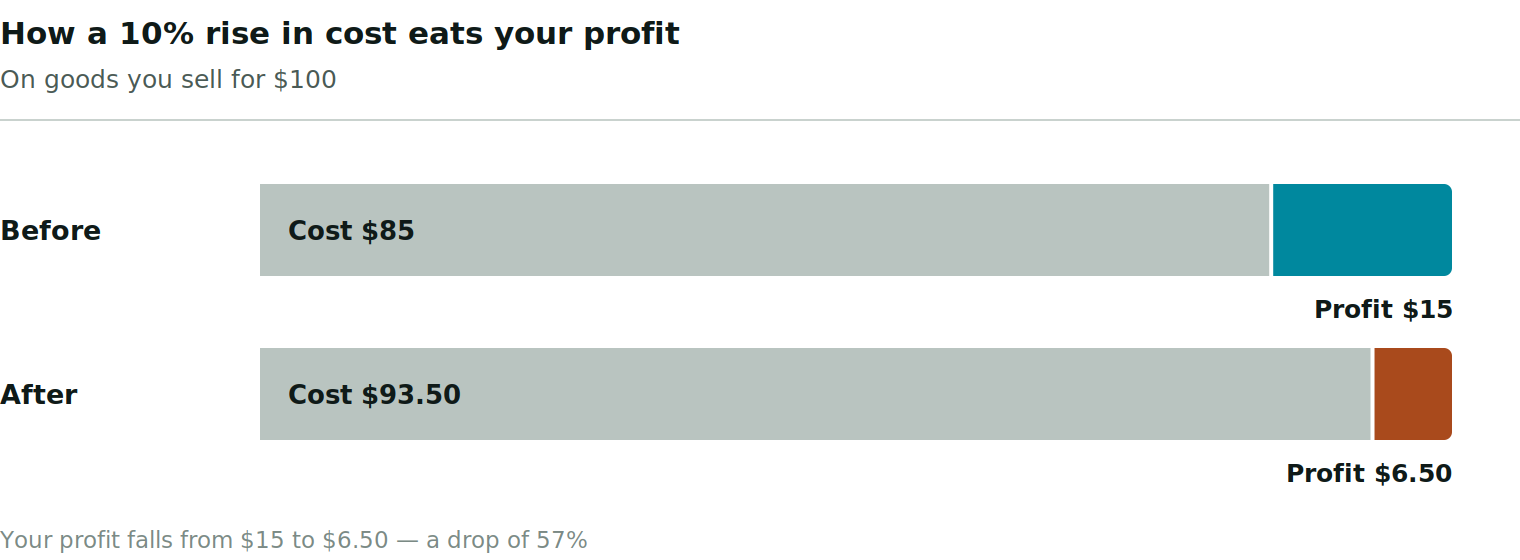
A tariff is a tax a country charges on goods coming in, and in a buy-sell business the seller usually absorbs it. By 2 April 2026 the average tariff the United States actually collected had reached 11%, which outside 2025 is the highest since 1943. The World Trade Organization then cut its forecast for world goods trade growth this year to 0.5%, down from 1.8%. Trade grew 2.4% in 2025, so the slowdown has already begun. The DHL survey shows what this did inside the businesses. Sixty-six percent raised prices, which is the expected response. But 53% delayed or dropped their growth plans, and 42% ruled out any new foreign market this year. Asked to name the biggest obstacle to selling abroad, 35% said import duties and rules, ahead of finding customers. That is not a business absorbing a price. It is a business that can no longer estimate the cost of a new market, and has decided not to find out.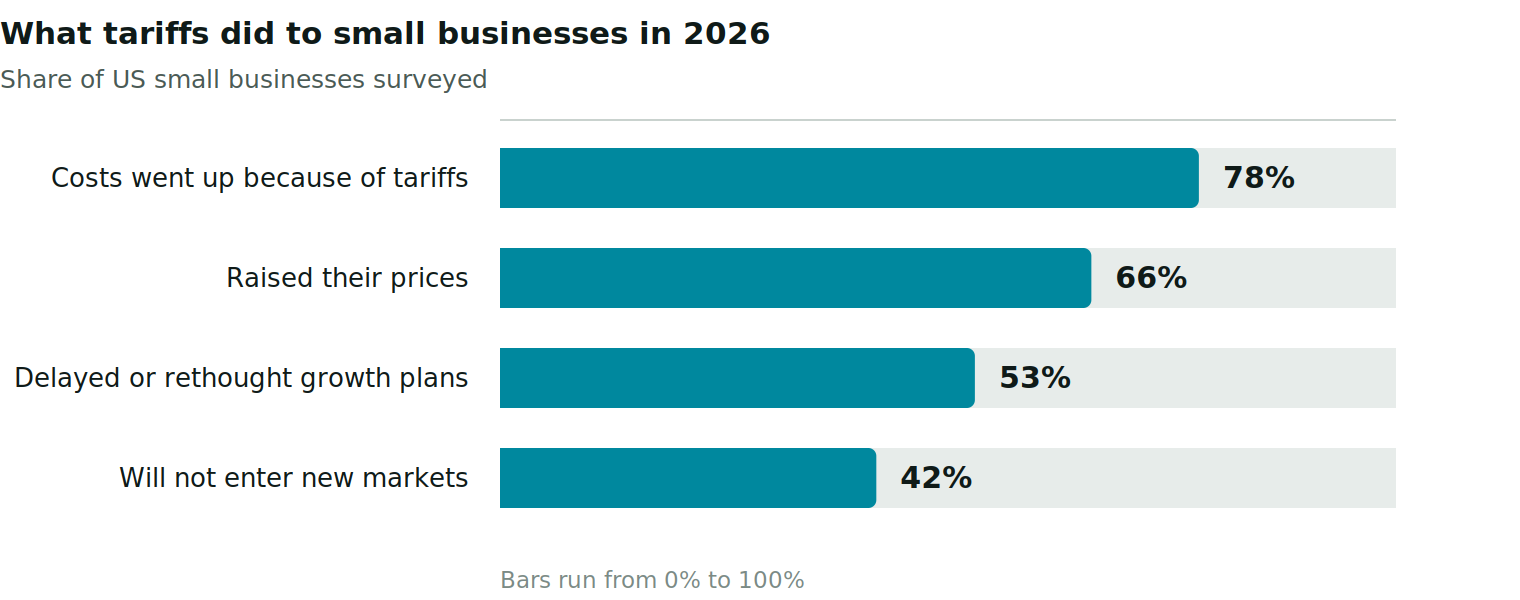 The reason becomes obvious once the arithmetic is written down, and most owners never write it down. Take goods bought at $85 and sold at $100. The gross profit is $15, the ordinary shape of a buy-sell trade. A 10% tariff lifts the purchase price to $93.50 and leaves $6.50. A 10% move in cost has removed 57% of the profit. To earn what you earned before, you would have to sell more than twice the volume through the same warehouse and the same staff. So the question is not whether to accept the higher cost, because somebody else has already decided that. It is whether anything else in the deal can win part of it back. Where is the company registered? Which trade agreement covers the goods? Which currency is on the invoice? Who carries the risk when the rate moves between the quote and the payment?
Currency cost the average affected exporter £71,600, and 36% of buyers now demand payment upfront
The second deduction happens while the goods are at sea, and it never arrives as an invoice. Forty-four percent of the British exporters Bibby surveyed had been hit by currency movements, and among them the average loss was £71,600. It builds quietly, in the gap between the rate on the day you quote and the rate on the day you are paid. Beside that sits a number that changes the shape of the risk rather than its size. Thirty-six percent of overseas partners now ask to be paid upfront. You pay your supplier first, in his currency, then wait months to learn what your own receipt is worth. The remedies are dull and mechanical. Invoice in a currency you can hold. Keep accounts in the currencies you actually trade in. Remove every conversion step the deal does not need. Whether you can do any of this depends on where your company banks, not on how well you forecast.Banks refused 41% of small firms and 40% of large ones, so size stopped being the reason
The third deduction is the one owners most often misread. The Asian Development Bank surveys more than 110 banks, handling roughly a third of the world's trade finance, and puts the gap between what businesses ask for and what banks supply at US$2.5 trillion. In 2023 the rejection rate was 45% for small firms and 30% for large corporates, a spread wide enough to justify blaming your size. By 2025 small firms had improved to 41% and large firms had worsened to 40%, and the two rates had effectively met. Asked what stops them lending, more than one bank in five put a shortage of dollars or local currency first. Close to half placed country and counterparty risk in their top two. About one in seven named an inability to establish who sits behind the applicant. Only that last one describes your business, and it is the only one you can fix inside a quarter.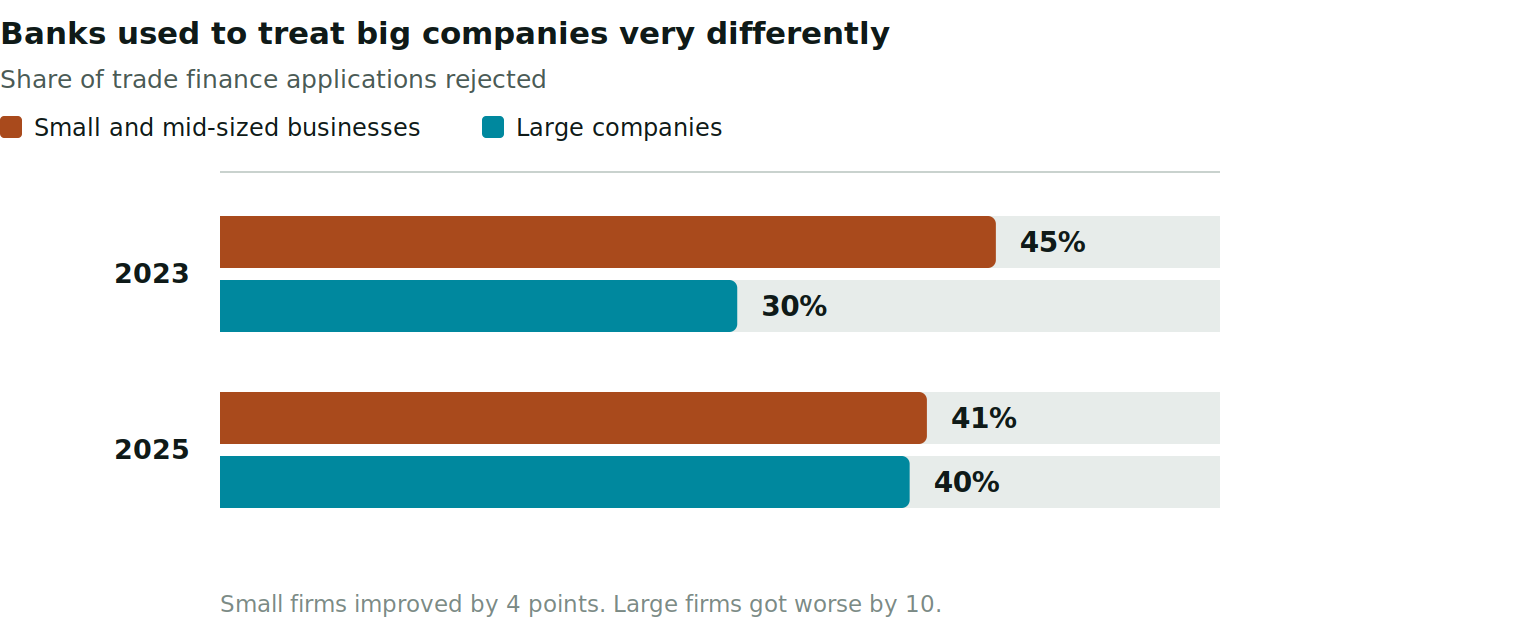
Singapore moved a record 44.66 million containers, but none of that opens a bank account
Changing where the company sits changes all three deductions, which is why so much regional trade is invoiced from Singapore rather than only shipped through it. The Maritime and Port Authority reported 44.66 million containers handled in 2025, a record, up from 41.12 million. In November 2025 a ranking of 160 container ports by DNV and Menon Economics placed Singapore first in the world. That density is why banks here already understand the routes you are describing. Underneath the port sit 27 free trade agreements and membership of RCEP, which removes tariffs on about 92% of goods traded between members. Corporate tax is 17%, there is no capital gains tax, and dividends are not taxed again in a shareholder's hands.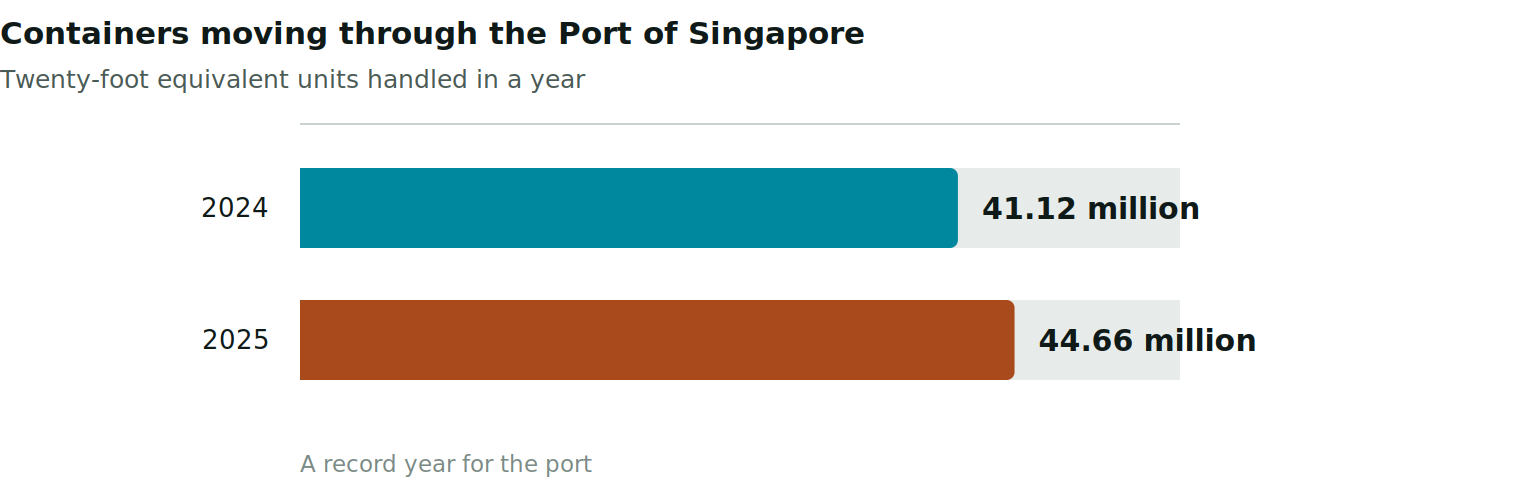 None of that reaches a company that cannot open a bank account, and this is where structures fail rather than at registration. MAS requires banks to establish where an owner's money comes from, and they apply that hardest to foreign-owned companies with no trading history. That describes almost every new company at the moment it needs an account. Since 2024 there is a tax consequence too. Gains on foreign assets brought into Singapore can be taxed where the company holding them has no real substance here. The good treatment attaches to operating, not to being registered. The usual failure is one of sequence. The company is incorporated first, banking is attempted months later, and the trade flow is squeezed into whatever the owner ended up with. Your route, your counterparty countries, your settlement method and your financing need should be settled first.
What this means for buy-sell operators, exporters selling into Europe, and businesses moving into Southeast Asia
For buy-sell operators sourcing in one country and selling into another, all three deductions run against the same margin at once, and the current company almost certainly stops none of them. The first step is not incorporation. Incorporating before the banking question is answered is how owners end up with a structure that cannot carry their flow. Establish first which banks and payment providers will actually accept your corridor, your counterparty types and your settlement method, and treat an adviser who will not name providers as having declined to answer. If no mainstream bank will take the corridor as you describe it, that is worth learning before the incorporation fee rather than six months after it.
For exporters selling into the United Kingdom or Europe, read £71,600 as a central case rather than a worst case, because it is an average among affected firms and not an outlier. Read the 36% now demanding upfront payment as a direction of travel rather than a few difficult customers. The highest-return change available this quarter is almost certainly your currency setup, not your pricing or your procurement. Pricing has to be negotiated with a customer. Currency only has to be arranged with a bank. Establish which currency each customer will accept on an invoice, hold accounts in the currencies that actually appear in your deals, then count the conversion steps in a typical transaction. Operators who have never counted them often find two where one would do.
For businesses planning a move into Southeast Asia in the next twelve months, the conditions that caused 53% of surveyed owners to delay are the conditions you are entering. With world goods trade forecast to grow 0.5%, there is less room for a poorly built structure than at any point in a decade. The operators who proceed and make money are usually those who priced the structure into the cost of entering the market, rather than treating it as admin for later. If a bank has already refused you trade finance, do not assume your size was the reason, because the 2025 data no longer supports that. Ask which of the three constraints applied to your file. If nobody could establish who runs the company, that is solvable in weeks, through a banking history in the destination market, a resident director who will take the call, and a document trail connecting the flow to the entity.
Our blog
Latest blog posts
Tools and strategies modern teams need to help their companies grow.