US tariffs on Asian goods now turn on the product, not the country
Written by

Huan koh
Published on
October 19, 2026

Copy link
Link copied!


The Supreme Court struck down the emergency tariffs in February 2026. What replaced them leaves barely two and a half points between Southeast Asian exporters. The tariff regime that most trade planning still assumes no longer exists. On 20 February 2026 the Supreme Court held that the International Emergency Economic Powers Act does not authorise the President to impose tariffs. The vote was six to three. The decision came in the consolidated appeals heard as Learning Resources against Trump, with the Chief Justice writing for the majority. Every tariff imposed under that Act was terminated by executive order five days later. Collection stopped for goods entering on or after 24 February 2026. About USD 166 billion had been collected under those orders. Roughly USD 126 billion of it had been certified as refunded with interest by the start of October 2026. The Court itself did not order refunds, and the refund process came out of separate litigation in the Court of International Trade. A class covering importers of record who paid between February 2025 and February 2026 was certified on 8 October 2026, and the government's appeal is pending. What replaced the emergency tariffs is narrower and differently built. The country layer now rests on a forced labour determination made under Section 301 of the Trade Act. It was published on 28 July 2026 and took effect from 24 July 2026. It sets twelve and a half per cent for most Asian economies and ten per cent for Indonesia and Malaysia. The practical consequence is a change of kind rather than degree. Where a country once carried a rate, a product now does.
The spread between Southeast Asian exporters has collapsed
Under the emergency orders the gap between Asian exporters ran from ten per cent to fifty per cent. An exporter could change its landed cost materially by changing where goods were made. That was the arithmetic behind the relocation of assembly work out of China across 2025. The gap is now two and a half points. The same decision, taken on the same grounds today, would be worth a fraction of what it was worth eighteen months ago.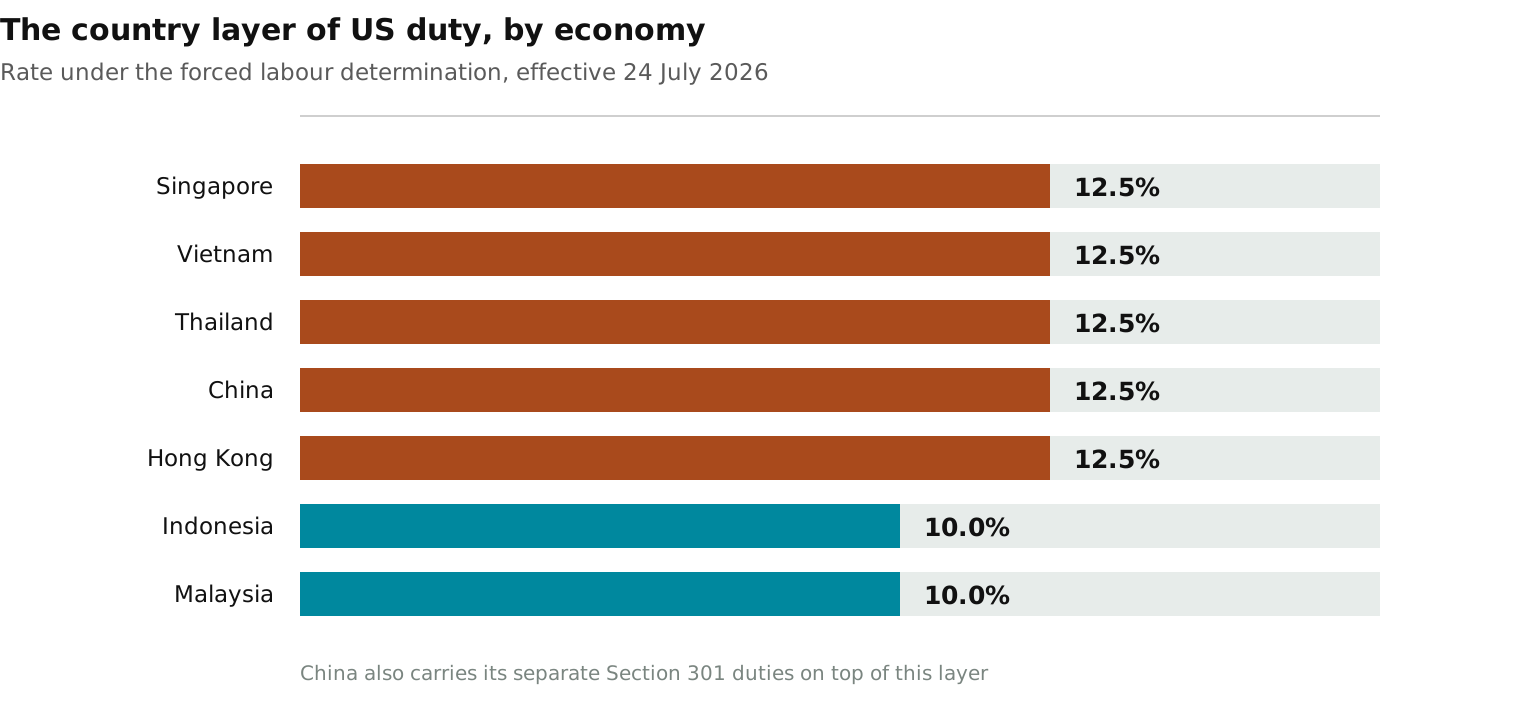 Singapore, Vietnam, Thailand, China and Hong Kong all sit at twelve and a half per cent. Indonesia and Malaysia sit at ten. For a business that moved production to Vietnam on tariff grounds between 2025 and early 2026, the arithmetic that justified the move has largely disappeared. The remaining large differentials are attached to goods rather than to places.
Those product duties are where the money now is. Steel, aluminium and copper carry fifty and twenty-five per cent under Section 232 proclamations effective from 6 April 2026. Those rates now apply to the full customs value. Patented pharmaceuticals carry up to one hundred per cent. Automobiles and furniture carry twenty-five per cent, lumber ten. A narrow semiconductor duty of twenty-five per cent took effect on 15 January 2026. China's separate Section 301 stack from the 2024 four-year review survives at rates between seven and a half and one hundred per cent by product.
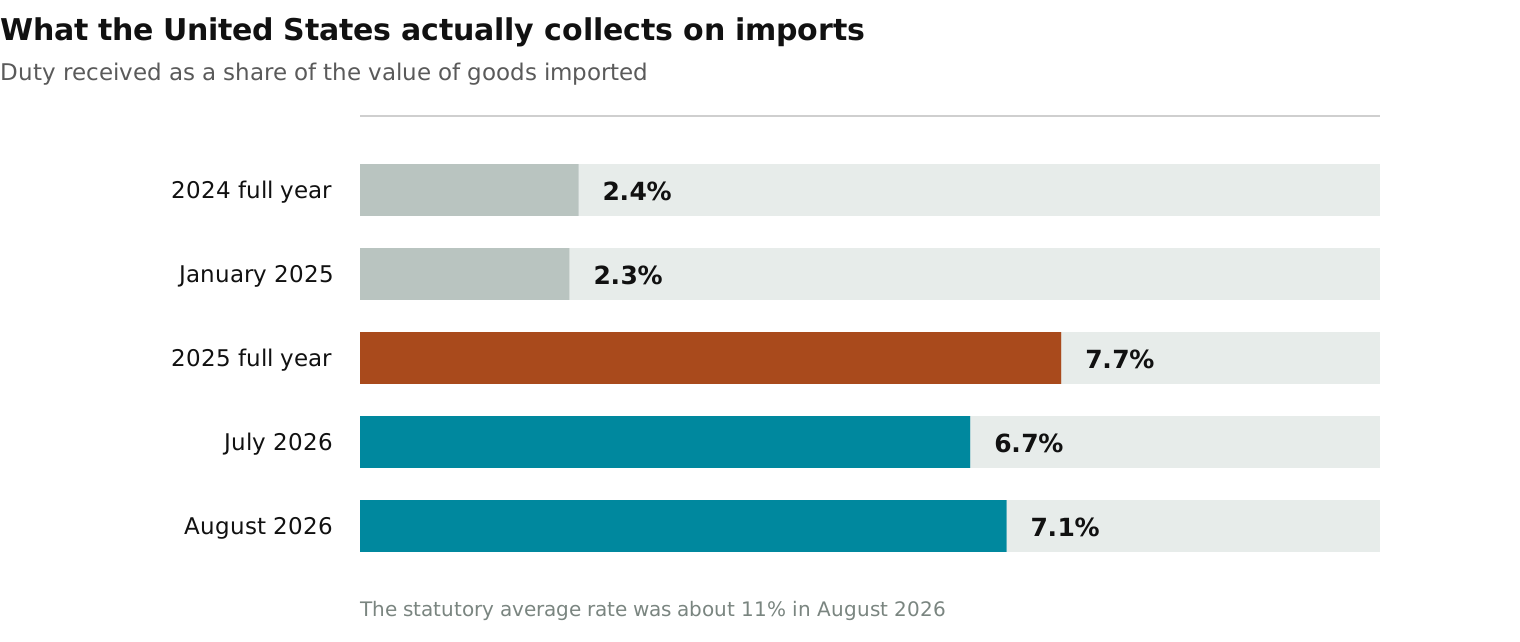 Two different numbers circulate as the American tariff rate, and mixing them is the most common error in the field. The collections measure divides duty actually received by the value of goods imported. It stood at 2.4 per cent in 2024 and rose to 7.7 per cent across 2025, the highest since 1947. In August 2026 it sat at 7.1 per cent. The statutory average, which weights published rates against trade, was about eleven per cent in August 2026. The gap between the two is exclusions, preferences and goods that do not arrive.
Singapore faces a duty the United States did not impose over trade imbalance
Singapore's position is unusual and worth stating precisely. The United States runs a surplus with Singapore, and has done every year from 2019 to 2025 except 2020. In 2025 that surplus was USD 3.4 billion on goods and USD 29.5 billion on services. There is no deficit grievance to answer. The twelve and a half per cent comes from a forced labour finding, not from an imbalance. The free trade agreement does not solve it either. The agreement reduces the most favoured nation component of the duty, and Section 301 duties sit outside that. Singapore has no country-specific exclusion list. The Ministry of Trade and Industry stated on 24 July 2026 that about one third of Singapore's domestic exports to the United States are affected.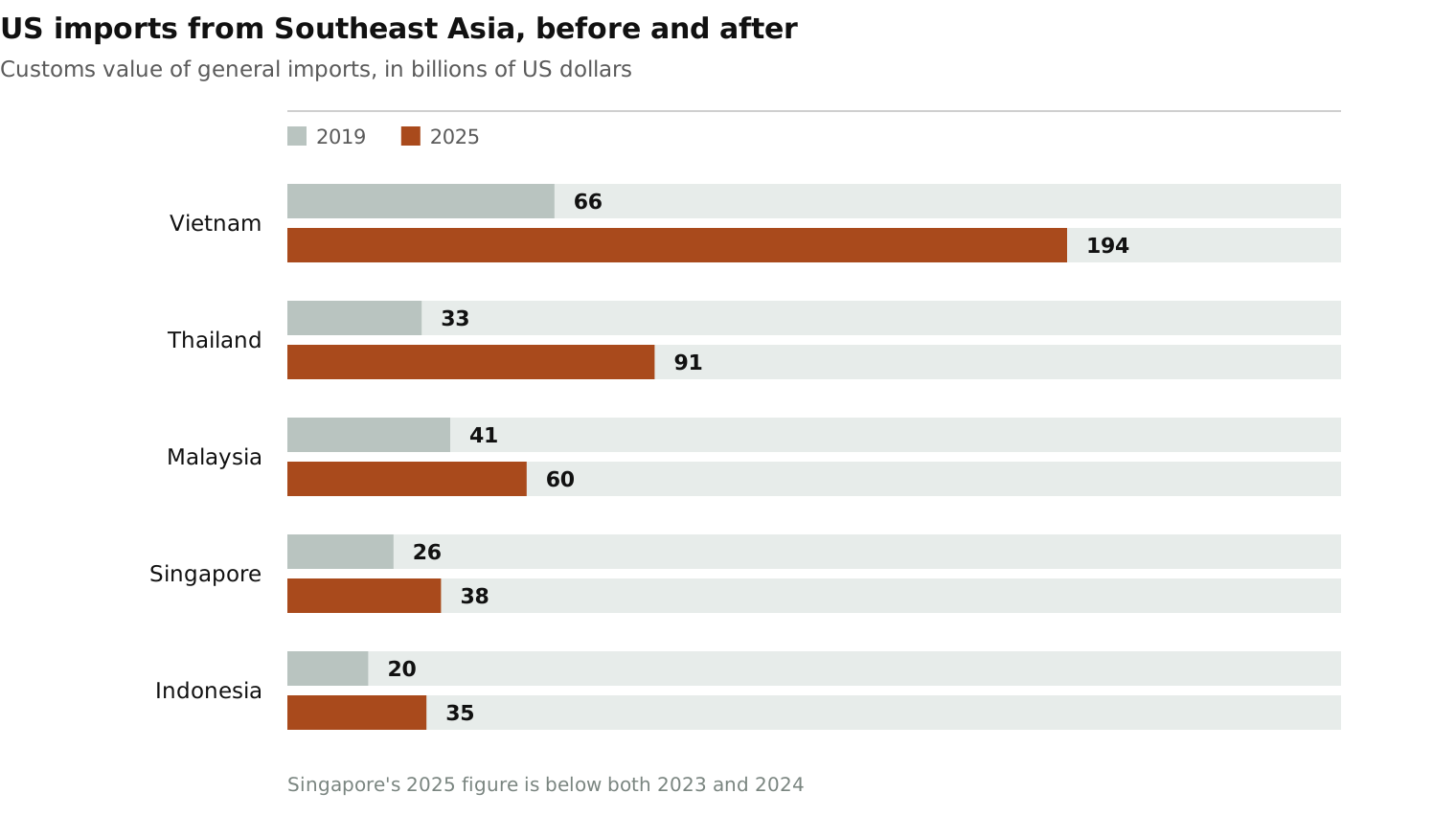 A larger exposure is still forming. On 11 March 2026 the United States initiated a Section 301 investigation into excess capacity covering sixteen economies, Singapore among them. The named sectors are chemicals, semiconductors, electronics and machinery. Any duty arising from it could stack on the existing twelve and a half per cent. For an exporter in those sectors, that pending investigation matters more than the duty already in force.
The import data also contradicts a pitch that was common through 2025. American imports from Vietnam rose from USD 66.4 billion in 2019 to USD 193.9 billion in 2025. Imports from Thailand rose from USD 33.4 billion to USD 91.3 billion. Imports from Singapore rose from USD 26.4 billion to USD 38.2 billion, which is below both 2023 and 2024. Singapore is not absorbing diverted Chinese volume the way its neighbours are.
Origin is decided by substantial transformation, and routing is not origin
The rule that matters most to anybody considering a Singapore entity is the origin rule, and it is unforgiving. Non-preferential origin turns on substantial transformation. Work done in a country must give the goods a new name, character or use. Simple assembly does not qualify, and the regulations treat an operation involving five or fewer foreign parts as simple assembly. Preferential rules under a free trade agreement do not decide whether a Section 301 duty applies. The forty per cent transshipment duty that featured in so much 2025 commentary came from an emergency order of 31 July 2025. It applied in place of the emergency rate, and that rate has now been struck down and terminated. No transshipment duty appears in the Section 301 forced labour notice or in any Section 232 proclamation. Its current status is therefore unclear rather than settled, and no exporter should plan on either answer.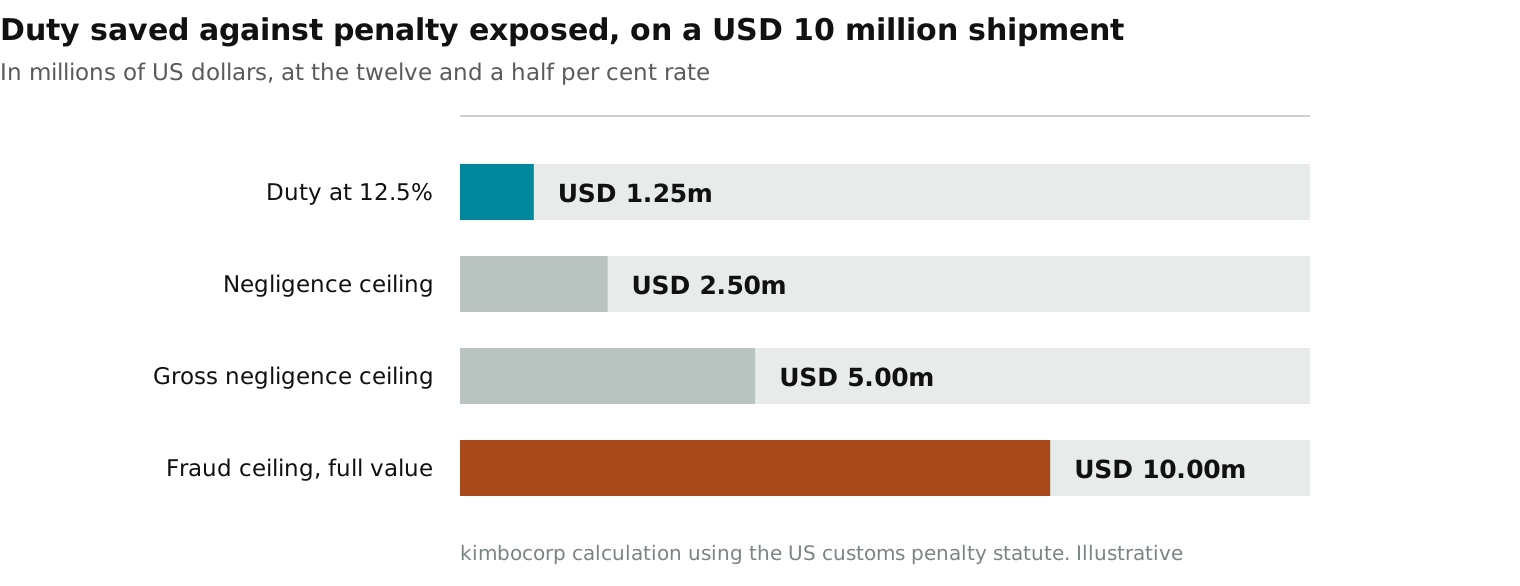 The exposure is far larger than the duty, and this is the figure that should end the conversation. On a USD 10 million shipment the duty at twelve and a half per cent is USD 1.25 million. The negligence ceiling is twice the duty avoided. Gross negligence is four times. Fraud is the full domestic value of the merchandise, which is USD 10 million. A false origin declaration risks eight times the amount it was meant to save, and that is before any criminal exposure.
| What the structure changes | Effect on the tariff | What the law actually looks at |
|---|---|---|
| Where the company is incorporated | None | Not an input to the origin test |
| Who holds title to the goods | None | Not an input to the origin test |
| Where the invoice is raised | None on the rate | Can affect dutiable value, under conditions |
| Where goods are warehoused or consolidated | None | Routing is not origin |
| Relabelling or repackaging | None | Does not create a new name, character or use |
| Simple assembly of foreign parts | None | Expressly excluded from transformation |
| Substantial manufacturing in Singapore | Changes the rate | New name, character or use, documented |
| Where profit is booked | None | An income tax question, not a border one |
A middleman sale can lower the value, and it does not touch origin
There is one legitimate structure in this area, and it is narrow. The first sale rule allows the dutiable value to be the price in an earlier sale in the chain rather than the price to the American importer. A Singapore trading company may buy from an Asian manufacturer and sell to an American buyer. In the right circumstances the manufacturer's price becomes the customs value. The conditions are strict and the documentation burden is real. There must be a bona fide sale at each step. The goods must be clearly destined for the United States at the time the middleman contracts. Each sale must be at arm's length. The supporting documentation requirements were set out by customs in a decision published on 2 January 1997 and have not become easier since. What this does is reduce the base on which duty is calculated. It does not change the rate, and it does not change the origin. Take a product carrying twelve and a half per cent. A first sale structure that moves the customs value from USD 10 million to USD 8 million saves USD 250,000 of duty. That is a real saving, obtainable lawfully, and it is an order of magnitude smaller than what the tariff-avoidance pitch implies. The profit side is a separate question entirely, and it is governed by transfer pricing rather than by customs. Singapore requires transfer pricing documentation above a revenue threshold. It also applies a five per cent surcharge on any adjustment, even where no additional tax results. The per-transaction documentation threshold for goods and loans rose to SGD 2 million from the 2026 year of assessment. A margin left in a Singapore company that does not perform the functions earning it will be adjusted.The remittance tax is one per cent, and it applies to cash
A separate measure is widely misdescribed, and the correct version is much narrower. A one per cent excise applies to certain outbound money transfers under a provision added by the budget reconciliation act signed on 4 July 2025. It took effect for transfers after 31 December 2025. Proposed regulations were published on 13 April 2026, and final regulations have not been confirmed as published.
The scope is where the misreporting sits. The tax applies to cash, money orders, cashier's cheques and traveller's cheques. It does not apply to transfers from a bank account. It does not apply to debit or credit cards, regardless of where the card was issued. It does not apply to cheques, automated clearing house transfers or prepaid cards. Transfers of fifteen dollars or less are excluded.
Two further points matter for a business. Citizenship and immigration status are irrelevant to the charge, despite the versions reported during the bill's passage. The sender must be a consumer transferring money for personal, family or household purposes, which places commercial transfers outside the measure altogether. The rates of five per cent and three and a half per cent that circulated widely were House versions. The enacted law carries neither of them. It also dropped the citizenship test that accompanied one.
A separate proposal would raise the rate to twenty-five per cent and extend it to all non-citizens. It was introduced on 21 May 2026 and has not been enacted. Section 899, the retaliatory tax measure that caused considerable alarm in mid-2025, was never enacted either. It was removed from the Senate bill before the vote of 29 June 2025, following an understanding reached with the Group of Seven. The act signed on 4 July 2025 does not contain it.
Where a Singapore entity does not help at all
The tariff follows the goods. A Singapore company does not change where something was made, and a customs officer assessing origin does not look at the certificate of incorporation. For goods manufactured in China, the Chinese Section 301 duties apply wherever the invoice is raised. The new twelve and a half per cent sits on top of them. For steel, aluminium, copper, pharmaceuticals, automobiles, furniture and lumber, the Section 232 duties are product-based and indifferent to country.
The free trade agreement does not shield Singapore-origin goods from the new duty. On the Ministry's own figures, one third of Singapore's domestic exports to the United States are affected. Singapore is also one of the sixteen economies in the excess capacity investigation, so its exposure may grow rather than shrink. None of this is improved by a holding structure.
What a Singapore company does for a business selling into the United States is commercial rather than tariff-related. It provides a contracting entity with an established legal system, multi-currency banking, treaty access across Asia and a workforce for regional functions. Where the company performs real functions, the profit attributable to those functions can properly sit there. That case stands on its own merits, and it does not need a tariff claim attached to it.
What this means for exporters, importers and advisers
For an exporter, the first task is to classify by product rather than by country. The country layer is now ten or twelve and a half per cent across the region. The decisive question is whether the goods fall under a Section 232 proclamation or a China-specific list. A business that relocated production for tariff reasons in 2025 should rerun the calculation. A two and a half point spread may no longer justify the cost of the move.
For an importer of record that paid emergency tariffs between February 2025 and February 2026, there is money to recover and a process already running. About three quarters of what was collected had been certified as refunded by early October 2026. A separate claims process for finally liquidated entries opened on 6 October 2026, and a class action covering that period was certified on 8 October 2026. Any business that paid those duties should establish where its entries sit rather than wait.
For an adviser, the tariff landscape should be checked against the issuing documents rather than against commentary. A large number of automatically generated tariff tracker sites still publish rate tables that were made obsolete in February 2026, and they carry no dates. The status of the transshipment duty is genuinely unresolved, and the honest answer to a client asking about it is that nobody can state it with confidence. What can be stated with confidence is the penalty arithmetic, and it is the part of the conversation worth having first.
Our blog
Latest blog posts
Tools and strategies modern teams need to help their companies grow.