What it takes to move money out of India, and out of Singapore

Written by

Huan koh
Published on
October 5, 2026

Copy link
Link copied!


The owner's allowance is capped at US$250,000 a year and taxed at 20% on most uses. The company pays no such tax, but one late filing stops the next payment. Two different sets of rules govern money leaving India, and they are constantly confused with each other. One applies to a person. The other applies to a company. Treating them as a single regime produces advice that is wrong in both directions, and it is the first thing a finance team should separate. An individual resident in India may send up to US$250,000 abroad in a financial year under the Liberalised Remittance Scheme. Most of what that person sends is taxed at 20% as it leaves. An Indian company is not using that scheme at all, has no annual ceiling of that kind, and pays no such tax on its remittances. What the company faces instead is a sequence of filings before each payment. An enforcement lever then stops the next payment if any of them is late. A Singapore company faces neither. Singapore abolished exchange control in 1978 and has not reintroduced it. There is no ceiling, no purpose code, no pre-payment certificate and no annual return on money held abroad. A Singapore company instructs its bank, the bank applies its own anti-money-laundering checks, and the money moves. That difference is the whole of this article.
A resident Indian may send US$250,000 abroad each year, and pays 20% on most of it
The remittance allowance has stood at US$250,000 per resident individual since 2015, and the 2026 Budget did not change it. The figure is denominated in United States dollars rather than rupees. Every resident individual holds one, including a minor, so a family of four adults has four allowances between them. One point is routinely misunderstood. The ceiling is a single pool covering both spending and investing, not a separate allowance for each. The tax on top is where the real cost sits. India collects tax at source when the money leaves, at a rate that depends entirely on the stated purpose. The rates were last changed on 1 April 2026, when education and medical remittances came down from 5% to 2%. The rate that applies to almost everything a business owner does was left untouched at 20%.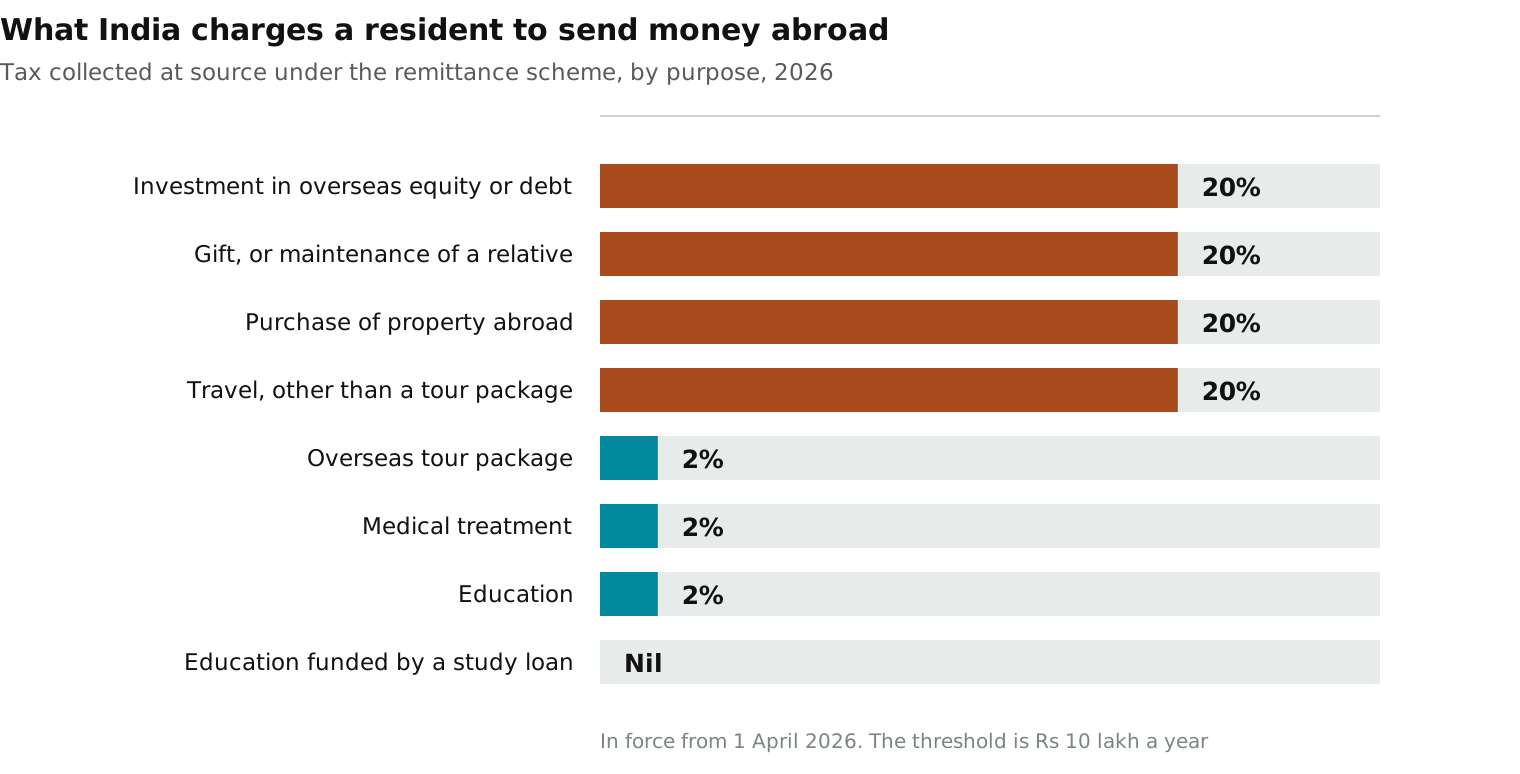 Investing abroad, buying property abroad, making a gift and supporting a relative are all taxed at 20% above ₹10 lakh in a tax year. The threshold itself was raised from ₹7 lakh on 1 April 2025, which is a change many published guides still have not picked up. Education funded by a qualifying study loan is the only category that bears nothing at all. An overseas tour package is now taxed at 2% with no threshold whatsoever, so the first rupee is caught.
The 20% is recoverable, which makes it a financing cost rather than a tax
Tax collected at source is not a final charge. It is a prepayment, credited against the person's income tax for the year and refunded if it exceeds what is owed. India also pays interest on a delayed refund. So the money is not lost, and any adviser who describes it as a 20% tax on sending money abroad is overstating the position. What it does cost is time. Consider a remittance of ₹1 crore to fund an overseas investment. Tax of 20% applies to ₹90 lakh of that, which is ₹18 lakh collected at the moment of transfer. That sum is recovered when the return for the year is assessed, which can be a year or more later. At a cost of funds of 9%, carrying ₹18 lakh for twelve months costs about ₹1.62 lakh. On those assumptions the real cost is roughly 1.6% of the amount remitted, and it buys nothing. That arithmetic is an illustration rather than a measurement, and the cost of funds is an assumption rather than a published figure. No Indian authority has ever quantified the working capital cost of the timing difference, so any number presented as official should be treated with suspicion. Two relieving measures notified in October 2024 help salaried remitters, by letting the credit be factored into payroll withholding instead of waiting for assessment.An Indian company pays no remittance tax, but it files before every payment
The company position is different in kind. There is no ceiling on what an Indian company may pay abroad for goods, services or royalties, and no tax collected at source on those payments. What there is instead is a documentary sequence, and each step has to be completed before the bank will release the money. The sequence begins with establishing whether the payment is taxable in India and at what rate. That requires a tax residence certificate from the recipient and a declaration of eligibility. Where the chargeable payments to non-residents exceed ₹5 lakh in a tax year, a practising chartered accountant must certify the rate in a prescribed form. The remitter then files its own declaration with the tax department electronically, before the payment is made. Only then does the exchange control step begin. The company files a declaration with its authorised dealer bank, identifying the payment against a purpose code, with supporting documents. The withholding tax is deposited, a return is filed and a certificate is issued to the recipient. All of this precedes a transfer that a Singapore company would complete in a single banking instruction.| What has to happen before the money moves | India | Singapore |
|---|---|---|
| Establish whether tax is due, and at what rate | Required, with a residence certificate from the recipient | Not applicable |
| Accountant’s certificate on the rate | Required above ₹5 lakh of chargeable payments in that tax year | None |
| Declaration to the tax department before payment | Required, filed electronically | None |
| Declaration to the bank under exchange control | Required, against a purpose code, with documents | None |
| Deposit the withholding tax and file the return | Required | None |
| Annual return on money invested abroad | Required in every year, by the last day of December | None |
| The bank’s own anti-money-laundering checks | Required | Required |
| Can an earlier filing lapse block the next payment | Yes | No |
One late filing stops the next remittance
The enforcement mechanism attached to overseas investment is the part most finance teams underestimate, because it is not framed as a penalty. When an Indian investor puts money into a foreign company it files a form at the time of remittance. The bank then obtains a reference number for that investment. That number is frequently mistaken for a regulatory approval, and it is not one. An annual performance report is then due for each foreign company, in every year, by the last day of December. It must be based on the foreign company's audited accounts and certified by an auditor or a chartered accountant. A late filing can be regularised by paying a fee. That fee starts at ₹7,500 and rises with both the amount involved and the length of the delay, up to the full amount. The real consequence is not the fee. Until the delay is regularised, the bank will not process any further remittance or financial commitment to that foreign company. A single missed annual report therefore stops the next funding round, the next capital injection and the next intercompany payment. Businesses discover this at the moment they most need the money to move, which is the worst possible time to find out.Indians sent US$28.98 billion abroad last year, and the fastest-growing use was investment
The published totals do not support the idea that money is flooding out of India. Outward remittances by individuals peaked in the 2023-24 financial year and have fallen in each of the two years since. The 2025-26 total was US$28.98 billion, down 2% on the year before, which was itself down almost 7%.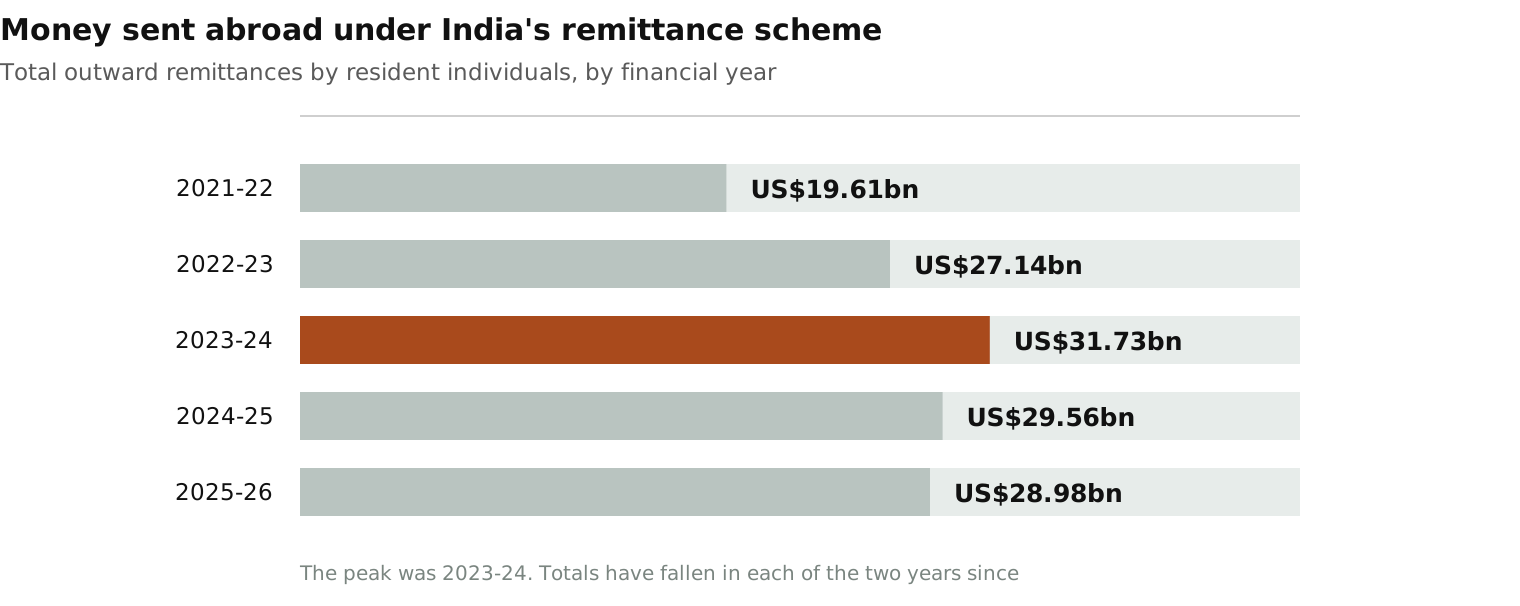 What has changed is the composition rather than the total. Travel still accounts for the majority of the money, and spending on overseas education fell by 21% in a single year. The two categories that grew were investment in foreign equity and debt, up 56%, and the purchase of property abroad, up 64%.
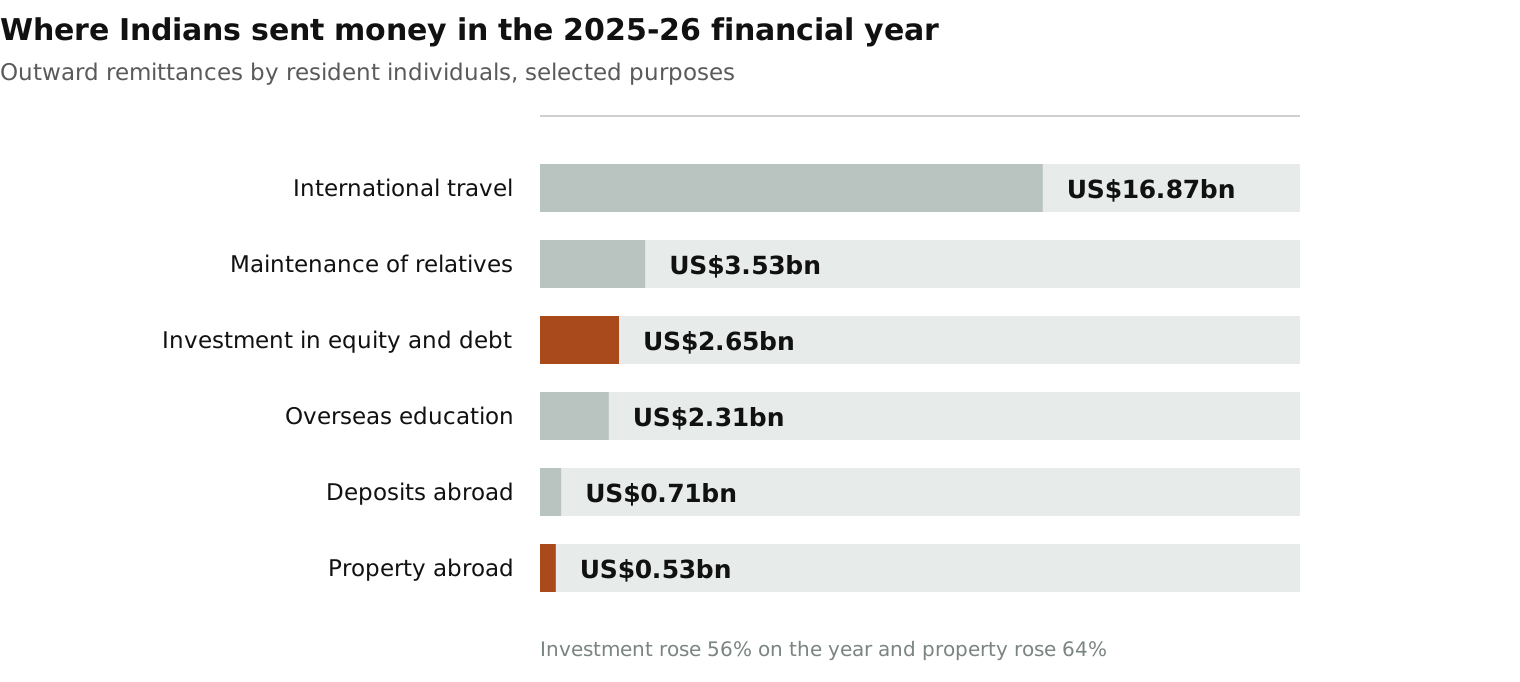 Those two growing categories are precisely the ones taxed at 20%. The categories that received a rate cut in April 2026, education and medical treatment, are both shrinking. Whatever the policy intention, the relief landed on the uses that are declining and left the full rate on the uses that are rising.
India withholds tax when money leaves, and the treaty roughly halves it
Separately from all of the above, India taxes the payment itself in the recipient's hands and collects it by withholding. The domestic rate on dividends, royalties and fees for technical services is 20%. Surcharge and cess push the effective rate to between 20.8% and 21.84%, depending on the recipient's income band.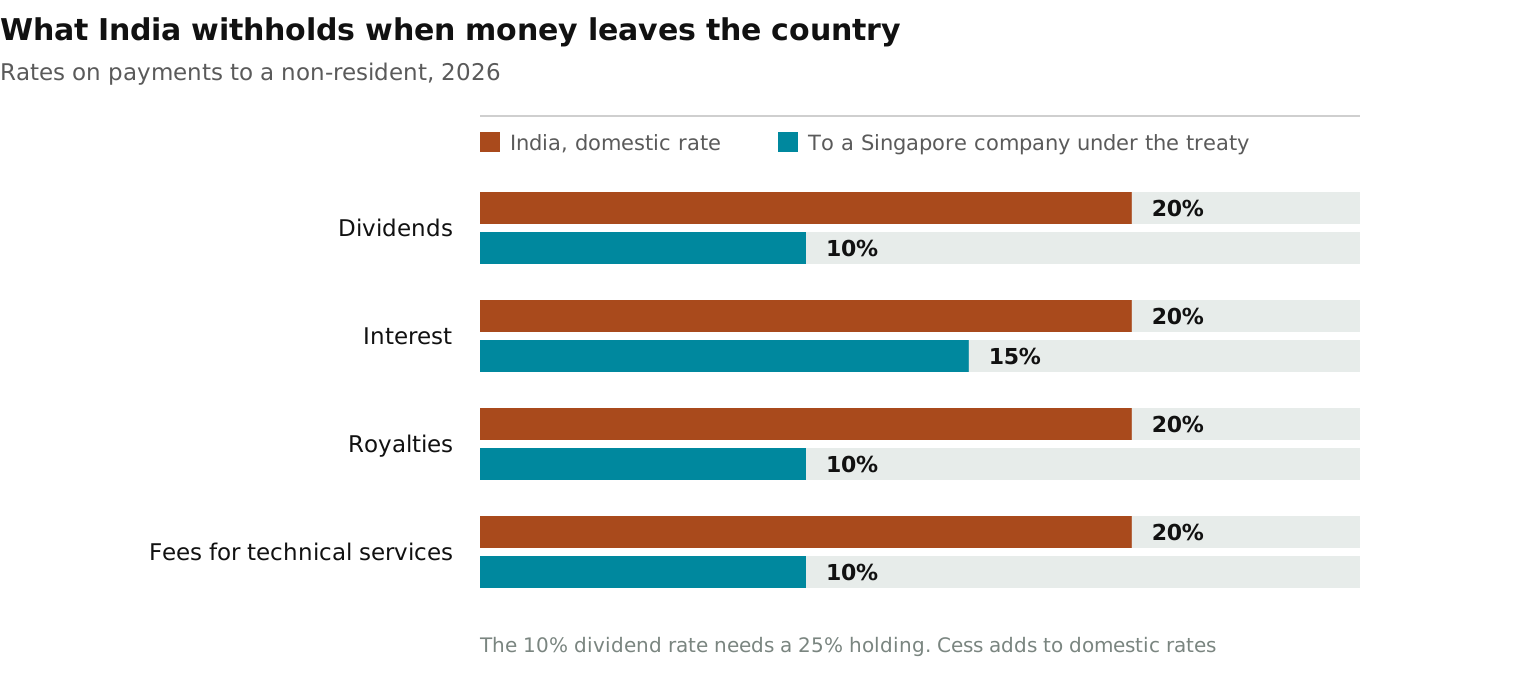 A Singapore recipient does materially better under the treaty, and the detail matters. Dividends are capped at 10%, but only where the beneficial owner is a company holding at least 25% of the shares. Everyone else pays 15%. Royalties and fees for technical services are both capped at 10%. The inclusion of technical service fees is a genuine advantage, and several of India's other treaties do not offer it.
Interest is the exception that should be stated honestly. The treaty caps it at 10% only where the lender is a bank or a similar financial institution. Ordinary intercompany lending is capped at 15%, which is higher than Singapore's own 15% domestic rate on interest paid out. The comparison is not one-sided on every line, and presenting it as though it were invites an easy rebuttal.
The treaty rate is not automatic, and India's Supreme Court said so in January 2026
On 15 January 2026 the Supreme Court of India decided a long-running dispute involving an investment held through Mauritius and Singapore. It held that a tax residence certificate alone does not establish entitlement to treaty benefits, and that the authorities may examine where management and control actually sit. It also held that the general anti-avoidance rule can be applied to deny benefits that would otherwise have been grandfathered. The practical consequence is straightforward. A Singapore company claiming the 10% dividend rate on Indian profits needs real decision-making in Singapore. It needs a genuine commercial reason to exist and directors who actually decide things. A certificate and a registered address no longer carry the point. Any structure sold on the treaty rate alone is now exposed to exactly the analysis the Court applied. This cuts in the same direction as Singapore's own rules. The conditions for a Singapore certificate of tax residence already require control and management to be exercised there. In practice that means a working executive director, or management by a Singapore firm. Both authorities are asking the same question, which makes the answer easier to give once and harder to fake.India rewrote parts of its exchange control rulebook in 2026, and tightened one part
India has been consolidating its foreign exchange regulations through 2026, and the direction is genuinely towards simplification. New guarantee regulations notified in January 2026 replaced a set that had stood since 2000. Consolidated export and import regulations were notified in the same month. A draft set of foreign investment rules published on 21 July 2026 would replace the existing non-debt instrument rules entirely. The consultation on it closed on 31 August 2026, and the rules have not been notified since. One change ran the other way, and it is worth knowing about. An amendment effective 1 October 2026 shortened the period allowed for bringing export proceeds back into India, from fifteen months to nine for goods and services. Exporters already on the caution list stay under the old timetable until they come off it. A business that routinely gives long credit to overseas customers now has less room than it had in September 2026. The honest summary is that India is tidying its rulebook rather than dismantling it. The filings are being consolidated, not removed. The draft foreign investment rules are a draft, and treating them as current law would be a mistake. Nothing notified in 2026 changes the fact that an Indian company files before it pays and reports every year afterwards.Singapore has had no exchange control since 1978
The comparison is short because there is almost nothing to describe. Singapore liberalised exchange control in 1978 and has not reinstated it. A Singapore company may move working capital to or from a group company in any currency, in any amount, in either direction, without permission from anyone. There is no annual ceiling, no purpose code and no pre-transfer certificate. Nothing is withheld when a dividend leaves Singapore, to any shareholder, anywhere. That follows from the one-tier system in place since 1 January 2003, under which tax paid by the company is final. Interest paid to a non-resident is withheld at 15% and royalties at 10%, so Singapore is not a jurisdiction with no withholding at all. On dividends, which is what matters to an investor taking money out, the rate is nil. One Singapore rule is regularly misquoted and should be put in its place. Physical currency and bearer instruments worth S$20,000 or more must be reported when carried across the border. That is a cash-smuggling control and it expressly excludes electronic and bank transfers. Anyone citing it as evidence that Singapore limits transfers to S$20,000 has read it backwards.What this means for owners funding a business abroad, finance teams paying overseas suppliers, and groups holding cash in the region
For an owner funding a business abroad from personal money, the allowance and the 20% are both planning problems rather than obstacles. The allowance is per person and per financial year. Capitalising a foreign company properly is therefore a question of how many people and how many years, decided in advance. The 20% is recoverable, so the real cost is the carry on it until assessment. Both are worth modelling before the first transfer rather than after it. For a finance team paying overseas suppliers, the filings are manageable and the reporting lapse is not. The forms renumbered on 1 April 2026, so every internal template and checklist needs reviewing against the current rules. The annual return on any overseas investment is the one deadline that carries a stop attached. It falls on the last day of December each year, regardless of how convenient that is. A calendar entry and a named owner inside the business are a cheaper control than an emergency regularisation. For a group holding cash in the region, the question is where the money needs to be rather than where it happens to land. Money that sits in a Singapore company moves between regional entities without permission. It pays no Singapore withholding on its way to investors, and it is available at the speed of a bank instruction. Money routed through India for the same journey needs a filing before it leaves. It also needs a report in every year it stays out. That difference is operational before it is fiscal, and it compounds every time the business needs to move quickly.Our blog
Latest blog posts
Tools and strategies modern teams need to help their companies grow.