Four governments rewrote wealth rules in the week the rankings stood still
Written by

Huan koh
Published on
September 22, 2026

Copy link
Link copied!


Hong Kong proposed a 5% treasury rate. The Netherlands, Panama and Australia moved on migration, residence and trusts.
The Global Financial Centres Index published its fortieth edition on 16 September 2026. New York, London, Hong Kong and Singapore held the top four places, in that order, exactly as they did in March 2026. All four lost rating points. Four governments moved in the same week. Hong Kong proposed a 5% profits tax rate for corporate treasury centres. The Netherlands proposed a valuation step-up for companies moving in. Panama doubled one of its residence thresholds, and Australia closed consultation on a 30% minimum tax for discretionary trusts.
The ranking is the least informative of those five events. It measures perception through a survey of practitioners. The other four change what a structure costs, or where it can be put, and three of them carry dates that can be planned around. The ranking gets the coverage. The rule changes get the consequences.
The top four held their ranks and lost their ratings
The index is compiled by the Z/Yen Group with the China Development Institute. The fortieth edition researched 139 centres and placed 117 of them in the main index. It drew on 39,531 assessments from 6,147 respondents. Each centre is scored on a thousand-point scale, combining that survey with a set of instrumental factors such as infrastructure and regulation.
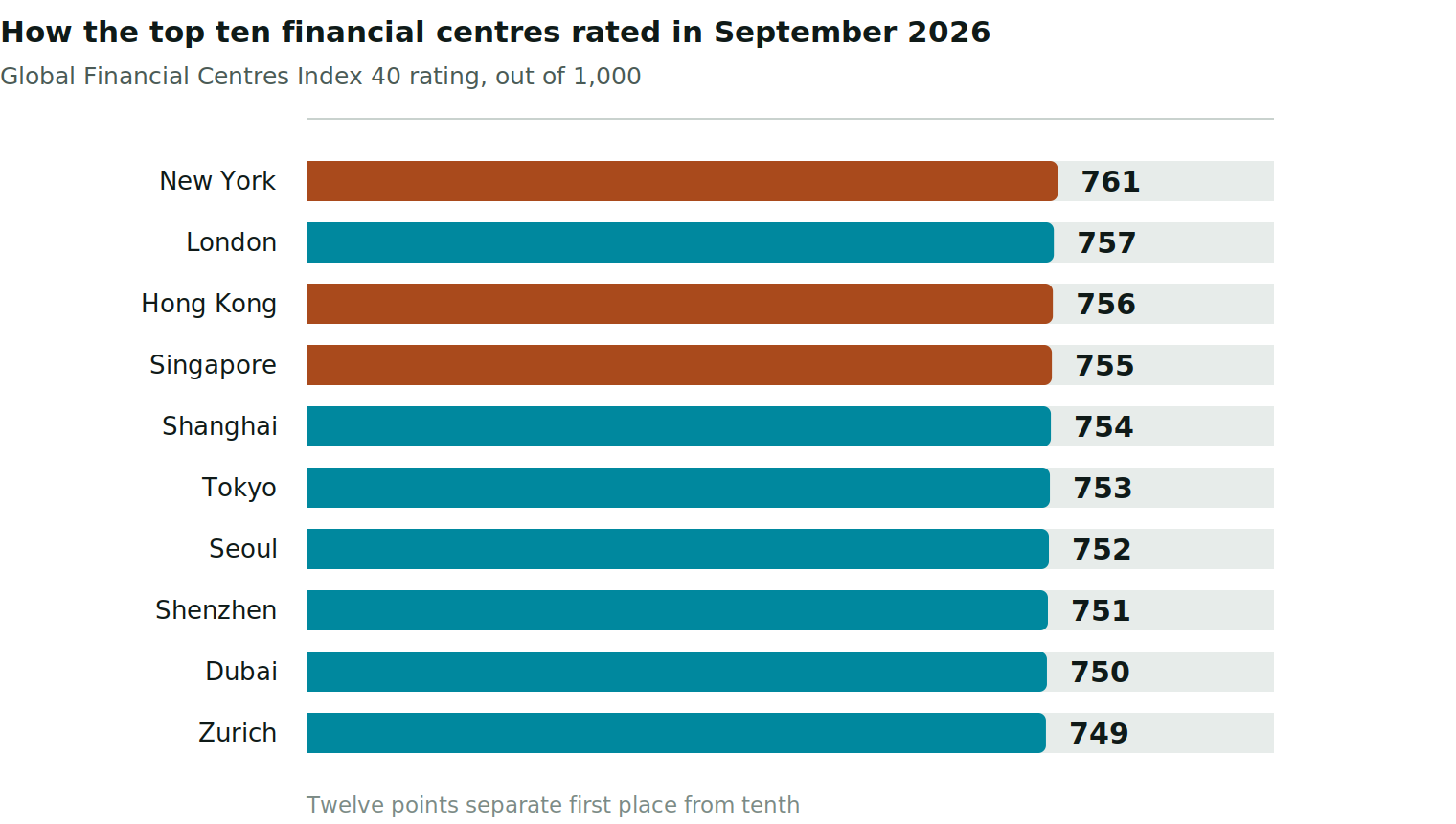
New York rated 761, London 757, Hong Kong 756 and Singapore 755. Shanghai, Tokyo, Seoul, Shenzhen, Dubai and Zurich followed in single-point steps down to 749. Twelve points separate first place from tenth. Singapore ranked second worldwide for finance and fifth for investment management. It ranked seventh for banking and seventh for trading. Its position therefore varies by four places depending on which activity is measured, which the single headline rank conceals.
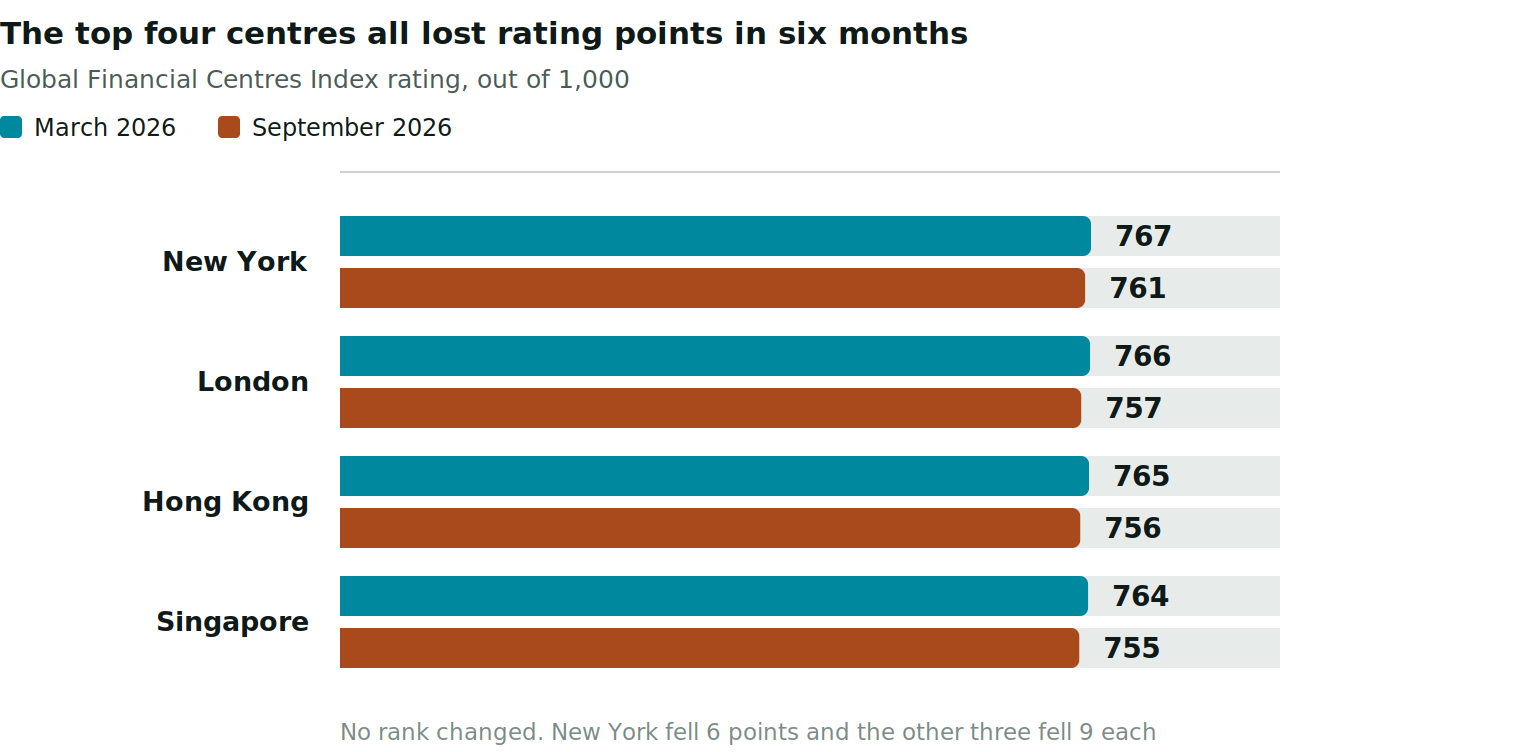
Against March 2026, New York fell 6 points. London, Hong Kong and Singapore each fell 9. No rank changed. A fall across an entire leading group usually reflects a shift in the survey population or in sentiment, not movement between centres. The index is a perception measure. It is not a measurement of assets or of capital flows, and a nine-point move on a thousand-point scale should not be read as money leaving.
Hong Kong proposed a 5% rate for treasury and sourcing centres
Hong Kong's Chief Executive delivered the 2026 Policy Address on 16 September 2026, the same day the index appeared. It commits the government to legislate a preferential profits tax rate for selected enterprises in key sectors. The rate would be 5%, or half the standard rate at 8.25%, for companies establishing corporate treasury centres and sourcing centres in Hong Kong. A corporate treasury centre is the entity that manages cash, funding and currency risk for a group.
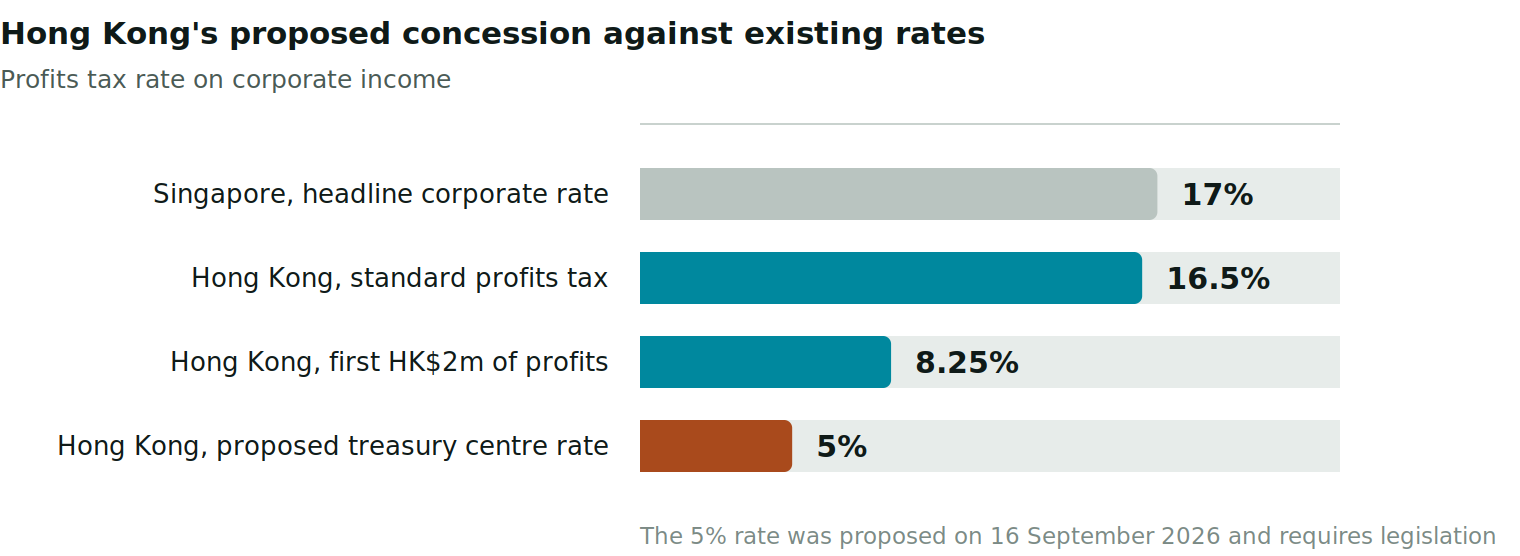
Hong Kong's standard profits tax is 16.5%, with the first HK$2 million of assessable profits taxed at 8.25%. A 5% rate would sit well below both, and below Singapore's 17% headline corporate rate. The address set out three further commodity measures. A central clearing and settlement system for gold is to launch in the first quarter of 2027. A renminbi-denominated, physically settled gold futures contract is to be introduced at the exchange later in 2026. And a half-rate concession for eligible physical commodity trading is to go before the legislature in 2027.
All of these are announced rather than enacted, and each requires a bill that has not been introduced. The address also referred to preferential regimes for funds, single family offices and carried interest. Those were the subject of a separate bill gazetted on 12 June 2026. That bill was still before the legislature as at 20 September 2026, with no record of passage. Its concessions are therefore proposed rather than available. If it passes, the government has said they would apply from the 2025/26 year of assessment.
The Netherlands proposed a step-up for companies that move in
The Dutch government presented its 2027 Tax Plan on 15 September 2026. The measure that matters to holding structures is a step-up in Box 2, the part of the Dutch system that taxes substantial shareholdings. Where a company moves its place of effective management to the Netherlands, the acquisition price of its shares would be reset. The new price would be their fair market value on the date the company becomes Dutch tax resident.
The effect is that only gains accruing after migration fall into the Dutch charge. Gains built up while the company was resident elsewhere do not. That removes one of the standard objections to moving a holding company into a treaty jurisdiction. The objection is that the move itself imports a historic gain into a new tax net. The same plan holds the Box 3 rate at 36% for 2027, with tax-free capital of EUR 60,098 per person, up from EUR 59,357 in 2026. A replacement system taxing real returns is proposed for 1 January 2028 and remains a bill.
Panama doubled one of its residence thresholds
Panama replaced its qualified investor residency regime by Executive Decree No. 17 of 8 September 2026. It came into force on 16 September 2026, superseding the decree that had governed the programme since 2020. The regime grants residence in exchange for a qualifying investment, and the thresholds are the whole of it.
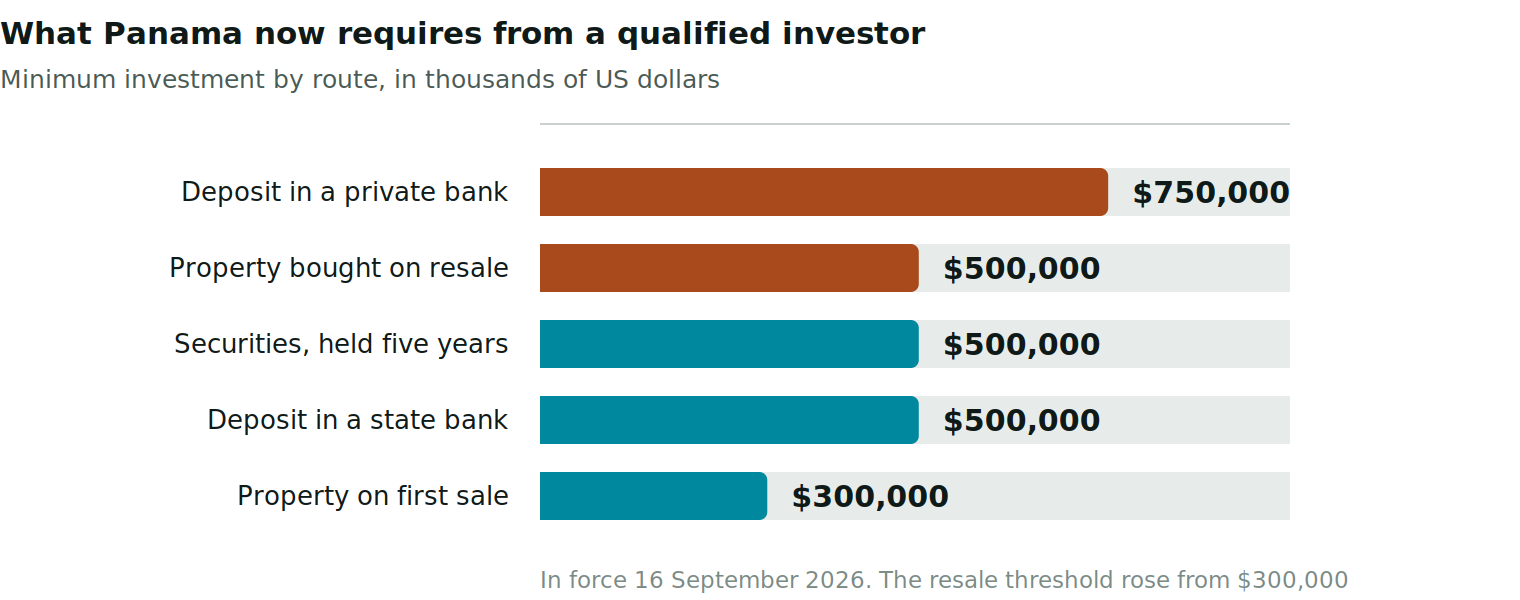
Property bought on first sale still qualifies at US$300,000. Property bought on the resale market now requires US$500,000, double the previous threshold. A securities market investment requires US$500,000 held for five years. A fixed-term bank deposit requires US$500,000 in a state bank, or US$750,000 in a private one. The decree also tightens valuation and appraisal requirements. It allows an applicant to switch between investment types within the five-year period, and permits dependants to be added after approval.
Australia closed consultation on a 30% trust tax on 18 September 2026
Australian Treasury released exposure draft legislation on 3 September 2026 for a minimum tax of 30% at trustee level on discretionary trusts, and consultation closed on 18 September 2026. The measure was announced in the 2026-27 Australian Budget and would start on 1 July 2028.
Non-corporate beneficiaries presently entitled to trust income would receive a non-refundable credit for tax paid at trustee level. Fixed trusts, managed investment trusts, widely held trusts, deceased estates and genuine testamentary trusts are all excluded. Trusts in existence on 1 July 2028 may elect to nominate fixed percentage entitlements and fall outside the charge. A temporary restructure rollover runs from 1 July 2027 to 30 June 2030. It allows assets to be moved out of discretionary trusts into companies or fixed trusts without an immediate tax charge. The measure is a draft and not law.
What this means for families in Hong Kong, families holding through trusts, and anyone choosing on rankings
For a family with Hong Kong exposure, the treasury centre proposal is worth tracking and not yet worth acting on. A 5% rate on treasury and sourcing activity would be among the lowest available anywhere for that function. It signals clearly where Hong Kong intends to compete. But it requires legislation that has not been introduced. The separate bill on funds, single family offices and carried interest has been before the legislature since June 2026 without passing. Structures should be built to work at current rates, with any concession treated as upside rather than as the basis of the plan.
For a family holding assets through a discretionary trust with Australian connections, the timetable is now visible and long. The charge would begin on 1 July 2028. The election for existing trusts attaches to trusts in place on that date. The restructure rollover opens a year earlier, on 1 July 2027. That sequence rewards deciding early, because the rollover window closes on 30 June 2030 and the election depends on a structure existing before the start date. Families with no Australian connection should still note the direction. A minimum tax at trustee level on discretionary trusts is the kind of measure that gets copied.
For anyone choosing a jurisdiction from a league table, the fortieth index shows the limits of that approach. Twelve points separate the first centre from the tenth. The top four have not changed order, and all four moved down together. Nothing in that tells a family where to put a holding company. The four rule changes in the same week do, because each one alters a specific cost, threshold or date. Singapore's own position varies from second to seventh depending on which activity is measured. That is the most useful line in the report and the one least likely to be quoted.
Our blog
Latest blog posts
Tools and strategies modern teams need to help their companies grow.