Category: Virtual Business

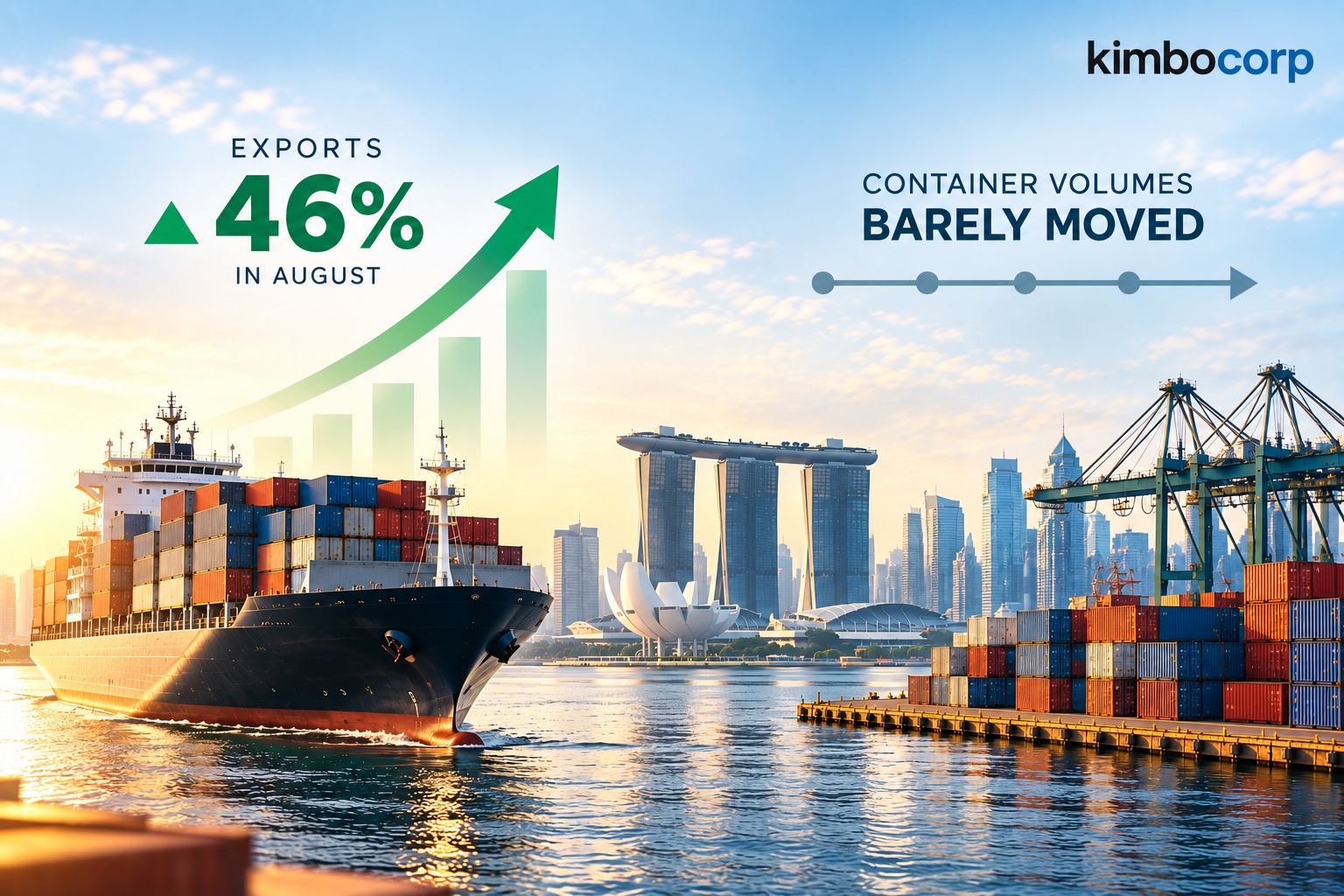
  • Singapore’s exports rose 46% in August while its container volumes barely moved

    Singapore’s exports rose 46% in August while its container volumes barely moved

    Value and volume have come apart. The goods driving the surge take up almost no space.

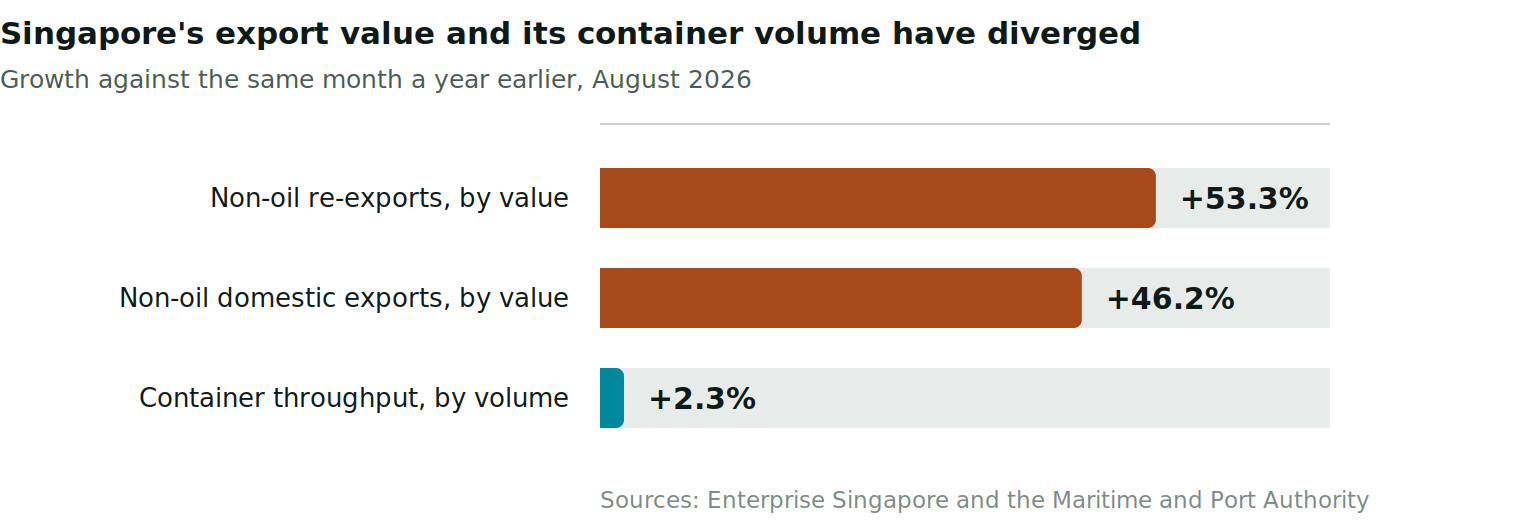
    Singapore’s non-oil domestic exports rose 46.2% in August 2026 against the same month a year earlier, Enterprise Singapore reported on 17 September 2026. Non-oil re-exports rose 53.3%. Total merchandise trade rose 44.5%. Over the same month, container throughput at the Port of Singapore rose 2.3%, according to Maritime and Port Authority data. Both figures cover the same month and the same port.

    Export value and container volume measure different things. Value counts what the goods are worth. Volume counts how much space they take up, measured in twenty-foot equivalent units. When growth concentrates in small, dense, expensive electronics, the first number can move many times faster than the second. That gap decides whether an export boom reaches a trading company’s freight bill and warehouse space, or stays in the headline. It also decides which businesses in Singapore feel the boom at all.

    Exports grew 46.2%, and four products carried most of it

    Electronics exports rose 131.8% in August 2026, up from 112% in July 2026. Non-electronics rose 12.0%, reversing a fall of 2.4% the previous month. That reversal matters more than the headline rate. July 2026 was a month in which one category carried everything while several others contracted. August 2026 was broader. Exports rose to nine of Singapore’s top ten markets, and the United States and China remained the two largest.

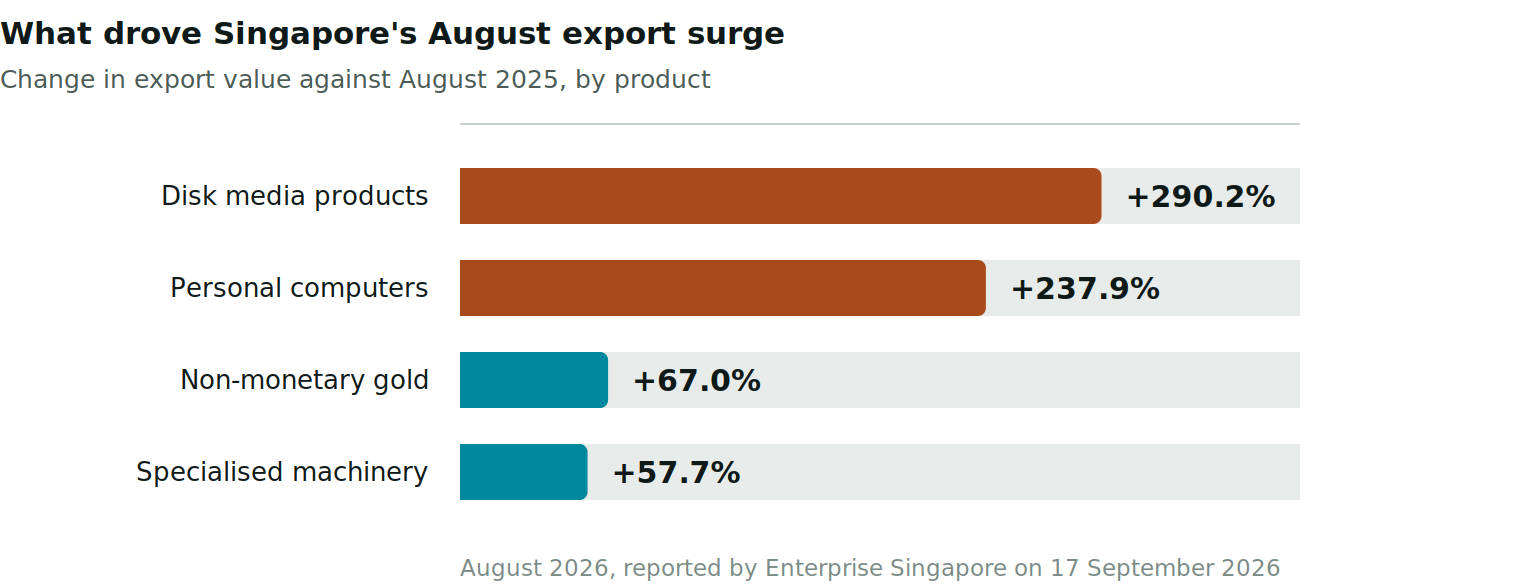
    Four products account for most of the increase. Disk media products rose 290.2%, adding S$1.4 billion. Personal computers rose 237.9%, adding S$1.3 billion. Specialised machinery rose 57.7%, adding S$0.8 billion. Non-monetary gold rose 67%, adding S$0.5 billion. Three of those four are artificial intelligence hardware or its inputs. The fourth is gold, which moves for reasons unconnected to technology demand. Separating gold out is worth doing before quoting the total, because it is the one line most likely to reverse on its own.

    Container volumes grew 2.3% over the same month

    The port handled 3.95 million containers in August 2026, on a preliminary estimate, against 3.86 million in August 2025. That is a rise of 2.3%. Against July 2026, volumes fell 0.9%. For the first eight months of 2026 the port handled 30.68 million containers, up 4.2% on the same period of 2025.

    So Singapore moved roughly the same number of boxes while the value inside them rose by almost half. For a trading company this has three practical consequences. Freight capacity is not the constraint on this particular boom, because the goods driving it are light. Cargo insurance and financing requirements rise with declared value rather than with volume, so both move with the larger number. And a business trading in anything other than electronics gains nothing from the headline, because the 12% growth in non-electronics is the figure that applies to it.

    Transpacific rates reached a four-year high in the week to 17 September 2026

    Freight costs moved sharply in the same period, and they moved in opposite directions by route. The Drewry World Container Index composite stood at US$4,500 for a forty-foot container in the week to 17 September 2026, up 1% on the week. Underneath that composite the spread widened considerably.

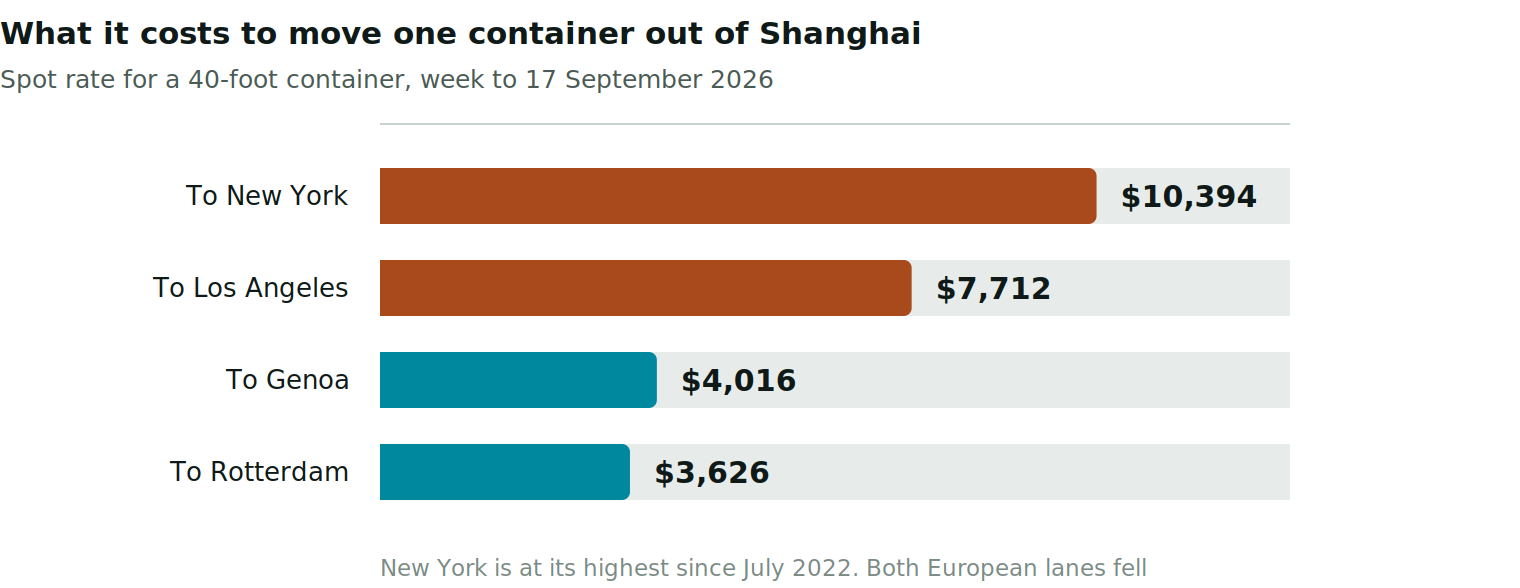
    Shanghai to New York reached US$10,394, up 7% on the week. That is the highest level since July 2022. Shanghai to Los Angeles reached US$7,712, up 5%. Shanghai to Genoa fell 5% to US$4,016, and Shanghai to Rotterdam fell 9% to US$3,626. Carriers announced nine blank sailings on the transpacific for the following week, meaning scheduled voyages cancelled to take capacity out of the market. Asia to Europe had four, up from one. Xeneta assessed Far East to US East Coast at US$11,259 per forty-foot unit on 17 September 2026, up 324.7% from 28 February 2026.

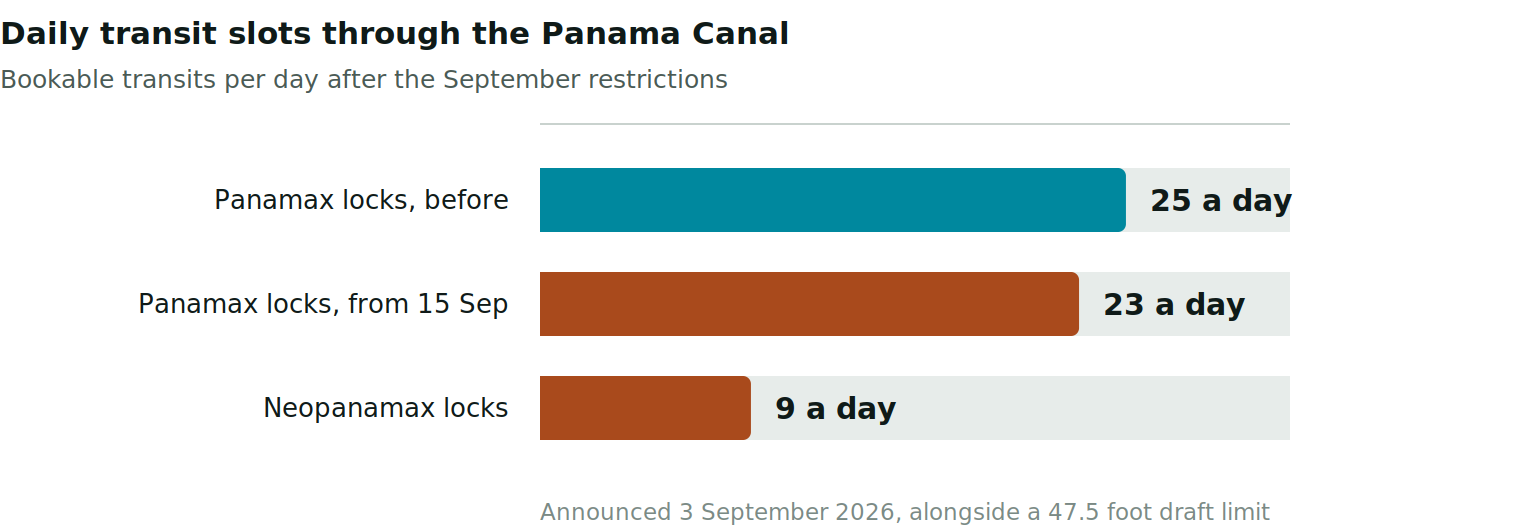
    A second constraint tightened on the American east coast route in the same week. The Panama Canal reduced bookable transits to 32 a day from 15 September 2026, made up of nine slots through the Neopanamax locks and 23 through the Panamax locks. Normal capacity is closer to 36. The cause is low water in the watershed that feeds the locks, which is a supply problem that higher payments do not solve. One transit slot sold at auction for US$5.3 million on 1 September 2026, reported as the highest price ever paid for passage.

    Carriers moved services back to the Suez Canal

    The second structural change is the route itself. On 14 September 2026 Maersk and Hapag-Lloyd announced that four services in their Gemini network, AE5, AE11, AE12 and ME2, would shift from the Cape of Good Hope to the Suez Canal. MSC said the same day that its Indusa service would resume Suez transits westbound from 23 September 2026, while eastbound sailings continue around the Cape. On 16 September 2026 the OOCL Portugal, at 24,188 containers, made the first southbound Suez transit by a COSCO group vessel since the diversions began. Evergreen has not returned.

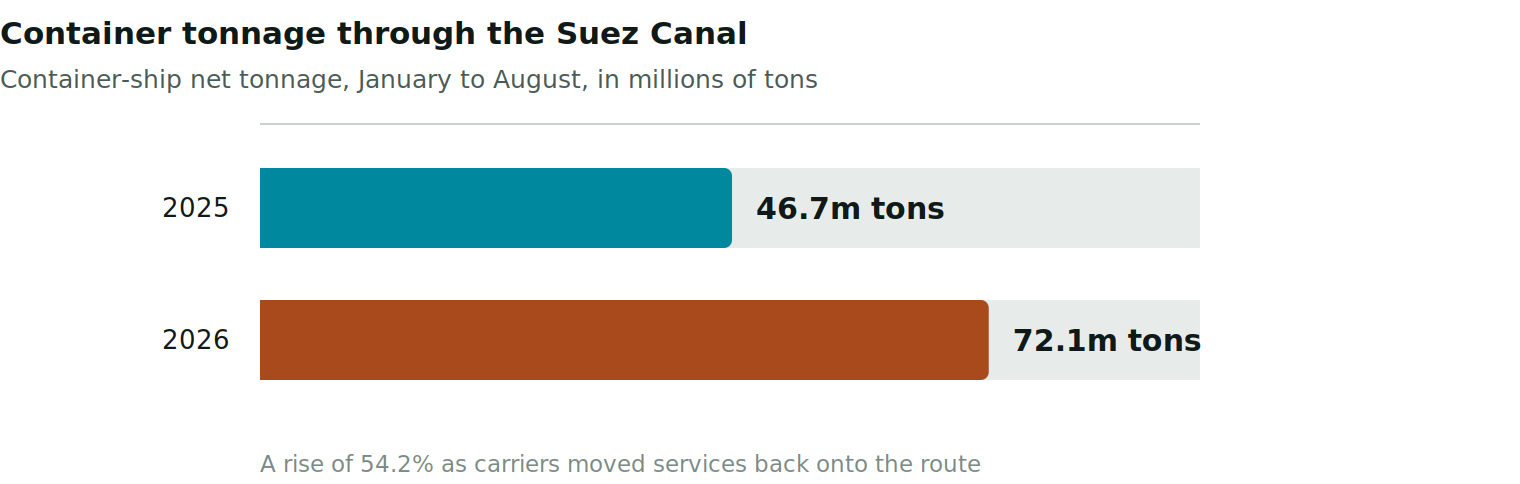
    Suez Canal Authority figures put container-ship net tonnage at 72.1 million tons for January to August 2026, against 46.7 million tons in the same period of 2025. That is a rise of 54.2%. A normalised Suez routing shortens Asia to Europe transit times by roughly ten days against the Cape, which is the single largest variable in European lead times and a direct input to Singapore’s role as a transhipment point. Carriers have announced no day-count savings of their own, and the return is partial rather than complete.

    What this means for exporters, importers into America, and companies routing through Singapore

    For an exporter outside electronics, the August 2026 headline does not describe the conditions that apply. The relevant figure is the 12.0% rise in non-electronic exports, which is a genuine improvement on July’s contraction but a different order of growth. Costing and forecasting should use the category number rather than the aggregate. The same discipline applies to any customer or lender quoting Singapore’s trade performance back at a business, since the aggregate has been carried by four products for two consecutive months.

    For a company importing into the United States, freight is now a larger risk than tariffs on this route. New York at US$10,394 and Los Angeles at US$7,712 are both far above European levels. Both rose while European lanes fell. Nine blank sailings in a single week indicates that carriers are managing capacity to hold those rates rather than to fill ships. The Panama restriction points the same way on the east coast route. Any quote given on a September 2026 rate should carry a short validity period, or an explicit freight adjustment clause, and the east coast premium is worth costing separately from the west.

    For a company routing goods through Singapore, the Suez return is the development to plan around. European lead times should shorten as more services move back, which releases working capital tied up in longer transits and in the inventory held to cover them. The return is not complete, carriers are phasing it and at least one major line has not moved, so schedules should be confirmed service by service rather than assumed. Businesses that recalculate their European inventory cover on the shorter transit before their competitors do will free cash that is currently sitting on the water.

  • Singapore eased its family office rules one week after China taxed offshore trusts

    Singapore eased its family office rules one week after China taxed offshore trusts

    For a Hong Kong owner weighing a move, the deciding factor is tax residence rather than nationality.

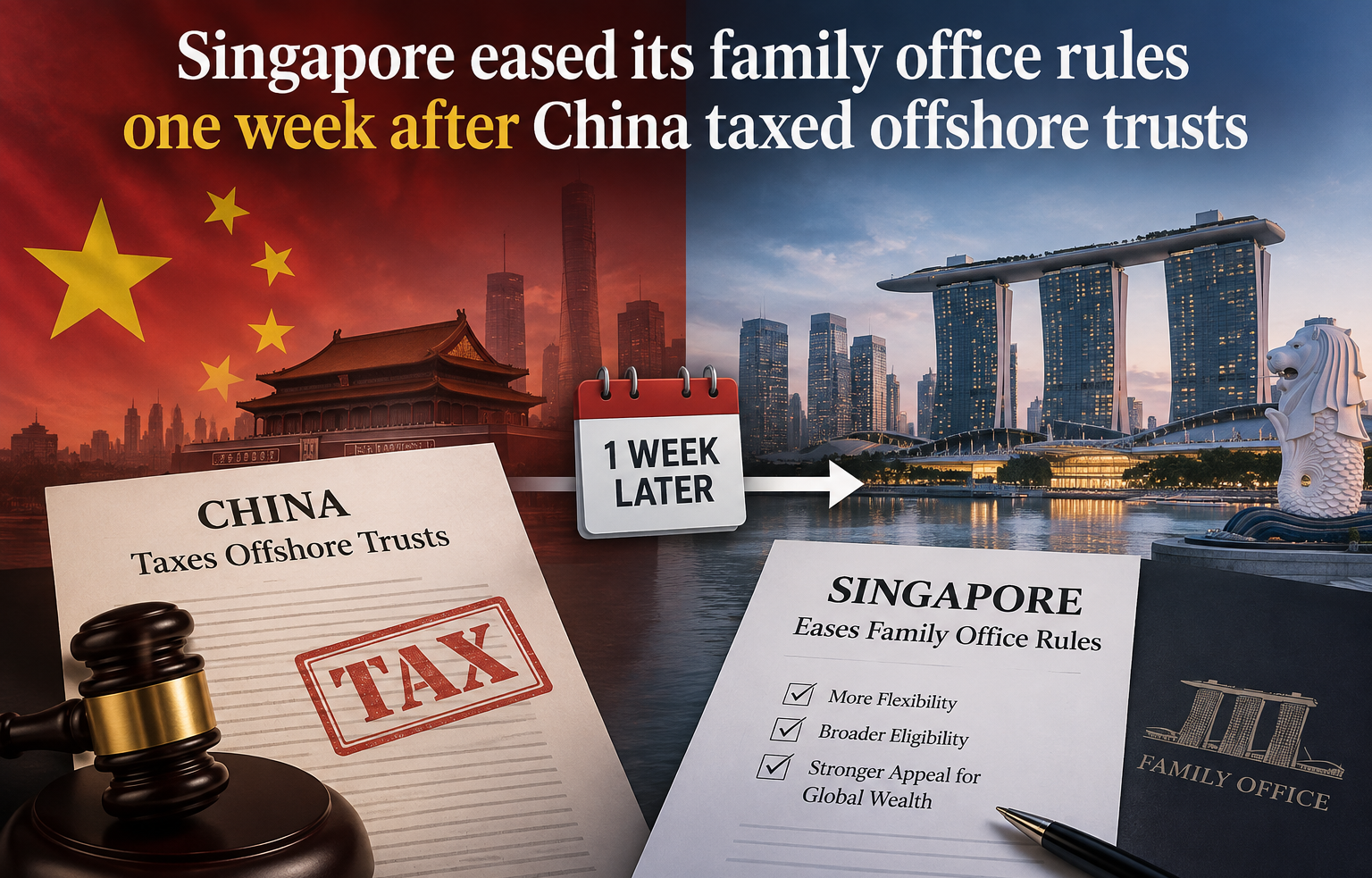
    China’s Ministry of Finance and State Taxation Administration issued Announcement No. 21 of 2026 on 24 July 2026. It brings offshore trusts into the individual income tax net. It also sets a deadline of 22 October 2026 for historic filings. Seven days later, on 31 July 2026, the Monetary Authority of Singapore issued circular FDD Cir 05/2026. That circular eased several conditions attached to the tax incentives Singapore family offices rely on. The two documents are unrelated. Together they frame the decision now facing a large amount of Hong Kong capital.

    Consider a Hong Kong business owner in his fifties. He has been a permanent resident since before the 1997 handover, and his manufacturing and distribution company still operates from Kowloon. His assets sit across Hong Kong banks, a British Virgin Islands holding company and property. He wants to move part of that to Singapore. He also intends to sit in the investment meetings himself, alongside a locally hired manager and a resident director who takes part in decisions. The scenario that follows is a composite rather than a client.

    What Singapore changed on 1 August 2026

    The Monetary Authority of Singapore administers the section 13O and section 13U fund tax exemptions on two separate tracks. A single family office, or SFO, is a firm that manages the assets of one family and no one else. A non-SFO fund is any other qualifying fund. In practice that means a fund run by a third-party fund management company, for investors drawn from outside a single family. From 1 August 2026, a non-SFO fund must also hold third-party capital at the point of application, or show a bona fide intention to raise it.

    The two tracks carry different entry thresholds. More than 2,000 family offices in Singapore held one of these incentives at the end of 2025. That figure comes from a written parliamentary reply by the MAS chairman.
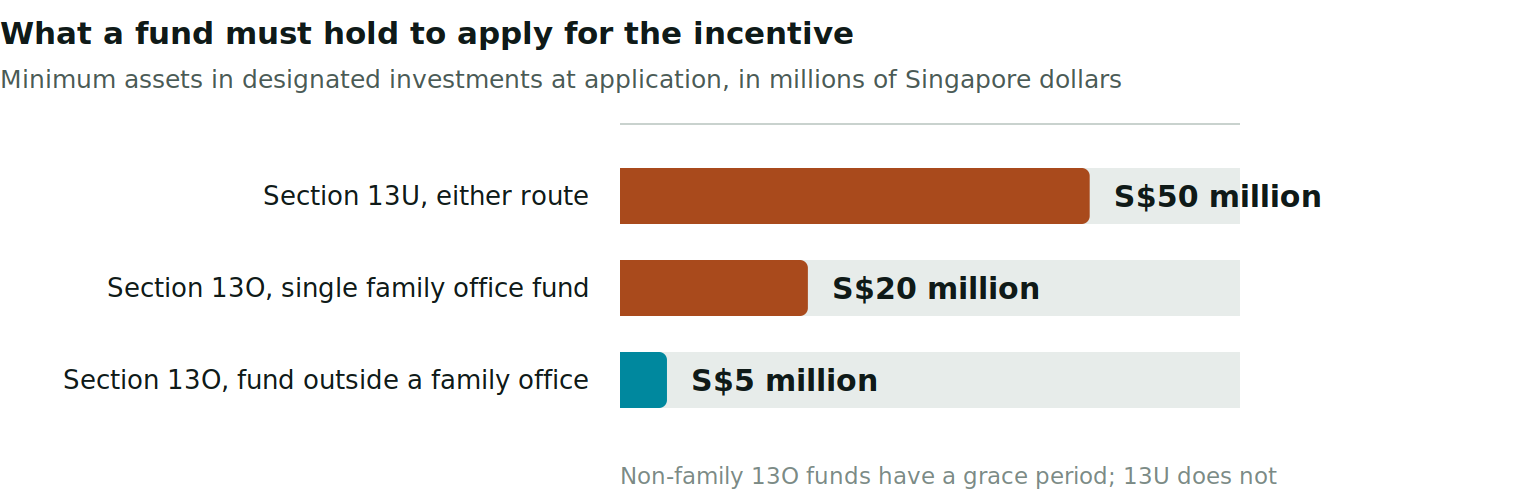
    An SFO fund applying under section 13O must hold at least S$20 million in designated investments at the point of application. A non-SFO fund needs S$5 million under the same section. It also gets a grace period, running to its third year of assessment. Section 13U sits at S$50 million on both tracks. It must be met at application, with no grace period. A 13O fund must be a company incorporated in and tax resident in Singapore. A 13U fund may take any legal form, onshore or offshore, provided it is managed from Singapore.

    Sections 13O and 13U, before and after

    The changes taking effect on 1 August 2026 fall into three groups. The hiring requirement was rephased. The post-award assets test was recast. The cap on physical precious metals was removed altogether.

    Condition 13O before 13O from 1 Aug 2026 13U before 13U from 1 Aug 2026
    Minimum assets in designated investments at application S$20 million S$20 million S$50 million S$50 million
    Investment professionals at application 2 1 3 2
    Investment professionals by first financial year end 2 2 3 3
    Assets tested after the award Throughout the incentive period At each financial year end Throughout the incentive period At each financial year end
    Physical precious metals as designated investments Capped at 5% of portfolio No cap Capped at 5% of portfolio No cap
    Fund vehicle Singapore-incorporated company Singapore-incorporated company Any form, onshore or offshore Any form, onshore or offshore

    A phased hiring concession for family office funds

    The concession on investment professionals moved a deadline rather than a headcount. A 13O fund managed by an SFO may now apply with one qualifying investment professional in place. The second must be employed by the end of the financial year relating to the first year of assessment of the award. A 13U fund may apply with two and must reach three by the same point. The totals of two and three are unchanged.

    The conditions on those individuals are also unchanged. At least one must come from outside the family. Each must be tax resident in Singapore. Each must spend more than half their time on qualifying investment activity, and be paid more than S$3,500 a month. For the owner in this scenario, the concession removes the step at which family office plans most often stall. That step is recruiting a second professional before the structure exists, and before there are assets for that person to manage.

    The annual spending floor for an SFO fund

    The second condition that determines whether the structure is viable at a given size is local business spending. It is a fixed annual cost, payable whether the portfolio rises or falls.
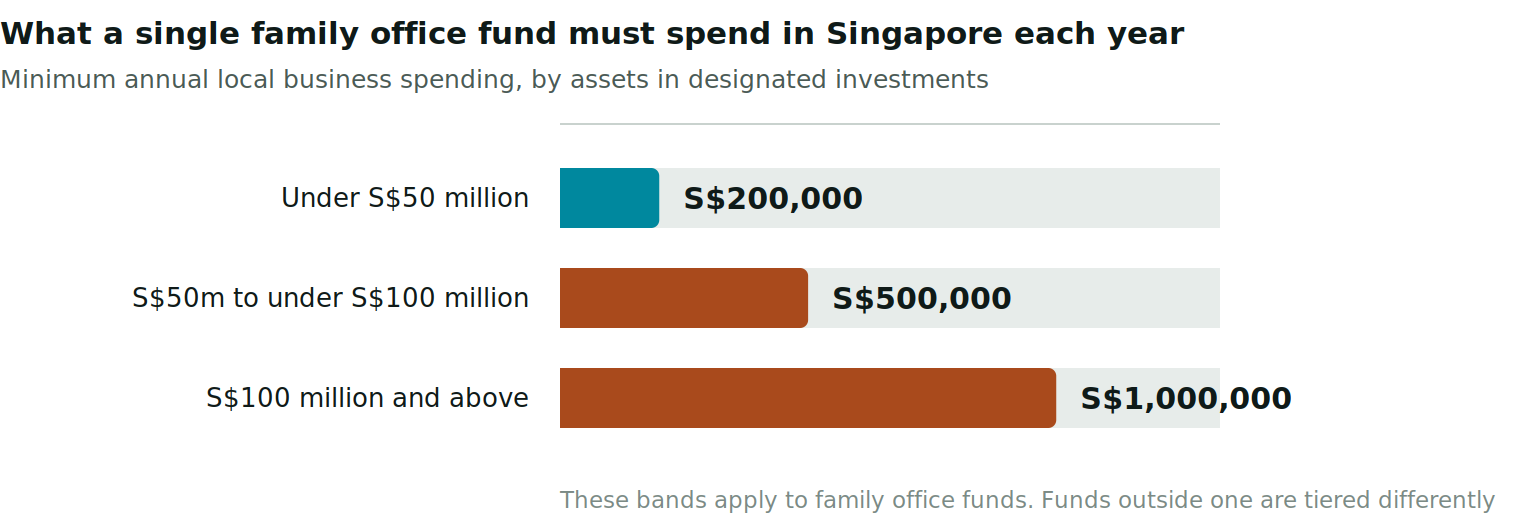
    An SFO fund holding under S$50 million in designated investments must spend at least S$200,000 a year in Singapore. Between S$50 million and just under S$100 million, the floor is S$500,000. At S$100 million and above it is S$1 million. The bands for non-SFO funds sit at much larger asset levels and lower amounts. They run from S$200,000 below S$250 million to S$500,000 at S$2 billion and above.

    The spending rules treat two categories differently. Eligible donations to Singapore charities count toward the requirement at face value. The two-times multiplier attaches to a different category. That category is grants to blended finance instruments distributed by licensed financial institutions in Singapore. The annual test of assets under management was removed for non-SFO funds, retroactive to 1 January 2025. It survives for SFO funds in recast form, tested at application and again at each financial year end.

    A class licensing exemption from 15 June 2026

    Separately from the tax incentives, the regulatory framework for single family offices changed on 15 June 2026. A qualifying SFO now benefits from a class exemption from fund management licensing. It is granted under the Securities and Futures regulations, in place of the case-by-case exemptions that preceded it. No individual approval is required.

    The conditions attached to that exemption are administrative. The office must file a notice of commencement of business with MAS within 14 days of starting operations in Singapore. The office and each of its fund vehicles must maintain an account with a bank licensed in Singapore. A foreign-incorporated vehicle may instead use a regulated bank in a jurisdiction that meets international standards. An annual return goes to MAS within four months of the financial year end, stating total assets under management and the name of the bank. No extensions are granted.

    Three further conditions apply. The office must be incorporated in Singapore, must serve one family only, and must keep non-family key employee shareholdings at 10% or below. Family offices already operating before 15 June 2026 have until 15 June 2027 to meet the conditions and file the notification.

    China’s Announcement No. 21 of 2026

    Announcement No. 21 of 2026 took effect on the day it was published, 24 July 2026. A State Taxation Administration announcement covering filing mechanics accompanied it. The announcement does not set a rate. It assigns trust events to two categories of income that already exist in the Individual Income Tax Law. Those are income from the transfer of property, and income from interest, dividends and bonuses. Both are taxed at 20%.

    The announcement creates a charge at several points. Transferring property into an offshore trust is a taxable event on the gain. Trust income is then attributed annually to a resident contributor, whether or not a distribution is made. That is the most significant departure from prior practice. Distributions to a resident beneficiary are taxed. So are deemed distributions, such as pledging trust assets against a resident’s borrowing, or meeting a resident’s personal expenses. A further charge arises on exit, liquidation or the death of the settlor.

    Income already taxed on the annual attribution is not taxed again on distribution. The look-back period runs to 1 January 2023. The announcement allows 90 days from publication to settle historic liabilities without a late payment surcharge, a window that closes on 22 October 2026.

    Tax residence, not nationality, sets the boundary

    The announcement is drafted entirely in the statutory language of resident individual and non-resident individual. The terms Hong Kong and household registration do not appear in it. Nationality appears once, and not as a charging test. The operative question for the owner in this scenario is whether he is a mainland tax resident. That is determined by the Individual Income Tax Law and its implementing regulations, not by the announcement.

    A person is a mainland tax resident on one of two bases. Either he is domiciled in China, or he is present there for an aggregate of 183 days in a tax year. Domicile is defined as habitually residing in China by reason of household registration, family or economic interest relationships. Hong Kong permanent residents are treated in practice as not domiciled, on the same footing as foreign nationals, and a home return permit is a travel document that does not alter tax status.

    Day counting requires a full 24 hours, under a 2019 announcement of the finance ministry and the tax administration. A same-day trip to Shenzhen therefore does not add to the total. A six-year rule also applies to non-domiciled individuals. Foreign-source income paid from outside China may be exempted on filing, until the seventh consecutive year of residence at that level. A single absence of more than 30 consecutive days in any qualifying year restarts the count.

    Article 11 of the announcement addresses individuals who have left. It covers a person who has acquired foreign nationality, or a long-term or permanent right of residence outside the mainland. Such a person may still be determined to be a domiciled resident individual, where his principal economic interests derive from within China. Hong Kong is outside the mainland for these purposes. A Hong Kong right of abode is therefore capable of falling within that wording. No official guidance published to date addresses the point.

    The practical consequence is that exposure turns on the location of economic interests, not on nationality. An owner whose revenue, plants and customers are substantially mainland faces a real prospect of being treated as domiciled. An owner whose economic centre is genuinely Hong Kong or offshore does not. A narrower limb also applies to non-residents. They are taxed on contributions of mainland-situated property into offshore trusts made since 1 January 2023.

    What active management costs in personal tax

    The section 13O and 13U exemptions apply to the fund’s specified income from designated investments. They do not extend to the principal personally, and they do not extend to the management company. Those are three separate taxpayers, and the incentive reaches one of them.
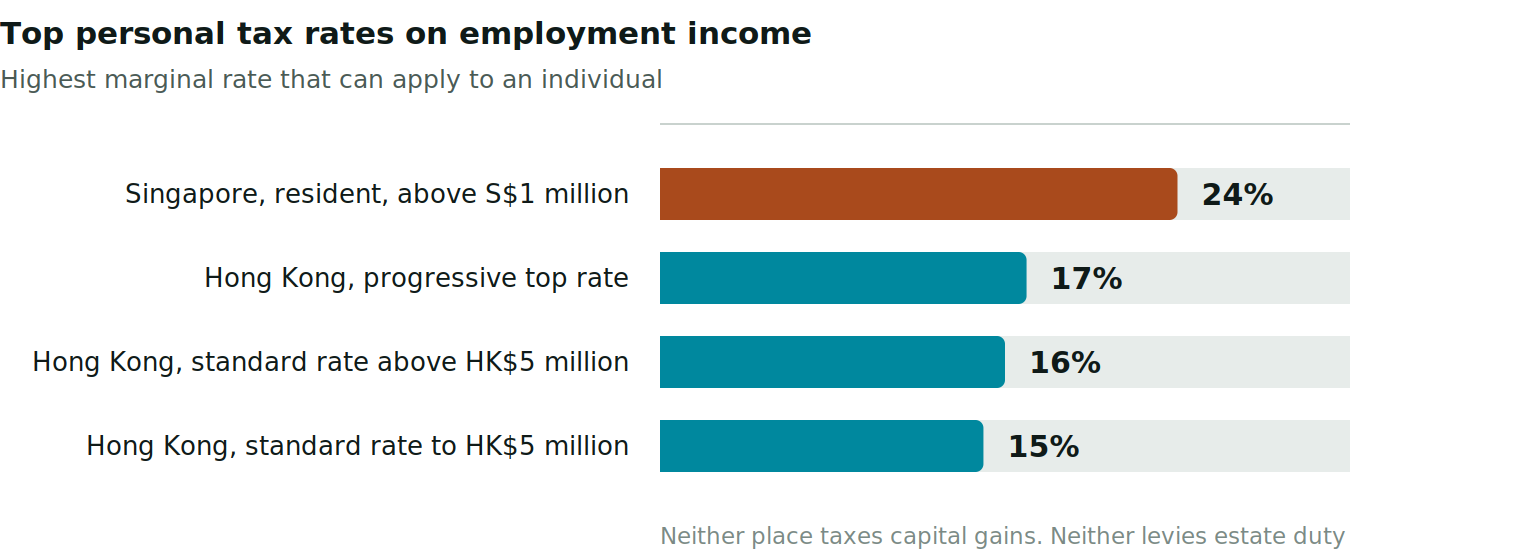
    A salary drawn from the family office for work performed in Singapore is Singapore-sourced employment income. It is taxable. Resident rates run progressively to 24% on chargeable income above S$1 million. Hong Kong tops out at 17% on the progressive scale. Its standard rate is two-tiered, at 15% on the first HK$5 million of net income and 16% above that. On salary alone, Singapore is the more expensive of the two. The management company pays the 17% corporate rate on its fee income.

    An employment pass is also required. In financial services the qualifying salary currently begins at S$6,200 a month at age 23 and rises with age to S$11,800 at 45 and above. Higher thresholds have been announced for new applications from 1 January 2027, at S$6,600 and S$12,700 respectively.

    The other side of the comparison is larger. Singapore does not tax capital gains. The rules bringing foreign disposal gains into charge apply to entities within multinational groups, not to individuals. Foreign-sourced income received in Singapore by a resident individual has been exempt since 2004, other than income received through a partnership. Dividends from Singapore-resident companies carry no further tax under the one-tier system. Estate duty has not applied to deaths occurring on or after 15 February 2008. There is no wealth tax and no gift tax.

    Hong Kong offers much of the same treatment and abolished its own estate duty in February 2006, so the gap on rates alone is narrower than commonly assumed. What distinguishes Singapore is that the fund, the manager and the substance can sit in one jurisdiction that banks, regulators and counterparties all recognise.

    Presence carries a second effect. Days spent in Singapore are days not spent in the mainland. Take a principal near the 183-day threshold, or managing a six-year count. Running the office in person creates the substance the incentive requires. It also moves the day count at the same time. Substance planning and residence planning are usually treated as separate exercises. For a Hong Kong principal with mainland exposure they are one exercise.

    What this means for three kinds of Hong Kong owner

    For an owner whose business is substantially mainland-facing, the work to complete before 22 October 2026 is diagnostic rather than structural. The location of principal economic interests is now a question of fact under Article 11. It is established by evidence rather than by drafting. Mainland days for prior years should be counted on the full 24-hour basis, and any running six-year count identified. Contributions of mainland-situated assets to an offshore trust since 1 January 2023 fall within the narrow limb applying to non-residents. That limb has a fixed date attached to it.

    For an owner whose economic centre is genuinely Hong Kong or offshore, the announcement is unlikely to bite. The task is to document why, rather than to assume it. The test turns on records showing where revenue arises, where the family lives and where time is spent. Singapore then becomes a commercial decision rather than a defensive one. The 1 August 2026 changes make a modest family office materially easier to establish. The class exemption removed an approval that previously took months. And applying with one investment professional instead of two matters more to a first-time applicant than any headline rate.

    For an owner already holding an offshore trust, the structural question will outlast the filing deadline. A trust whose treatment depends on where its contributor and beneficiaries are resident is fragile. It is most fragile for a family spread across several countries. The residence of the next generation in ten years is a variable the current generation does not control. That favours structures whose treatment depends on where the substance sits rather than on where the people do. In practice, that means one real presence rather than three nominal ones.

  • Southeast Asian startup funding fell about 84% in a single month

    Southeast Asian startup funding fell about 84% in a single month

    Equity has become lumpy and unreliable. Most of the money now arriving in the region comes with a repayment schedule.

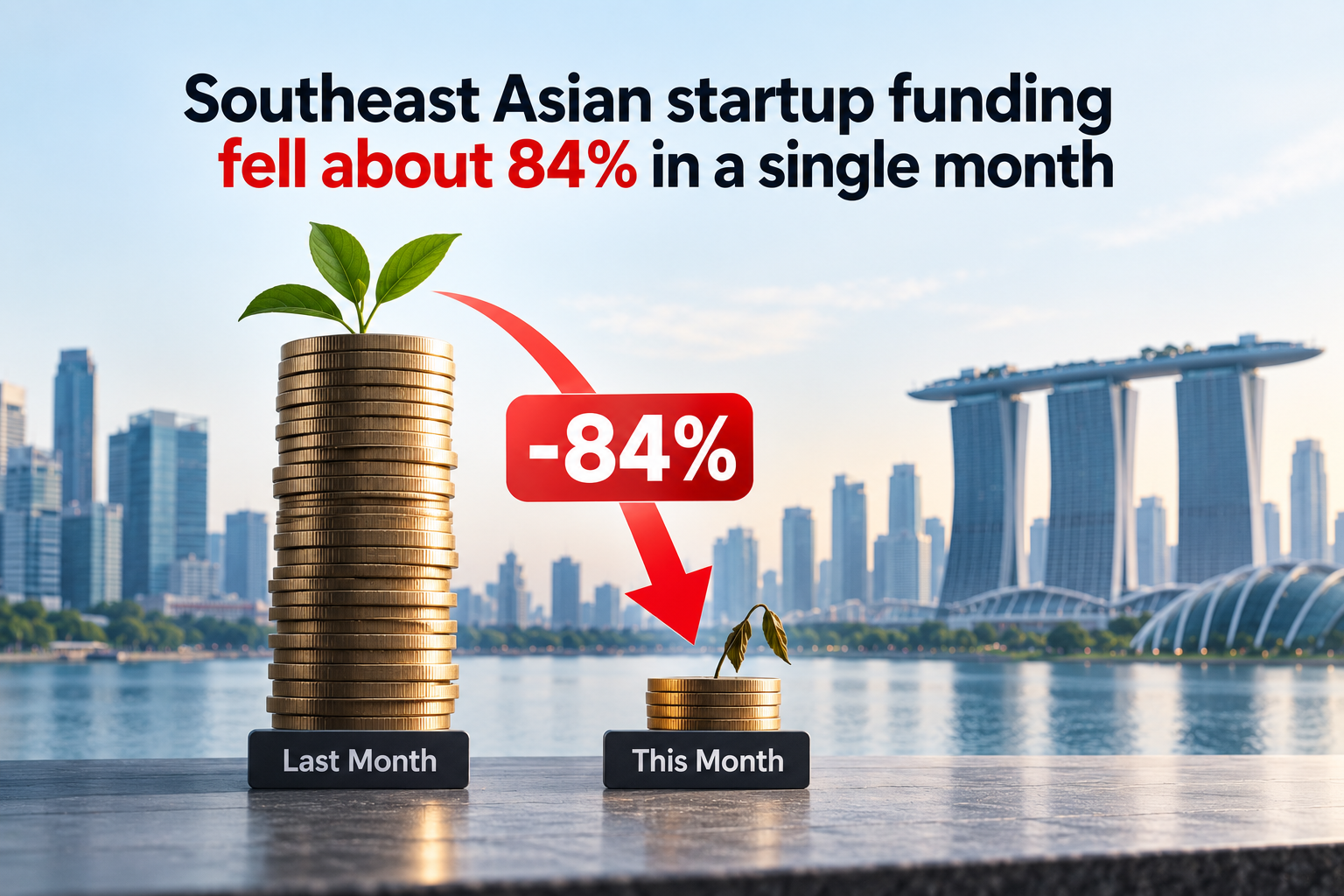
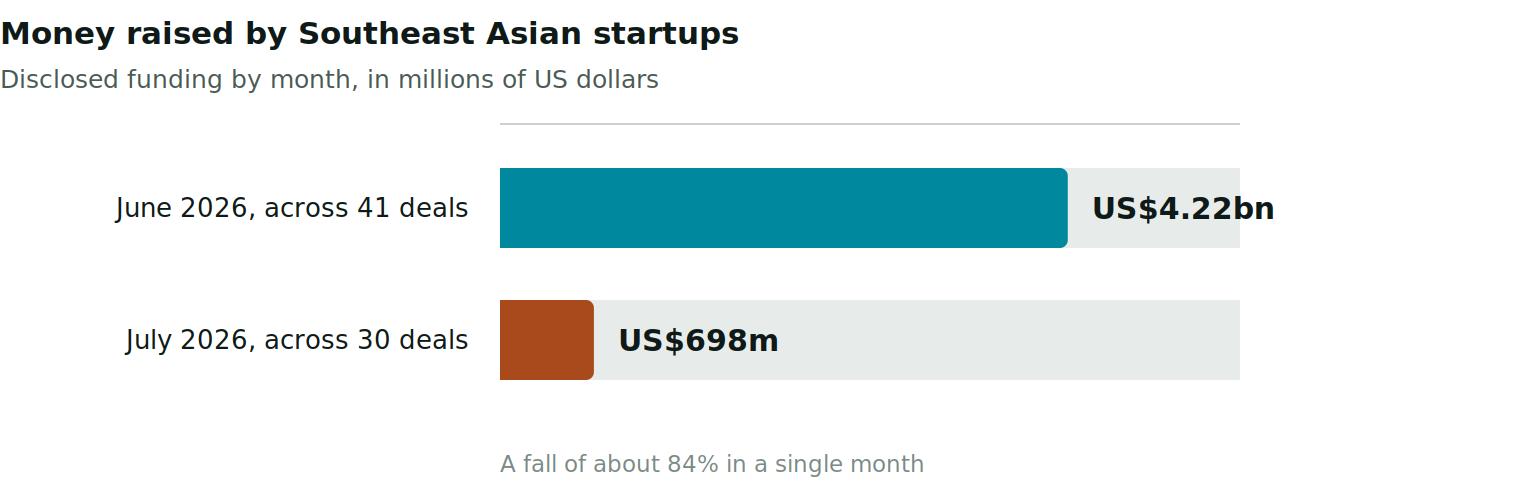
    A founder reading regional funding headlines this year would have seen two markets. One looks healthy and one looks broken, often in the same week. Both come from real numbers. Southeast Asian startups raised about US$4.22 billion across 41 deals in June 2026. In July they raised roughly US$698 million across 30 deals. That is a fall of about 84% in four weeks. Neither month describes the market fairly, and the gap between them is what is worth understanding. Equity capital in the region has not disappeared. It has concentrated into a handful of very large rounds, so any monthly total now depends on whether one of those rounds happened to close. Meanwhile a different kind of money has been arriving quietly, and it is not equity at all.

    June raised US$4.22 billion and July raised US$698 million

    Start with the raw movement, because its size is what makes every monthly comparison unreliable. Two consecutive months, in the same region, covering broadly the same companies, differed by a factor of six. Nothing changed in those four weeks that could explain a gap like that. No policy shifted and no market closed. What changed was which deals happened to sign.

    The deal count barely moved. June recorded 41 deals and July recorded 30, a fall of about a quarter. The capital fell by about 84%. When the number of transactions holds roughly steady while the money collapses, the explanation is almost never that investors stopped investing. It is that the largest cheques stopped clearing in that particular window. For a founder this has a direct consequence. Benchmarking your raise against a monthly regional total means benchmarking against a statistic driven by three or four companies you will never compete with for capital. The deal count is the more honest signal, and it says the market is slower rather than closed.

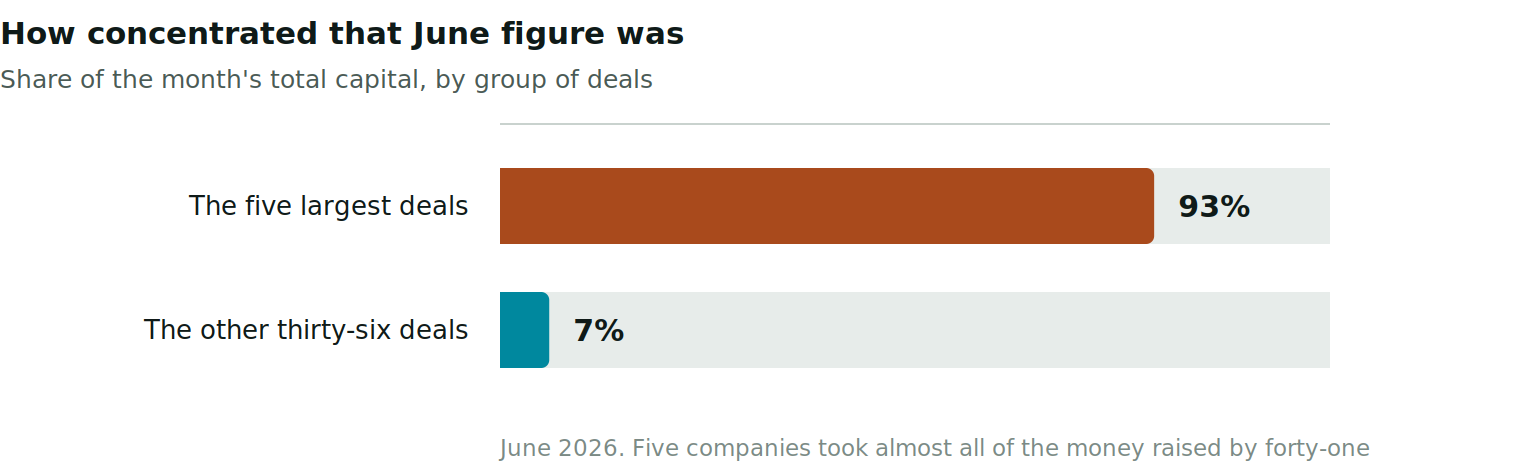
    Ninety-three per cent of June’s money went to five companies out of forty-one

    The concentration is visible as soon as you break the good month apart rather than taking it whole. June is the month that looked healthy. It is worth asking who it was healthy for, because the arithmetic is not close.

    Five deals accounted for about 93% of the capital raised in June. The other thirty-six companies shared roughly 7%, which on a US$4.22 billion total is something under US$300 million between them. That is the pool a typical founder is actually raising into, and it bears almost no relationship to the headline. The same pattern showed up in the regional artificial intelligence figures earlier this year, where one very large round accounted for most of an annual total. This is not a distortion in the data. It is what the market now looks like. Capital is available in enormous quantities to a few companies and in ordinary quantities to everybody else, and averaging the two describes neither.

    Three debt and hybrid funds appeared in the region inside a single week

    While equity behaved like this, something else was happening with far less attention paid to it. In the week to 11 September, three separate credit or hybrid vehicles aimed at Southeast Asia were in the news. Granite Asia, headquartered in Singapore, confirmed it has raised over US$500 million for a hybrid strategy, with eight transactions and two exits completed and no fixed cap on its eventual size. OSK Ventures and Affin Hwang launched a debt and equity hybrid fund for revenue-generating Southeast Asian companies, on a three-year investment tenure. And a European development finance institution was reported to be proposing a US$10 million top-up to a Singapore-managed venture debt fund. That would sit on top of US$20 million already disbursed in March.

    That third item rests on a single outlet and should be treated as unconfirmed. The pattern across all three does not depend on it. These structures share a purpose. They give a company capital without forcing a valuation, which matters when the last equity round was priced in a different market. They also carry obligations that equity does not. A repayment schedule is not a milestone you can miss quietly. Hybrid instruments usually come with covenants, security or conversion terms, and those bite in exactly the circumstances that made you need the money.

    Hong Kong raised HK$342 billion from new listings in eight months

    The public markets tell a third version of the same year, and it is worth seeing next to the private numbers. The two moved in opposite directions over the same months. Private fundraising in the region thinned out. Public fundraising in Hong Kong more than doubled.

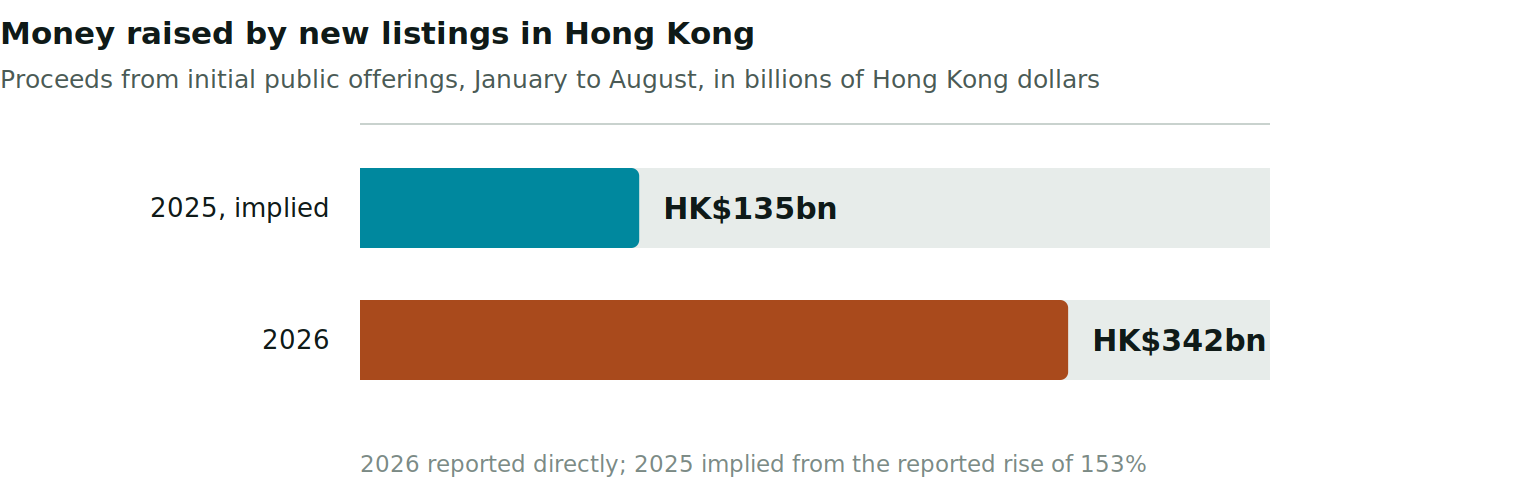
    Hong Kong raised HK$342.4 billion from initial public offerings between January and August 2026, up 153% on the same eight months of 2025. New listings numbered 106, up 80%. Average daily turnover rose 14%. At the end of August the exchange had 2,761 listed companies and a market value of about HK$47.2 trillion. It also doubled the validity period of a new listing application, from six months to twelve, a temporary measure in force since 21 August. That matters more than it sounds. An application that expires before approval has to be refiled from the beginning, and several hundred companies were reported waiting earlier this year.

    Singapore traded 35% more by value in August, which is not the same as raising money

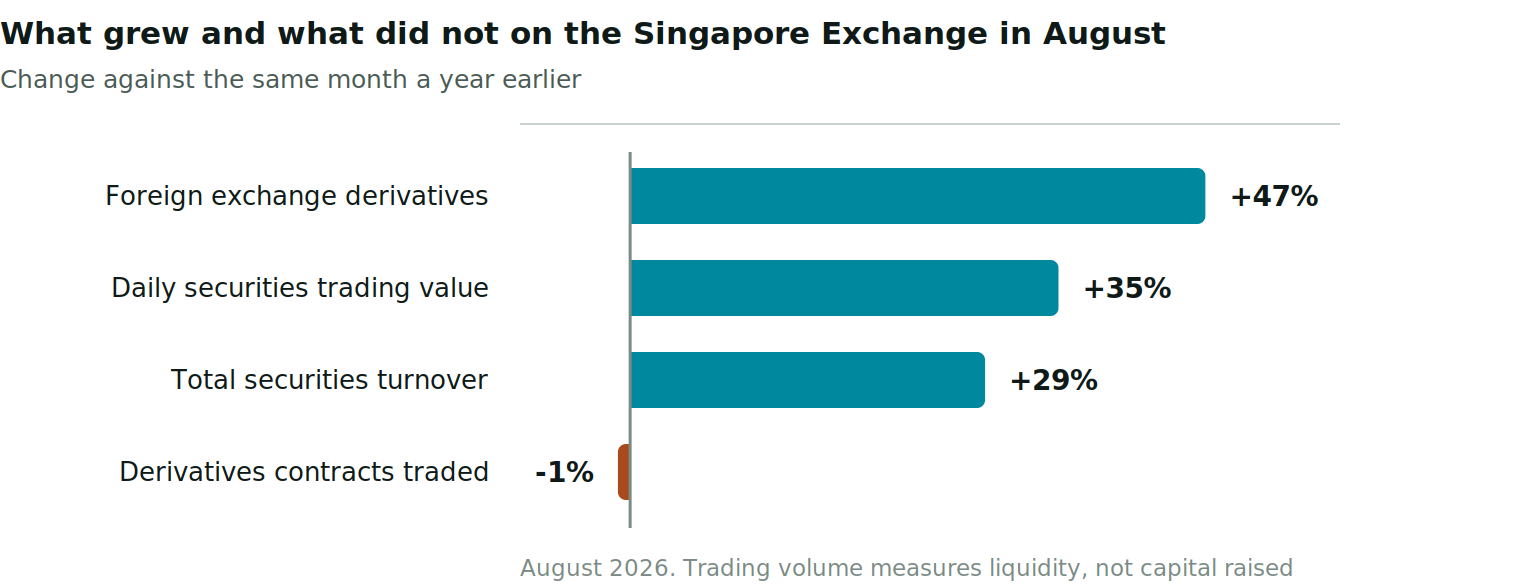
    Singapore’s exchange reported its August figures on 11 September. They need reading carefully, because the strongest numbers measure the wrong thing for a company that wants money. There is a difference between a market where shares change hands briskly and one where companies raise capital. Both are useful, but only one puts money into a business.

    Daily securities trading value reached S$2.2 billion, up 35% on August a year earlier and 8% on July. Total securities turnover was S$43.3 billion, up 29%. Foreign exchange derivatives volume rose 47% to 8.1 million contracts. Total derivatives contracts fell 1%. Retail participation rose 22% month on month in real estate investment trusts. All of that describes liquidity, which is how easily existing shares change hands. It is not capital raised, and the two are regularly confused. Liquidity does matter to a company considering a listing, because it affects the price you achieve and how easily early holders exit. But an exchange can trade heavily for a year without one new company raising a dollar on it.

    What this means for founders raising now, companies weighing debt, and anyone benchmarking against a headline

    For a founder raising equity in Southeast Asia, build the plan around the deal count rather than the capital total. Thirty deals in a weak month and forty-one in a strong one means transactions are still happening at close to normal frequency. What has changed is the size distribution, and that changes who can lead your round rather than whether anyone can. Assume a longer process than your last raise, and that the first cheque is harder to secure than the rest. Be honest about which group you are in. A company raising into the 7% that thirty-six companies shared is competing on completely different terms from the five that took the rest. Both are viable, but running the second playbook from the first position wastes months.

    For a company weighing debt or a hybrid instrument, the arrival of these funds is useful and is not a consolation prize. Capital without a priced round protects you from setting a valuation in a bad market, and for a business with real revenue it is often cheaper than the equity it replaces. The conditions are where the attention belongs. Understand what triggers a default, what security sits over which assets, and what happens if revenue slips for two quarters rather than one. Equity is patient by construction and debt is not, so the instrument that looks kinder at signing gets stricter precisely when trading is hard. Model the downside case before the base case, which is the reverse of how most term sheets get read.

    For anyone benchmarking against a published figure, this month is a lesson in how easily accurate numbers mislead. Funding fell 84% and the market did not change much. Hong Kong raised 153% more and Singapore’s turnover rose 35%. Neither of those tells a Singapore company what it can raise. The useful comparisons are narrower and harder to find. How many companies at your stage, in your sector, in your region raised in the last two quarters, and from whom? That takes about a week to answer properly and it is worth the week. Every shortcut produces a number built mostly out of other people’s outliers.

  • Abu Dhabi issued 1,814 new licences while Swiss banks cut 2,345 jobs

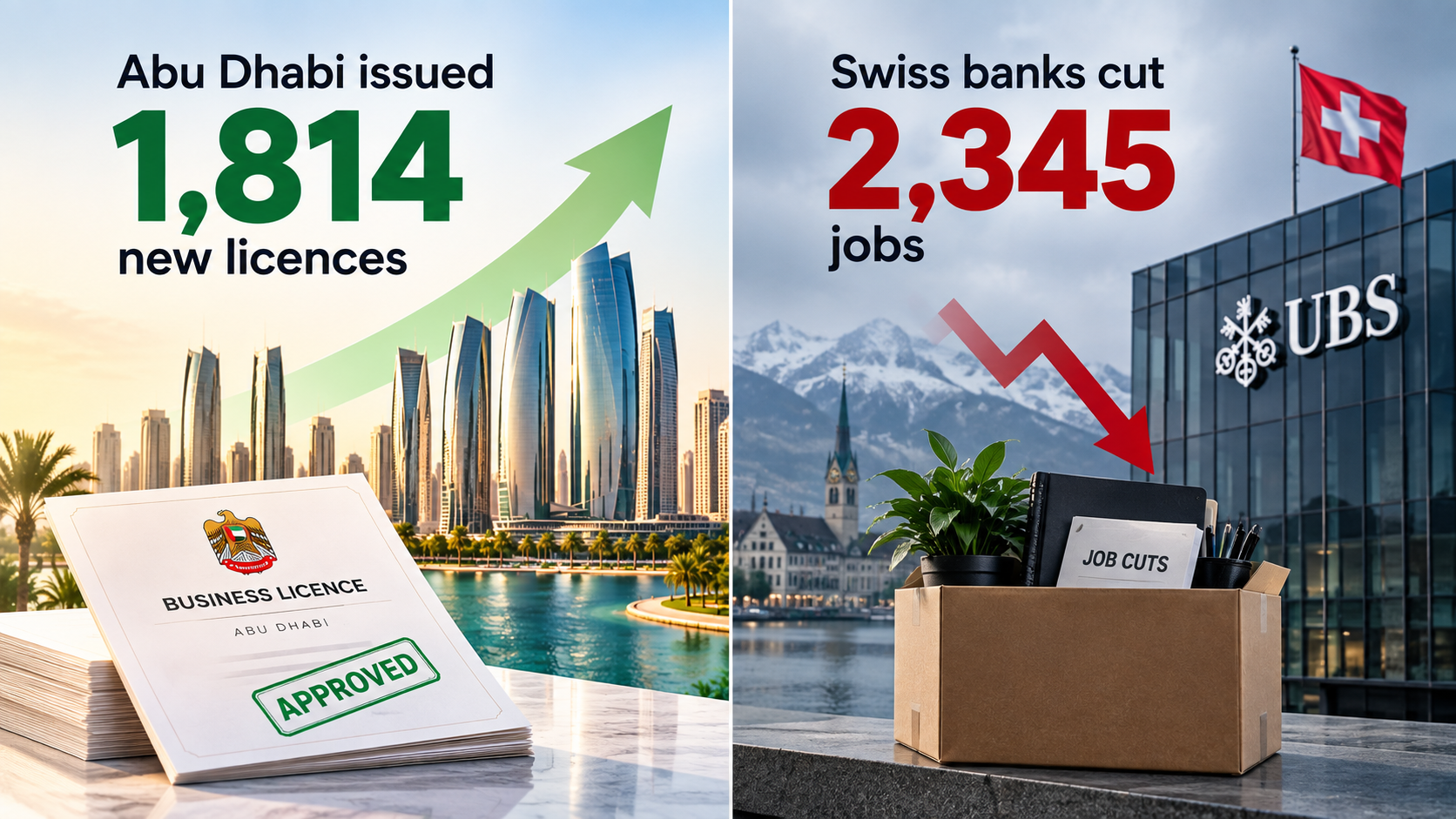
    Abu Dhabi issued 1,814 new licences while Swiss banks cut 2,345 jobs

    Two wealth centres reported the same six months and described different worlds. The direction of tax policy across 92 countries explains part of why.

    Financial centres publish their scoreboards on their own schedules, so they rarely land together. Three arrived within about ten days of each other this month. Abu Dhabi Global Market reported growth in every category it counts. The Swiss Bankers Association reported record assets alongside a second year of falling employment. The House of Lords Library set out a British tax take heading for its highest recorded share of national income. Then on 8 September the OECD published its annual review of tax reforms across 92 countries, and the direction it describes is consistent with all three. Read together, these are not four separate stories. They are one story about where capital is managed from, and what governments are doing to the people who own it.

    Abu Dhabi’s financial centre grew every category it counts, and fund managers fastest

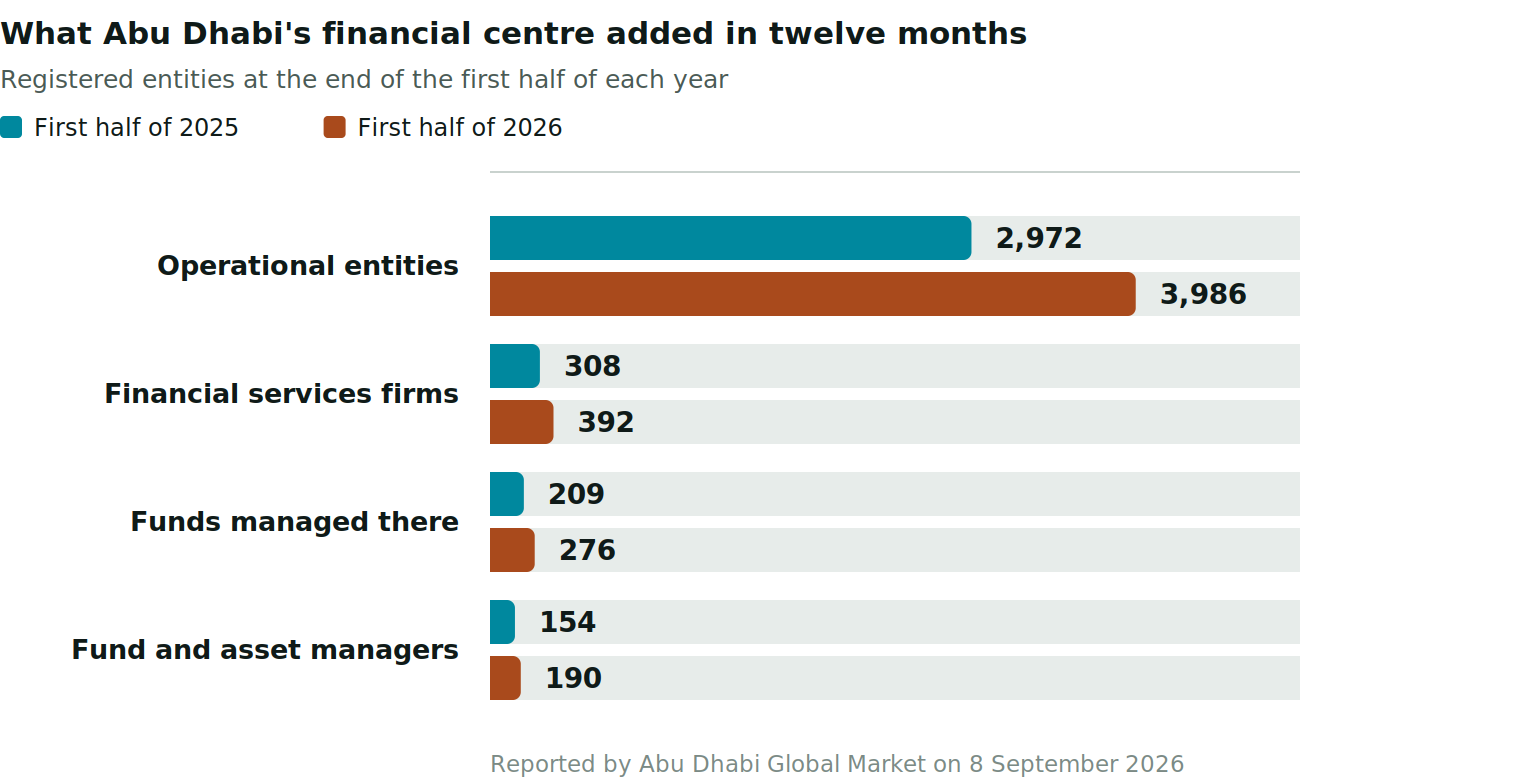
    Start with the newest of the three centres, because its numbers are the cleanest. Abu Dhabi Global Market published its first-half results on 8 September. It counts entities rather than money, which makes the figures checkable in a way that headline asset numbers rarely are.

    Operational entities rose from 2,972 to 3,986, a gain of 34%. Financial services firms rose from 308 to 392, up 27%. Funds managed from the centre rose from 209 to 276, up 32%. Fund and asset managers rose from 154 to 190, up 23%. The centre issued 1,814 new licences in the half and holds 13,974 active ones. Its stated workforce is 49,027. It also reported assets under management up 54% on the year, and that figure deserves a caveat the others do not. No absolute value was published and the term was never defined, so the percentage cannot be checked against anything. Use the entity counts, which are registry facts.
    Swiss banks still manage more foreign money than anywhere else

    Switzerland reported the same period, and the contrast is instructive rather than simple. It is the older centre by about two centuries, which is worth holding in mind when comparing growth rates. A base that large does not grow at 34%. The Swiss Bankers Association published its Banking Barometer at the end of August. Total assets under management reached CHF 9,729.1 billion at the end of 2025, up 4.8% in the year. They crossed CHF 10 trillion by May 2026.

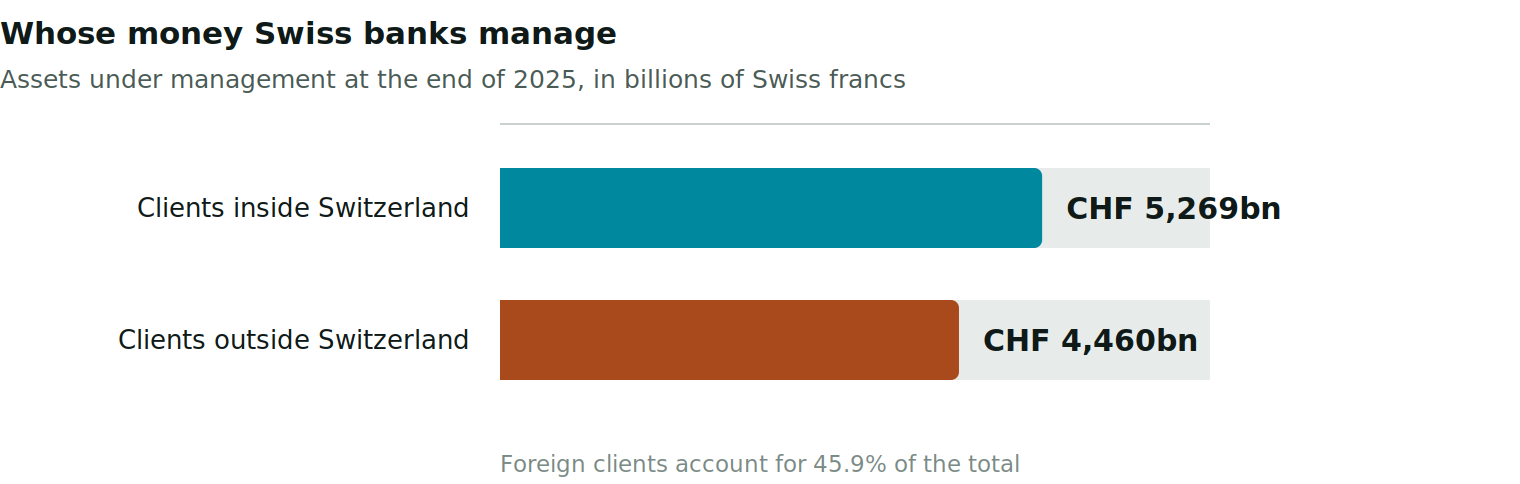
    Domestic clients accounted for CHF 5,268.7 billion and foreign clients for CHF 4,460.4 billion. So 45.9% of the money comes from outside the country. Cross-border wealth management for private clients reached CHF 2,945.7 billion in 2025, up 7.6% after adjusting for currency. Aggregate operating profit was CHF 73.8 billion, up 5.8%. Commission income rose 6.5% while net interest income fell 0.8%, which is the shape you would expect from a sector earning more from managing money and less from holding it. On the money itself, Switzerland is not in retreat. That is the part most commentary gets right.

    Swiss banking employment fell by 2,345 posts in a single year

    The part most commentary skips is who is doing the work. That number moved the other way in the same report, and it is the one a family should care about most. Money can be managed from anywhere. The people who manage it cannot, and a centre losing them is telling you something its asset total will not show for years.

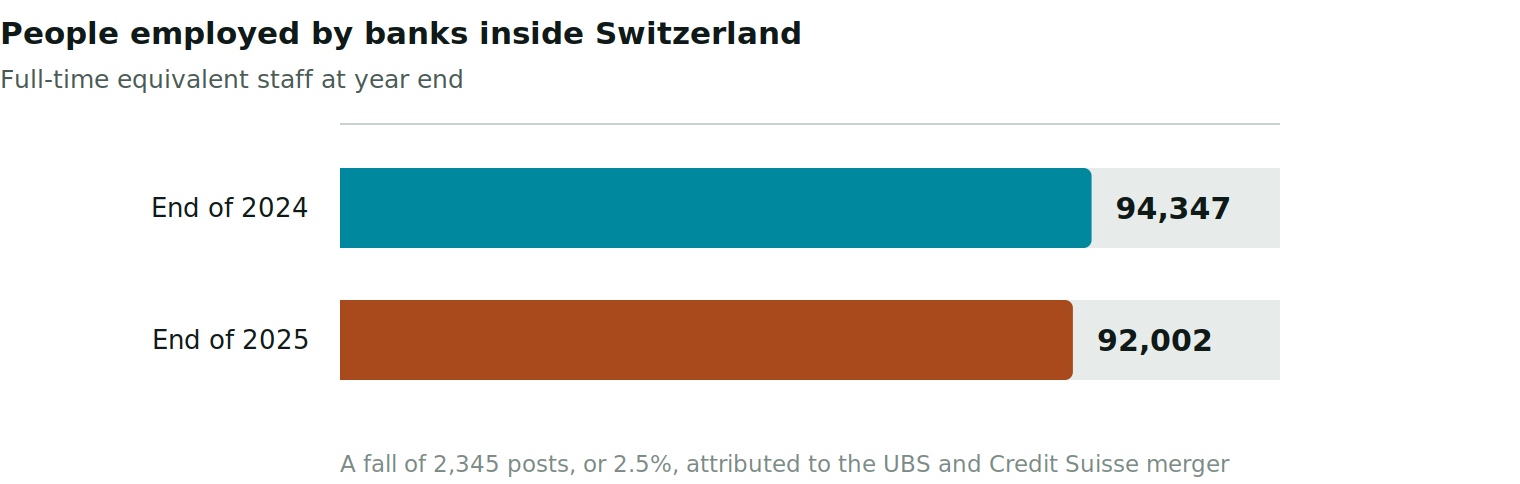
    Domestic banking employment fell to 92,002 full-time equivalents at the end of 2025. That is down 2,345 posts, or 2.5%. It fell a further 1.4% in the first half of 2026. Unemployment within the sector rose from 3.3% in December 2025 to 3.5% by June 2026. The association attributes the decline to the merger of UBS and Credit Suisse, which is a specific cause rather than a general one. But consider what the two Swiss numbers say together. Assets rose while headcount fell for a second year. Abu Dhabi’s headcount rose alongside its entity counts. A family choosing where to base a structure is choosing between a place consolidating and a place hiring.

    Britain’s tax take is at 36% of national income and forecast to reach 38.5%

    The third publication is about the other side of the same decision. Choosing a centre is one half of the question. The other half is what happens to wealth that stays where it is, under a government that needs money. Britain is the clearest current example, and it publishes enough detail to see the trajectory. The House of Lords Library set out its fiscal outlook on 3 September.

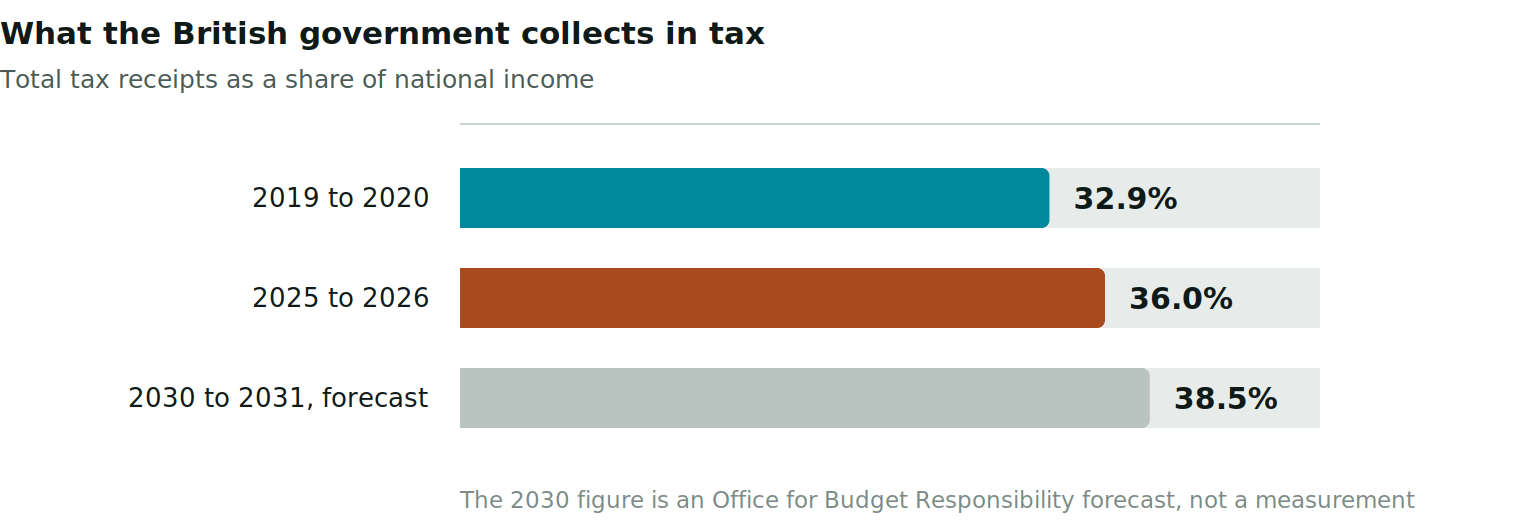
    The tax take was 36.0% of national income in 2025 to 2026, against 32.9% in 2019 to 2020. It is forecast to reach 38.5% by 2030 to 2031, which would be a record. That last figure is a forecast rather than a measurement, and should be quoted as one. The deficit was £130 billion, or 4.2% of national income. National debt stood at £2,985 billion in July 2026, about 94.1% of national income. A Budget is set for 28 October under a new Chancellor. Several capital gains measures have been reported as under consideration, including an exit charge on people leaving the country. Nothing has been announced, and similar reports circulated a year ago without result. Treat the trajectory as the fact and the specific measures as speculation.

    The OECD looked at 92 jurisdictions and found the same direction in most of them

    Behind all three scoreboards sits a broader pattern. On 8 September the OECD published the eleventh edition of its annual survey of it. The report covers tax reforms introduced or announced during 2025 across 92 countries. Its findings are directional rather than numerical. Personal income tax is being used mainly to increase progressivity. Several countries raised top rates, or revised how they tax dividends and capital gains. The average combined corporate tax rate was stable for a third consecutive year. That last point is the one to hold onto. Governments under fiscal pressure are no longer reaching for the corporate rate, because it is competed over internationally and everybody knows it. They reach instead for the taxation of individuals and of investment income, where the competition is slower and people move less easily.

    What this means for families choosing a jurisdiction, families already in one, and anyone watching the British Budget

    For a family choosing where to base a holding structure or a family office, these reports are more useful than any ranking. Abu Dhabi is growing quickly from a small base and is hiring. That means staff are available and the regulator has capacity to process an application. Switzerland holds far more money and has a deeper bench, but it is consolidating rather than expanding. Singapore sits between the two on both measures. The right question is not which centre is winning. It is which one will still have the specific people your structure depends on in five years, and whether you can meet them before you commit. That is answerable by asking, and almost nobody asks.

    For a family already established somewhere, the OECD finding is the one to act on. The direction across 92 countries is higher personal rates and tighter treatment of dividends and capital gains. A structure optimised for the corporate rate is therefore optimised for the number least likely to change. Look instead at where your distributions are taxed. Look at where your beneficiaries are resident, and at what happens if one of them moves. Those are the variables governments are actually adjusting. A structure that survives a change in the corporate rate but fails when a beneficiary relocates has been built against the wrong risk. That is far more common than it should be.

    For anyone with British exposure, the 28 October Budget deserves preparation rather than prediction. The tax take is 36.0% now and forecast to rise. The fiscal position described in the Lords Library briefing does not leave a great deal of room. What is being reported about exit charges and the uplift on death is speculation. Comparable stories ran last year and came to nothing. The useful preparation is knowing your own position before any announcement. Establish what you hold and where it is held. Establish what a disposal would trigger, and what a departure would trigger. Families who know those answers can act within a week of a Budget. Families who do not will spend that week finding out, which is when the options are fewest.

  • Intra-Asia freight rose nine per cent in a week, and a cyber-attack closed the port next door

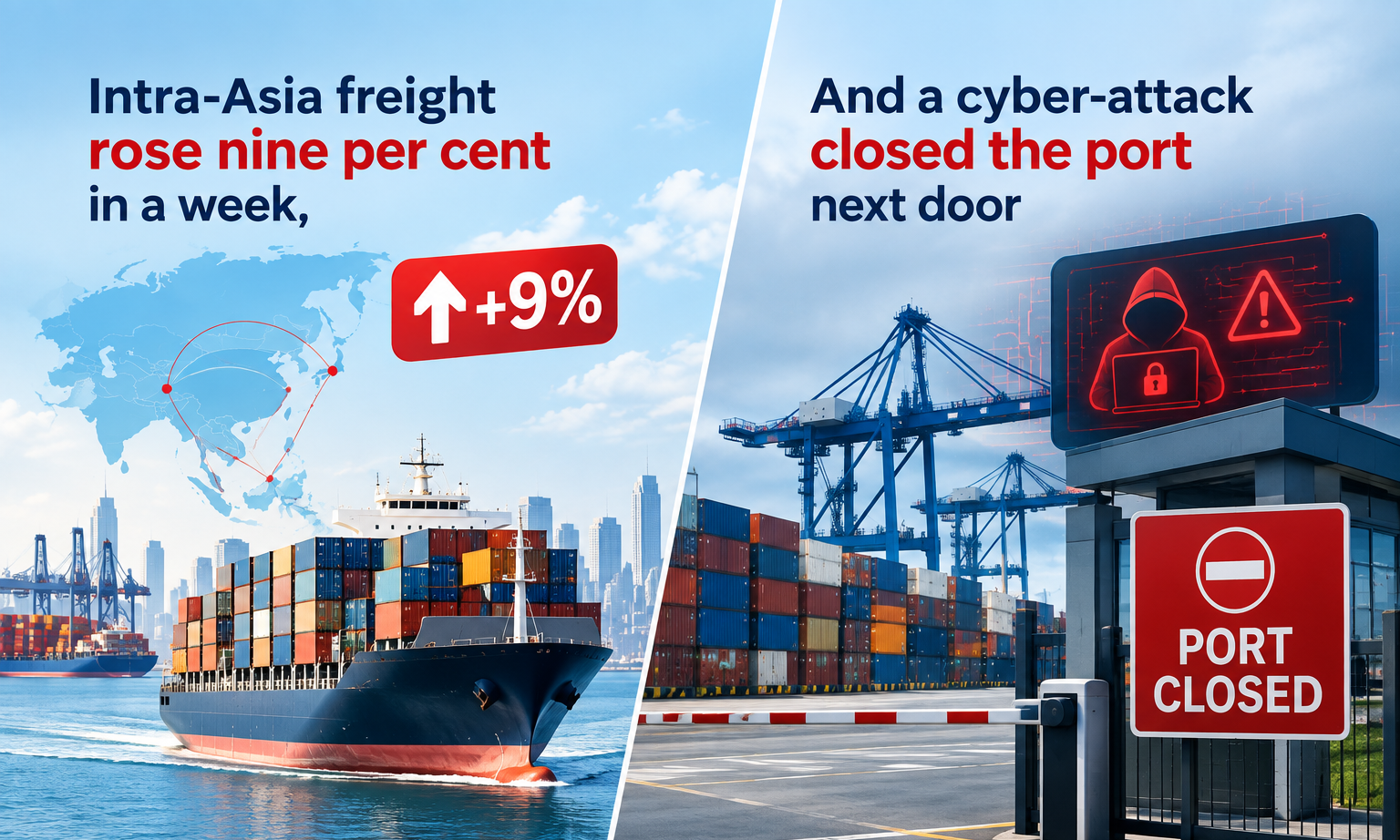
    Intra-Asia freight rose nine per cent in a week, and a cyber-attack closed the port next door

    Four separate cost increases landed inside seven days, and not one of them was a tariff.

    Most traders watch tariffs. Tariffs are announced, dated and argued over in public, so they are easy to watch. But the costs that actually moved in the week to 11 September 2026 arrived by four other routes. Typhoon congestion pushed intra-Asia container rates to a multi-year high. A cyber-attack stopped Malaysia’s largest container terminal for about twenty hours. One carrier announced a surcharge of up to ten thousand dollars a box from 1 October. Singapore bunker prices rose for a third straight day. None of these was a policy decision. None was voted on anywhere. Each of them lands on the same landed cost, and a costing model built around tariff risk alone will not see any of them coming.

    Typhoons closed two Chinese ports for three days, and the rates have not come back down

    The intra-Asia trades are where most ASEAN businesses actually operate, and they have been tightening for over a month. Typhoon Saudel closed Shanghai and Ningbo between 26 and 28 August, following four earlier storms in the same season. The backlog did not clear when the ports reopened, and the rates show it.

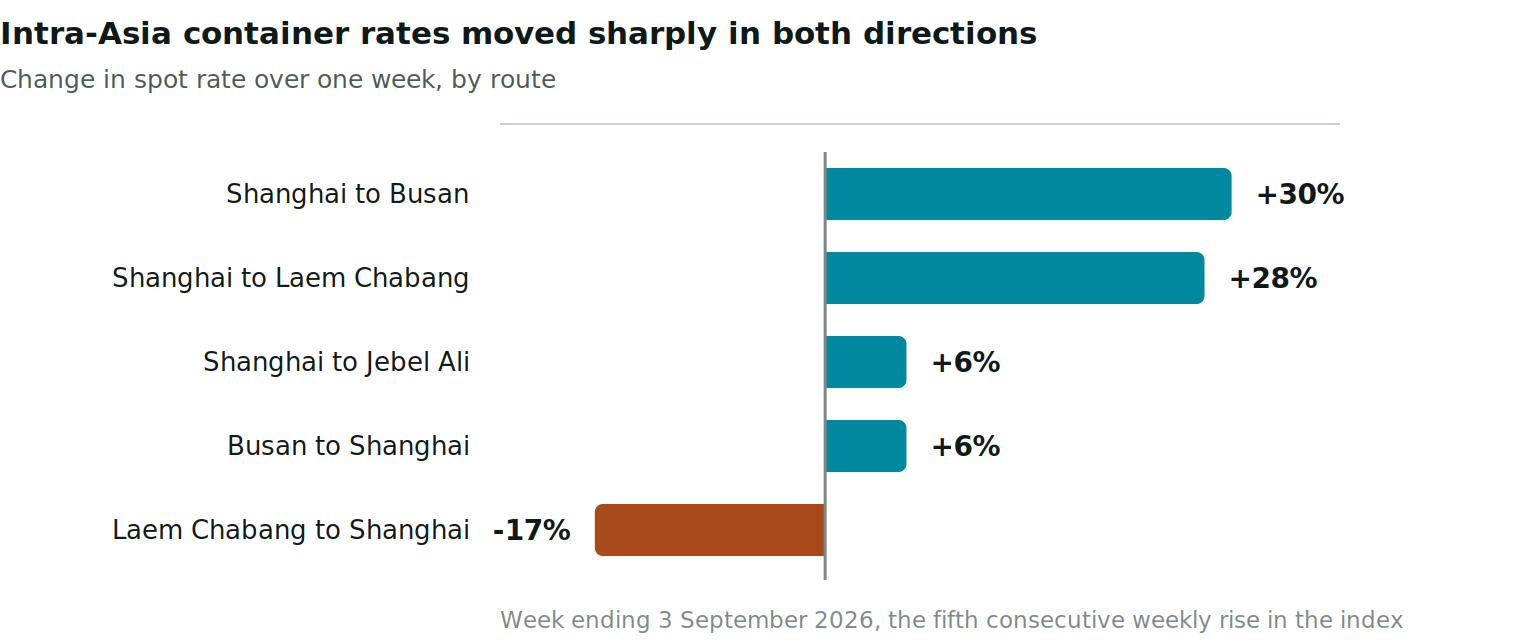
    The index rose 9% to US$1,312 for a forty-foot container. That was its fifth consecutive weekly increase. Underneath it the moves were far larger and went both ways. Shanghai to Busan rose 30% to US$925. Shanghai to Laem Chabang rose 28% to US$1,310. Shanghai to Jebel Ali rose 6% to US$8,254. Laem Chabang back to Shanghai fell 17%, to US$194. The outbound legs rose steeply while one return leg fell, which is the signature of congestion rather than of demand. Average vessel waiting times reached 98 hours at Shanghai and 54 hours at Ningbo. Bottlenecks were also reported at Busan, Hong Kong and Singapore. So a box moving through any of those hubs was affected, whether or not it called at a Chinese port.

    A cyber-attack stopped Malaysia’s largest container port for about twenty hours

    The second event was not weather and had no warning at all. At 23:34 local time on Wednesday 9 September, the Port of Tanjung Pelepas detected a cyber-attack and halted container terminal operations. The port is Singapore’s nearest transshipment competitor, sitting across the strait in Johor. The Johor port complex handled 15.1 million containers in 2025, with Tanjung Pelepas alone above 14 million.

    A phased restart began at 19:30 the following evening, starting with manual processing at the gates. One large vessel, the Maersk Hanoi, deviated for roughly ten hours while inbound through the Strait of Malacca. By the Thursday there were no significant queues and no ships waiting at anchor. The port said there was no evidence that customer data had been accessed. What is worth noting is what did not happen. No source reported cargo diverting to Singapore, and none has since. A twenty-hour outage at a fourteen-million-box port absorbed itself without a visible regional effect. That tells you the system had slack that week. It also tells you what a longer outage would do, because the slack is finite and nobody publishes how much of it is left.

    One carrier will add up to ten thousand dollars a container from 1 October

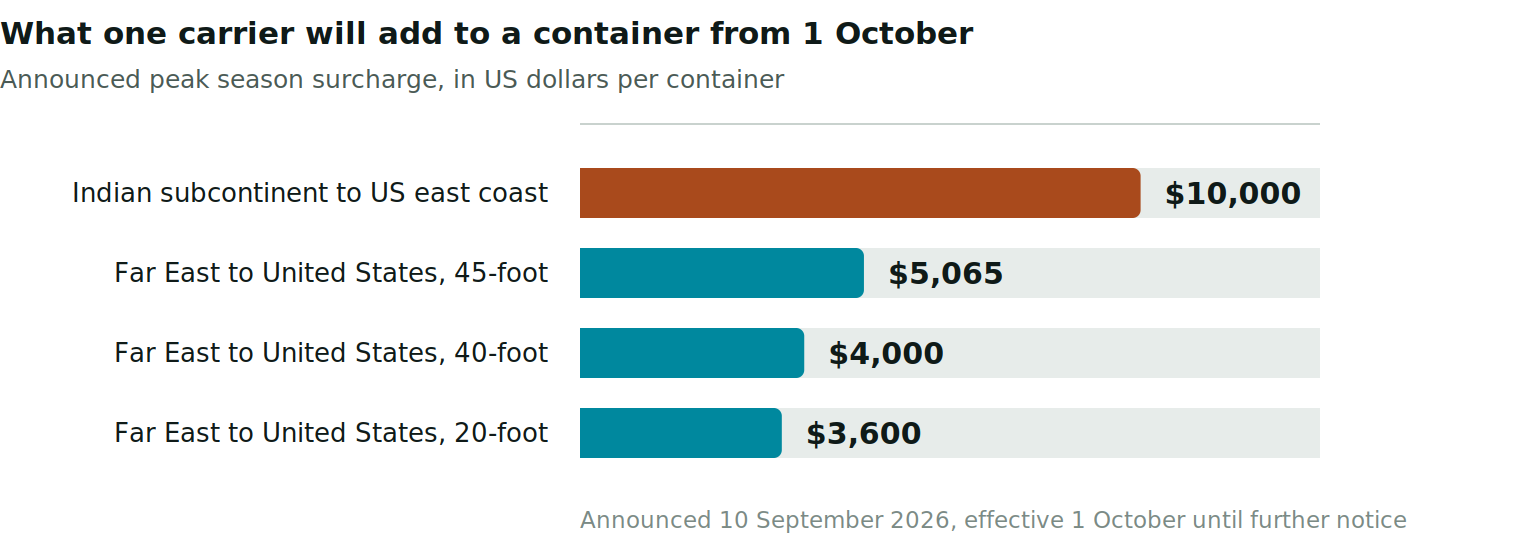
    The third cost is the only one of the four that anybody chose deliberately. Weather and cyber-attacks happen to a business. A surcharge is a decision, made by a company, on a date. That makes it the only one of the four you can plan around. On 10 September, CMA CGM announced a peak season surcharge on its Asia to United States trades. It takes effect on 1 October and runs until further notice.

    For Far East origins, the surcharge is US$3,600 on a twenty-foot container. It is US$4,000 on a forty-foot and US$5,065 on a forty-five-foot. For the Indian subcontinent and Bangladesh to the United States east and gulf coasts, it is US$10,000 per unit whatever the size. Honolulu and Dutch Harbor are excluded. Two things matter here for a buy-sell operator. The surcharge is announced rather than in force, so there is a window in which cargo can be pulled forward. And it is one carrier’s tariff rather than an industry-wide change, so the comparison between carriers is worth running again before October. Carriers were also cancelling sailings that week, eight transpacific voyages against seven the week before, which usually precedes an increase holding rather than collapsing.

    America’s containers are increasingly arriving from Indonesia, Thailand and Vietnam

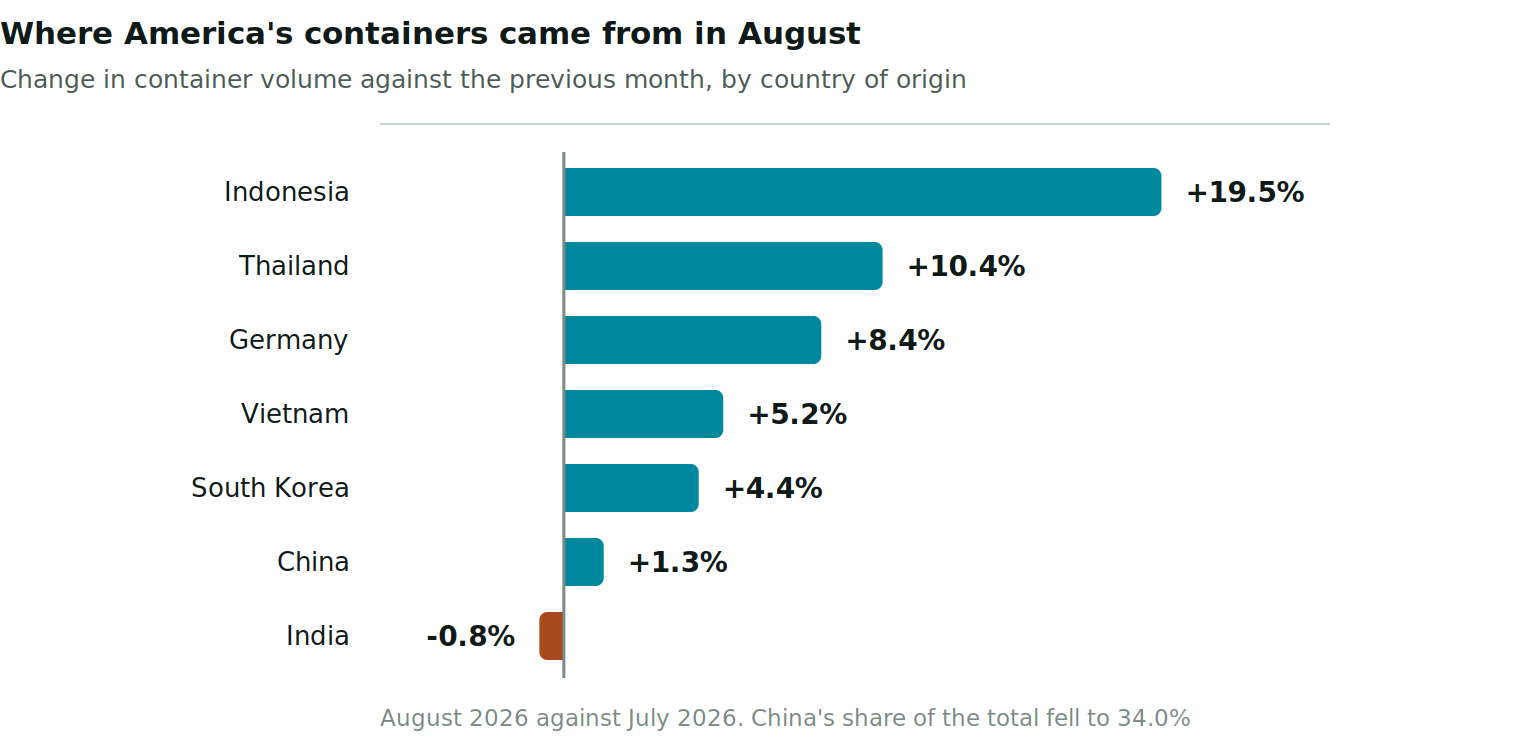
    The fourth thing that moved was demand, and its shape says more than its total. A strong import month tells an exporter little on its own. What matters is which countries the extra boxes came from. United States container imports reached 2,603,709 containers in August. That was the third-highest month on record, 3.8% above July and 3.3% above August a year earlier.

    China-origin volume rose 1.3% on the month, to 884,318 containers. Every major ASEAN origin rose faster. Indonesia gained 19.5%, Thailand 10.4% and Vietnam 5.2%. Germany rose 8.4% and South Korea 4.4%. India was the only major origin to fall, by 0.8%. The consequence is that China’s share of American container imports fell to 34.0%, from 34.8% in July. That is a small monthly move and part of a much longer one. For a trader with ASEAN manufacturing or ASEAN suppliers, the demand side is going your way at present. That is why the freight cost of serving it deserves attention now, rather than after the fourth quarter has been quoted.

    Fuel in Singapore rose for a third straight day, and that reaches every rate eventually

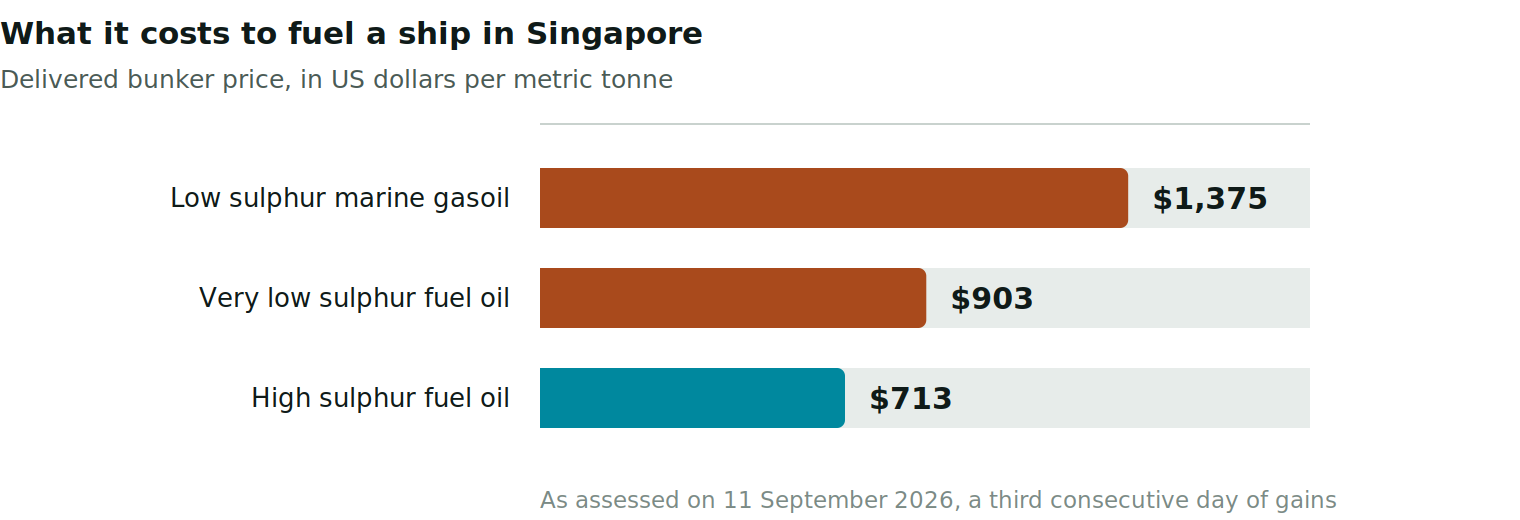
    The last of the four is the one furthest upstream, which is why it is the one most often left out of a costing sheet entirely. Bunker fuel is the shipping line’s largest variable cost. When it moves, freight rates follow, though never immediately and never evenly across trades.

    Low sulphur marine gasoil was assessed at US$1,375 a tonne, up US$87 in a day. Very low sulphur fuel oil was US$903, up US$43. High sulphur fuel oil was US$713, up US$54. All three had risen for three consecutive days, the marine gasoil to a multi-month high. One caution is worth stating plainly. A second price reporter assessed the same day’s very low sulphur fuel oil at US$878.50. That is a genuine difference in method and timing between assessors, not an error by either. If you index a contract to bunker prices, name the assessor in the contract. Two honest numbers for the same fuel on the same day is exactly the kind of ambiguity that becomes an argument nine months later.

    What this means for traders shipping within Asia, traders shipping to America, and anyone with one port in their plan

    For a trader moving goods within Asia, the intra-Asia rise will reach you first and is least likely to be in your budget. A 30% move on Shanghai to Busan in one week is not something a quarterly freight assumption survives. Check which of your lanes touch Busan, Hong Kong or Singapore as transshipment points. The congestion was reported at the hubs, so a lane that looks unaffected at both ends may not be. If you quote customers on intra-Asia lanes, shorten your validity periods now. Congestion of this kind unwinds slowly, and five consecutive weekly increases suggests it has not begun.

    For a trader shipping into the United States, there is a decision with a date on it. The CMA CGM surcharge takes effect on 1 October. Cargo that moves before then is not subject to it. If you have flexibility on timing, compare the inventory cost of pulling a shipment forward against four thousand dollars a box. Where the inventory cost is lower, move early. Run the comparison across carriers too, since this is one carrier’s tariff rather than a market-wide change. The demand backdrop supports the increase holding. Import volumes are near record levels and carriers are removing capacity, so treat this as a real cost.

    For anyone whose plan depends on one port, one carrier or one route, the Tanjung Pelepas outage is the one to think about, even though it cost you nothing. A fourteen-million-container port stopped for twenty hours because of something nobody saw coming. The system absorbed it. That is the good outcome. The question worth asking is what your business would have done had the outage lasted a week, and whether you know who to call to find out. Most trading companies cannot name their second port, their second carrier or their second bank. Each of those is a single point of failure that costs nothing to identify and a great deal to discover under pressure.

  • Singapore listed 21 companies this year, and not one Southeast Asian buyout fund closed

    Singapore listed 21 companies this year, and not one Southeast Asian buyout fund closed

    The exchange had its best year in a decade while the funds that supply private capital to the region raised almost nothing.

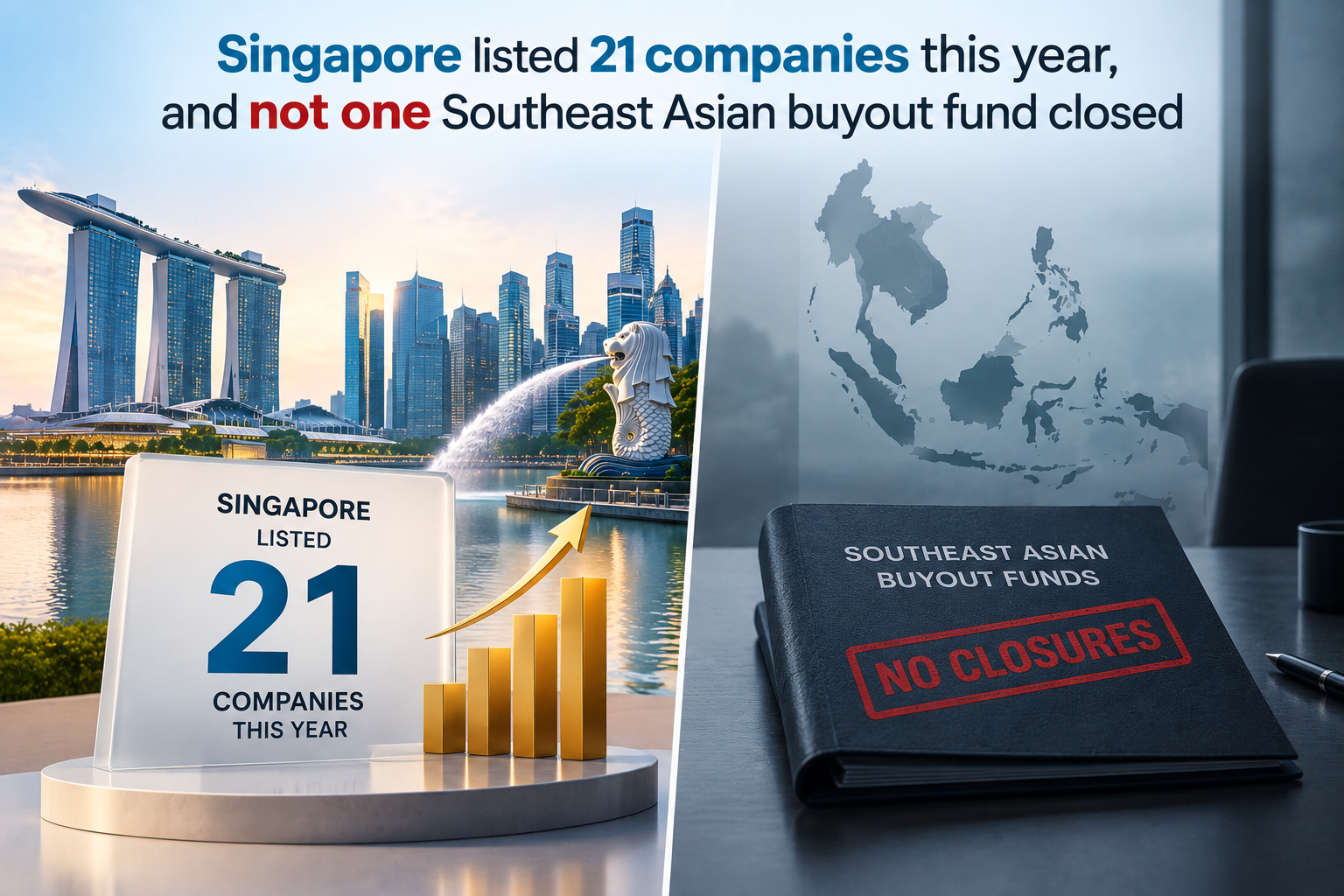
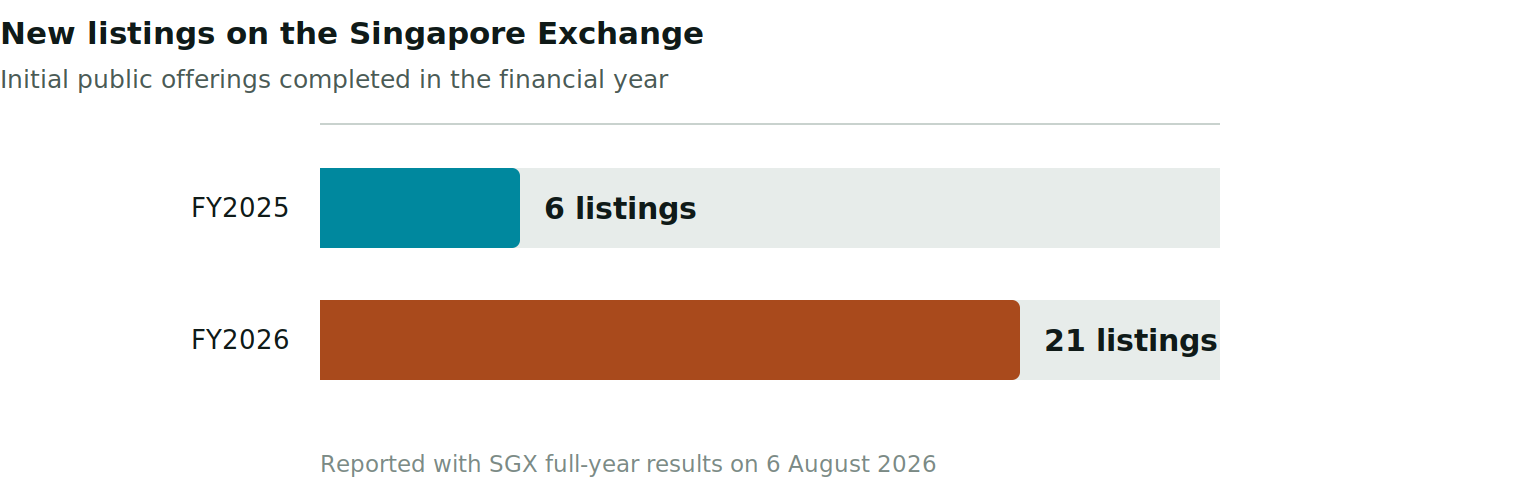
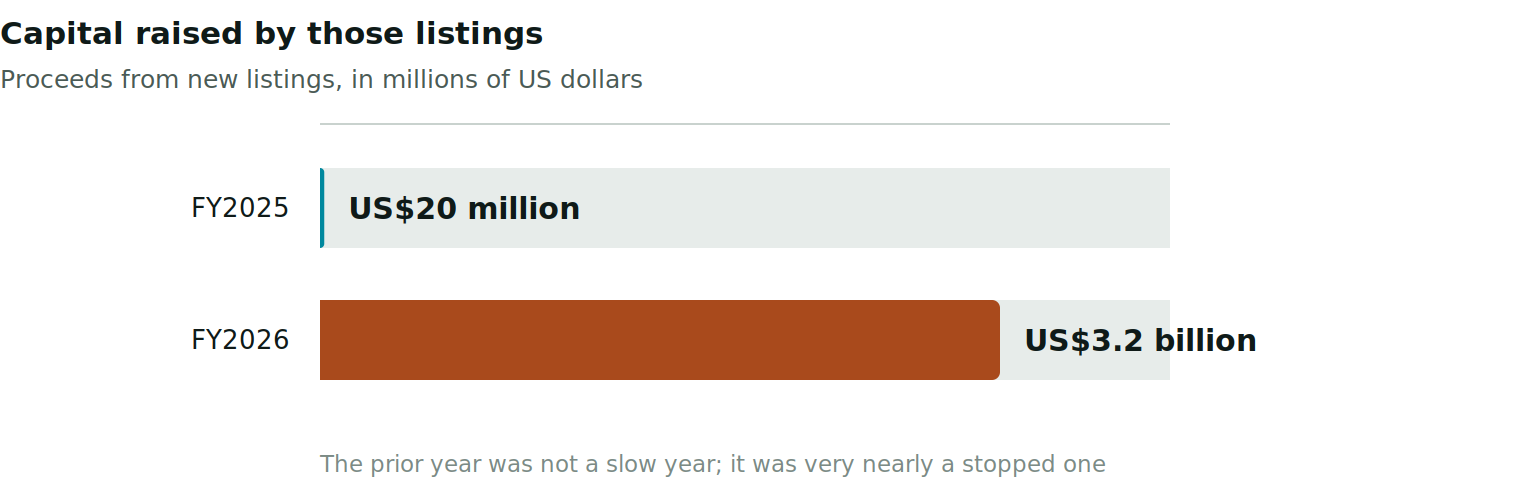
    Two sets of numbers published four weeks apart describe a market doing well and badly at once. Which one you meet depends on which door you are trying to walk through. On 6 August 2026 the Singapore Exchange reported its full-year results. They included twenty-one initial public offerings raising about US$3.2 billion, against six raising US$20 million the year before. On 31 August a review of regional fundraising reported the other side. No dedicated Southeast Asia private equity fund reached a final close in the first half of 2026. Only one venture fund in the region did, at US$8 million. Public listing became far easier and private fundraising far harder, over the same twelve months, in the same city. A founder planning a raise needs to know which market applies, because the advice that follows from each is close to opposite.

    The exchange went from six listings to twenty-one in a single financial year

    Start with the public side, where the change is unusually clean. No interpretation is required and no adjustment has to be made. One year the venue was almost empty and the next it was busy. That kind of turn is rare enough in a listing venue to be worth pausing on before asking what caused it.

    Twenty-one companies completed listings in the financial year to June 2026, against six in the year before. Group revenue rose 14% to S$1.17 billion. A jump of that size in one year is rarely explained by a single cause. The direction of policy, though, is not ambiguous. Singapore’s authorities have spent two years working on the depth of the local equity market. That included placing public money with fund managers who invest in Singapore-listed companies, and a review of listing rules aimed at shortening the process. Whatever weight you give each measure, the result is the same for a company weighing a listing. You are joining a queue rather than standing in an empty room, and the comparable companies whose valuations set your pricing actually exist.

    The money raised moved by far more than the count of listings did

    The count understates what happened. The size of what listed changed far more than the number of listings did. Six companies can raise almost nothing or a great deal, and which it is tells you what kind of company was willing to use the venue. On that measure the two years are barely the same market.

    Those twenty-one listings raised about US$3.2 billion. The six listings the previous year raised about US$20 million between them. That is not a slow year followed by a good one. A market raising twenty million dollars across six listings is one where only very small companies are listing. Companies that could have raised properly went elsewhere, or they waited. So the recovery is not only in volume. It is in the size of company willing to use the venue, and that matters more for anyone deciding where to list. A venue that can absorb a large offering prices a small one better, because the investors who buy the large deals are present and paying attention.

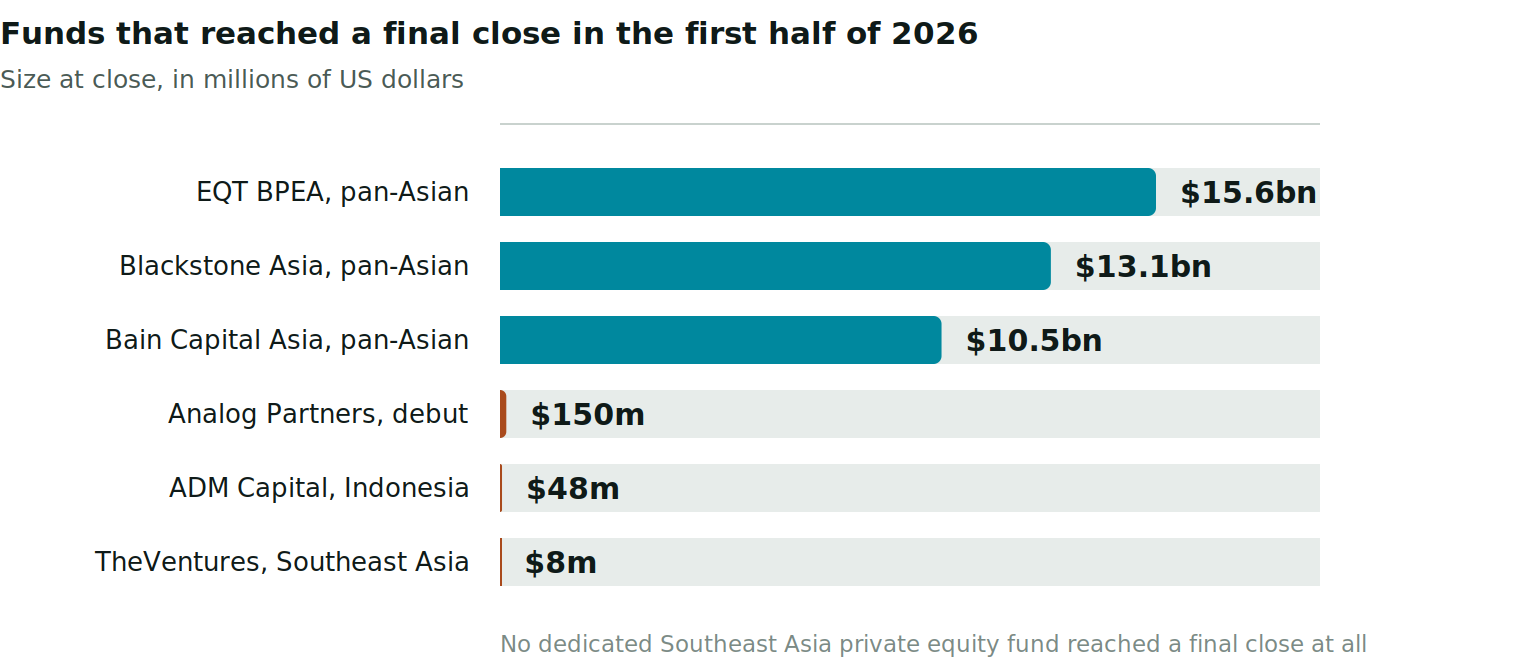
    No dedicated Southeast Asia private equity fund reached a final close in the first half

    Now the other door, which is where most companies in the region actually go for capital. Very few businesses list. Almost all of them raise privately at some point, from funds that have to raise their own money first. That second step broke this year, and it broke quietly, because a fund that fails to close issues no press release.

    Not one dedicated Southeast Asia private equity fund reached a final close between January and June 2026. The only regional venture close was TheVentures, at US$8 million. Two smaller vehicles closed with a regional focus. Analog Partners raised US$150 million and an ADM Capital Indonesia fund raised US$48 million. Meanwhile the pan-Asian megafunds closed enormous amounts. EQT BPEA closed at US$15.6 billion, Blackstone Asia at US$13.1 billion and Bain Capital Asia at US$10.5 billion. Roughly 85% of Asia Pacific private equity capital went into pan-Asian vehicles rather than country or region-specific ones. The money has not left Asia. It has moved into larger and more diversified funds, which write bigger cheques and do fewer deals.
    The regional venture figures look strong until one round is removed from them

    The same distortion appears in the venture numbers. The aggregate has been widely quoted this year and the composition rarely is. It is the kind of statistic used in a pitch deck by the founder and the investor alike, to support opposite claims, without either being wrong about the arithmetic.

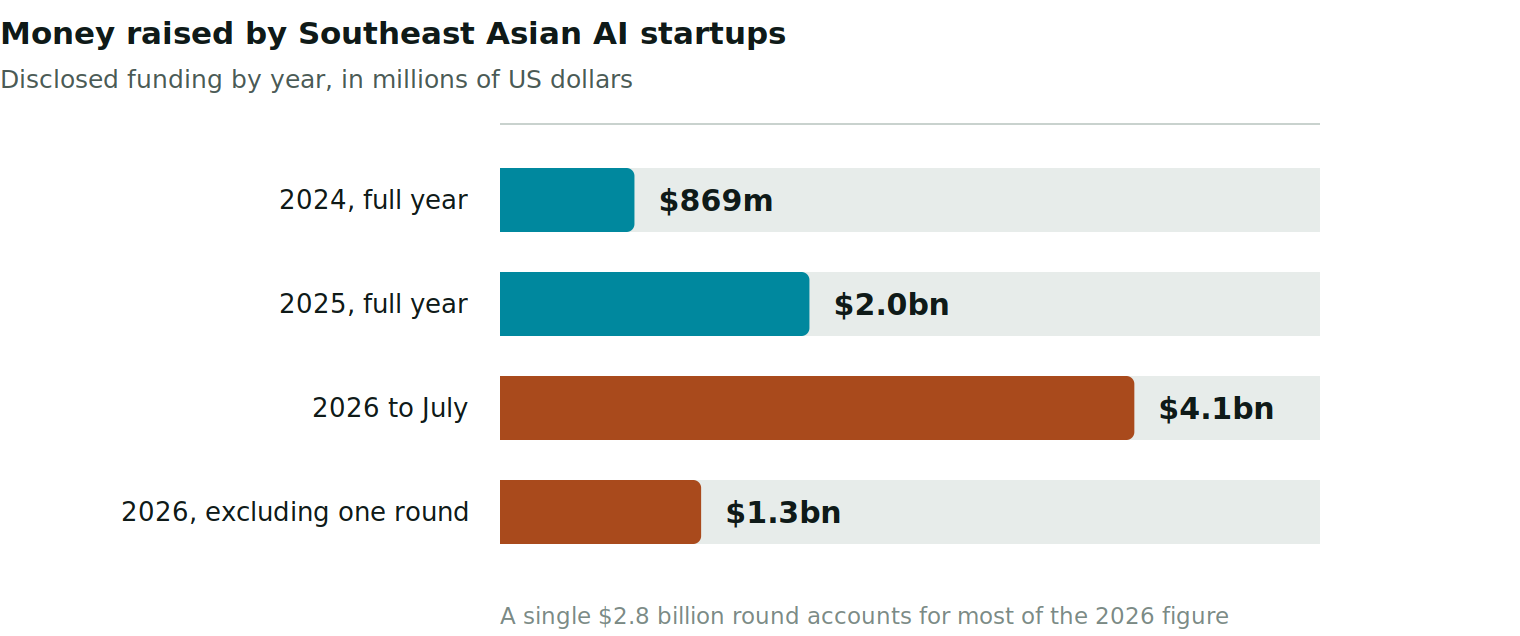
    Funding into Southeast Asian artificial intelligence companies rose from US$869 million in 2024 to about US$2 billion in 2025. By July 2026 it had reached US$4.1 billion. Read on its own, that is a market roughly doubling every year. But a single US$2.8 billion round for Kling AI accounts for most of the 2026 total. Remove it and about US$1.3 billion remains, which is below the full-year 2025 figure. Both readings are accurate and they point in opposite directions. The honest version is this. Capital is available in very large quantities to a small number of companies, and scarce for everybody else. That is the pattern the private equity closes describe. A founder benchmarking against the headline is benchmarking against something that happened once.

    Institutional money is still arriving, but at a size most companies cannot use

    Capital does keep being committed to the region through other channels, and its shape is consistent with everything above. In the first week of September 2026, IFM Investors opened a Singapore office. The Australian institutional manager stated an intention to deploy around US$1 billion across Asian infrastructure and private markets. That is real money arriving with real intent. It also goes out in large positions, from an institution that measures success over a decade. That makes it relevant to a company raising a hundred million dollars and almost irrelevant to one raising five. Take the listings, the fund closes, the venture rounds and the institutional arrivals together. Capital is concentrating, and the threshold for receiving it has risen.

    What this means for founders raising now, companies considering a listing, and fund managers trying to close

    For a founder raising private capital in Southeast Asia over the next year, plan on a longer process against a smaller field. The regional funds that would historically have led your round did not raise this cycle. The buyer list is shorter than the one your adviser assembled two years ago, and several names on it are managing existing portfolios rather than deploying new money. The pan-Asian funds that did raise write far larger cheques than you are asking for. Three adjustments follow. Raise for a longer runway than the round nominally requires, because the next one will take longer to assemble. Treat strategic and corporate investors as a primary channel rather than a fallback. And be precise about which fund can lead at your size, because a fund that closed US$13 billion will not lead a US$10 million round.

    For a company considering a public listing, the venue argument has changed materially in twelve months, and is worth re-examining even if you dismissed it before. Twenty-one listings raising US$3.2 billion brings research coverage, comparable valuations and an investor base that is actually present. None of that existed in a six-listing year. Listing remains expensive, slow and permanently disclosing. It is not a shortcut around a difficult private round. But consider a company with predictable earnings that private investors have told to wait another cycle. For that company the arithmetic has changed, and not marginally. The time to test it is while the queue is forming rather than after it has cleared.

    For a fund manager trying to close a Southeast Asia vehicle, the first-half data says something about positioning rather than about the region. Allocators concentrated in pan-Asian funds for understandable reasons. Those funds offer diversification, scale and a familiar reporting relationship. A single-region fund must now explain why its exposure cannot be obtained inside a larger vehicle. The honest answer usually involves access to deals the megafunds never see and could not service. That argument is made with a track record and a live pipeline, not with a slide about market size. It also has to be made from somewhere an allocator’s operational due diligence clears without friction, which is a large part of why managers keep arriving in Singapore.

  • China set a 22 October deadline for offshore trusts while Singapore made family offices easier

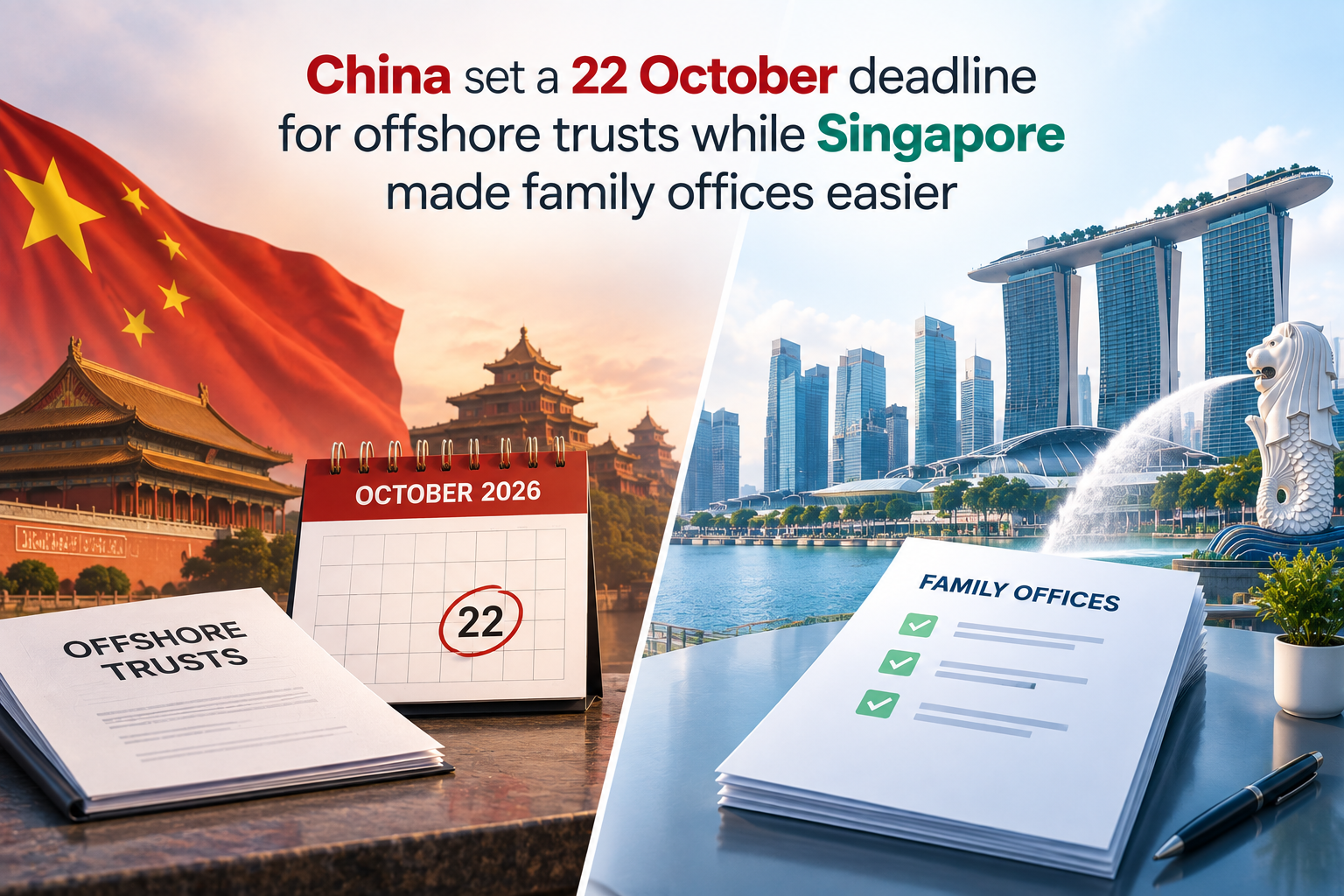
    China set a 22 October deadline for offshore trusts while Singapore made family offices easier

    One government started taxing structures that were built to be untaxed. Another loosened the conditions on the alternative in the same week.

    Two decisions taken days apart this summer will move a great deal of Asian family money. In late July 2026, China’s Ministry of Finance and State Taxation Administration issued guidance on offshore trusts. Distributions are now taxable income of the Chinese-resident beneficiary, at 20%, with a declaration deadline of 22 October 2026. On 31 July the Monetary Authority of Singapore issued circulars of its own. They cut what a family office must have and spend to qualify for Singapore’s tax incentives. The first decision makes an old structure expensive. The second makes a newer one cheaper. Families who set up an offshore trust years ago were told it sat outside any tax net. That understanding had a shelf life, and the alternative they were quoted last year has just moved closer.

    China’s guidance treats a trust distribution as the beneficiary’s own income, taxed at 20%

    The Chinese change is the more consequential of the two, and it is worth being precise about what it does. The guidance was issued in the last week of July 2026, and it looks through the trust to the person receiving the money. Where a Chinese tax resident benefits from an offshore trust, the distribution is treated as that person’s income, taxed at the 20% rate applied to investment income. The mechanism defeats the usual defence. A trust is normally argued to be a separate person, holding assets for itself, so distributions are gifts rather than income. The guidance does not accept that where the beneficiary lives in China. It also applies retroactively, rather than only to distributions made after publication. The 22 October date is when affected taxpayers must declare.

    The practical problem is that the records the tax office wants may not exist

    Retroactive application creates a difficulty that has nothing to do with willingness to pay. Think about what a family would need to produce. It received distributions over several years, from a trust administered abroad, by a trustee who reported to the person who set it up rather than to the people receiving money. Documentation of the kind a tax office wants was never assembled, because nobody had reason to. Distributions were often described as loans, capital returns or gifts, and at the time that carried no consequence. Working out which payment was which, across several years and more than one currency, is an accounting reconstruction under a fixed deadline. It falls to people who did not create the records. The trigger for moving is often the impossibility of that computation rather than the rate itself. A family that could pay 20% comfortably may still be unable to prove 20% of what.

    Singapore cut the investment headcount a family office must have at application

    Against that, Singapore moved in the opposite direction. The circulars issued on 31 July 2026 took effect on 1 August. They changed several conditions attached to the section 13O and section 13U fund tax exemptions, which almost every single family office in Singapore relies on.

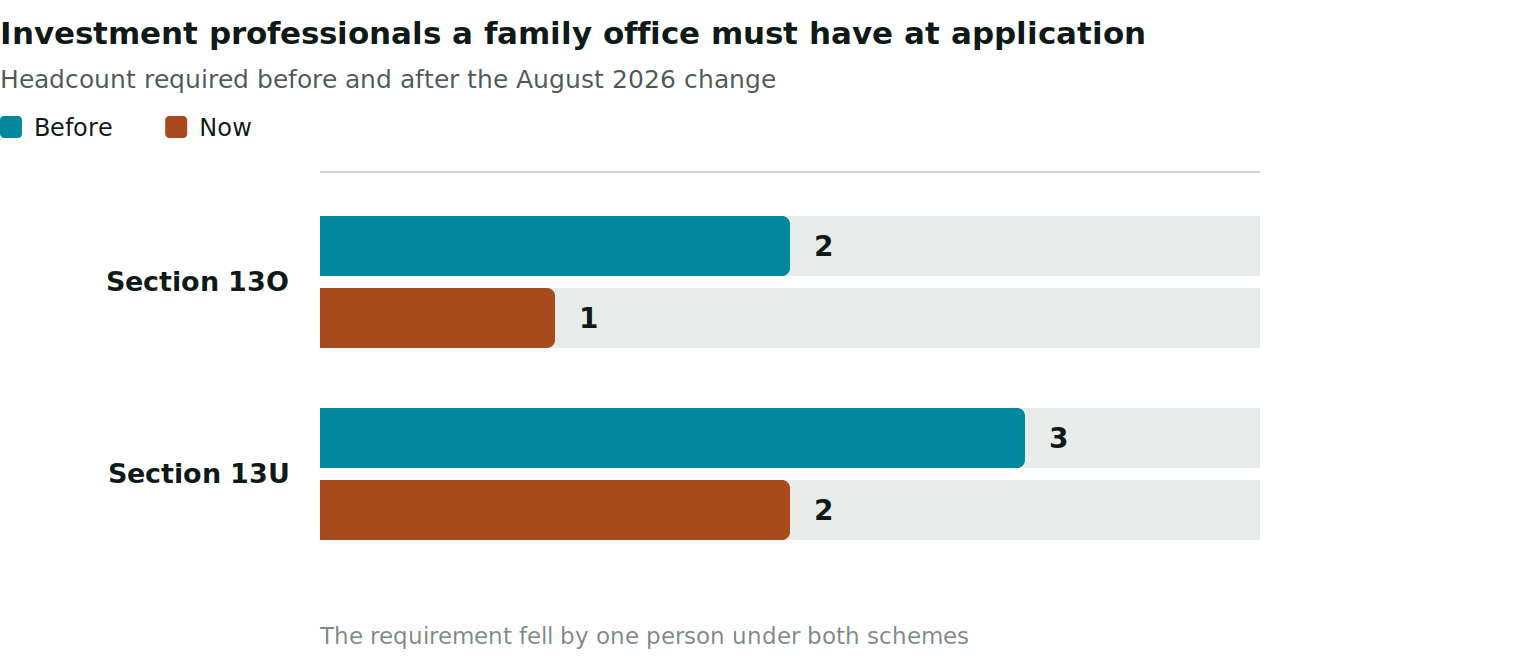
    The headcount requirement fell by one person under both schemes. A section 13O fund previously had to employ two investment professionals at the point of application. It now needs one. A section 13U fund needed three and now needs two. That sounds like a small administrative adjustment. It is not. The hardest part of setting up a family office here has consistently been the hiring. You must find, employ and relocate qualified investment staff before the structure generates anything for them to manage. A family with one capable person and a plan to hire the second can now begin. Under the old rule it waited, and the waiting is where many applications quietly died.

    The local spending requirement now separates single family offices from everyone else

    The second change concerns what the fund must spend in Singapore each year. This condition decides whether the incentive is worth having at all for a smaller structure. A family with S$80 million to manage cares far more about the annual spending floor than about the headline relief. The tiers were redrawn on 1 August, and they no longer treat every fund alike.

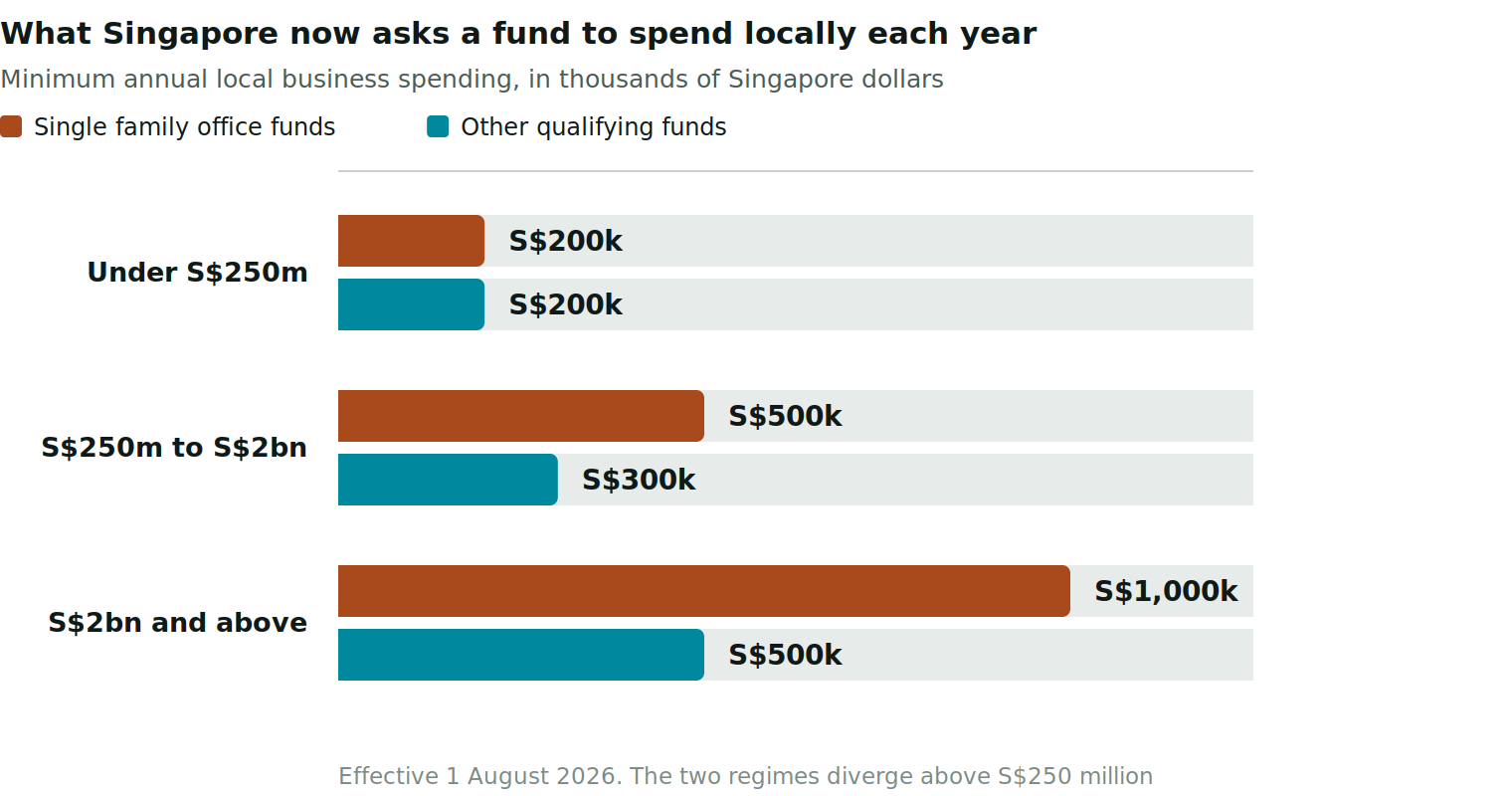
    For a single family office fund, the tiers run at S$200,000 a year below S$250 million of assets. They rise to S$500,000 between S$250 million and S$2 billion, and to S$1 million above that. For other qualifying funds the same bands carry S$200,000, S$300,000 and S$500,000. The two regimes agree at the bottom and diverge sharply above S$250 million, where a single family office is asked for roughly twice what a non-family fund is. Two further changes matter as much. Qualifying donations to Singapore charities now count double toward the spending requirement, so a family already giving can convert part of that into compliance. And the annual re-test of assets under management has gone, retroactive to 1 January 2025. A fund whose assets fall below its band in a bad year no longer risks its status.

    Singapore now manages S$6.7 trillion, and three quarters of it belongs to somebody else

    These adjustments are worth watching because of the scale of what they adjust. Singapore is not competing for this money from a standing start. It is tuning the conditions on a pool that is already very large, and still growing at a double-digit rate.

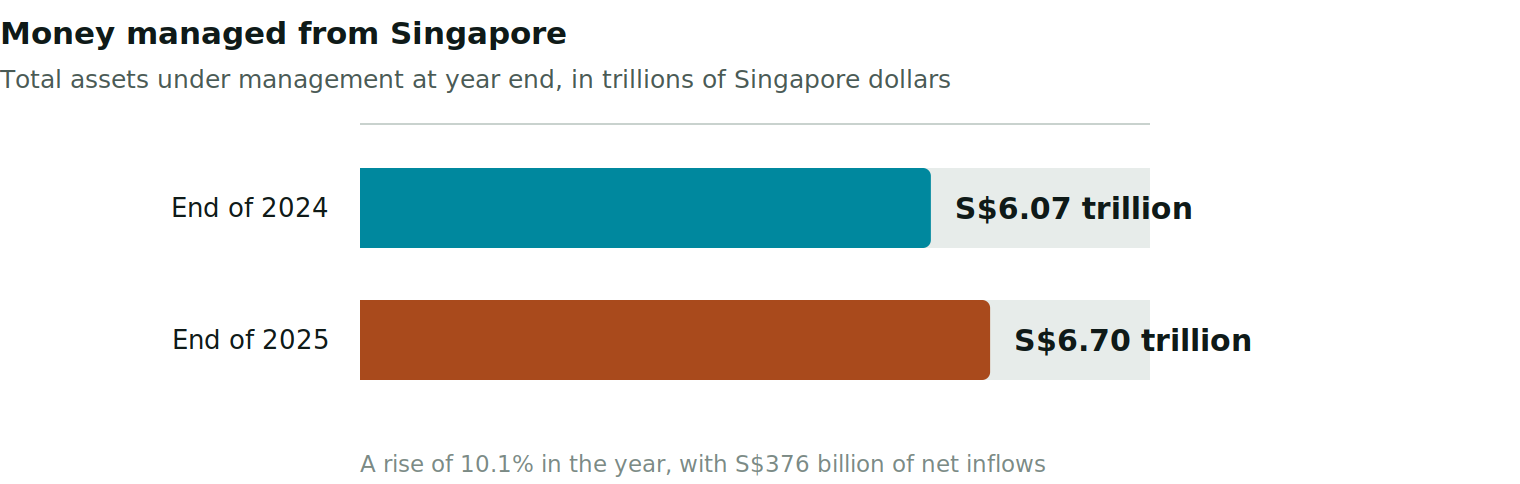
    Assets under management reached S$6.7 trillion at the end of 2025. That is up 10.1% from S$6.07 trillion a year earlier, with net inflows of S$376 billion. Inflows are the number to watch rather than the total. A total can rise because markets rose. Inflows rise only because money was moved here deliberately, by people who had other options.

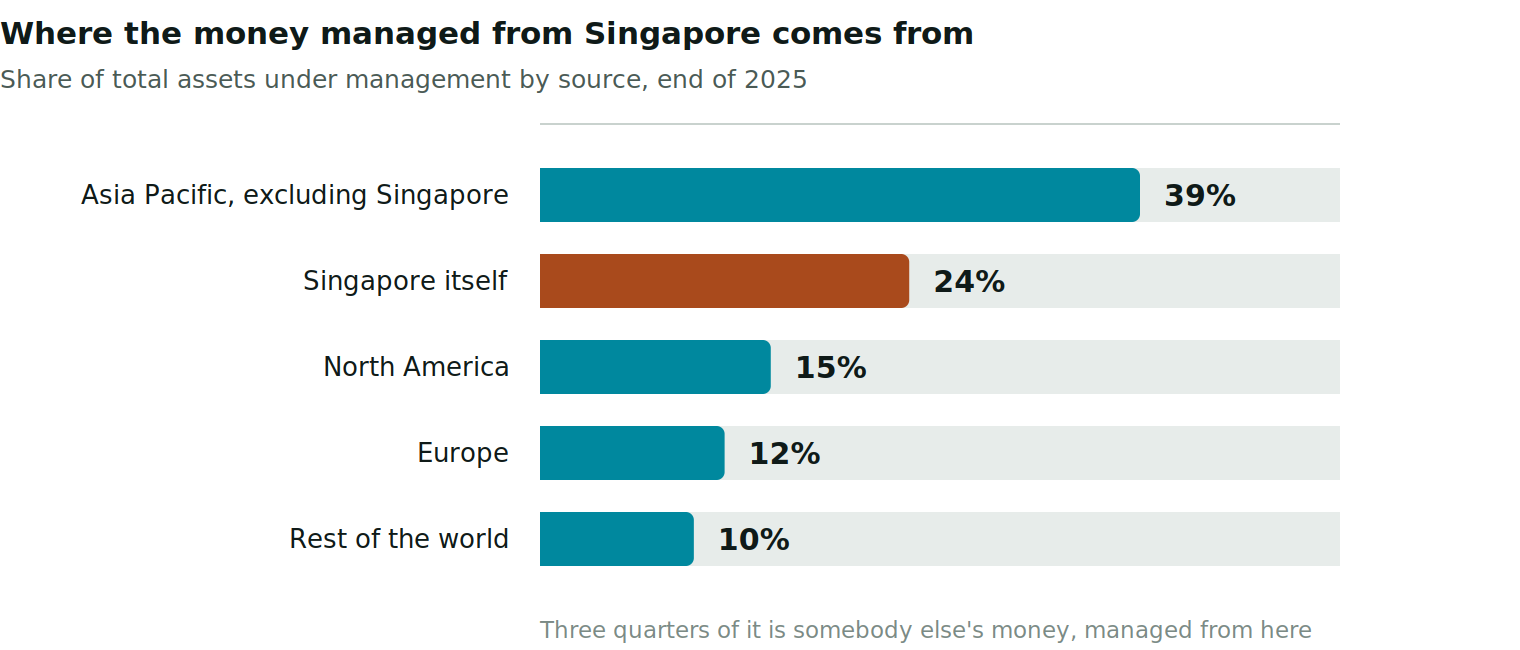
    Twenty-four per cent of the money originates in Singapore. Thirty-nine per cent comes from the rest of the Asia Pacific. North America supplies fifteen per cent, Europe twelve, and the rest of the world ten. So roughly three quarters of the money managed from Singapore was made somewhere else and brought here. That is what a working hub looks like from the inside. It is also why the conditions get adjusted rather than simply lowered. Singapore competes for flows it does not generate at home, against Hong Kong, Dubai and Luxembourg. It must stay attractive without becoming the kind of place the OECD writes reports about, and those two aims pull against each other.

    What this means for families with an offshore trust, families considering Singapore, and existing family offices

    For a family with an offshore trust and a Chinese-resident beneficiary, the deadline is the immediate problem and the structure is the longer one. Establish before 22 October what was actually distributed, to whom, and how it was described at the time. That answer determines the exposure, and the reconstruction takes longer than anyone expects. Ask the trustee for a complete distribution history in writing now rather than later, because trustees respond at their own pace and your timetable is no longer flexible. A structural question sits behind the filing one. A trust whose tax treatment depends on where its beneficiaries live may not suit a family whose members live in different countries and may move again. That should not wait until the next country issues guidance of its own.

    For a family considering Singapore, the conditions are better than they were three months ago, and for specific reasons. One investment professional rather than two lets a section 13O application begin with the person you already have. Removing the annual asset re-test means a market drawdown no longer threatens the incentive. Double-counting donations means money you were giving anyway can carry part of the local spending requirement. What has not changed is that the structure must be real. The people must be here. The decisions must be taken here. The file must show both. Singapore has loosened the arithmetic of qualifying without loosening the substance behind it, and applicants who confuse the two fail slowly and expensively.

    For a family office already running under either scheme, the changes are worth applying rather than noting. The removed re-test is retroactive to 1 January 2025. A fund that has been managing its assets to stay above a threshold has done a year of unnecessary work and can stop. The donation double-count may apply to giving you already do through another entity, so the fix is which vehicle writes the cheque. There is a wider point in the timing. Both governments moved within a week of each other, in opposite directions, and neither announcement reached the general news. Families who found out in September had three months less to act.

  • Container rates to America rose while rates to Europe fell, in the same week

    Container rates to America rose while rates to Europe fell, in the same week

    What a shipment costs now depends less on the goods than on which way they are pointed.

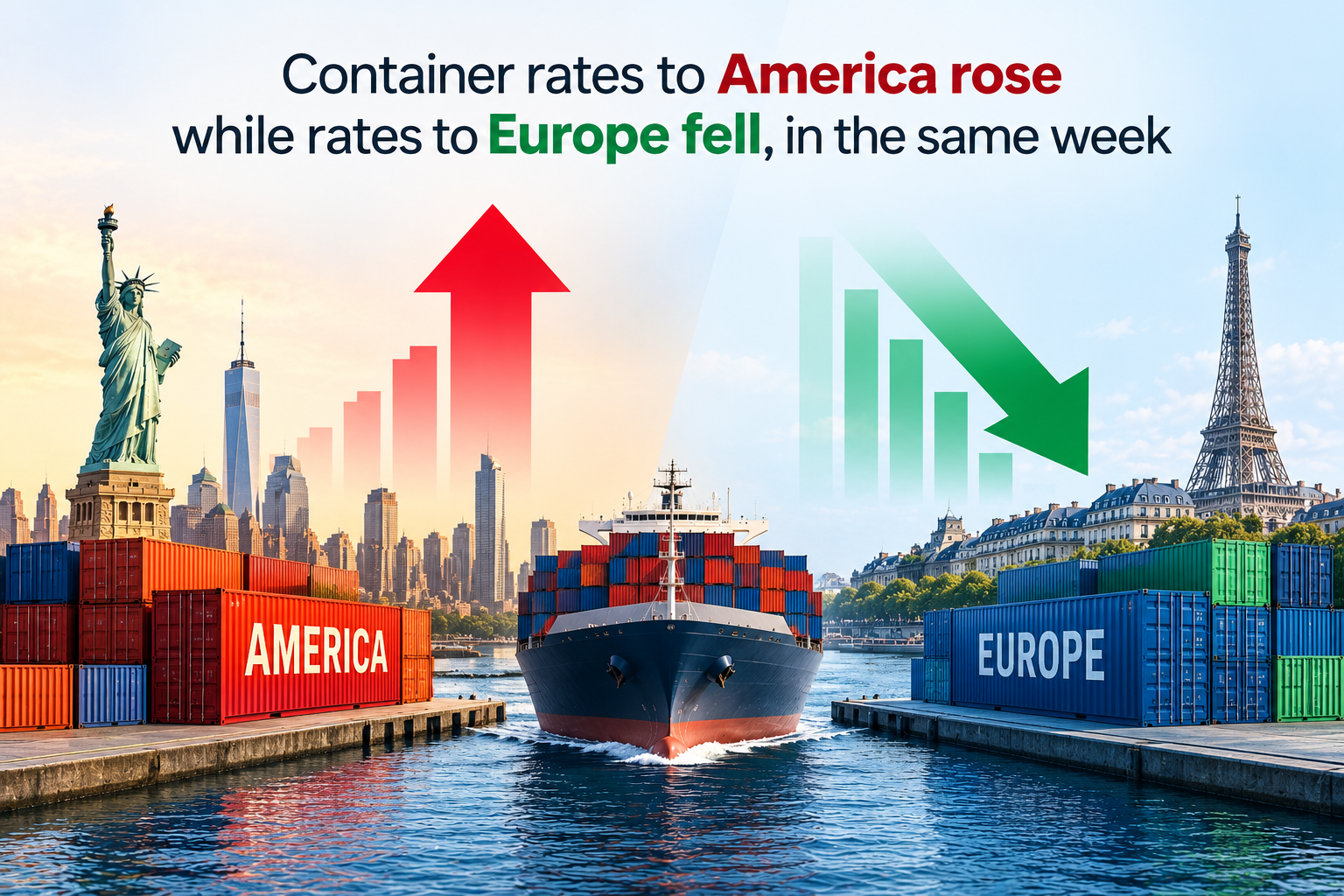
    For most of the last two years, freight cost has been discussed as one number. It went up for everybody, or it came down for everybody. That is no longer what the market looks like. In the week to 7 September 2026, spot rates out of Shanghai rose on both transpacific routes. They fell on both routes into Europe. The gap between the two directions widened rather than closed. A trader shipping to Los Angeles and a trader shipping to Rotterdam now sit in different cost environments, while loading from the same port. On top of that, the Panama Canal cut its daily transit slots on 3 September. That tightened one of the two routes into the American east coast. None of this shows up in a single headline figure. That is why so many costing models are quietly wrong this month.

    A container to New York now costs more than twice one to Rotterdam

    The absolute numbers are the place to start. The ratio between them is doing more work than the level itself. A trader who knows only that freight has risen this year knows almost nothing useful. What matters is the spread between the lane he ships on and the lane his competitor ships on. That spread is now wide enough to decide a tender on its own.

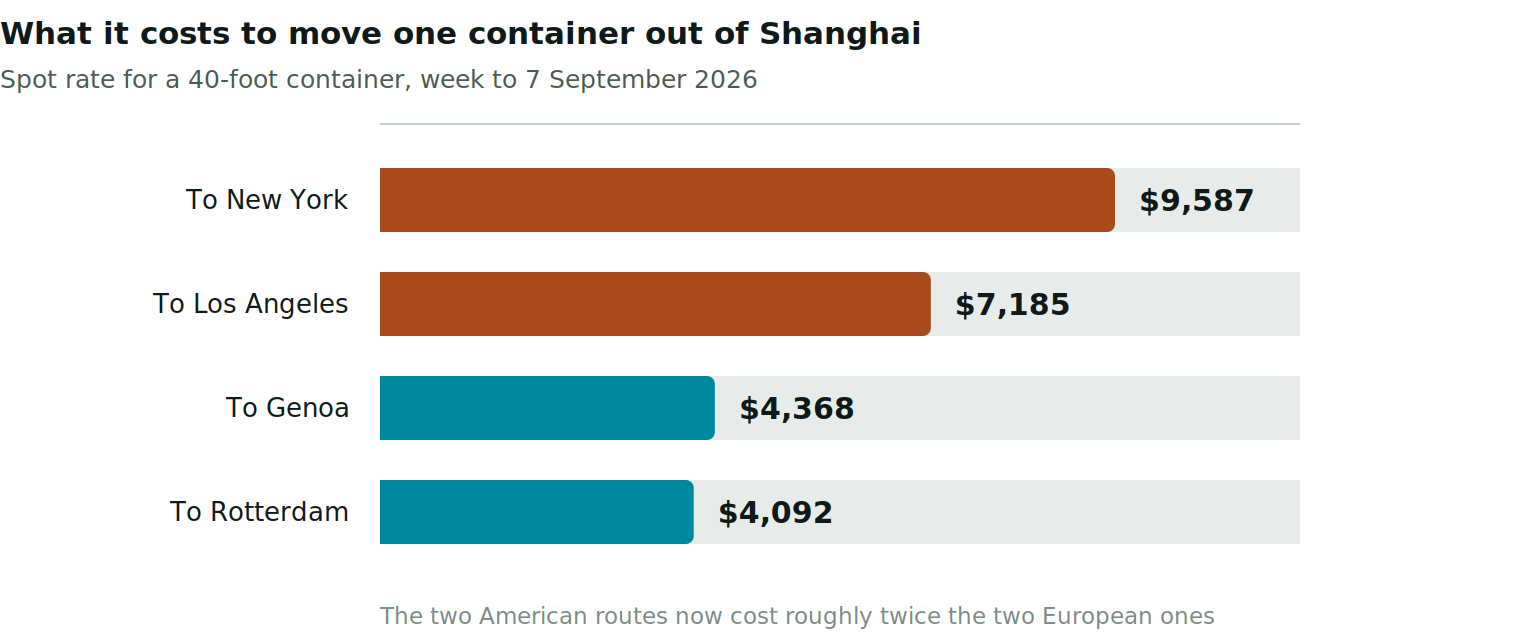
    Shanghai to New York stood at US$9,587 for a forty-foot container. Shanghai to Los Angeles was US$7,185. Shanghai to Genoa was US$4,368, and Shanghai to Rotterdam US$4,092. The two American routes cost roughly twice the two European ones. A year ago most traders would have assumed something close to parity. The Asia to Europe voyage carries more days at sea, so on distance alone it ought to cost more. What has changed is not distance but pressure. Demand into the United States is being pulled forward ahead of tariff changes. Capacity into Europe has loosened over the same period. If your pricing applies one global freight rate to every destination, it is now overstating the cost of your European sales. It is understating the cost of your American ones by a wider margin still.

    The direction of travel is also splitting, not just the level

    The weekly movement matters more than the level for anyone quoting forward. Here the two directions are pulling apart rather than drifting together. A quote is a commitment made at one moment and honoured at another. What sits between those two moments is the rate of change. That rate now differs by lane, which is the part most costing sheets do not capture.

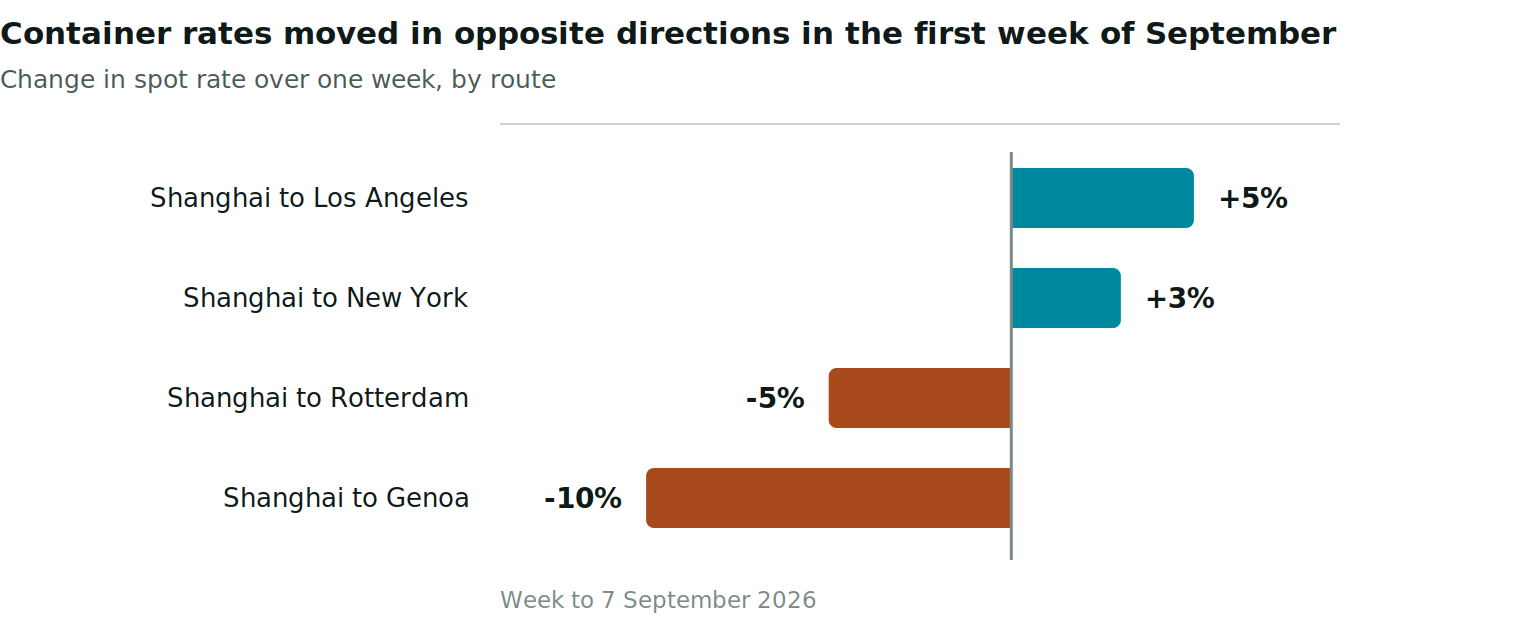
    Los Angeles rose 5% in a single week and New York rose 3%. Rotterdam fell 5% and Genoa fell 10%. Broader indices confirm the split rather than contradicting it. The Shanghai Containerized Freight Index rose 2.3% over the same week. The Freightos Baltic index fell 2%. For a buy-sell operator this carries a consequence that is easy to miss. A quote given three weeks ago on a European lane is probably now conservative. The same quote on an American lane is probably now short. If you quote in fixed terms and absorb freight yourself, that difference lands directly on the margin. It also lands unevenly across your customer list rather than uniformly. The customers costing you the most are not the ones you would guess from the invoice values.

    The Panama Canal cut its daily slots on 3 September, tightening one of two routes east

    Underneath the rate movement sits a physical constraint. It has returned after a quieter period, and it is not the kind that money resolves. The canal is a water problem before it is a shipping problem. When the rain does not come, the locks cannot be filled, and fewer ships can pass through them.

    The Panama Canal Authority reduced Neopanamax transits to nine a day. Panamax transits fell to twenty-five, and drop again to twenty-three from 15 September. Maximum draft for the larger vessels was cut to 47.5 feet. Some ships therefore transit lighter than they could otherwise load. The cause is low rainfall in the watershed that feeds the locks. That is a supply problem rather than a demand one. It does not resolve because shippers are willing to pay more. What it does produce is auction pricing for the slots that remain. One reported transit slot sold for US$5.3 million. That is an extreme case rather than a typical cost. It still indicates how scarce the capacity has become, and it is one reason the Shanghai to New York rate sits where it does.

    Singapore’s July exports rose 24.2%, and the composition matters more than the headline

    The same lesson about averages applies to the demand side. Singapore’s own trade data makes the point unusually clearly, because the July figures were reported as a triumph. They were a triumph for one industry. For several others the same month was a contraction. Both results were published as a single number, and only the single number travelled.

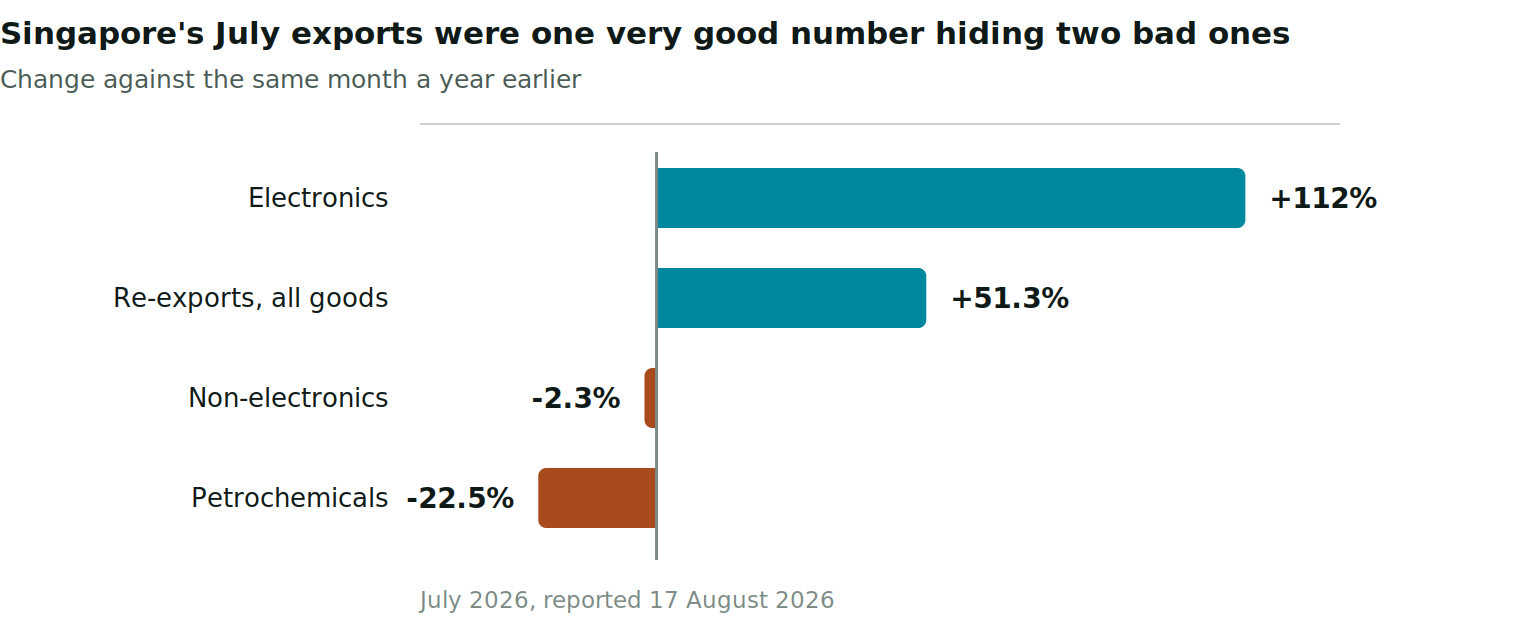
    Non-oil domestic exports rose 24.2% against July a year earlier. That reads as a strong month. Underneath it, electronics rose 112% on artificial intelligence demand. Non-electronics fell 2.3% over the same period. Petrochemical exports fell 22.5%, to S$809.6 million, after Middle East disruption led producers on Jurong Island to declare force majeure. Re-exports across all goods rose 51.3%. So one very large category carried the headline while several others contracted underneath it. A trader in electronics and a trader in chemicals both read the same 24.2% figure. Both would be wrong to apply it to their own business. The useful number is almost never the aggregate. The aggregate is almost always the one quoted back at you in a meeting.

    What this means for traders shipping to America, traders shipping to Europe, and anyone quoting fixed prices forward

    For a trader shipping into the United States, treat freight as a rising input for the next quarter rather than a stable one. Separate your east coast and west coast costings while you are at it. New York at US$9,587 against Los Angeles at US$7,185 is a difference of about a third, on the same box from the same origin. The Panama Canal restrictions make the east coast route the one more likely to tighten further. If you have flexibility on port of entry, the arithmetic currently favours the west coast. Inland haulage may reverse that, depending on where your customer sits. If you have no flexibility at all, build the slot scarcity into your lead times rather than only into your rates. The constraint is on the number of ships that can pass, not on what they are willing to pay.

    For a trader shipping into Europe, the current softness is an opportunity that will not announce its own ending. Rotterdam at US$4,092 and Genoa at US$4,368 are both falling week on week. European landed costs are the most favourable they have been in some time relative to the transpacific. If you have been deferring a European customer because the freight maths did not work, run it again this month. The risk in the other direction is straightforward. A rate that falls 10% in a week can rise at a similar pace. Any quote given on today’s level should carry a validity period measured in weeks rather than months. The alternative is an explicit freight adjustment clause, which most buyers accept once they see the same indices you are reading.

    For anyone quoting fixed prices forward, the structural answer is to stop treating freight as a single number in the model. Hold separate assumptions by lane. Refresh them at least monthly. Make sure the person doing the quoting has the current figure rather than the one that was correct at the last budget. The same discipline applies on the demand side, where a 24.2% headline concealed a 112% rise and a 22.5% fall in the same month. Businesses that survive periods like this are rarely the ones that forecast the direction correctly. They are the ones whose pricing was built to be updated quickly, once the direction turned out to be different for each of their lanes.

  • Investors spend four weeks checking the company after they say yes

    Investors spend four weeks checking the company after they say yes

    The questions that decide a round are about control, signing authority and custody. Most founders have never been asked them before.

    The difficult part of raising money is not the meeting where somebody says yes. It is the four weeks afterwards, when the term sheet has been signed and the work moves to people the founder has never met. A lawyer, an analyst and somebody in compliance now examine the company rather than the business. They are not asking whether the product is good, because that was settled in the meeting. They are asking who controls the company and who is authorised to sign for it. They want to know where the money will sit once transferred, and who is accountable if it moves. A founder who has spent two years on the product frequently cannot answer any of those. Nothing is wrong. Nobody has asked before, and the company was assembled to satisfy a registration form rather than an investor.

    The questions that decide a round are about control and custody, not about the product

    Investors are not only buying growth. They are buying the prospect of getting their capital out again, years from now, through a process nobody can predict today. That prospect rests on four things unrelated to what you sell. Whether the directors are genuine participants or names on a form. Whether a bank account exists, and has been open long enough to show a pattern. Whether the register and statutory records are accurate. Whether an investor can see what is happening after the money goes in. A certificate of incorporation answers none of these. A structure that has been operating for six months answers all four without anyone needing to ask.

    S$6.7 trillion is now managed from Singapore, and three quarters of it comes from outside the country

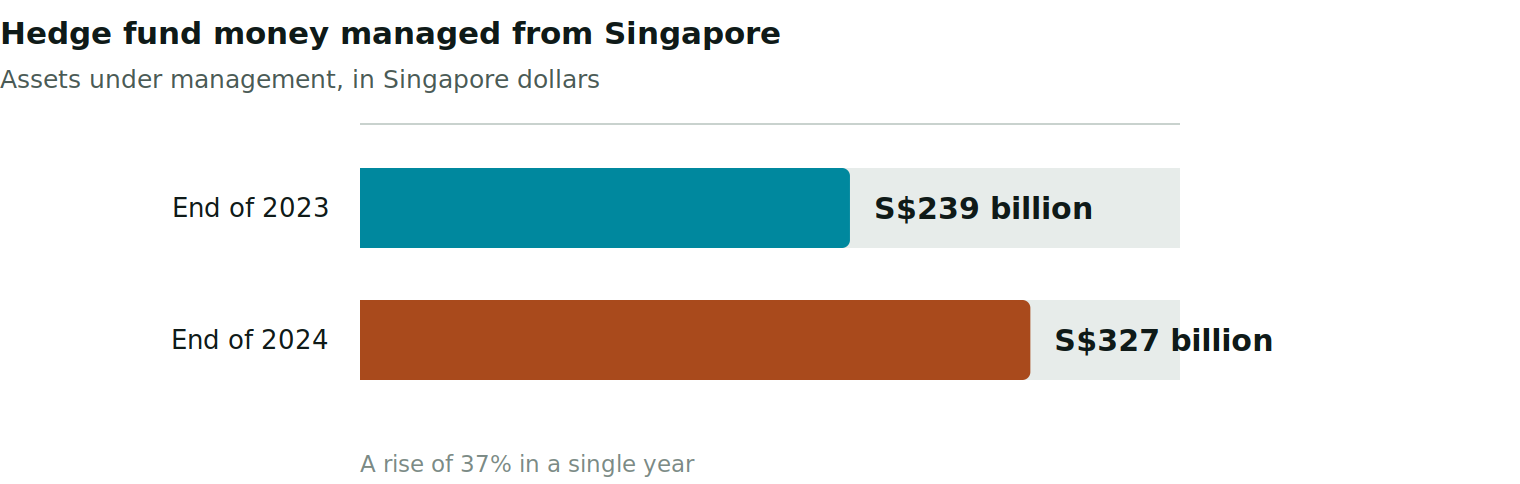
    There is a reason so many of these conversations run through Singapore. Hedge fund assets managed here rose 37% in a single year, from S$239 billion at the end of 2023 to S$327 billion at the end of 2024. Across all fund types, MAS reported S$6.7 trillion under management at the end of 2025, about US$5.2 trillion, and 10% more than the year before. S$376 billion of new money arrived during the year, and there are now 1,320 licensed and registered fund management firms. Hong Kong is the only other centre of comparable size in Asia, and the two now compete for the same managers in public rather than quietly.

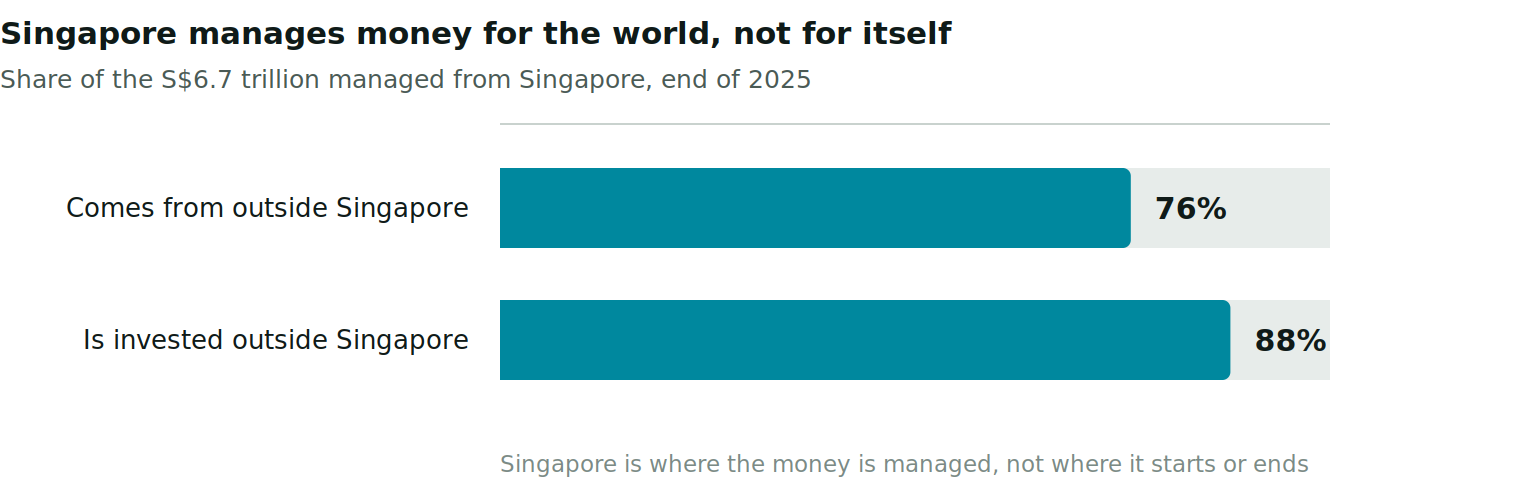
    One pair of numbers explains Singapore better than the totals do. Three quarters of the money managed here originates outside the country, and nearly nine tenths is invested outside it. Singapore is neither where the capital starts nor where it ends. It is the place in the middle, where money is managed, governed and accounted for. That is what a founder is offering an investor, and it is worth saying plainly. You are not asking anyone to bet on Singapore’s economy. You are asking them to accept Singapore’s courts, accounting standards and regulator as the referee. Investors in Jakarta, Tokyo, Dubai and London accept that referee on ordinary working days.

    MAS announced a carried interest exemption on 19 August, days after Hong Kong widened its own

    On 19 August 2026 MAS announced a set of measures aimed squarely at fund managers. The headline was tax. When a fund performs, its manager earns a share of the profit. MAS and the Ministry of Finance said that share will be exempt from personal income tax for managers based here, covering qualifying income from the 2026 calendar year. The mechanics arrive at Budget 2027 in February. This is an announcement rather than a law anyone can yet rely on, and it should be described that way to an investor. Two smaller changes came with it. The ONE Pass work visa requires S$30,000 a month, and senior asset management staff may now meet that with other forms of income. MAS also said it would run a programme to anchor hedge funds here. The timing is the substance: this landed days after Hong Kong widened its own fund tax concessions.

    A Korean state fund chose a Singapore VCC over Cayman for its first vehicle outside Korea

    The clearest reading of that competition came the following day, from an institution with no reason to flatter anyone. On 20 August 2026 MAS granted a full Capital Markets Services licence to Korea Venture Investment Corp, a South Korean state fund that invests in other funds. It is the organisation’s first asset management licence outside Korea. Its K-Global Venture Fund is being established as a Singapore Variable Capital Company, targeting US$300 million by 2030. A VCC is Singapore’s purpose-built fund structure, launched in 2020, and it is what most new funds here use instead of a Cayman company. A single VCC can hold many sub-funds, each with its own assets and investors, ring-fenced from the others. That is how 1,406 companies carry 3,443 funds between them.

    Consider what that decision actually was. A state-backed institution, accountable to its own government and auditors, chose Singapore over Cayman for its first vehicle abroad. That is not a tax calculation. It is a decision about which regulator it wants its name standing beside. The capital flows point the same way. In the first quarter of 2026, private equity firms committed US$9.2 billion to Southeast Asian companies across 19 deals. A year earlier it was US$2.04 billion across 14 deals. The region’s share of Asia-Pacific private equity deal value moved from roughly 4% to roughly 17% in twelve months.

    Two routes at S$5 million and S$50 million, and the annual size re-test has been removed

    If you are running a fund rather than raising into a company, Singapore offers two main tax routes and they differ mainly by size. One change here matters more than its wording suggests. A fund previously had to clear its size threshold every year. A well-run fund could lose its tax status because markets fell or a large investor redeemed. That annual test has been removed, backdated to 1 January 2025, so it covers funds that have already filed. Closed-end funds may now also count committed capital towards the entry threshold. The rest is straightforward to explain in a first meeting. Corporate tax is 17%, there is no capital gains tax, and dividends are not taxed again in a shareholder’s hands.

    None of this opens a bank account, which is where most timelines actually break. MAS requires banks to establish where a customer’s money comes from, and they apply that most carefully to foreign-owned companies with no trading history. That describes nearly every new company at the moment it needs an account. Corporate service providers report that account opening for a foreign-owned company usually takes several weeks. Most of the delay has nothing to do with the business itself. It is a missing ownership declaration, an address document that does not match the passport, or a register that disagrees with the application. Each is preventable, and none is visible to a director who does not participate. Which returns us to the lawyer, asking who is accountable here.

    What this means for first-time raisers, fund managers elsewhere in Asia, and anyone choosing between Singapore and offshore

    For a founder raising a first outside round, do not treat the structure as work to be tidied up once the term sheet is signed. The checks happen between the handshake and the transfer. That is the worst possible moment to discover the register is wrong or the account is not open. Give the company six months of operating history before the first serious conversation. Six months means an account with transactions in it, board minutes recording real decisions, and a register that matches the application. If a round is already in motion and none of that exists, tell the investor early rather than late. A disclosed gap is a workstream. A discovered one is a reason to reprice.

    For a manager running a fund elsewhere in Asia, the August announcement changes where it makes sense to base people. But the tax mechanics only arrive at Budget 2027, and nothing requires signing this month. Start the slower work instead. Choose a route, establish that you meet its size threshold on the correct measure, and get banking underway. Those take considerably longer than the tax paperwork. For most managers the removal of the annual size re-test matters more than the headline exemption. It means a route you qualify for today is far more likely to still be yours in three years.

    For anyone weighing Singapore against an offshore structure, compare the cost of being believed rather than the cost of being registered. Offshore jurisdictions now require resident contacts, faster reporting and more frequent inspection, so the substance requirement follows you there anyway. If real substance must be built somewhere regardless, the only question left is where it buys the most credibility with the people who will fund you. And if a bank has stalled your application, ask two questions before assuming the business was refused. Which document is missing, and who at the company was the bank able to speak to? If the answer to the second is nobody, fix that before anything else.